October 19, 2007

Good night, Deborah Kerr...

A colour publicity still for the black-and-white film,
The Innocents


Here’s a farewell I’ve been dreading for years, the lovely Deborah Kerr has passed away. I was aware that she was unwell and liked to avoid the public eye, but had heard little else recently.

While many obituaries focus on her famous roll in the surf with Burt Lancaster in From Here to Eternity, and her dancing with Yul Brynner in family favourite The King and I, I’ll also remember her for the extraordinary performances in weirder movies, to be enjoyed down here in the Black Hole.

She could easily play a pillar of virtue, a beacon in the dark. In Powell and Pressburger's Black Narcissus (1947), where she has to wrestle with another nun’s failing faith as they are both tempted by sins of the flesh… There are many reasons that this sumptuous sixty year old film still plays today, and Kerr is definitely one of them.

Despite being typecast as the voice of reason, Deborah wasn’t afraid to play against type, notably her guardian in Jack Clayton's The Innocents (1961), whose wavering sanity threatens the very children she’s supposed to be caring for. It's another extraordinary role, so complex, that viewers are still unravelling whether the film is actually a ghost story, or a portrait of madness...

Another cult horror that is less remembered, is Eye of the Devil (1966). But it's thick with atmosphere, and watchable for the cast alone, that also includes Sharon Tate, David Niven and David Hemmings. The film's theme of satanism proved to be a premonition of Tate's ghastly fate...

Lastly, the crazy sixties psychedelic James Bond comedy with a huge budget. I always look forward to Deborah's segment in the first Casino Royale (1967), also playing against David Niven (as Sir James Bond). Her character has a Scottish accent, some lively physical comedy, and even sends herself up, as she again appears in a nun’s habit…

Beyond being a great actress, she helped create memorable characters that continue to intrigue and impress, long after the films are over.


- - - - - - -

October 13, 2007

GHOST IN THE SHELL - A phenomenal overview


GHOST IN THE SHELL:
STAND ALONE COMPLEX
(2003, Japan, anime TV series)

If you feel deprived of intelligent sci-fi, or are a big fan of Blade Runner, or want to try out an anime series that's not about children with magical pets, this could be the one for you. Until Akira was released in the UK, I'd not seen any adult anime. Then there was a gap of a few years while I struggled to find anything nearly as good. Ghost in the Shell: Stand Alone Complex boasts spectacular action, a peek into a likely future, must-have robots and major babe Motoko Kusanagi - she's all android...


THE STORY SO FAR
First, I'll attempt to summarise the various incarnations on DVD
, because there's an awful lot of Ghost in the Shell out there...

GHOST IN THE SHELL (1995) - the anime movie

Ghost in the Shell: Stand Alone Com
plex (2003) - anime TV series (26 x 30 minutes)

GHOST IN THE SHELL 2: INNOCENCE (2004) - second anime movie

Ghost in the Shell: S.A.C. 2nd Gig (2004) - the second TV series, (26 x 30 minutes)

Ghost in the Shell: Solid State Society (2006) - the third story for TV, is a single feature-length episode


GHOST IN THE SHELL - the beginning
Masamune Shirow (also the author of Appleseed) first wrote and drew the obsessively detailed manga in 1991. It described the adventures of Section 9, a heavily armed secret police force in a near-future Tokyo.

The squad is headed by a brilliant political strategist - 'old man' Aramaki. He's supported by Major Motoko Kusanagi, a completely synthetic super-soldier, disarmingly disguised as a sex-bomb. She is the poster girl for the entire franchise, and the most obvious requirement of an anime nominally aimed at teenagers. Her closest ally is the mostly-human Batou, his steely eyes betraying that he has been partly cyberized (a process equivalent to bionics).

There's also a brainy bearded super-hacker and a token all-human policeman. They're all connected by internally-installed audio-visual communications, that looks like telepathy to outsiders.

The manga inspired the influential film, directed by Mamoru Oshii, which in turn eventually lead to the TV series, which explores an alternate timeline to the film.


STAND ALONE COMPLEX - first gig
I’ve just finished rewatching the first TV series (a term that doesn't do it justice). It's an epic achievement from the Japanese animation house Production I.G. It looks like a big-budget showreel and was created entirely on computer, when most anime was either still painted on cels, or too electronically 'video' a look (like Ghost Stories). It was recorded on High Definition masters, following the one-off experiment Blood - the Last Vampire. Again, the animation is state of the art for TV, 2D characters successfully mixing with 3D vehicles and robots.

Besides the cutting-edge production techniques, the story-telling is just as intricate and pitched at adults, without surrendering to excessive gore or nudity. There are pure sci-fi concepts, intricate plots, predictive designwork, and hard-hitting action.

Watching the series is like looking into the future, seeing technology that will exist one day, and the programme creators are already wrestling with the sociological problems that will arrive with it, as well as making it all look good!

Anyone who gets cybernetic brains or eyes could be also be online... and therefore hackable. Other individuals won’t trust these artificial body-parts, however advantageous. And how will people cope when they become emotionally attached to completely lifelike androids…

The feelings of artificial humans have been a prime concern to Japanese storytellers for decades, particularly in the Astro Boy series. In the Ghost in the Shell stories, the Major (and the tachikoma) are constantly aware of the differences between them and humans. The crux of the matter is if they can have a spirit, or 'ghost'.

The non-humanoid A.I. devices are more expendable than soldiers, but how sophisticated can the A.I. be allowed to get? The totally robotic tachikoma droids for instance, that assist Section 9, are slightly too intelligent and prone to individuality. They are impressively designed and are the most likeable characters, possessing mischievous child-like innocence.

Besides an almost unfathomable series-length story arc, about a kidnap plot involving a faceless hacker, there are many single episode stories that are easier to grasp, each tackling a techological theme as well as telling a 'stand alone' story.

An amazing amount of research and design-work goes into the hardware on display, even if it's only seen in a couple of shots. The implications of many designs is almost mind-expanding. Though it remains a puzzle why the ghastly 1980's mullet hairstyle is back in fashion.

The series has been sold in a variety of DVD sets around the world. I opted for a region 1 set, to avoid standards conversion artefacts. There's also a special edition available with DTS audio, rather than just 5.1. Both series were produced in a 16:9 aspect ratio, like most big-budget TV anime is now.


OTHER G.I.T.S.

The second TV series was just as long and complicated, Ghost In The Shell SAC 2nd Gig. I didn't enjoy this story nearly as much - the scale of the plot got way too big, the issue being a burgeoning civil war with an unhappy immigrant workforce. The focus shifted from the problems of future technology, to possible political situations, something too huge and messy to be solved by even a crack team of cyber-police. I will rewatch and reappraise it, because I love the characters, but it didn't feel as much like a 'ghost' story.


After the second series was over, the first was boiled down to make a single straight-to-video feature, focussing on just the story arc. Called Ghost in the Shell - The Laughing Man, it has had additional scenes to bridge gaps in the narrative, and has had some animation reworked for continuity purposes. For instance, the Major's hairstyle 'evolved' during the lengthy 26 episodes. Her look was standardised for this cutdown version.


The Laughing Man is now available on DVD in the US and the second series has been given a similar treatment. Called Ghost in the Shell - Individual Eleven. This should be available on DVD in the US in December.


With the spectacular second film, Ghost in the Shell 2: Innocence, not scoring a hit, even in Japan, despite being a visual masterpiece, no further G.I.T.S. feature films are currently likely, so I hope that the TV projects continue.


The third TV incarnation - Solid State Society, is a straight-to-video feature-length episode, that is now available in the UK and US.

There are also rumours of a live-action American remake of the first film – this would need a lot of money, but could it succeed where Aeon Flux failed? I’d rather see new stories as anime, rather than dumbing down the original story for a mass market.


G.I.T.S. MERCHANDISE
A phenomenon like this spawns goodies. Lots. Here's a few of my faves:


Essential was the series guidebook, Ghost in the Shell - Stand Alone Complex: Official Log (Volume 1), which helps list and explain some of the background details in each of the first 20 episodes of the first series. Unfortunately, the second volume has yet to be translated into English. A DVD is included that groups the behind-the-scenes interviews onto one disc, as well as featuring a fantastic showreel for the series, with montages on vehicles, weapons and practically all the action scenes.

The most creative spin-offs from the series have been the many CD soundtracks. Besides writing the usual fast-paced electro background music, composer Yoko Kanno collaborated with a variety of artists to produce futuristic music and a unique theme tune. Her first, with Russian singer Origa, backs the impressive opening sequence.


After years of waiting, the tachikoma robots have finally been released in the form of intricately jointed and detailed 'toys'. There are plastic and die-cast versions of these cleverly designed robots.

And of course there's the manga stories, still being translated into English, video games, novels, action figures...

October 07, 2007

TALES FROM THE CRYPT (1972) - finally on DVD


TALES FROM THE CRYPT
(UK, 1972)


Updated November 2007
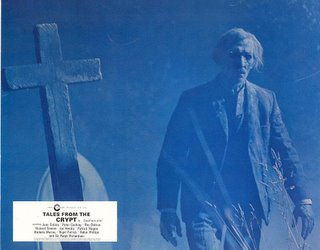
One of the best Amicus films and certainly the most consistent 'portmanteau' horror from that period. Thankfully, there are no 'comedy relief' segments included here - just solid non-stop scares.

The film's five tales are all based on stories from the original EC horror comics Tales from the Crypt and Vault of Horror. Linking the tales is Sir Ralph Richardson as the first screen incarnation of the Crypt-keeper. His piercing and accusatory questioning suitably transfixes the five tourists lost in his catacombs. As the Crypt-keeper asks each lost soul why they have come here, they tell their stories in turn - tales of deception, murder and life beyond death...


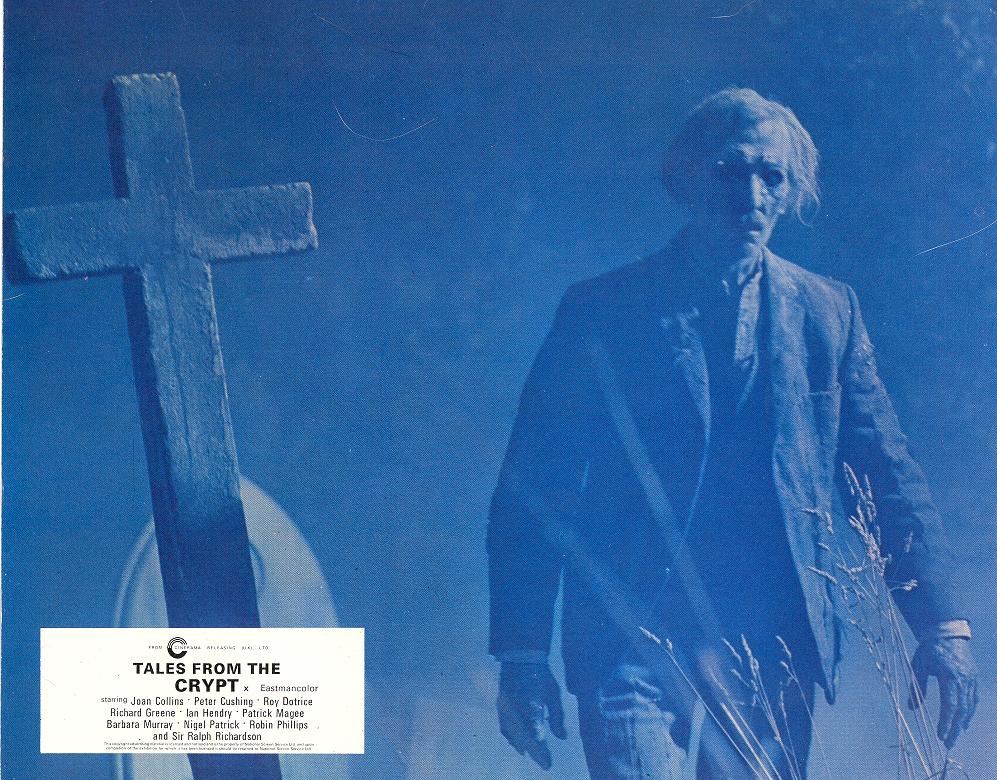
Among the cult British cast are Patrick Magee, (shortly after his appearance in Kubrick's A Clockwork Orange), Roy Dotrice, Ian Hendry and Joan Collins. The film's standout performance is from Peter Cushing, playing a victimised widower - it's very sad to watch him here, as he had recently lost his own wife. He won one of his few awards for this role and, without spoiling it too much, this is also a rare occasion when Cushing appears in 'monster' make-up, sparingly but brilliantly applied by Roy Ashton. The brief scenes of his 'little walk' provided some of the best publicity stills.


Cushing's role typifies the film's approach - to turn characters that were originally comic strip stereotypes into real people. In addition, the pervading grim atmosphere makes this 'compendium' horror far more successful than Vault of Horror or The House That Dripped Blood, both of which have comedic episodes.

The poster for the film also included my favourite scary movie skull - it was also on the cover of the paperback novelisation - the only merchandise from the film. The skull warns potential viewers of the pervasive atmosphere of premature death and is a visual link with the deathmask motorbike rider in 'The Monkey's Paw' segment.


It's been released on a double-bill with another short-story structured Amicus film, Vault of Horror, which is also widescreen, but unfortunately censored. Tales of the Crypt on the other hand, is not only the first time on DVD, but also the first time uncensored on home video.


An original trailer for Tales from the Crypt...


Here's the cover of the novelisation, and the 1964 paperback of EC Comic reprints which luckily includes four of the five stories adapted for this film!

The movie's opening theme is Bach's 'Toccata and Fugue in D minor' - this was a much overused tune in the horror genre - the most likely music to be played by any villain who owns a church organ - but this is my favourite rendition.


Presumably the delay getting Tales From The Crypt onto DVD was because of conflicting rights issues? Surely there was enough leeway not to confuse it with the nineties movies and the TV series?


Coincidentally, both the 1972 and 1989 films start off with an adaption of the same 'psycho-Santa' story ('And All Through The House'). You are therefore invited to make a side-by-side comparison and choose whether you like your EC horror played straight, or for laughs...


October 05, 2007

Not on DVD: MADCHEN IN UNIFORM (1931) decades ahead of MEMENTO MORI

MADCHEN IN UNIFORM
(1931, Germany, Girls in Uniform)

This isn’t the kind of film that I normally mention in the Black Hole, but by the end of it, I felt like it was worth mentioning for the similarities with Memento Mori (reviewed here), which I’d also seen recently.

In both films, the setting is a girls boarding school, the story never leaves this location, the girls (and presumably the filmmakers) have anti-establishment sentiments, there’s a pivotal lesbian relationship, attempted suicide (also by jumping from a great height), overly strict teachers, and a hysterical-schoolgirl chaotic climax.

All that’s missing is the ghost story. And for a 70 year-old German film, it’s so ahead of its time that it’s still progressive today!

In fact, more progressive than the South Korean Whispering Corridors series, where the lesbian subplot could be read as causing the deaths and unhappy hauntings. In Madchen in Uniform, the other girls don’t even give them a hard time, but rally round in defence. When one girl is victimised by the headmistress for declaring her love, the rest of the dorm propose to help her - using a boycott, going over the head’s head to complain, and finally an all-out revolution!

For the most part it’s a mix of humour and drama, centred on the girls and their relationships with the different teachers, particularly their favourite who many of them have a crush on. A new girl, Manuela, has something more than a crush… When her feelings are discovered, scandal rocks the school.


Today, I guess there’d be much more focus on the motivations and consequences of the teacher, who kisses all her girls goodnight, and counters the headmistress's wishes by treating them all humanly and fairly.

The head is in favour of strictness, discipline, and getting the girls ready to make lots of babies strong enough to be soldiers! Considering that this is Germany before WWII, it’s prophetically worth rebelling against!

There have been a variety of stories about the German censors insisting on a fatal, unhappy ending for the film, but I’ve not seen this confirmed satisfactorily.

Gay-themed movies in early German cinema were allowed to be astoundingly open before Adolf rose to power. As early as 1919, Conrad Veidt (star of Cabinet of Dr Caligari, and The Thief of Baghdad) appeared in Anders als die anderen (Different from the Others) about gay blackmail – 40 years before Britain dared tackle the subject in Victim. Also, the first film version of Victor and Victoria was made in Germany in 1933, fifty years before Julie Andrews put trousers on in Victor/Victoria.


Considering the historical importance, and the fact that it’s still both powerful and entertaining today, makes for another not-on-dvd mystery. The last home video releases I can find are on VHS in both the US and UK (both pictured). It's not even on DVD in Germany! But the 1958 remake is (starring Lilli Palmer and Romy Schneider), which I'm looking forward to watching soon...

If you want to read a lot of academic exuberance about the 1931 film, try this article on Jump Cut.

OK, don't worry, now I'll go back to films with blood and ghosts...

- - - - - - -

October 04, 2007

WISHING STAIRS (2003) - WHISPERING CORRIDORS 3

WISHING STAIRS
(2001, South Korea)

Frustrating and not recommended

To complete my reviews of this haunted schoolgirl series, I’ve watched the third Whispering Corridors film, Wishing Stairs. It was a real slog to get through this one. There's some nice touches, but there’s too much wrong with it to recommend it to anyone but completists.

The actual pivotal setting of the wishing stairs (a similar location was glimpsed in the first film) is a reasonably spooky premise. If you wish hard enough as you climb the 28 steps, the 29th will magically appear and your wish will be granted. Of course, you’d expect that nothing like this in a horror film is without a price, and when the DVD has a spooky cover you’d expect the price to be something nasty.


But what actually happens in the film is very tough to follow - not because of an innovative narrative structure, like Memento Mori, but because the storytelling is quite poor. There’s a long slow build-up as we meet several schoolgirls, two of which are vying for a single place in ballet school. So-hee and Jin-sung are very close friends (but not that close). The other main character is an eccentric, overweight girl seemingly unconnected to the ballerinas. The overplaying of both her eccentricities and fatness for comedy effect, really doesn’t work.


For nearly half the film, all we get is several feeble scares, all caused by the girls creeping up on each other. Then the supernatural element finally kicks in - or does it? The fat girl suddenly loses weight after saying that she used the wishing stairs, but we only have her word for it, and we also see her gobbling diet pills.

One ballerina wishes for first place in a competition (to win the place in ballet school) and shortly afterwards an accident cripples her main rival (again this is not a supernatural incident). As she uses the stairs, she appears (from a distance) to hover on the non-existent 29th step – which has been portrayed, in posters, as a girl hanging from a tree at the top of the steps, or a noose, but these doesn’t appear in the film).


Then, confusingly, and offscreen, her friend dies. But we only see the body in a nightmare – we’re not even sure it happened.

It's not until the fat girl takes centre stage and wishes for the dead girl to return, that something definitely spooky happens, I think. But during this wish, the 29th step appears to be real and not invisible. The resulting haunting could also be a result of her dementia.

The continuously baffling storyline, and the feeblest motivation for a murder (“you’re in my chair!”), made me suspect that we were in the hands of inexpert filmmakers. With important events not being shown, choppy editing, particularly towards the end, all topped off with a painful rip-off of the TV scene in Ring, indicated a script scrabbling for ideas.


Looking around for help from other reviewers to explain the plotline confirmed this. There was no one who could describe the story precisely, step by step, it's so muddled. The only person I could find who was able to explain the characters’ motivations was someone on IMDB who’d watched all the extra documentaries on a DVD! But the film should tell the story, not the bonus material.

It’s a shame that this is easily available on DVD in the US and UK, but Voice (part 4) is not. Possibly the poor returns from 3 has made 4 a harder sell.

So, please, watch all the other films in the series before going near this one. As I've said, you can watch any of the films on it's own, and in any order. South Korean sequels are apparently related by theme, rather than storyline (like Chan-wook Park's Vengeance trilogy).

WHISPERING CORRIDORS - Black Hole review here
MEMENTO MORI - Black Hole review here
VOICE - Black Hole review here

- - - - - - -

October 03, 2007

New VIDEO WATCHDOG out now - dammit!


Just when you think you've seen it all, the writers at Video Watchdog unearth not just obscure films of interest, but whole genres.

Issue 134, explores Germany's Edgar Wallace 'krimi' films boxsets. The article compares this genre of lurid, creepy, violent crime dramas to the Hammer films being made in the UK at the same time, and also looks for cross-influences with the Italian giallo movies, makes them sound pretty essential. Plot descriptions, tempting photos and full details of what's on the DVDs are all in the huge centrepiece article.

The additional attraction of these films, is the understandable yet loopy situation where they were shot in Germany, based on English stories, and set in a London where everyone speaks German! Some of them were dubbed into English for other countries, too.

Besides which, there's DVD reviews that make you want to go shopping for films you've never heard of (Don't Go In The House), and recent films you didn't think you wanted to see (the Black Christmas remake).

It's always been a definitive guide to rare genre films from around the world. A movie magazine that has nothing to fear from the internet. I've been hooked from the start, when it demonstrated that the films I'd always wanted to see, were actually out there... but sometimes on strange new video formats, and available in unexpected countries.


- - - - - - -

October 01, 2007

THE WARRIORS (1979) the 'Ultimate Director's Cut'

THE WARRIORS
(1979, USA)

Another example of preserving a movie… from its director…


In the mid-seventies, by the time I was old enough to see A Clockwork Orange in the cinema, director Stanley Kubrick had withdrawn the film from circulation. My first experience of the story was therefore from Anthony Burgess’ novel, and then the illustrated screenplay from the local library. It wasn’t until 1989 that I finally saw the film on a bootleg VHS. (It then officially re-emerged in Britain in cinemas, DVD and TV, after Kubrick’s death in 1999).

So back in 1979, I was expecting The Warriors to be the next best thing. A near-future metropolitan tale of gang warfare. Once again, the film was preceded in the UK by newspaper stories about gang violence in cinemas. But unlike A Clockwork Orange, the gang members aren't amoral, and the establishment is always one step behind. As for the ultra-violence that I was expecting, the gang fights were edited and staged Peckinpah-style as entertainment. Rather than the realistically shocking scenes also depicted that year, in Scum.


In any case, I was still impressed, and looked forward to future projects by Walter Hill. But for years afterwards, The Warriors was misrepresented on home video. The VHS releases had a re-edited music score, changing some of the songs used on the mysterious radio station. Then the DVD release only had a mono soundtrack, despite the importance of music to the film. The early DVD release was presented in widescreen, but non-anamorphic.

In 2005, when we finally get it in stereo, 5.1 even, it’s a version of the film called the ‘Ultimate Director’s Cut’, without the option of seeing it in the original form. This remastered version is substantially the same as the original. There’s now a tacked-on introduction, that looks like video rather than film, but all of the original scenes are still present in the new cut. There are also no new ones (despite a sticker on the DVD packaging promising seven new scenes!), making it unremarkable as Director's Cuts go, ultimate or otherwise.


There’s still a glimpse of the originally-filmed prologue in the accompanying documentary, but this scene was removed before the film was exhibited. It showed the Warriors’ leader Cleon talking to his girlfriend (who never appears again) in the Coney Island fairground in the daytime before it all kicks off. This was never officially part of the film, even though it appeared in a British 'Moviedrome' TV showing, presented as ‘the original version’. The producers correctly removed this scene so that the film started at night-time, and not showing daylight until the end of the story.

To replace the exposition from this removed opening scene, the director shot extra scenes and intercut them into the title sequence. These flashbacks, the subway train at night, the graffiti-like opening titles, all mesh to become the exciting, hit-the-ground running start to the story. The Director's Cut adds a narrated prologue about a Greek warrior who also fought all odds to get back to the sea. Where are the producers to lop off slow-moving introductions when you need them?

The Greek influence is there in the story anyway, and didn’t need highlighting again. Some of the characters’ names (taken from Sol Yurick’s novel) also hint at the Greek legend. This new prologue does nothing but derail the start with an unenlightening subtext.


My other gripe about this Director's Cut is the only other change that’s been made. From out of nowhere, the director now presents the film as if it was a comic strip. With newly-created comic book frame transitions between scenes. Hill now admits he’s embarrassed by the simplistic premise of the film, and compares the characters to those from kids' comics. He points out the lack of damage that the heroes suffer in a fight with baseball bats as evidence. But unrealistic violence happens in most adult action thrillers and this realisation isn't where his intentions were when he made the film - it's a retrospective fix. A redux. Not his original cut. 

If he wanted to be more accurate, retrospectively, I would have thought that the scenario more closely resembles a video game – with the low numbers of New Yorkers on the streets, a dot-to-dot story, and easily recognisable goodies and baddies.

These changes are annoying but not too damaging. The qualities of the film are still on show. Particularly the impressive opening scene, as every gang in New York meets to plot a lucrative team-up, united by the charismatic leader, Cyrus.


Planning a movie shoot where hundreds of gang members begin organising a Manhattan crimewave, at the same time as asking the Mayor of New York for dozens of location permits, seems ridiculous. But they were allowed to shoot almost all of the film on location all over New York, and extensively on the subway.

The episodic action set pieces, iconic characters, wry dialogue, terrifying gangs... all make for a unique experience. Especially the Baseball Furies with their bats, 'Kiss' make-up, and nightmarish, tireless running. But real-life fighting in cinemas damaged the success of the film and turned it from hit to cult.


Inner sleeve of the vinyl soundtrack


For a while, the only legacy of the film was the snips of dialogue, used in the soundtrack album, making them instantly accessible for sampling. Specifically, Cyrus’ inspirational speech (“Can you dig it?”), the Riffs leader (“Who are The Warriors?”), and Luther’s wavery psycho taunts (“Warriors, come out to plaaay-ee-aaay!”). The songs on the soundtrack are actually soft rock (including a memorable closing song from Joe Walsh) and only Barry De Vorzon’s driving electro score totally fits the atmosphere. His music opens the film and plays behind the pivotal fight scenes.

Although Walter Hill originally wanted a primarily black and latino cast, the movie sidesteps a racially-divided gang culture, by mixing up the members in each, right down to the skinhead gang.

Also to avoid controversy, the Warriors are very moral. Despite having the opportunity, these guys don’t harrass helpless women, they fight only in self-defence, and as a last resort. The violence isn't realistic either - the only blood that’s drawn is when a policeman hits someone who’s already in handcuffs. Sneaky.

The best thing about the Ultimate Director's Cut DVD, is the documentary with it. Like watching The Monster Squad special edition on the same weekend, it was sometimes painful to 'catch up' with people after several decades. The Warriors' leader Michael Beck is barely recognisable. One suspects that starring in Xanadu was not a good way to build on his success, and this is the first time I’ve seen him in anything in 25 years.

For fans of the film, there’s some great behind-the-scenes stories, and it’s good to see Deborah Van Valkenburgh (also in Walter Hill’s Streets of Fire), David Patrick Kelly (Commando, Twin Peaks) and other gang members again. Though only James Remar (as Ajax) seems to have worked solidly since.


The Warriors is still highly recommended, but once again, the Director's Cut isn’t the version that was originally shown in cinemas. For the moment, it’s another instance of a new release unable to replace the old. I'm hanging onto this one (above) thank you very much. The new cut is available on DVD as well as HD-DVD and Blu-Ray, dammit.


Do you want to know more?

There's a HUGE British fansite devoted to the film, just click here.

2013 update:
A superbly thorough three-part guide to all The Warriors' filming locations around New York City on Scouting New York, here...

September 26, 2007

DRACULA (1958) if you only see one Hammer Film on the big screen...

. . . make sure it's this one!

On the front of the November programme for BFI Southbank, (the new name for London's National Film Theatre), is Christopher Lee in the original Hammer Film of Dracula, known as Horror of Dracula in the US.

Almost 50 years old, the film has been carefully and completely restored in time for a special Halloween screening in the BFI IMAX cinema on October 31st. That's followed by a two-week run in NFT1 and NFT3. Both screens would be an ideal way to see one of the best British horror films ever made.


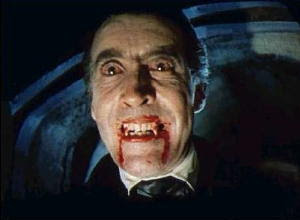
Peter Cushing redefined the role of Van Helsing, and Christopher Lee added an animalistic evil to Dracula, adding the ghastly bloody hiss when he's really angry. Beloved director Terence Fisher doesn't miss a beat with a tight, layered and compelling style of storytelling. Lush art direction, pounding music, and gory special effects make this a complete entertainment even today.

In 1958 (just imagine it) the effect was so strong that it launched the studio's international success. It's a marvellous choice for a thorough preservation. But will there be any more Hammer Films treated this royally?

Why not ask them yourself? Nigel Algar and Ben Thompson, the two men in charge of this restoration will be talking about the project at a free event in NFT3 on the afternoon of Friday 9th November.


- - - - - - -

September 22, 2007

THE MATRIMONY (2007) a Chinese ghost story... from China!


THE MATRIMONY
(2007, China, IMDB: Xin zhong you gui)


Region 3 NTSC DVD (Mei Ah Entertainment)

It’s a little late to bring out a ghost story this simple, but China hasn’t actually seen many. The government simply hasn’t allowed any supernatural storylines in movies, and this one has possibly only been made because of the period setting. Still, even for Hong Kong, serious ghost stories are rare – and this isn’t played for laughs. While it doesn’t provide any particularly new scares, it’s still a beautifully made film.

The Matrimony also has the kind of budget only lavished on films destined for international success. The huge period sets recreating Shanghai in the 1930's are convincingly done. The opening scenes, that set up the tragic love affair, are only marred by a very poor computer-generated road accident. The CGI effects throughout the rest of the story are used more subtly and effectively.

The opening titles, indeed the first half hour of the film, lays on spooky atmosphere and loud shock moments so thickly that it detracts from the flow of the story. Junchu (Leon Lai), loses his sweetheart in a car accident and is forced into an arranged marriage with Sansan (Rene Liu), a woman he simply doesn’t love. But will he change his mind if the ghost of his sweetheart, Manli (Fan Bingbing), possesses the body of his wife?


Basically, this is a love triangle, with strong performances from the three leads. There’s even a heavy nod to Hitchcock’s Rebecca (1940), as a spooky housekeeper prevents Sansan from entering a locked room in Junchu’s huge mansion.

It reminded me more of Stanley Kwan’s Rouge (1987), a similarly unrequited love story which preferred to tone down the supernatural element and played successfully as a drama. Again, the ghost was very beautiful (Anita Mui), but the setting was modern day, with flashbacks to the 1930’s. Rouge works so well because it treats the ghost as a character rather than a scary monster.


I will watch The Matrimony again in the future, for the lavishly recreated sets, the colourful cinematography, and the cast, but not for the scares.

The Hong Kong no frills DVD release has good English subs, an anamorphic widescreen picture, and an optional DTS audio track.


UPDATE - also out now on region 1 DVD in the US.


- - - - - - -

September 20, 2007

MEMENTO MORI (1999) WHISPERING CORRIDORS 2

MEMENTO MORI
(1999, South Korea)

Two schoolgirls fall in love with each other, and are not about to hide the fact. An accident, or is it suicide, or murder? leaves one of them haunting the school and causing chaos... The discovery of her diary might hold the key to what happened.

What could have been just a retread of the first film, Memento Mori, sometimes called Whispering Corridors 2, now stands on its own, almost seperate from the rest of the series. While 1 was a good horror, 2 is a good film. It’s hard to classify, it’s good as a drama, it also delivers shocks, and is not without a little blood...


Beloved in South Korea, as evidenced by the huge recent 6 disc Ultimate Edition boxset, Memento Mori is also considered internationally as a good example of South Korean cinema. Successful for its portrayal of defiant characters, school life, and a girl-girl love affair.

It also revels in non-linear storytelling – a narrative form that has vexed some viewers of SE Asian cinema. For example, the back and forth storylines of Ju-On had to be toned down for the western remake as The Grudge. Many South Korean films use this fractured form at present. Memento Mori is so playful that you can almost make up your own story with all the scenes – but there aren’t too many clues as to what order they’re supposed to be in. By the end, I was doubting that the story had been in any sort of order from the very start, with scenes from dreams and fantasies thrown in as well.

From the underwater opening (a nightmare?) you soon know that this is a beautiful-looking film, and that not every scene is included for plot, but for mood. Two schoolgirls, an athlete Yoo She-eun, and a pianist Min Hyo-shin are in love. Gawky classmate, So Min-ah, finds her diary - a strange collection of poems, and pictures. As she reads it, we sometimes see the incidents the pages refer to. She discovers that the girls have been meeting in secret on the school roof.


But then we see an accident, a fatal one. Through clues in the diary and flashbacks from other girls and teachers we get a better idea of what caused it. At the same time, her ghost is stalking the school in search of the diary. As more people sense her spirit, and gossip why she’s dead, panic eventually grips the school…


This is easy to recommend as an interesting film, by two creative directors full of ideas. The lesbian storyline is probably new and strong stuff for South Korea, although it’s sensitively handled and not exploited (that’s if you ignore the bathtub scenes excised from the director’s cut – but these are still without nudity). The teacher’s treatment of pupils is shocking, part of the first film’s ‘tell it like it is’ attitude.

Technically, the cinematography makes the whole film very easy on the eye, and interesting – like the series of hospital visitors all reflected in an eyeball – I don’t think this scene was faked, just cleverly shot. The production was all shot on location, on a low budget and is slightly rough-edged. The most obvious sign being the few special effects are quite poor. But they somehow don’t spoil it at all. The acting of the young cast, the direction and the cinematography make it memorable. Together with the beautiful and mournful soundtrack, it’s even haunting.

The climax is maybe overlong and more successful for what's heard (screaming, thunder, music) rather than what happens. It successfully portrays being in the middle of a panic-stricken situation. The confusing structure of the film are is the only other weakness. But that makes it more of a mystery. It’s a drama, but has enough cheeky shocks to keep ghost fans happy, if not horror fans.


Having enjoyed the Hong Kong region 3 DVD (pictured at top), I then purchased the Korean 6-disc (5 DVDs) Ultimate Edition at a very reasonable price - a boxset that can only be kept in a box! There’s an excellent transfer of the film with English subtitles on disc 1. While the rest of the set is unsubtitled. Except for one of the director’s early films, also set in school, also exploring the problems that young lesbians face in society, also starring a rather more boyish-looking star of Memento Mori. Disc 2 has the three-hour director’s rough cut. Disc 3 behind the scenes. Disc 4 earllier short films. Disc 5 is an HDTV tranfer included as an MPEG, disc 4 is a CD soundtrack. There’s also a hardback replica of the diary included, but without the pills tucked into the spine…

I'm pleased to say that the film is now also available on region 1 and region 2 DVDs, misleadingly under the Tartan Asia Extreme banner label.


So far in the Whispering Corridors series...

WHISPERING CORRIDORS (1998) Black Hole review here

MEMENTO MORI (1999)

THE WISHING STAIRS (2003) Black Hole review here

VOICE (2005) Black Hole review here


- - - - - - -

September 16, 2007

EARTHQUAKE (1974) my early taste of bad-taste

EARTHQUAKE
(1974, USA)

Region 1 NTSC DVD (Universal)

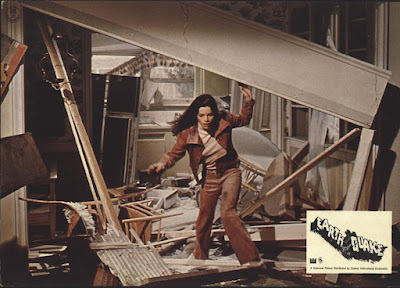
Imagine L.A. being wiped out by a series of devastating earthquakes. Famous buildings, skyscrapers, shopping malls are all disintegrating into piles of bricks. The dam to the Hollywood Reservoir, poised high in the hills, looks like it's going to break. Charlton Heston is rushing around trying to save his wife... and his girlfriend. You're watching all this in a cinema, and during the quakes, your seat is actually shaking...

It's 1975, it's Earthquake, presented in in Sensurround...


Besides big-budget disaster movies, Hollywood also tried to woo punters away from the TV with this realistic gimmick. Sensurround involved temporarily installing huge low-frequency speakers into cinemas, to kick in with rumbling that felt like the whole place was shaking during the appropriate action onscreen. (I remember seeing a big black four-feet cube sitting ominously at the back of the cinema). But afer a few years, the system was no longer used, accused of actually damaging the fabric of the cinema buildings! A ton of technical details and a history of the format is here on 70mm.com.


Being a sedentary thrill-seeker, I caught two other Sensurround releases around at the time - Rollercoaster and Battlestar Galactica, (the first three tv episodes were cut down, beefed up and released as the first of several movie releases outside of the US). I missed The Battle of Midway (also starring Charlton Heston) and don't know of any other films that used the short-lived process.

The recent DVD region 1 release even has the Sensurround mix on it, as well as a 5.1 option. Through a home cinema set-up, I was able to experience the ground-shaking all over again.

B
ut even without the fear of your lounge collapsing, the film still entertains in a variety of ways. It's less serious than The Poseidon Adventure, less grim than The Towering Inferno, and delivers action in huge chunks, without worrying about characters or, well, taste. It's the disaster film most suitable to be turned into a fairground attraction, which it was at Universal Studios theme parks.


Writers George Fox and Mario Puzo (yes, Mario Puzo! - halfway between writing The Godfather and Superman - The Movie) were determined to wring the maximum potential out of every suspenseful quake-related situation. Cracks in the earth, buildings caving in, getting trapped in lifts. The scene where the water is snaking towards the powerlines had everyone lifting their feet off the floor... People getting hit by falling glass, pans of boiling water, girders... every conceivable quake injury is presented as a thrill-packed stunt show. It's very Hollywood, and not at all like real quake footage. But at the time, the experience wasn't sullied by conscience, except occasionally when the film-makers overstepped the mark...

Like the plummeting lift, packed with office workers - as it hits the bottom of the shaft, we get a knee-level shot of their legs... and special effects blood zaps into the screen. Outside, a woman is hit by shattered windows, she turns to face the camera and has shards of glass poking out of her face. It's like a cheesy horror movie, so fake, it passed the censors. Even at the age of 15, I knew that it was tasteless, but was fascinated nevertheless.


Nowadays it's harder to work out what the hell they were thinking - two characters appear for the first time in the movie, one get's injured, the other yells 'Mother', and we never see them again. Are we supposed to care? Is five seconds enough time to build an emotional bond with them? It's a key moment in understanding the mentality of seventies disaster movies. Crass, high bodycount, spectacular deaths, unequalled by Freddie or Jason combined. I think the phenomenon peaked with 'the pylon through the stomach' in The Cassandra Crossing. A character who only appears in one spectacular shot in the middle of a train crash.

Today, disaster movies keep a distance from death scenes, or even cut away completely. Victims are usually computer-generated specks, and only the key characters (usually bullies or baddies) get a close-up demise. (I'm thinking Poseidon, here). So death scenes are only allowed as part of the story. Random acts of movie violence for entertainment, are no longer. Pets, pensioners and children are safe again in action films.

Spare also a thought for the stunt performers back then - no digital wire removal for them! If it goes wrong, it's not 'fixed in post', they had to do it again! The highfall in Earthquake, shot straight downwards, an angle stolen from The Poseidon Adventure, looks dangerous, as stunts should. As does the motorbike stunt - a loop-the-loop that goes wrong. And it looks like it really did go wrong, and they left it in.


Even before the quakes hit off, the overacting is just as spectacular. Ava Gardner continuously shouting at Charlton Heston would send anyone into the arms of Genevieve Bujold. Marjoe Gortner barely convinces anyone that he's a sane gorcery clerk, before he goes psychotic when Martial Law is declared. Victoria Principle is quite good, but with her afro wig, she just looks over the top.

Richard Roundtree has nothing much to do. It's sad to see him demoted way down the cast list. His iconic run as the superbad Shaft had expired after three films and a quickly-cancelled tv show. He had a few more leading tough guy roles, like Diamonds, and Escape to Athena, before settling down to a long-running career in bit parts as cops and commissioners.

I won't tell you the story, you know it's not important. The idea is to introduce dozens of characters, lining bottles up on a wall, with silly fast-moving soapy plots. The bottles are then knocked off the wall.


Some dodgy optical special effects are weighed up against some spectacular large-scale model work. The wide shots of mayhem are done with matte paintings overlaid with optical fires and smokes, but only some of these stand up today.

At the time it was a huge and expensive undertaking. Quake movies had previously only provided centrepieces or climaxes to films set around famous disasters, notably San Francisco (1940) which had a short but spectacular recreation of 'the big one'. Earthquake did its best to deliver one long disaster, to follow up The Poseidon Adventure. It then took two movie studios to team up to follow it up and beat it for scale…
The Towering Inferno…

There were a couple of different versions of Earthquake. It was padded out with extra scenes specially made for TV, in order to pad it out to three TV hours. These mainly involved a plane waiting to land at LAX despite the damage to the runways.

There's a fantastic fansite, devoted to the film, with photos and details about the special effects, missing scenes, and loads more...
here at EarthquakeMovie. The only other source of behind-the-scenes info was an early 'making of' book, published at the time. A slim 128 pages long, half of it is devoted to telling the story of the film!


The film is long enough at 123 minutes, but obviously the TV scenes would be a good extra for completists. As would a trailer or a documentary. But a widescreen presentation with Sensurround is what really matters, despite the no-frills.


I remember watching Earthquake in an early multiplex in the UK. My mother was next door watching The Great Gatsby, and said that she could hear the quakes through the walls of the cinema. OK, Sensurround wasn't without it's major faults...

- - - - - - -