Showing posts with label UK. Show all posts

April 03, 2013

Cinema-going in the 1970s - my decade in the dark


A trip to the cinema doesn't change drastically from decade to decade - pay for a ticket, overpay for junk food and stare at a wall for a few hours. But now it's forty years since my frequent movie-going began, and it was quite a different ritual.

As a child in the 1960s, I was taken to see a movie as an occasional treat, but my appetite became so voracious that, when I was old enough (13 or 14), I went on my own to the local cinemas. A lot. Between 1973 and 1980, I went weekly, sometimes more often. I also went up to London on my own to catch the latest films on even bigger screens.


What's on?

At the time, Britain had to wait several months for the US to finish with their prints of the movie. This often meant that we'd not see major films until the year after they premiered. As well as that delay, London had the opportunity to show new films exclusively for several weeks. With bigger screens and higher prices, it was presumably another chance for word of mouth and press reviews to drum up anticipation around the country. Or it could have been that there weren't enough prints to open everywhere at the same time. The London cinema listings were in national newspapers and the London evening papers.

Then new movies would open in different towns on different weeks, being held over for longer if they did well. I'd check other nearby towns to see if different films were playing. Saturday was when the local paper printed adverts for what was showing in the area, along with screening times. As the cutting above mentions, the programme changed every Sunday. For me it was the first page I'd look at in the the weekend paper. It was also the only way of knowing what films were playing.

At the time, only the biggest movies would get adverts on television. But most new films would have adverts on local radio. Made up of quotes and music from the soundtrack, with a deep, movie guy voice emphasising the taglines from the posters. ("The lucky ones died first!"). I've made a YouTube playlist of the best radio movie ads from the late 70s and early 80s. Many are in stereo - which was still a novelty on radio at the time.


Admission

I've little hard proof, but I think that the price for children was about 50p a ticket, and £1 for the over sixteens. By the end of the decade it was definitely £1.40 for an adult ticket at my local cinema.


Certification

I'm relying on this page on Wikipedia - from 1970 to 1982, cinema certification was U, A, AA and X, which is certainly how I remember defining what I watched. The Rocky Horror Picture Show, Blazing Saddles and Young Frankenstein were 'AA', The Omen and The Exorcist were 'X', and incredibly Jaws was 'A'. Here's what they stood for...

'U' certificate was open to everyone. 

'A' certificate wasn't recommended for under 14s (but we were let in anyway. But before 1970, in many areas, children had to be accompanied by an adult).

'AA' meant that under 14s weren't allowed in (these were roughly the equivalent of American 'R' certificates - violence and swearing but no explicit sex scenes).

'X' certificates were for over 18s only (before 1970. it was only restricted to over-16s), but they were still censored, cut for extreme violence.

As a tall teenager, I played a moneysaving game. I'd pay one week as an adult to see an 'X' film, then be cheeky enough the next week to ask for half-price (because I was under 16). I soon moved up to the right age for 'AA' films, but wasn't supposed to see 'X' certificates until 1979. If I'd agreed to that, I'd have missed the chance to see Carrie, Tower of Evil, Suspiria, Death Race 2000 and many more, so I pretended to be older...

('X' certificate image courtesy of Mounds and Circles blogspot).


Double Features

Throughout the 1970s, local cinemas were still showing double-bills, two full-length films, whether or not they were a suitable pairing.

So, for the price of one ticket, everyone could get three or four-hours of entertainment. Sometimes, I would stay and watch everything through twice - four films in a row. Most of the time, local cinemas didn't have 'separate showings' or booked seats (like they did in the central London cinemas). You turned up when you wanted, you could even go in halfway through. Rather than hang around an hour for the next performance, I made the mistake of going in late, when I saw Jaws for the first time. Then I then saw the first half, and watched it through to the end again.


Many big films kept on making money with rapid re-releases, especially popular series like Planet of the Apes, Pink Panther and James Bond films. They made so much that TV couldn't afford to show recent films until years after they first appeared in cinemas. Double-bill re-releases were a great way of catching up on films that I'd missed and a chance to rewatch favourites. The order I saw them in was of course quite random. For insatnce, I started with the last Planet of the Apes film...


Queues to get in were longer in the evenings, especially at weekends. It was first come, first served. If there weren't enough seats, you'd have to wait till the next showing. Several ushers had to maintain traffic control and scout for empty seats during screenings, pointing torches at the floor to show us the where the steps were. 

In between the support and the main feature, there'd be adverts and trailers. An experience approximated by Tarantino's Grindhouse (2007). The support might be a re-run that was a year or two old, usually with the same certificate. Or it might have been specifically made as a second feature! We'd also see American TV movies, that hadn't been shown in Britain yet - like The Savage Bees. In terms of production values, there was only a thin blurry line between low-budget feature films and TV movies.


Through the decade, the double-bills became rarer - more and more blockbuster movies like Jaws and The Towering Inferno didn't need support films, but the tradition of having a 'supporting feature' remained. Specially-made short films and documentaries, little more than 25 minutes of filler, like travelogues, were shown instead. Few were memorable, except Bob Godfrey's Great (1975, a bawdy, musical, animated story of Isambard Brunel) and Leonard Rossiter as Le Petomagne (1979, based on the true story of a French stage entertainer who could fart musically). With horror films, there was a brief spate of weird, adult short films. I remember a Basil Brush presenter turning up half-naked in one about a sacrifice to Satan! 


Intermissions

Between the support and the main film, there'd be diabolical local adverts, then slicker adverts (usually for alcohol or cigarettes - the Gordon's Gin music became a hit in its own right), then trailers for coming attractions.

Incidentally, smoking was still allowed in most cinemas, ashtrays built into the arms of every seat (but nowhere to put your drinks or popcorn). Smokers were eventually pushed to one side of the cinema (the right). But if the seats on the left filled up, you had to sit with the smokers!


Long 'event' movies, like Ben-Hur, might not get a supporting feature. Though even 2001 - A Space Odyssey (on re-release) started off with a Tom And Jerry cartoon (they were in space, of course). With these epic running times, there'd be a break halfway through the film. I still remember exactly where they stopped Chitty Chitty Bang Bang and The Towering Inferno, both with cliffhangers and groans from the audience.

Waiting for the film to start, you might get music played, but were often sitting in silence listening to the projectionist rewinding the reels for the next performance. You could take the long walk down to the front and get a warm Kia-ora from the usher or a melty ice cream, or hike back down to the foyer for more Revels, as long as you still had your torn ticket stub to get back in.

If you were very lucky, there would be some sort of light display to keep your brain alive. The multi-coloured oil wheel projected over the curtains at Wimbledon Odeon once kept me amused for over half an hour. 


The wait between films could get ridiculous. Presumably. the manager had to stick to the published times placed in the local newspapers, before they actually knew the exact running times. 


Magazines sold at the ticket booth passed the time, though there was barely enough light to read them. There was Film Review or Photoplay magazine, and sometimes a special brochure for the main film. Japan still makes these, with high quality colour photos and behind the scenes info, they're very collectable. 

By the end of the decade, brochures at local cinemas gave way to tie-in magazines and foldout poster mags, which you could buy at any newsagent. Star Wars was one of the first films to have such a tie-in (but you could still get the brochures in the big London cinemas).


Projection

Everything (except in a few of the biggest cinemas) was shown on 35mm film reels, in either 1.85 or 2.35 aspect ratios. 

As I remember, the changeover between film reels was every twenty minutes. The print would visibly get more scratchy, before the circular marks scratched into the top right corner of the picture appeared (once as a warning, the second as a cue) and the sound might glitch out at the moment of changeover. Distributors would try and divide up reels so that there was no music and a gap between dialogue at the end of each reel. There might be a momentary blackout if the projectionist was late switching over. 

Censor cuts would have been made, physically, to each print. Because the projector bulb shone behind a different frame to where the sound pick-up was. If a section of film was cut out, the sound that was removed would differ by half a second. You could often tell where the censor cuts were because of the mismatched audio, besides a blatant jump in continuity.


Odeon Leicester Square, May 1980
Up in town

To see a major new film without having to wait, I'd go up to London, where some cinemas even had multichannel or stereo audio, 70mm prints or even floor-shaking Sensurround. A chance to see them as soon as they'd opened in this country, Star Wars, Close Encounters of the Third Kind, Superman - the MovieAlien, Battlestar Galactica, The Black Hole, Apocalypse Now in six channel stereo... I have the brochures to prove it.


Soon, I'll be looking back in detail at these, my local cinemas at this time, and what's happened to them since. Also, how you can travel back in time to see how your favourite cinemas looked...


February 17, 2013

AMICUS: HOUSE OF HORRORS (2012) - heartfelt fan-made documentary


AMICUS: HOUSE OF HORRORS
(2012, UK)

Attempting to document the famous horror studio

For British horror films of the 1960s and 1970s, Amicus Productions rivalled Hammer films by taking a different approach with considerable success. Amicus brought horror to mostly modern day settings, like the living rooms of The Skull, the film studios of Madhouse, the high-tech werewolf hunt of The Beast Must Die... They also monopolised on the 'portmanteau' horror, a film made up of short sharp shocks, held together by a linking story - Dr Terror's House of Horror's lead to the first EC Comics adaptions of Tales From The Crypt, Vault of Horror and beyond to Tales That Witness Madness and The Monster Club.

Strangely, the company started and ended with child-scary family adventures, from Dr Who and the Daleks to Warlords of Atlantis. Amicus made a lasting impression on several generations of filmgoers and late night TV horror fans.

Geoffrey Whitehead from And Now The Screaming Starts
On a limited budget, writer and director Derek Pykett has made dozens of interviews on home video around England. But looks like he was unable to pay for any expensive archive materials to portray a more complete story with behind the scenes footage, movie clips or old interviews. Instead he gives us some valuable time with many surviving cast and crew members who worked on the films.

I wish he'd spent a little more time on editing and deciding on a target audience. The running time is unnecessarily inflated by introducing many extremely familiar plots and people. Worse still, by repeating facts and introductions as if we've not been paying attention. His pieces to camera are also very downbeat, as he repeatedly reminds us who's dead, in stark contrast to the many chirpy interviewees who remember the good times they had while they colleagues were alive.


The variable sound levels also make this contrast with the flashy DVD extras that we're used to on special editions.

But.

No-one else has got these interviews or even some of the interviewees that he has here. No one's bothered to go this far down the cast list and persuaded the directors and cameramen to talk about these almost forgotten films.

This could have been slicker, and a bigger budget could have pulled in better interviews and bigger names, Christopher Lee and Stephanie Beacham are absent. But there are no other Amicus documentaries out there anywhere!


It starts a little confusingly by introducing Milton Subotsky and Max Rosenberg, the two producers who started Amicus. But then fast-forwards through the whole story of Amicus by telling us their entire life stories upto their deaths. Making me think the whole documentary was going to be a series of biographies all told in voiceover...

The style then settles down with a great remembrance from Milton Subotsky's widow who thankfully has great recall about his heyday. Then we get into the main meat of the programme, split over two discs, an exhaustive film-by-film account of the entire Amicus filmography, related by an impressive roster of surviving cast and crew members.
Angela Pleasence and father in From Beyond The Grave
I was particularly pleased to see interviews with Geoffrey Bayldon (Asylum, Tales From The Crypt, The House That Dripped Blood), indeed he introduces it. Also a pleasure to see Angela Pleasence (a stark presence in From Beyond The Grave) who's still out there working!

Actors who only appeared in one scene in one Amicus film are also delightful, partly because someone else remembers their characters as vividly as I do. Angela Grant as Ian Hendry's girlfriend in Tales From The Crypt is famous (to me) because I've seen it so often, and the shocking scenes that she's in. It's surprising just how much insightful material can come from someone who worked with Amicus so briefly.


Some are character actors who were more famous for their non-horror roles, like Jeremy Kemp (Dr Terror's House of Horrors) who regularly appeared as German commanders. Kenny Lynch (also Dr Terror) and Geoffrey Davies (Vault of Horror, above) were far better known for light entertainment and will only otherwise be recognised by those who remember 1970s' TV.

Crew members include production designers, cameramen and a couple of directors, like Kevin Connor (From Beyond The Grave, The Land That Time Forgot) and Stephen Weeks (I, Monster). There are of course many other interviewees and even a couple of visits to filming locations.


Director and voiceover Derek Pykett keeps appearing to fill in gaps in the timeline where he has no relevant interviewees, most annoyingly on my favourite, Tales From The Crypt, giving the first of a seemingly endless, dour reminder of how wonderful Peter Cushing was and reminding us that he's dead. I'll forgive him all this because Derek also wrote this invaluable paperback guide, British Horror Film Locations.


I won't forgive that Derek skips over the Amicus monster movies far too quickly, even though he's interviewed their director, Kevin Connor. The Land That Time Forgot, The People That Time Forgot, At The Earth's Core, and Warlords of Atlantis are scarcely covered. They were the few Amicus films that I saw at the cinema and indeed the only ones I was allowed to see at the time. They were also a large part of Amicus' success in the 1970s, and just as much a part of producer Milton Subotsky's love affair with fantastic literature.

So, after the extended run through most of the Amicus filmography, it then circles a little randomly for a while with another downbeat Cushing tribute and some leftover bits of interviews to try and sum up.


For enthusiasts who know these films and recognise these actors from relatively small roles, this is a treat. But it's a rough introduction to the subject, with not enough enticingly presented clips (just trailers) or thorough enough background, to please newcomers.

But there's more good stuff in the DVD extras! Also included are two rare archive interviews with Peter Cushing! The first is from 1990, and both are introduced by the interviewers as they are today.


While many of us are more than aware of how the death of his wife severely affected him, it's rare to see Peter talking about it at any length. And rather than being overly sentimental, he remains composed, self-deprecating and even humorous about what was a disastrous and prolonged grieving process of nearly thirteen years! He admits he tried to kill himself. Too cowardly to throw himself into the sea, he ran back home and tried to bring on a heart attack by running up and down the stairs! Which is quite an admission, that he treats with a smile. To slowly get over Helen's death, he threw himself into work and said yes to any and all offers. 

The second is a 1983 interview, with a young inexperienced interviewer who Peter politely but occasionally catches out. This was crucially filmed just at the end of his 13-year exile from the public. Perhaps it's Peter easing himself back into talking about things. This is a slightly more guarded interview, but reveals he actually doesn't like watching horror films! He prefers war, drama, comedy, westerns. Though he makes a point of gratefully acknowledging the horror fans who enjoy his work. He only watches his rushes but not his films.

Amicus: House of Horrors is only sold in the US, but the DVDs aren't region-coded. They can be bought direct from Oldies.com in the US, or you can easily get them via Amazon.co.uk, if you're in Britain.


The DVD set makes a great companion to this similarly covered Little Shoppe of Horrors' magazine recent Amicus special.

See many more of the classic Amicus movie posters here at The Wrong Side of the Art.


February 15, 2013

THE GHOUL (1975) - Peter Cushing horror not on DVD


THE GHOUL
(1975, UK)

Peter Cushing, John Hurt, Freddie Francis... but no DVD

The horror films in the many themed seasons on the BBC, late on Friday and Saturday nights in the 1970s and 80s imprinted on a generation of British horror fans. But while many have appeared on DVD and even blu-ray, The Ghoul hasn't been seen since the days of VHS. While Hammer Films are getting restored and reissued, some of the company's rivals haven't been so lucky.

Champion of the Classic Horror Campaign for late-night TV horror double-bills @Cyberschizoid recently reminded me that none of Tyburn Productions' horror films have made it to DVD. I then realised that there are in fact only three! Here's me thinking that Tyburn were a major horror studio, when I've been confusing them with Tigon films all these years. They started producing movies with a splash, when I was first reading horror film magazines, so the name of Tyburn stuck with me. But that opening burst of publicity was pretty much it.

Their most famous film is probably Legend of the Werewolf, starring Peter Cushing. Yes it's a werewolf movie, but a disappointing one, despite the great make-up work.. Much more interesting is Persecution (also 1975), starring Ralph Bates battling against his domineering mother (elegantly played by Lana Turner).

Their tiny library and small independent status has probably lead to their films subsequently falling through the cracks. But I'd especially like to pimp The Ghoul for your attention. This photo certainly caught mine...

World of Horror #4 photos made this a must-see!
A drunken party of well-dressed socialites and flappers runs into trouble when they decide to race their extremely expensive vintage motor cars through the foggy country lanes. This ends in disaster, with young Daphne seeking help at an isolated manor house. For her friends to find her, they'll have to tackle the neurotic groundskeeper, the devoted housekeeper, and the thing in the attic...

While set in the 1920's, this has less of a period feel than the Hammer films and aligns itself closer to contemporary horror with a variety of shock tactics and a far stronger heroine than Hammer usually managed. Veronica Carlson's character was relatively soppy in Frankenstein Must Be Destroyed, but here she's braver and more independent.


Peter Cushing is also allowed a role with more emotional depth than allowed him in Hammer films, with an uncomfortable-to-watch level of grieving, parallelling the actual loss of his wife. The cast also boasts John Hurt, in an early role (a few years before Alien) as a feral, scheming handyman. It's a treat to see him spark fireworks off Cushing.


Freddie Francis is often mocked for his worst horror films as a director. But his strongest films are definitely strong, like this one. It's fun to see him reprise the meathook gag from Trog, though he later seems unsure as to how to stage, prolonged frenzied violence.

Also very welcome in the cast, Alexandra Bastedo (wishing she had her superpowers from The Champions) and Ian McCulloch (wishing he had a rifle from Zombie Flesh Eaters).


The Ghoul is languishing, waiting in the attic, full-frame on VHS...


Rare photos (some are definitely spoilers) and the brief history of Tyburn films over on the extraordinary Peter Cushing fansite - The Black Box Club.


July 04, 2012

BLOOD OF THE VAMPIRE (1958) - a choice of DVDs


BLOOD OF THE VAMPIRE
(1958, UK)

Hammer films opened the bloodgates of sadistic melodrama!

(updated in April 2014, to include French Artus DVD release)

A heartless doctor is using his 'lunatic asylum' patients for merciless experiments – trying to separate human blood types into categories in order to perfect successful transfusions, utter madness!

This doesn't rate as a horror movie by modern standards, but pushed the boundaries to their limits in a different era. It's a fascinating look at the changing perception of movie violence. This was once a censors' nightmare, but now appears on DVD uncensored and PG rated. Does that mean in fifty years time the shock value of Hostel and Saw will be treated just as lightly?

For fans of early Hammer films, this is a must-see, especially as it's written by Jimmy Sangster who scripted many of the first successful Hammer horrors, helping launch the studio worldwide. While this doesn't have the supernatural atmosphere (or the incisive direction), it's an interesting comparison. 


This could be classified as an Eros Film, the distributor used by this production team (Monty Berman and Bob Baker) who also made lower budget horrors The Trollenberg Terror, Jack The Ripper (1959) and The Flesh and the Fiends before successfully producing most of the jewels of ITC's TV hits like The Saint, The Champions and The Persuaders. There's no nudity in Blood of the Vampire (just suggestive leering and manacling), but the following year Jack The Ripper would include topless shots, allowed only in the continental versions (my comparison of those scenes is here). 

My opinion of the film has changed now that I've seen a decent remastering of the film. On DVD it looks better than it ever has, less seedy, poorly framed and grainy than it appeared on VHS and old TV screenings. Now it looks closer to an expensive production, with lavish sets (far roomier than Hammer) and impressive matte paintings. The amount of bloody violence makes this a worthy companion to Hammer's Curse of Frankenstein and Horror of Dracula, whose thrills it carefully emulates (a gunshot in the eye and a head in a jar, like Curse, a bloody staking like Dracula) presumably to sneak as much past the censors as possible ('you let them show it').


The story is even a mix of Frankenstein and Dracula, played as a nasty adventure in medical experimentation. OK, we now know he wasn't a mad doctor, he was on the right track. But his methods are a little unorthodox...

Sir Donald Wolfit (who you can also see in Lawrence of Arabia!) took a break from performing Shakespeare in British repertory to play the obsessive Dr Callistratus. He’s far better here than he was in the first colour version of Svengali (1956) and certainly makes this more enjoyable.


He's upstaged by his psychotic hunchbacked assistant, providing comedy actor Victor Maddern with a chance to both evoke sympathy and overact wildly. The hunchback provides a chronological bridge between between Bela Lugosi’s Ygor (Son of Frankenstein, 1939), and Richard O’ Brien’s Riff Raff (The Rocky Horror Picture Show, 1975).

Besides Wolfit, the best reason to see this is Barbara Shelley, one of the most accomplished actresses to appear in Hammer Films. Particularly Dracula Prince of Darkness (1966) and Quatermass and the Pit. She hasn't much of a character here, but ably endures many difficult scenes, being ravished and ogled by the bad guys.


The original publicity photographs have long teased horror fans since they appeared in 1960s' monster mags. The photo of the flogging victim was strong stuff even in black and white. But some of these images were from censored scenes, resulting in disappointment when we eventually got to see it. Over recent years, through a progression of three DVD releases, these scenes have all re-emerged from the darkness...


Blood of the Vampire first surfaced on DVD in 2006 as a region 1 US release (from Dark Sky) a double-bill with The Hellfire Club. It includes some censor cuts (not seen on British TV), but they are jumpily integrated into this print. Besides film weave and an unavoidably grainy image, this version is compromised by a zoomed-in image on several scenes, that crop the lower edge and sides of the picture. For the most part, the framing is acceptably tightened to 16:9 from 1.66 (the original ratio shown in the opening titles).


Some of the additional shots (that I hadn't seen on earlier TV screenings) reinstated the head in a jar (!) and some spurting blood being decanted during a transfusion (this glimpse is still cross-faded out in the UK DVD).

There's also a jovial and informative commentary track, Hammer historian Marcus Hearn getting the most out of writer Jimmy Sangster and producer Bob Baker.


A young Barbara Shelley and Sir Donald Wolfit
Then there was the region 2 UK DVD from Simply Home Entertainment in 2007. The image quality is similarly grainy but has slightly more depth to both detail and colour. While the image suffers a little too much digital scratch-reduction on both the US and UK discs, I'm not expecting a practically unknown film to look any better without a ton of far more expensive restoration work.

The UK version is better framed overall, with none of the strangely zoomed-in scenes of the US DVD. Though the opening scene and titles are better presented, full height and less cropped, on the US disc. Both DVDs are presented anamorphically for 16:9 screens. 


Barbara Burke on the slab - a scene missing from the US DVD
The UK DVD has an entire extra scene with the housekeeper strapped to the operating table, though nothing scandalous happens. The censor seemed preoccupied with what was being infered. As far as I could tell, the other cuts have been restored, apart from the blood spurting into the jar.

The UK disc also lacks any extras, and is sadly missing the commentary track. But most of the information that was discussed is included in a packed colour 16-page booklet of posters and photos.

For frame grabs from the US and UK DVDs, and an alternate opinion of how they compare, see this page from Mondo Esoterica...


Finally in 2013, there is this 'Version Integrale' region 2 DVD from Artus Films in France, announced as the complete version. Sold as Le Sang Du Vampire, it not only contains the spurting blood and the head in a jar (from the US DVD) and the housekeeper scene (from the UK DVD) but also the long lost manacling of Mary Marshall (as seen below)! We've been discussing that scene in the comments (at the end of this post) and it's a relief that I've finally seen it. The capper is that this restored scene shows not just two, but four women chained to the dungeon pillars! The quality of these long-censored scenes is notably poorer, scratchier than the rest of the film. There's a clumsy transition (a crossfade) during the tracking shot from the severed head, between a bad and good film element.


Mary Marshall (right) only seen in the French DVD
Gushing and spurting blood was a whole new problem for censors, now that it could be seen in colour. These censor cuts are now more fascinating than the slim story, in what was a pivotal year. Also in 1958, Hammer's Dracula was censored (scenes that have only just been reclaimed) and Horrors of the Black Museum was released. That has a far more sensational reputation, but shows far less than Blood of the Vampire

The manacled maidens scene was presumably more problematic because of the lascivious look in Victor Maddern's remaining eye! The Artus DVD also restores and extends a few additional scenes or leering and bloodshed, none of which would increase the certificate from PG if it were ever to be released in the UK.

The French DVD is presented widescreen anamorphic with English and French audio options and removable French subtitles. It also looks slightly more colourful than the UK DVD, which was my previous favourite version. The extras are an appreciation (all in French) an extensive montage of posters and lobby cards and a trailer.


More examples of the fantastic Blood of the Vampire lobby cards, here on Four Color Comics...


July 01, 2012

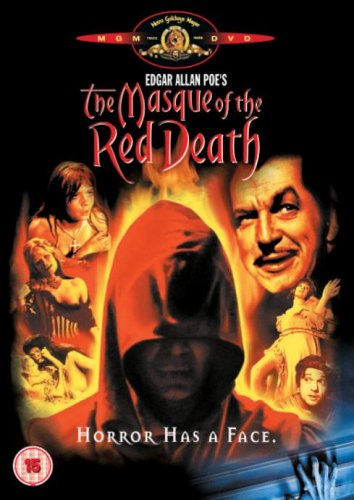
THE MASQUE OF THE RED DEATH (1964) - Roger Corman's colour-coded Poe

THE MASQUE OF THE RED DEATH
(1964, UK)

Gorgeous, colourful, complex, bloody, Roger Corman adaption of Poe


The Masque of the Red Death is a costumed ball held in a castle fortress for the rich landowners, while all around the villagers are dying of a mysterious plague. With a captive audience, Prince Prospero (Vincent Price) can indulge in a wild party and even a little black magic without anyone complaining. Spurning his beautiful wife (Hazel Court), he kidnaps and attempts to lure a young christian (Jane Asher) to defect and worship Satan...


Roger Corman directed a series of the best ever adaptions of Edgar Allen Poe, while remaining true to his stringent budget guidelines. How he successfully managed to sell these movies to teenagers at the same time as the beach party films, I'm not sure. Poe's poems and short stories needed expert scriptwriters (such as Richard Matheson and Charles Beaumont) to remain true to the gothic sensibility while expanding the material to feature-length. The themes of plague, evil, class and religion make for a rich set of subtexts for a period horror film.


For the first time, Corman increased his budgets in order to get colour cinematography for these Poe films. The rich look was complemented by Daniel Haller's imaginative and psychological production design. The casts were usually headed by Vincent Price, grateful for material with some literary kudos.


For newcomers to these films, I wouldn't start with Corman's first Poe, The Fall of the House of Usher. The Poe films shot in America are characterised by endless creeping around cobwebbed corridors waiting for Vincent's dead wife to pop up. The Pit and the Pendulum is my favourite of these, for the magnificent finale and the dark presence of Barbara Steele. But Corman shot two Poe films in England, resulting in lusher and more ambitious productions. The Tomb of Ligeia even has exterior locations, at odds with the usual claustrophobic atmosphere of the series. The Masque of the Red Death is therefore my recommended starting point.


It has intertwined subplots, making for repeated payoffs, gets more than a little violent and subtly focusses on the battle between satanism and christianity. Prospero's repeated blasphemies are veiled in fancy words, but even the current home video version is missing gobbets of dialogue based on past censorship cuts. The oblique references to the outrageous sexual behaviour of his guests remain.


The production is entirely set-bound, but this is the best-looking Roger Corman Poe. The colour-coded sets, costumes and death scenes still look gorgeous, in no small part due to cinematographer and future director Nicolas Roeg (Don't Look Now, The Man Who Fell To Earth).


Vincent Price is once again matched by a strong female lead, the late Hazel Court  (The Curse of Frankenstein, who looks rudely ravishing, and relishing an evil role (rather than her usually cheerful romantic lead). She'd previously appeared opposite Ray Milland in Corman's gloomy adaption of The Premature Burial. and his Poe spoof, The Raven.


The rival of her affection is played by a young Jane Asher (here aged about 18) surrounded by professional thespians and having to do nude scenes. She'd later appear in Alfie (1966)and star in the recently restored Deep End (1970). She'd already been a child actress, unrecognisable as the little girl who meets the monster in The Quatermass Xperiment(1955).


The large cast is bolstered by many other British actors, best of all Patrick Magee (A Clockwork Orange, Tales From The Crypt) as the queasily curious Duke Alfredo. Skip Martin gets a meaty role as Hop-Toad the vengeful dwarf - who also appeared in a string of horror movies (Vampire Circus, Horror Hospital, Corridors of Blood). For added gravitas, there's Nigel Green(The Ipcress File, Jason and the Argonauts)in a too-small role.


For years I watched The Masque of the Red Death with the sexual and violent scenes cut out, with the 2,35 frame cropped savagely to fullframe 4:3. It's now on anamorphic widescreen DVDs in the UK and US, but it's been noticed that some older censor cuts are still in place. The film was last spotted uncut on TV in the 90s, with a couple of extra short scenes (the two little people discuss running away, and when Asher says she "slept badly"), extra blasphemy (Asher calls to God and Price assumes she's addressing him), as well as a glimpse of nudity (Asher being thrown in the bath). This BBC showing was of a print that started 'Anglo Amalgamated Presents' and had George Willoughby credited as producer, rather than Corman. To my eyes, the 'dream sequence' that Hazel Court endures was also a notably different colour, much more blue than the greener hues of the DVD transfers.


More details about the various versions here on the Classic Horror Film forum.


These cuts are annoying but negligible (Skip Martin's scenes with his love interest are unintentionally creepy as she's played by a little girl, her voice dubbed in by an adult (unconvincingly). The veiled, blasphemous dialogue remains mostly intact, as are the scenes of violence. Of the two DVDs, I'd recommend the US DVD (the MGM Midnite Movie double-bill) for having richer colours, which this movie definitely needs. The low-light scenes with mist and smoke still struggle desperately with the DVD compression and it screams for a Blu-ray release. The MGM UK 2005 DVD is also anamorphic but doesn't include the trailer.


Here's Jane Asher's own website!