Showing posts with label 1950s. Show all posts

February 22, 2014

I MARRIED A MONSTER FROM OUTER SPACE (1958)


I MARRIED A MONSTER FROM OUTER SPACE
(1958, USA)

Sex rears it's ugly head

There are some great movies with lousy titles. 'I Married A Monster From Outer Space' would be better as a tabloid headline or the title of a musical comedy. Looking past the screaming poster and the title, which deserves at least two exclamation marks, there's a sinister sci-fi horror lurking beyond. Not much of a budget, but moody black and white cinematography that money can't buy and a script brimming with sexual tension and subtext.


The decade of the 1950s, when you couldn't talk directly about sex or show it. But that's the core of this story. A newlywed couple has had the groom swapped out on his wedding night, replaced with an alien from outer space. The question looms in every scene - will she have sex with an alien? And what does he want? But they can't talk about it explicitly...

There are many 'aliens that look like humans' stories, the best being Invaders From Mars, Invasion of the Body Snatchers and the TV series The Invaders - all obsessed with finding the details in appearance and behaviour that allow us to tell friend from foe.


Here the paranoia has reached the bedroom, which makes for an enduring theme - who are you sleeping with? Beneath the sci-fi story are layers of sexual angst and hints of impotence and frigidity. 

It's also enjoyable as sci-fi, played deadly serious by all involved. Creepy too, but the delicate way we learn about what goes on between these two newlyweds still has dramatic punch without showing everything. There's also a strong element of Rosemary's Baby (written nine years later) as the new bride turns to friends for help, only to find that they've been taken over as well...


The extraordinary alien make-up was sculpted by Charles Gemora, who also built (and performed) the alien E.T. in The War of the Worlds (1953).

After many rewatches over the years, This keeps on giving - the dramatic and visual shocks still work. This time round I recognised a young Ty Hardin (as one of Tom Tryon's beefcake swimming buddies). Probably missed him because he's credited here as Ty Hungerford. He later played the boyfriend of, gulp, Joan Crawford in Berserk (1967). Hardin was also the FIRST choice to play 1966 Batman - only because he was unavailable did Adam West get the part.

As the groom, Tom Tryon is very good at doing very little - a spaced out, distant look, similar to Keir Dullea after his brain was fried by the trip through the star gate.


The bride, Gloria Talbott, made a handful of low budget horrors (The Cyclops, Daughter of Dr Jekyll, The Leech Woman), but this is easily the best. Her performance anchors the entire story, undermined by being imprisoned in too-tight teenage angora sweaters, her chest lit as carefully as her face. Though this emphasises the limits of how sexuality could be portrayed at the time.

Director Gene Fowler Jr worked on as much TV as film, and mainly as an editor (one of his last credits was Skatetown U.S.A.!). His experience is evident in some seamless scene transitions, and a clever, subtle use of back projection and reflections.


Besides the other 'they look just like us' stories, this would make a great double-bill with I Was A Teenage Werewolf (1957). The same director saddled with another silly title, but again a serious horror film with sexuality barely contained beneath the surface. This time the agonies of adolescence with a teenager who can't hide his raging lust (above).


The DVD is presented anamorphic widescreen, though it looks a little tight top and bottom. This isn't too distracting, but the lack of clean-up of film scratches in a movie that takes place mostly at night certainly is.

More posters on Wrong Side of the Art...


August 28, 2013

ON THE BEACH (1959) - post-apocalyptic waiting game

ON THE BEACH
(1959, USA)

Before 'post-apocalyptic' meant an action movie...

There has just been a nuclear world war. Anyone in the countries involved who didn't get hit by one of the hundreds of direct strikes has succumbed to the deadly radioactive fallout. Most of these were in the northern hemisphere. The winds have yet to carry the invisible danger to Australia, where a lone submarine crew assembles for a mission to check for any remaining life, especially the source of a mysterious radio signal. If nothing can survive on the planet, then there's no hope for anyone...

I'm no scientist, so I don't know whether this scenario is accurate or not. Is there definitely no chance of escape from a release of airborne radiation on that scale? No place to hide while radiation levels drop? Later global catastrophe movies like the biohazard thriller Virus (1980) assume that the North and South poles remain safe. Terminator 3 and Damnation Alley (1977) have faith in nuclear bunkers deep underground, that might enable a few survivors to last out.

In On The Beach, made at the end of the 1950s, the premise is that no-one will escape the fatal levels of radiation that have been released in a nuclear war and it's only a matter of time before the weather circulates it everywhere on Earth. Unlike the atomic mutation movies unleashed throughout that decade, here is an invisible opponent that cannot be blasted with flamethrowers or even more missiles.


Unusually, it doesn't even begin with a montage of stock footage mushroom clouds. If you don't pay attention to a radio broadcast early in the film (or haven't read Nevil Shute's book), you'll not know that there's been a nuclear war! I remember watching this on TV and being puzzled for a while as to what was going on, it's such a subtle set-up. We're in the same shoes as the characters - they've seen no explosions and are waiting for news, or evidence.


There's little to say that this is set in Australia either. The characters are either American actors or have British accents. The clue to the location is the theme of 'Waltzing Mathilda' in the soundtrack. The calm reaction to the inevitable seems very British. This is in complete contrast to the later post-nuclear movies of Oz, particularly the Mad Max trilogy, which is all about heroism, high adventure and car chases. Examples of where the apocalypse is taken for granted. 

There isn't even a breakdown of society, like in The Day The Earth Caught Fire (1961) where the masses get drunk and start killing each other. On The Beach imagines a very resigned, logical mass suicide as the only option. Unless there's any good news from the submarine mission...


In the meantime, everyone goes about their daily routines, keeping civil to the last. A mass resignation to the inevitable. The terrible implications aren't talked about directly, instead there's an acute double-edge to every conversation. Each scene has an implied ironic or tragic kick. The effect is increasingly terrifying. I found it intensely depressing and, even though I'd seen it before, it's stayed with me since.

At this time, director Stanley Kramer was tackling gigantic social issues in major films every year. Race relations in The Defiant Ones (1958), religion versus science in Inherit the Wind (1960) and Nazi war crimes in Judgement at Nuremberg (1962). No wonder he made a comedy in 1963!


For our last days on Earth, we could do far worse than spend it with Gregory Peck, Ava Gardner, Anthony Perkins (just before he was typecast by Psycho) and Fred Astaire (in an early non-singing, non-dancing role). Pleasant company in an awful situation.

On The Beach an early mainstream film to tackle this unthinkable subject, made over twenty years before the TV movies The Day After and Threads showed what a nuclear war could look like. It was also released five years before Fail Safe and Dr. Strangelove, which described how a world war could start. This was produced when the man-made doomsday scenario first loomed large. Now, the concept of nuclear destruction is, strangely, forgotten. Though thousands of warheads still lurk in America and Russia, enough to destroy life on Earth a hundred times over...


I rented the UK DVD release of On The Beach from LoveFilm. It's presented in black & white, 2.35 widescreen from good-looking film elements. But I believe this has yet to be re-released anywhere anamorphically.


(Written, while listening to Philip Glass' soundtrack to 'The Fog of War' and thinking of Jack, who's just left us.)


June 08, 2013

JACK THE RIPPER (1959) - the impressive continental version


JACK THE RIPPER
(1959, UK)

Differences in censorship between Britain and France

I've been using Horrors of the Black Museum (1959) as a benchmark of 1950s censorship. The outlandish murder weapons would suit seventies slasher movies, but while the methods are grisly, the violence is mostly implied and offscreen. The same year, another small independent production was also challenging the censor's rules on sex and violence. Jack The Ripper gives us timely insight into what was allowed in Britain, and how much more was allowed 'on the continent', before the swinging sixties had swung their first swing.

X-Cert is a new book that looks at the less talked about X-rated independent horror films of the fifties and sixties. While most of these horror films were familiar, the depth of research about their problems with the censors is invaluable. It made me take a second look at this early depiction of Jack The Ripper, author John Hamilton noting that it was the first film to actually portray Jack and his deeds directly. Many films had alluded to the story, notably Hitchcock's The Lodger (1927), but this is an (approximate) restaging of the original events. But the British censor was extremely watchful, even when it was only a script, and would have instructed the producers what would and wouldn't be acceptable in British cinemas before they'd even filmed a foot.


That didn't stop them from shooting more explicit scenes for the film's distribution in France. X-Cert demonstrates with some choice screengrabs the astonishing differences between the British and 'continental' versions of Jack The Ripper. Even in 1959, France allowed more violence during each murder and far more nudity throughout. With an old TV recording of the British film, and luckily the uncut French version on YouTube under the title Jack l'Éventreur, I could compare them for myself.


Jack The Ripper hadn't impressed me at all before. The portrayal of the murders dilute the original crimes to nothing more than muggings, and I was judging it on a 4:3 TV screening which renders much of the action cramped and confusing, tightened from its original widescreen. The French version on YouTube looks like 1.85 widescreen, roomier at the sides and showing off the carefully-framed cinematography admirably.

French DVD - cramped 1.33 framing and it's the censored version
The tension of each murder is heightened by the use of tilted 'dutch' camera angles which don't look nearly as good within a cramped frame. I don't know whether the sepia colour 'rinse' of the YouTube version is original, but it certainly works in favour of the story, being set over a hundred years ago. If this version was on DVD with an English option, I'd definitely get it. It all looks a dozen times better than the 1.33 transfer.


Continental version on YouTube - sepia, widescreen, uncensored
This Jack The Ripper portrays the increasing panic over the murders, while the identity of the murderer plays out as a whodunnit, with a wealth of suspects. The scarred, hunchback hospital porter limping around wielding a scalpel didn't fool me though. Presumably Blood of the Vampire, from the previous year, had set a trend for ugly, lunatic hunchbacks.


It's less low-budget than I'd remembered. The sets look good, my only quibble being that the East End of London should have been far, far busier. The cast is excellent, though largely unknown, and the investigating detectives are inexplicably American.


The French version lengthens each murder scene, showing more of the nasty knife. The bawdiness in the local music hall has been completely reshot so that many of the dancers are walking around topless. The amount of nudity in the dressing room scene makes Ken Russell look positively restrained. Note that the Ripper isn't hunting prostitutes, but music hall dancers. Any references to prostitution would be even more scandalous.


To add to all the possible variations, there's also an American version with a whole new soundtrack by a different composer. While I believe the violence and nudity are again missing, the final scene includes a single shocking shot added in colour! This scene is also currently on YouTube. More about the US version here.


The French DVD Jack L'Eventreur appears to be cropped horizontally to 1.33 full frame, but with English audio. The French DVD is reviewed here - in French - with screengrabs. But as you can see from the two comparison screengrabs above, the YouTube version demonstrates that a widescreen presentation could reveal far more of the frame at the sides. The screengrabs in the DVD review infer that ironically it's a release of the censored UK version!


An Italian DVD release, Jack Lo Squartatore, is 16:9 anamorphic widescreen but the composition now appears vertically tight, favouring too much headroom, indicating that 1.66 could be the ideal framing. The English audio track is sharper than the Italian! The transfer isn't clear but not perfect, possibly an analogue source, but the censor cuts are added as an extra, in even poorer condition.

A definitive DVD release would need a reframed transfer and some restoration. But this is just as scary and as much fun as many of the Ripper movies we've seen since.


More lobby cards and posters from this early Jack the Ripper here.

You can buy the book 'X-Cert - The British Independent Horror Film: 1951-1970'  here.

August 20, 2012

THE SPACE CHILDREN (1958) - rare Jack Arnold sci-fi now on Blu


THE SPACE CHILDREN
(1958, USA)

Love me, love my blob...

At a top secret military missile project, some of the worker's children spot a light from the sky that adults can't see. Following it down, they discover a glowing brain in a cave by the sea. Telepathically, it begins to communicate with them, bringing them into conflict with their parents.

After It Came From Outer Space, Creature From the Black Lagoon, Tarantula, and The Incredible Shrinking Man, The Space Children is probably the least well known of director Jack Arnold's films, in a magnificent run of iconic fifties sci-fi for producer William Alland.

While this is less elaborate than the previous films, it's rich in ideas and tougher on 'message'. Radiation hazards and damaged ecology figured in the background of the earlier films, but here the danger is spelled out. There are also children battling their parents, at a time when movie teenagers were only just attempting freedom from their families. Like The Day the Earth Stood Still, this is about extra-terrestrials (and scriptwriters) who aren't very happy with nuclear proliferation.

The telepathic abilities of the children aren't as creepy as in Village of the Damned, but the story elements were certainly similar. John Wyndham's book 'The Midwich Cuckoos' had only been published the year before... Hmm. There's even a throwaway reference that other groups of children are acting the same way in other parts of the world. Standing shoulder to shoulder against their parents, and the Army (!), I was strongly reminded of Children of the Damned.


But of course, an invisible alien is no good to 1950s' American sci-fi, they wanted visible aliens! A theme that continued throughout The Outer Limits. Sci-fi couldn't be sci-fi without a monster of the week! And what better fifties' alien could there be than a giant, pulsing glowing brain. Previous movies had featured bodiless brains, sitting in fish tanks, causing telepathic mayhem. They even glowed, purely for cinematic effect rather than any logical reason. This one glows very brightly because it's from outer space (I guess). It glows and grows, resembling a rival to The Blob, born the same year. This creature is less agile, but not without a few surprises up its sleeve...


Among the space children, Sandy Descher had already had a memorable sci-fi role as the little girl who staggers out of the desert screaming "Them!" (in Them!). Also fun to see Uncle Fester (Jackie Coogan) with hair, well some hair.

This is a small, atomic age sci-fi, gently hard-hitting (somewhere between anti-military and child-beating) but presumably much more anti-establishment at the time. Strange that this should beat Arnold's far more famous classics to Blu-ray (though Creature from the Black Lagoon is about to hit and in its original 3D). But The Space Children never hit DVD, and for years has only been seen on the receiving end of a Mystery Science Theater 3000 drubbing. Depending on mood, I can enjoy many of the MST3K targets in either their original form, or I can enjoy them being ripped.


The Space Children is presented on Blu-ray as 16:9, occasionally looking tight at the top and bottom of frame, but not a problem though. There are no extras, but it's not an expensive release either. I'm just happy to see it again, non-MST3K.

Olive Films have also released the lumbering but ultimately touching The Colossus of New York and William Castle's semi-animated, sci-fi oddity Project X from the same era, both also on Blu-ray.


August 18, 2012

JOURNEY TO THE CENTER OF THE EARTH (1959) - now on Blu


Twilight Time only started releasing DVDs and Blu-rays last year, aiming for classic older movies that the big studios have neglected. Their remit has stretched to titles as recent as As Good As It Gets (1997) and the original Fright Night. It's surprising that the studios don't think Ray Harryhausen films still sell, for instance.

Twilight Time are particularly interested in the widest of widescreen movies getting the best presentation possible, on Blu-ray. In the 1950s and 1960s, hugely expensive epics were filmed in the new process of Cinerama and other aspect ratios of around 2.35:1, to make movie-going more immersive with bigger-than-ever screens (to combat the rivalry from television). The spectacle wasn't just used on westerns and Roman historical epics, but action (like Grand Prix) and comedy (Those Magnificent Men In Their Flying Machines, It's A Mad Mad Mad Mad World). Viewed on a big screen, DVDs struggle to offer enough detail for these aspect ratios, and for some movies these Blu-rays offer their widescreen debuts on home video.


Obviously I've pounced on their monster movies. Journey to the Center of the Earth (1959) can't compete with Jurassic Park, but was the equivalent family adventure of the time. Some, not all, of the special effects still work. The spectacular production design offers imaginative large-scale sets, expanded by imaginative matte paintings. For two hours you can almost believe it's possible to hike to the Earth's core!


This science-fantasy is a fairly faithful adaption of Jules Verne's novel. But pandering to fans of the book means a fairly slow slog before the journey downwards begins and the small-scale melodrama turns into a unique cinematic adventure. Bizarrely, there's even a song to clog up the early proceedings, reflecting perhaps what was then expected of family entertainment.


Disney had previously made 20,000 Leagues Under The Sea (1954), epitomising the approach to family adventure stories for years to come. Another Verne adaption, it starred James Mason as Captain Nemo, no doubt making him a must for the leading role of Lindenbrook.

Amongst the colourful stalactites and giant mushrooms, there are dinosaurs and a rival expedition to compete with. I was surprised to see a couple of story details pre-empting Raiders of the Lost Ark. A configuration of the Sun's rays leading the way, and a large rolling boulder chasing our heroes.
As the unlikely band of explorers descend into the Earth, I'm pleased to say there are no children or teenagers in the ranks. But bizarrely there's a duck. Called Gertrude. Somewhat of a trendsetter, later pioneers took pets with them - the visitors to The Lost World (1960) a poodle, and The City Under The Sea (1965) a chicken...


Like The Lost World adaption the following year, the dinosaurs are portrayed by live lizards, but here a little more convincingly. The dimetrodon attack still looks pretty frightening. Am I going soft!


To contrast with the family-friendly wholesomeness, the amount of beefcake is a little surprising. As the expedition gets closer to the Earth's core, it gets pretty warm, so both Pat Boone and Peter Ronson get half-naked, revealing a smouldering amount of tanned manflesh, and get racily drawn towards the maternal figure of Arlene Dahl.
 
The experience is that much more impressive due to an awesome soundtrack from Bernard Herrmann, only a year after he scored Vertigo. The drama is certainly lightweight, but mounted on such an impressive scale that it remains epic fun!


Stranger still, this Ray Harryhausen spectacular, Mysterious Island (1961) should also be released by an independent. It features a wide range of iconic Harryhausen creations - the giant crab, giant bees, a prehistoric chicken (a phororhacos) and more! Like many unknown island stories, the plot is skimpy, building up with episodic encounters. The lengthy set-up of the explorers escaping from a military prison during the American Civil War has no real bearing on the rest of the story. But there's an enjoyable twist, a tremendous Bernard Herrmann soundtrack and many examples of Harryhausen's unique special effects sequences.

This release improves on the cramped aspect ratio of the previous (2002) DVD release, with fuller colour and more picture visible at the top and bottom of frame, closer to the 1.66 aspect ratio. And of course it's now high-definition. Sorry to tell you that both Mysterious Island and Journey to the Center of the Earth are now sold out.
A longer review of Mysterious Island on Blu-ray over at Black Gate.

Can't wait to see what else Twilight Time release...

July 04, 2012

BLOOD OF THE VAMPIRE (1958) - a choice of DVDs


BLOOD OF THE VAMPIRE
(1958, UK)

Hammer films opened the bloodgates of sadistic melodrama!

(updated in April 2014, to include French Artus DVD release)

A heartless doctor is using his 'lunatic asylum' patients for merciless experiments – trying to separate human blood types into categories in order to perfect successful transfusions, utter madness!

This doesn't rate as a horror movie by modern standards, but pushed the boundaries to their limits in a different era. It's a fascinating look at the changing perception of movie violence. This was once a censors' nightmare, but now appears on DVD uncensored and PG rated. Does that mean in fifty years time the shock value of Hostel and Saw will be treated just as lightly?

For fans of early Hammer films, this is a must-see, especially as it's written by Jimmy Sangster who scripted many of the first successful Hammer horrors, helping launch the studio worldwide. While this doesn't have the supernatural atmosphere (or the incisive direction), it's an interesting comparison. 


This could be classified as an Eros Film, the distributor used by this production team (Monty Berman and Bob Baker) who also made lower budget horrors The Trollenberg Terror, Jack The Ripper (1959) and The Flesh and the Fiends before successfully producing most of the jewels of ITC's TV hits like The Saint, The Champions and The Persuaders. There's no nudity in Blood of the Vampire (just suggestive leering and manacling), but the following year Jack The Ripper would include topless shots, allowed only in the continental versions (my comparison of those scenes is here). 

My opinion of the film has changed now that I've seen a decent remastering of the film. On DVD it looks better than it ever has, less seedy, poorly framed and grainy than it appeared on VHS and old TV screenings. Now it looks closer to an expensive production, with lavish sets (far roomier than Hammer) and impressive matte paintings. The amount of bloody violence makes this a worthy companion to Hammer's Curse of Frankenstein and Horror of Dracula, whose thrills it carefully emulates (a gunshot in the eye and a head in a jar, like Curse, a bloody staking like Dracula) presumably to sneak as much past the censors as possible ('you let them show it').


The story is even a mix of Frankenstein and Dracula, played as a nasty adventure in medical experimentation. OK, we now know he wasn't a mad doctor, he was on the right track. But his methods are a little unorthodox...

Sir Donald Wolfit (who you can also see in Lawrence of Arabia!) took a break from performing Shakespeare in British repertory to play the obsessive Dr Callistratus. He’s far better here than he was in the first colour version of Svengali (1956) and certainly makes this more enjoyable.


He's upstaged by his psychotic hunchbacked assistant, providing comedy actor Victor Maddern with a chance to both evoke sympathy and overact wildly. The hunchback provides a chronological bridge between between Bela Lugosi’s Ygor (Son of Frankenstein, 1939), and Richard O’ Brien’s Riff Raff (The Rocky Horror Picture Show, 1975).

Besides Wolfit, the best reason to see this is Barbara Shelley, one of the most accomplished actresses to appear in Hammer Films. Particularly Dracula Prince of Darkness (1966) and Quatermass and the Pit. She hasn't much of a character here, but ably endures many difficult scenes, being ravished and ogled by the bad guys.


The original publicity photographs have long teased horror fans since they appeared in 1960s' monster mags. The photo of the flogging victim was strong stuff even in black and white. But some of these images were from censored scenes, resulting in disappointment when we eventually got to see it. Over recent years, through a progression of three DVD releases, these scenes have all re-emerged from the darkness...


Blood of the Vampire first surfaced on DVD in 2006 as a region 1 US release (from Dark Sky) a double-bill with The Hellfire Club. It includes some censor cuts (not seen on British TV), but they are jumpily integrated into this print. Besides film weave and an unavoidably grainy image, this version is compromised by a zoomed-in image on several scenes, that crop the lower edge and sides of the picture. For the most part, the framing is acceptably tightened to 16:9 from 1.66 (the original ratio shown in the opening titles).


Some of the additional shots (that I hadn't seen on earlier TV screenings) reinstated the head in a jar (!) and some spurting blood being decanted during a transfusion (this glimpse is still cross-faded out in the UK DVD).

There's also a jovial and informative commentary track, Hammer historian Marcus Hearn getting the most out of writer Jimmy Sangster and producer Bob Baker.


A young Barbara Shelley and Sir Donald Wolfit
Then there was the region 2 UK DVD from Simply Home Entertainment in 2007. The image quality is similarly grainy but has slightly more depth to both detail and colour. While the image suffers a little too much digital scratch-reduction on both the US and UK discs, I'm not expecting a practically unknown film to look any better without a ton of far more expensive restoration work.

The UK version is better framed overall, with none of the strangely zoomed-in scenes of the US DVD. Though the opening scene and titles are better presented, full height and less cropped, on the US disc. Both DVDs are presented anamorphically for 16:9 screens. 


Barbara Burke on the slab - a scene missing from the US DVD
The UK DVD has an entire extra scene with the housekeeper strapped to the operating table, though nothing scandalous happens. The censor seemed preoccupied with what was being infered. As far as I could tell, the other cuts have been restored, apart from the blood spurting into the jar.

The UK disc also lacks any extras, and is sadly missing the commentary track. But most of the information that was discussed is included in a packed colour 16-page booklet of posters and photos.

For frame grabs from the US and UK DVDs, and an alternate opinion of how they compare, see this page from Mondo Esoterica...


Finally in 2013, there is this 'Version Integrale' region 2 DVD from Artus Films in France, announced as the complete version. Sold as Le Sang Du Vampire, it not only contains the spurting blood and the head in a jar (from the US DVD) and the housekeeper scene (from the UK DVD) but also the long lost manacling of Mary Marshall (as seen below)! We've been discussing that scene in the comments (at the end of this post) and it's a relief that I've finally seen it. The capper is that this restored scene shows not just two, but four women chained to the dungeon pillars! The quality of these long-censored scenes is notably poorer, scratchier than the rest of the film. There's a clumsy transition (a crossfade) during the tracking shot from the severed head, between a bad and good film element.


Mary Marshall (right) only seen in the French DVD
Gushing and spurting blood was a whole new problem for censors, now that it could be seen in colour. These censor cuts are now more fascinating than the slim story, in what was a pivotal year. Also in 1958, Hammer's Dracula was censored (scenes that have only just been reclaimed) and Horrors of the Black Museum was released. That has a far more sensational reputation, but shows far less than Blood of the Vampire. 

The manacled maidens scene was presumably more problematic because of the lascivious look in Victor Maddern's remaining eye! The Artus DVD also restores and extends a few additional scenes or leering and bloodshed, none of which would increase the certificate from PG if it were ever to be released in the UK.

The French DVD is presented widescreen anamorphic with English and French audio options and removable French subtitles. It also looks slightly more colourful than the UK DVD, which was my previous favourite version. The extras are an appreciation (all in French) an extensive montage of posters and lobby cards and a trailer.


More examples of the fantastic Blood of the Vampire lobby cards, here on Four Color Comics...


May 17, 2012

THE SMALLEST SHOW ON EARTH (1957)


THE SMALLEST SHOW ON EARTH
(1957, UK)

Vintage light comedy with a current theme...

Rewatching this comedy that used to frequently run on British TV, it resonated rather loudly. Now that we're in danger of losing film as a projection medium, not to mention the gradual decline of cinema audiences.

The story is set when old converted cinemas were being wiped out by new purpose-built chains. It gives us an interesting flashback to the small rundown music-halls that converted from stage to screen at the start of the century. When the cramped stage would be blocked by an academy ratio screen. Live comedians were replaced with silent ones from Hollywood, accompanied by a member of the cinema staff on piano. When talkies came along in the early 1930s, a primitive sound system would have been added. I guess they'd have survived until the 1950s as long as movies stayed in the 1:1.37 or 1:1.66 aspect ratio.


The ramshackle cinema in the story is up against the giant widescreen threat of a cinema chain, itself upgrading to combat the new competitor, television. What's worse is that since 'The Bijou' of the story was built, a railway now runs directly past it, drowning out the sound of the movie. This reminds me of one of my own local cinemas - also an old converted music hall, with flat floors (not ramped towards the screen) and sat next to both a railway line and the local bus station!

The scene where a passing train makes the whole building shake, projector and all, during a performance is memorably the funniest scene.


A newly-wed couple, depending on the fortunes of a struggling writer, inherit a cinema in the Midlands. Arriving in town to visit the solicitor, they cruise by the only cinema in town, a massive new Odeon makes them think they've hit the jackpot. But on meeting his uncle's lawyer, Matt learns that the cinema he actually owns has closed down, with the staff wondering what's to become of them. Should he give up, fire them all, cash in what little it's worth and go home?


This is a light comedy that could easily be remade now along the lines of We Bought A Zoo. I encountered this decades before Cinema Paradiso and it 'works' for me much better. Ironically the threat of new over old is seen as TV and a competitor who wants a monopoly over the town, but it still resonates with today's threats of digital over film, home cinema over cinema. One particularly touching moment shows how the staff remember the heyday of silent movies.

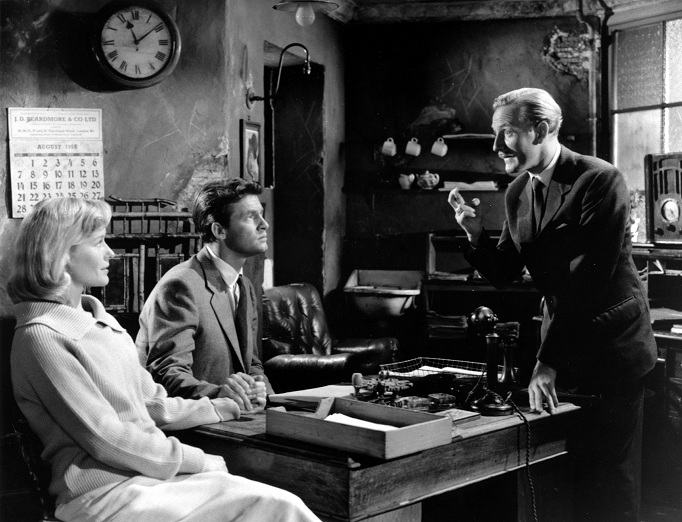
Peter Sellers watching a desert movie
Besides the longevity of the subject matter, the cast is very special, most of them on the verge of international fame! The film is now sold on Peter Sellers, but this is an early, fairly small role for him, his first movie since The Ladykillers. This was an early version of a long line of  'old man' characters he's play, usually in an exaggerated form. Sadly, he plays a character older than the age he managed to reach himself.

Margaret Rutherford was slipping back into character parts away from earlier starring roles (like The Happiest Days of Your Life), but only a few years away from fame as the first big screen Miss Marple, in the popular series of four films. While she usually plays similar characters, she's always good in pathos and comedy.


As the young couple, Bill Travers and Virginia McKenna both already had their own movie careers, but married during this year, 1957. They went on to star together in the smash hits Born Free and Ring of Bright Water. McKenna is also known for her stoic war survivors (Carve Her Name With Pride), though here she's a carefree soul with a penchant for awful puns. Horror fans might have seen her brief but memorable role in Holocaust 2000 (1977). Bill Travers you'll know as the grumpy co-star of the awesome British monster movie Gorgo (1961).

Rounding out the cast are more familiar comedy faces, like Leslie Phillips in a fairly straight role, considering he later played posh ladies' men and lecherous doctors. Bernard Miles as 'Old Tom' gives a humble but touching performance, another in his long career in classic movies.


Director Basil Dearden was one of the directors of ghost stories Dead of Night (1945) and The Halfway House (1944), at the start of a long resume including The League of Gentlemen (1960), Victim (1961) and Khartoum 1966). Director of Photography, Douglas Slocombe, was a veteran of Ealing comedies, but would eventually shoot the original Rollerball and the Raiders of the Lost Ark trilogy!


This Launder & Gilliat comedy is out of print on DVD in the UK, though it was available as a single disc and in a boxset, one of the many called 'The Peter Sellers Collection' (below). 


The US also have it in their equivalent 'Peter Sellers Collection' (reviewed here on DVD Beaver), pictured below.


Most of the above publicity photos are courtesy of Dusashenka and his wonderful Flickr account and are used here with his permission.