Showing posts with label Hong Kong. Show all posts

October 01, 2010

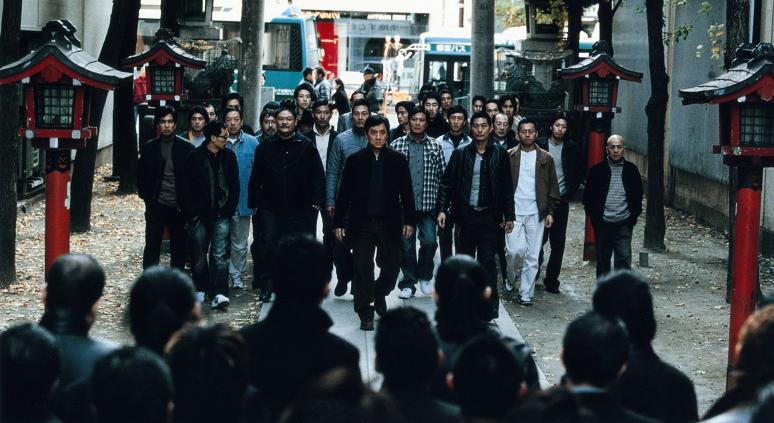
IP MAN (2008) - Donnie Yen vs the Japanese army


IP MAN
(2008, Hong Kong)

When he takes everyone on, feel sorry for the last man standing...

This is a gritty, tense historical drama showcasing spectacular fight scenes. I'm not into the martial arts genre particularly, partly because I need a good story to hang the action on, and I find them repetitive, unless they're exceptionally inventive like Jackie Chan's Hong Kong films.


But the historical setting of Ip Man, in a Chinese town besieged by Japanese troops, is an interesting scenario, with a strong story and a clear range of characters. The fight scenes, staged by Sammo Hung (who doesn't appear) are exceptionally impressive and varied in scale, setting and style.


The publicity for this has really hyped the fact that Ip Man himself, played by Donnie Yen, was a key figure in Bruce Lee's early martial arts training. But the events here take place just before World War II, decades before Ip Man met Lee. The story of their time together may be in the Ip Man sequel, as well as many other Ip Man movies that are have also been and are being made.

But it's the war setting is easily more dramatic than the Bruce Lee connection. While the Japanese are outgunning the Chinese in firepower, martial arts are seen as completely outdated and useless. Though the rival schools of fighting and philosophy, sitting side-by-side in the same quarter of town, are still popular and thriving. But Ip Man, the most accomplished teacher and fighter in town, is refusing to run such a school or even publicly demonstrate his superior skills.


When the Japanese army rolls into town to occupy the province, he's eventually forced to fight publicly, against the Japanese. They're keen to show that their unarmed fighting skills are better the Chinese. But who wants to when they're also holding guns?


This is a well acted and good looking production. While there are a couple of well-known Japanese actors in the cast, the story is heavily anti-Japanese. The short montage to represent the Japanese invasion China is heavy-handed and crassly staged. It underlines that there's a market for anti-Japanese sentiment at the moment, which really shouldn't be fuelled (see the article below). The brief use of CGI airplanes is also unnecessary, unconvincing and spoils the consistent look of the film.


It's a good story, focusing on one man's principles, but it doesn't offer insight into any history of the Japanese invasion (better see City of Life and Death instead) and it takes place decades before Ip Man met Bruce Lee. The DVD extras even spend time qualifying (backtracking) how long he actually taught Lee, or how much of this story has been 'dramatised'. This is an interesting and entertaining film, but I suspect it shouldn't be treated as any sort of documentary.

Director Wilson Yip has come a long way from the low-budget antics of Bio-Zombie (1998) and Donnie Yen gives an impressive and understated performance, a world away from his action hero image.


The UK DVD has some interesting extras about the film and the man, but mainly focusses on the Ip Man's fighting styles. It's also out on Blu-Ray in the US and UK.


Anti-Japanese sentiment seems to be at the core of the script for Ip Man, as argued here on Mister Hobbes.


August 11, 2010

NARAKA 19 (2007) - a deadly game in Chinese hell


NARAKA 19
THE 19th GATE OF HELL
(2007, Hong Kong, Dei yuk dai sup gau tsang)

Basically, if you're ever in Macau, don't order the monkey brains...

I buy movies when I hear that they might be good. Then they go into a big pile (well, on a shelf - it's not a good idea to store DVDs in a pile) and then years later I watch it, wondering where the hell I first heard of it.


A group of teenage college girls move into an apartment together. One of them is obsessed with her mobile phone and starts hanging around the 'Ghost Tower'. Soon afterwards she seemingly commits suicide, leaving her surviving flatmates in therapy with the creepy, limping Dr Yan, and being snooped by the slightly eccentric Police Inspector Yip. Then another girl starts getting eerie messages on her phone, inviting her to play a game called the 18 Gates of Hell...


I went into this Hong Kong horror movie with an open mind, thankful that it treated the genre fairly seriously. Though it's fairly late to be making a mystery which involves mobile phones (One Missed Call), serial curses that can be passed on (Grudge), ghostly girls (Ring) and suicides (Whispering Corridors). But with a young cast in a film aimed at a young teen audience, we are apparently already at a point where filmgoers might not realise these are well-worn horror cliches.


One of the clues that this was just for teens were that the cop, the doctor, the artist, the students, everyone was young and good-looking. If it wasn't for the nasty suicide at the start, there'd be barely a need for a restrictive certificate. The obsession with mobile phones was another clue - here the gadget can even lead you safely through Hell if you follow the red flashing arrows! Presented as a video game, it all seemed ridiculously easy.


I stuck with this because of the portrayals of Chinese Hell. The linking of modern technology directly to Hell reminded me of the Japanese series Hell Girl and I've enjoyed the visualisations of oriental Hell in Jigoku and Narok. In Naraka 19, the inspiration seems to be Constantine, where the weather in Hell was also post-apocalyptic. Some of the effects were very CGI, but the imaginative scale and execution was original, if underused. I particularly liked seeing a airborne forest of trees with their exposed root systems floating in the sky, all while it's raining knives! A couple of the levels of Hell were also realised almost completely with large sets rather than electronic effects. Though it's a pity that they missed out showing many of the 18 levels.


I was distanced from the film by the fast editing and a barrage of video effects to denote that something weird was going on. Holding a camera upside-down is the sort of novelty that should have worn off at the start of the last century. Distracting and hinting at desperation, I'd have preferred the handsome widescreen camerawork (which I think was carefully shot HD video) to do the scaring instead.


A more obvious drawback will be for any fans of Family Guy. Part of the curse depends on a supposedly scary monkey, who even hides in a locker at one point. Besides the parallel with the evil monkey in Chris' cupboard, it's very hard to get a cute little monkey to look scary. The same way horror movies about satanic cats and killer rabbits are a hard sell to animal lovers...

Topped off with some very arbitrary logic about the rules of passing in and out of other dimensions, a similar annoyance to the later Nightmare on Elm Street films - when anything is possible and everything onscreen could be a dream, it's hard to know or care what's happening by the end.

Still, I enjoyed the various trips to Hell, and that Hong Kong is still dabbling in horror. Also interesting that this had a female director, Caroline Lai.


Naraka 19 isn't on DVD in the UK or US. I got this from YesAsia. The Hong Kong DVD (pictured) is a good-looking 2.35 anamorphic widescreen transfer, with unobtrusive removable English subtitles, though a little loosely translated at times. There's also a trailer and a half-hour behind the scenes programme (no subtitles on the extras though).

More frame grabs at Twisted Flicks and another review at Love HK Film.

Here's a subtitled trailer on YouTube...

July 30, 2010

SHINJUKU INCIDENT (2009) - Jackie Chan, hard man

SHINJUKU INCIDENT
(2009, Hong Kong)

Jackie Chan proving he can act up a storm

I love the films that Jackie Chan makes in Hong Kong. The last I saw was his belated 2004 entry into the phenomenal Police Story series. Many of his Chinese action movies are legendary, with life-risking stunts and an inventive mastery of martial arts. His direction and imagination in comedy action has been compared to the work of Buster Keaton, one of the few film-makers who also included the ambitious staging of stuntwork into his stories.

But the other brand of Jackie Chan film is something less than phenomenal. His Hollywood films focus more on his imperfect English and are obsessed with him being Chinese. The restrictions on risky stuntwork in Hollywood, plus his advancing years, have prevented him from doing most of his own stunts, severely restricting his talents.


Thinking about it, the last Hollywood film I saw Jackie Chan in was The Cannonball Run II (1984), during his first attempt to break into the American market. Since then, I’ve not been at all tempted by his English-speaking films, mostly comedy or children’s films.

Even in his recent Hong Kong movies, he’s been doing far fewer stunts and more acting. But in his own country, he has no problem being accepted in more serious roles. This is a more interesting side to his talents, best showcased in the new Shinjuku Incident in which he gives his best performance yet.


A world away from Rush Hour and Shanghai Noon, this is a tough drama about a sensitive subject, illegal Chinese immigrants trying to work in Japan. The film opens with a spectacular image of a shipwreck and a beach swarming with exhausted survivors. A farmer nick-named Steelhead (Chan) makes his way to Tokyo to join his brother (Daniel Wu). He’s left North-East China to try and find his girlfriend.

But as he tries to find work in Japan, he discovers that crime is easier than the dirty work offered to ‘illegals’. Through flashbacks we see his former life in China, which really doesn’t look that bad. The film presents financial gain as the motivation for his friends and family trying their luck in Japan. But this doesn’t fully explain why so many would repeatedly risk their lives just to be able to afford the latest luxury goods? Is the story avoiding telling the truth about why some Chinese ran away from China?


But Jackie isn’t like the others, he’s not in it for the money. The first half of the film tells a convincing story, with Chan giving an excellent and underplayed performance. It’s also fascinating to see him play an ordinary man who doesn’t know how to fight when he gets into a physical confrontation. I thought this was a cleverly played angle for someone so famous for their fighting skills.

The story takes a rather forced turn as his new friends, in this home from home, take on Japanese organised crime! It turns into a faint echo of The Godfather, right down to the brutal violence. It can’t hope to compete with such a classic, though the unusual setting carries it along. There’s more action and cinematic drama in this second half, but it’s rather rushed, with a noticeable leap in the narrative that hints that the film may once have been even longer.


While Steelhead’s motivations were easy to understand early on, his increasingly complex situation makes it much harder for us to sympathise. It’s hard to feel any compassion during his power struggle in the world of organised crime, however noble his reasons.

This is no less believable than many modern thrillers, in that they forfeit logic for intrigue, but the opening story of immigrants in Japan felt interesting enough. I’d have liked to see it played out logically, comparing the quality of life in China with Japan.


The use of Tokyo as a backdrop, and the mix of Japanese and Chinese actors must have been an ambitious undertaking, but it's entirely successful and fascinating to watch.

As a violent gangster tale in an unusual setting, with Jackie Chan showing just what he’s capable of as an actor, this is worth seeing. It's out in the UK on DVD and Blu-Ray from Cine Asia.

Here's a trailer...


May 14, 2010

THE NANKING MASSACRE - two films to remind us


Why do I do this to myself? First I watch two intensely depressing dramatic recreations of war atrocities, intense enough to haunt me for days. Then I decide to review them, challenging my love of Japan with these accounts of atrocious conduct by their armed forces.

In 1937, when Japan was invading China, its armies conquered the (then) capital city of Nanking. The Japanese army then began killing the prisoners of war, then the civilians, to strike a psychological blow to the rest of China. Knowing full well that they were breaking international conventions of war, they disguised the massacre from the rest of the world.

These are two very different films about the siege, serving two audiences: one is obviously intended for 'international cinema', the other (possibly unintentionally) is 'exploitation'.

Though they're tough viewing, knowing that these events actually happened, I wanted to learn more about the depths that the Japanese army sank to. While I admire Japanese culture, pop and otherwise, I've mainly been learning about their history from their viewpoint. But after visiting several of Japan's neighbouring countries and reading their news sites, I became increasingly aware of 'old wounds' and lasting hostilities.

While the US and Europe are hyper-conscious of the history of Nazi Germany, we mainly remember wartime Japan for Pearl Harbor and Hiroshima. In China, Korea, Malaysia and the Philippines, Japan was regarded the same way we saw Germany. Indeed, the scale of Japanese war crimes and the variety of atrocities rivals Nazi Germany.

So I'm having trouble joining the dots between their peace-loving society of today and the extremes of their wartime mindset. How can a country change so quickly and so completely? I guess the answer is closer to home - my own country has much to answer for in it's conduct abroad, both recently and historically.

I'm not going to boycott Japanese culture for the crimes of the past, but I'm not going to ignore history either. When I first heard of the 'Rape of Nanking', I naively assumed it happened centuries ago in more barbaric times. To find that it was only last century showed up a large gap in my historical knowledge.


BLACK SUN: THE NANKING MASSACRE,
MEN BEHIND THE SUN 4
(1994, Hong Kong, Hei tai yang: Nan Jing da tu sha)


Relentless gory propaganda

This is a weird film that would need much more research to determine what the film-makers were trying to do, if I was at all impressed by it. The director, T F Mou, denies it's an exploitation film, and the size of the budget seems to lift the project out of that genre. But it's an endless diary of gory re-enactments of war atrocities, with little story or drama, and a near absence of continuing characters. The Japanese soldiers storm around the city, killing and raping. The commanders take pleasure in trying out various methods of execution, from machine-gun to samurai sword.

It looks like a wartime propaganda film, but it was made 1994. I'm almost guessing it was intended to pressure the Japanese government on outstanding issues - maybe compensation, apologies, selective history books? The other likely result was to incite outrage amongst Chinese audiences.

Compare this blunt approach to any modern American movie about the Nazis. One moment in Black Sun made me remember a silent movie where Eric Von Stroheim throws a baby out of a high window. The scene looked comical: a swift but lazy cinematic shorthand to make you hate the character in seconds, and tell you what to think about all German commanders.

While City of Life and Death shows only one Japanese leader orchestrating the destruction of the city, Black Sun takes pains to name and shame many different commanders and their personal roles in the killing. This is perhaps another clue to the movie's intentions.

After a while, the many shock moments reminded me of the climax to Soldier Blue, but in contrast with it's involving characters, storyline and complex portrayal of the invaders as well as the invaded (Soldier Blue himself is shocked by his own sides' misconduct). The Japanese soldiers of Black Sun are portrayed with a uniform hive mentality. It also doesn't help that the Japanese soldiers all look very Chinese. Only the commanders look as if they're played by Japanese actors. Lazily and inaccurately, the soldiers of both sides talk in Chinese.

I expected this to be far more cheaply made than it is. It looks largely authentic, uses a lot of extras and some extensive locations. The most spectacular scene illustrates how the Japanese burned the bodies of civilians before dumping them in the river. They could then claim that they'd only killed soldiers. The scale of the fire of hundreds of bodies along a riverbank rivals the inferno at the end of Apocalypse Now.

But if there's any doubt that what we're being shown happened, the catalogue of atrocities is verified onscreen, by cross-cutting with actual photographs and filmed footage. The power and importance of these images was not lost on the Japanese army who made every effort to destroy any incriminating material that left Nanking at the time, and they burnt any such evidence of their own when the war was lost.

There's no doubt that all this and worse actually happened, but without any emotional involvement and a clumsy, one-sided approach, it's a far less powerful and informative film than it should have been.

I watched the US region 1 DVD, which fills in much of the historical context with an informative old documentary episode of Frank Capra's Why We Fight as a DVD extra.


In the UK, it's purely been sold as exploitation, check out the crass DVD cover, which somehow borders on comedy, using a poorly staged publicity shot of one of the film's most infamous scenes. Contrast that with the US DVD cover that uses an actual archive photograph.

This is actually the fourth in a series of films, called Men Behind the Sun, which I won't be investigating any further. The first film in the series has an important subject, the horrifying human experiments of Camp 731, but the inclusion of animal cruelty and mondo footage (using an actual corpse for one scene) means I'll avoid it. However, the story of Camp 731 has one hell of conspiracy storyline and I'd like to learn more about it.

Black Sun is a bizarre experience - as it abandons so many movie conventions - that it's fairly silly to compare it to the professionally and artfully produced City of Life and Death. But I have.


CITY OF LIFE AND DEATH
(2009, China/Hong Kong, Nanjing! Nanjing!)

An involving man-made disaster

This major new film, shot in black and white, is still being premiered round the world. It's also about the Nanking during the Japanese siege.

While Black Sun throws out plenty of factual context in captions and voiceovers, this has no such introduction and relies on small badly-written postcards to set up a little historical background. Black Sun also portrayed the Chinese, soldiers and civilians alike, as totally defeated. This begins with the army still defending itself, albeit with guerrilla tactics. It also sets up storylines with soldiers from both armies, one Japanese soldier being just as traumatised.


The success of the film is the emotional involvement with the characters, focussing on the family of the Chinese translator to John Rabe - a German envoy famous for his attempts to protect the civilians against impossible odds.

Unlike Black Sun, if anyone gets hurt, raped, slaughtered, the impact is devastating. There's a dreadful scene that's basically a point of view experience of being herded into a mass slaughter.


After the threat of counterforce has been systematically eradicated, the invading army are rewarded with 'comfort women', Japanese prostitutes rationed out to the soldiers. But as the siege wears on, the supply of women starts taking Chinese 'volunteers'. The widescale use of civilian women for sex lends an awful, literal meaning to 'the rape of Nanking'.

While the Japanese use of unnecessary force was meant to terrify the rest of China, it instead unified the regions of the massive country into an unbeatable foe.

The inclusion of a sympathetic portrayal of a Japanese soldier has drawn criticism from Chinese critics, complaining that the tone of the film wasn't harsh enough on the Japanese. Perhaps they would have preferred a less-sensitive, less balanced film, like Black Sun perhaps?


I'd recommend City of Life and Death as a beautifully made and observed film on a harrowing subject.

It had a limited cinema release in the UK and there'll be a DVD and Blu-Ray release in August. I watched a Chinese DVD, which may be slightly censored (missing some violence). The subtitles didn't translate all the onscreen signs and nameplates.

The excellent WildGrounds site has an article comparing City of Life and Death to actual (and upsetting) photos from the siege.


April 13, 2010

THE BRIDE FROM HELL (1972) - Hong Kong horror before Tsui Hark


THE BRIDE FROM HELL
(1972, Hong Kong, Gui xin niang)

Useful tips to dissolve a dead marriage...

Had to buy this on the strength of the title alone. Wasn't expecting much and therefore wasn't disappointed. It's a spooky tale of revenge by a ghost with a grudge. No martial art swordplay, not many special effects, but a creepy tale treated seriously for the most part, like the older traditional Chinese ghost films (like Enchanting Shadow), and not the slapstick kung-fu that Hong Kong horrors soon developed into.

Our travelling hero, Yun Peng (Yang Fan) finds a house in the forest and wants to plead with the beautiful owner, Feng Anu (Margaret Hsing Hui), to let him rest for the night. Catching her by surprise lying naked on her bed (a shot missing from this Thai version) he does the chivalrous thing and offers to marry her, to protect her honour. But marriage means he's now trapped by a vengeful spirit. As those around her begin to suspect, she reveals a variety of powers to match those of the demon-catchers sent to exorcise her, while she targets her victims...

It's out of step with contemporary Hammer horrors, and decades behind Tsui Hark's revitalised supernatural stories that began in 1979 with The Butterfly Murders. But I enjoyed the serious approach and the many and various ways the Taoist master has up his sleeve to combat ghosts and demons. Though running around ringing a bell isn't quite as thrilling as seeing a vampire hunter wielding a stake.


The film opens with a solitary greenlit coffin in a swamp from which emerges a shrouded female ghost. All very Ringy, so I was disappointed that the battle to vanquish her didn't return to this spooky spot. But it resembled the 1960s Japanese ghost stories, without the elegant special effects and is useful to compare this with them.

It's seriously let down by the tiny modelwork and heavy reliance on jump cuts, without the camera even being locked off. The only successful visual effects are some very large-scale props. But the acting, the widescreen colour photography and production values make it very watchable.

I could only find a VCD of this when shopping in Malaysia - it's non-anamorphic and has the Chinese, Thai and English subtitles all in view throughout. But there's also a DVD edition
available from YesAsia, thankfully with a 2.35 anamorphic image.

This article on YesAsia has been a great help as a guide to other genre movies from the Shaw Brothers production team.

May 26, 2009

THE MOST DANGEROUS MAN IN THE WORLD (1969) - Gregory Peck meets THE CHAIRMAN


THE CHAIRMAN
a.k.a. THE MOST DANGEROUS MAN IN THE WORLD
(1969, USA)

First saw this when it was first released in England, under the title The Most Dangerous Man In The World. As a pre-teen, I wasn't interested in talky spy-thrillers, but the countdown clock climax and Jerry Goldsmith's soundtrack made an impression. I thought that the film had disappeared, only recently aware of the original US title change.


Gregory Peck (Moby Dick, Arabesque, The Omen) plays Hathaway, a scientist sent to China on a secret mission. He's to get hold of a formula that could allow the growth of food in inhospitable climates. As an expert in the field, and able to read Chinese, he travels there under the pretence of seeing a former colleague (Keye Luke).

As he says goodbye to his girlfriend (Anne Heywood), there's a sense that he won't be coming back. He has a one-way radio transmitter implanted in his skull to send any information back undetected, not realising that military intelligence have packed the device with explosive, in case they need to prevent him from talking.

Travelling through Hong Kong then China, to his friend's laboratory, Chairman Mao himself asks to meet him, and suddenly America has the opportunity to eliminate the communist leader with the oblivious walking bomb...


This is an intelligent, if gimmicky, spy thriller, with the suspense ramped up by frantic cross-cutting between Peck and his eavesdroppers, with their collective finger on the button.

Seeing it in 2.35 widescreen for the first time in 40 years, it still has much to offer. With China once again at the forefront of the world's economic stage, and the current threat of an insular Communist leader in North Korea, this story could almost play unchanged today.


I was impressed by the extent of the location filming. While the interiors and a huge compound were built at Pinewood Studios in London, there are some great scenes in 1960s' Hong Kong. I couldn't say for sure whether anything was actually shot in China. It would have been rare to film there at the time, though I've heard actress Zienia Merton talking about when she visited with Gregory Peck, and had to leave in a hurry when the Chinese heard about script being about assassinating their beloved leader!

The scenes of the huge temple and paddy fields could easily have been shot around Hong Kong. While the climax was apparently shot in the Welsh mountains of Snowdonia.


I always thought of this as shot in the US, but recognising many British actors throughout. Burt Kwouk, Mai Ling, Zienia Merton (a regular on Space 1999) plus Oli Levy (the same year he was in Moon Zero Two) again playing a Russian. The only American actors that needed to be ferried over are Gregory Peck, Keye Luke and Arthur Hiller (The Andromeda Strain, Futureworld). Director J. Lee Thompson (Happy Birthday To Me, Conquest of the Planet of the Apes) wrings as much excitement out of the story as possible.

Even now, I'm unsure if The Most Dangerous Man In The World is supposed to refer to Gregory Peck's character, or Mao Tse Tung...


The DVD (artwork at top) is presented 2.35 anamorphic widescreen. There is a commentary track, two alternate scenes with extra nudity, some trailers and a 'mini-movie' of alternate takes. The trailer and the nude scenes are the most interesting items.

Talking of nude scenes, actress Zienia Merton is still in the acting game, and has recently written her autobiography, available from her website.

The title sequence is on YouTube, a powerful photo-montage of communist China as was...


May 06, 2009

ENCHANTING SHADOW (1960) - inspiring A CHINESE GHOST STORY


ENCHANTING SHADOW
(1960, Hong Kong, Ching nu yu hun)

A beautiful film which inspired the internationally famous A Chinese Ghost Story (1987), which in turn revitalised the flying swords genre, as well as many more Hong Kong ghost stories. Recently restored on DVD, the 1960 Shaw Brothers version holds up as a favourable alternative to the better known Tsui Hark remake.

Based on the same source as A Chinese Ghost Story (Strange Tales from a Chinese Studio by Pu Songling, written in the 17th century) it has the same basic structure of a rent collector who can't find a place to stay in a small town, resorting to staying in a deserted temple that the locals say is haunted.


Exploring the grounds, he meets an attractive young woman in the splendid back garden, where she lives with her aunts and grandma. While she is initially annoyed at his nosiness, she starts to fall for the handsome young man. But courting has many strict rules and when she gets too amorous, he's in danger of getting into deep trouble with her family. Worse than that, there's a horrible murder at the temple, and a body has been drained of blood...

Shot completely in a studio, this early example of colour film from Hong Kong rivals its remake. It's a far more sedate version, but is as typical of the early 1960s as A Chinese Ghost Story is of the late 1980s. The characters, the lush sets and costumes, and especially the story are it's strength. There's almost no fighting and a restrained use of special effects, just enough to serve the story, but with enough shock value.


The remake now almost looks more dated, with fast cutting, wide-angle swish pans, OTT wirework, saturated blue lighting and backlit smoke. The special effects have aged too - the skeletons make Army of Darkness look good. Don't get me wrong, it's still a great martial arts comedy, with inventive routines as good as classic Jackie Chan, and the cast look perfect, Leslie Cheung almost as beautiful as Joey Wang...

But if it's a more serious ghost story you want, I'd certainly recommend Enchanting Shadow. It has a relatively slow start, but I was impressed at how gripping it became. It appears to have been influenced by Hammer Horror, that made an international impression at the end of the 1950s, enough to film in Eastman colour and use startling blood and make-up effects.


There's a short documentary about the director Li Hanxiang included on the DVD (pictured at top), thankfully with English subtitles. As well as a trailer, which is so scratchy and faded, it's a reminder of how miraculous the restoration has been of this fifty-year old movie. The packaging states the film is 2.35 widescreen, but after watching it, that must be a typo. It's presented 4:3, which looks correct.

There's another favourable review of Enchanting Shadow here on Illuminated Lantern, and the DVD is available at HK Flix here.


Meanwhile, there are now remastered editions of all three Chinese Ghost Story films, like this Hong Kong DVD boxset available at YesAsia. Tsui Hark also remade the first film as an animation, and 24framespersecond has news that a live-action remake is now in the works.

March 22, 2009

Malaysian DVD stores - gateways to Asian cinema


Before I forget, here’s a little about Malaysian DVDs – releasing movies from all over South East Asia. Plus a few locations of DVD stores that I descended on during a brief stay in Kuala Lumpur, if you should ever be passing through.

Malaysia lies on the peninsula between Thailand and Singapore, as well as owning a northern chunk of the island of Borneo. It was a different experience to Thailand, Malaysia is a very different mix of peoples and religions. While Thailand is predominantly Buddhist, Malaysia is largely Islamic, with Indian and Chinese temples sitting alongside mosques and Christian churches.

There are relatively few Malaysian movies, while Hollywood product and American franchised TV dominate the multiplexes and toy stores. But the larger DVD shops also has extensive selections from China (i.e. Hong Kong), as well as India, South Korea, Japan, Thailand, Indonesia and the Philippines. This makes Malaysia a great place to find a huge variety of movies from most of Asia.

Shelves of TV Boxsets are dominated by Japanese TV series and anime, and Malaysia releases English-subtitled DVDs that even Hong Kong hasn’t got. It’s a rare chance to get subtitled DVDs of practically every major Japanese TV series, like the live-action Hell Girl. Multiple releases can be due to Hong Kong versions being stocked as well as Malaysian, and also because some of them might be bootlegged.

The widest selection of Asian DVDs that I found, was at Classic World Entertainment, on the 3rd floor of the Times Square mall (nearest monorail stop: Imbi). The sign over the store simply says ‘Classic’. Here there were Hong Kong, Korean, Japanese, Indonesian, Indian and Malaysian horror films, plus a large section of anime.

Elsewhere in the Times Square mall were several stores devoted to Japanese anime figures and model kits – two can be found next to the indoor rollercoaster! I was pleased to find plenty of Ultraman and Masked Rider stuff in most of the toy stores too.

For anime fans, there's an even larger selection of DVDs in Kuala Lumpur’s Chinatown, which has two stores of Hiro Comic World on neighbouring streets. They also have a branch on the 3rd floor of the amusingly-named S&M shopping arcade.


The Video Ezy chain offer a more limited choice, with more Hollywood product, but were easier to find, like in the Times Square mall, and in the KLLC mall at the base of the Petronas Towers (pictured). I also visited the large DVD section upstairs in the Sogo department store, which had a generous Japanese TV selection.

Like I said, not all of Malaysia’s DVD releases appear to be official, no matter how official-looking the packaging is. The cover details aren't always accurate about languages and aspect ratios. The quality of the English subtitling is fairly stilted, like the Hong Kong releases, but sometimes much worse - misspelled, mistimed and loosely paraphrased. I've persevered with awful subtitles in the past, with their challenges of lateral thinking, because there's been no alternative available anywhere else.

Like Thailand, be careful as the latest films are also released on the VCD (VideoCD) format – these play in DVD players, but are much more compressed (worse picture quality) and the subtitles are burnt-in (not optional). If the film is on two-discs (VCDs only hold one hour of video), check whether there’s a VCD symbol instead of a DVD one. The artwork for VCD releases can be different from the DVD.


So, huge choice, but varying quality of product and English translation. It’s still a good way to pick through many weird and wonderful films that may never appear in the west.


Until now, the only online Malaysian websites I’ve used is Zoom Movie, which doesn't list many details about the DVDs, like the languages. Also, MovieXclusive from Singapore offers similar titles. Both sites offer releases that won't be found on the major Asian DVD suppliers like YesAsia.


May 22, 2008

THE EYE 3 (2005) - the third Eye is the weakest


THE EYE 10
THE EYE INFINITY
THE EYE 3

(2005, Hong Kong/Thailand, Gin Gwai 10)

How many second sequels can you name that are better than the first?

I love The Eye (2002) and was surprised at how good The Eye 2 (2004) was. Now I'm surprised at how bad The Eye 3 is - an unfunny comedy-horror from the Pang Brothers (who directed the first two films) is sneaking around under several titles, usually as The Eye 10 and The Eye Infinity, and is finally being released on DVD in the USA, under the more accurate title The Eye 3.


So beware – the cover art may look like a horror film, but it’s really trying hard to get laughs, with the directors aiming to spoofing their own films. They only get it half right – some of the scares work, but the humour doesn’t. For instance, the opening scene of a Buddhist exorcism. Inside a circle of monks, a young girl begins to levitate and act like a Linda Blair possessed. Her tongue begins to loll out of her mouth… But they take it a step too far and have the tongue slap the monks around, Three Stooges style! The scene was working fine until the gags crept in. Guess they haven’t seen Repossessed.

Another problem with the film is its completely disjointed nature, with a far less focussed plot than the first two films. Four friends on holiday in Thailand are telling ghost stories, and their Thai friend convinces them there are actually 10 ways to see real ghosts. The first two ways having been explored in the first two films - “yeah, we heard about them”.


As they work their way through the next 8 ways, there’s an uneven cross between Thai horror and broad Chinese comedy. The film works in places, like one scene when they are sitting in a deserted street at night trying to lure ghosts out with food.

But rather than a series of spoofs, this looks more like leftover, under-developed ideas. There’s also a constant assumption that seeing ghosts means danger. Surely, the ghosts are around all the time – they are only in trouble if the ghosts have a motive to do the characters harm.

By far, the worst scene is when a possessed human gets mistaken for a body-popper by two B-boys, who then try and engage in a challenge dance. No, no, no.


The cinematography is colourful, moody and predictably green for ghostly scenes. But unlike The Eye 2 where the editing was calm, the cutting style here is fast and random. The special effects start off well with some ghastly make-up effects, but then there’s an over-reliance on an easy electronic ripple effect over many of the ghosts – obscuring their features.

The whole mess certainly explains why there haven’t been any more Eye sequels since…


The Eye 3 is getting released in the US at the end of June, with that misleadingly scary cover… It’s already out in the UK and around Europe.


- - - - - - -

February 20, 2008

THE EYE 2 (2004) a solid sequel from the Pang Brothers


THE EYE 2
(2004, Hong Kong/Thailand)

The Eye 2 has renewed my interest in the Pang Brothers. After really enjoying The Eye (2002), I cooled off after seeing their Bangkok Haunted and The Tesseract, both of which failed to grip my attention.

The Eye 2 succeeds as a well-conceived sequel, faithful to the premise of the original, without copying it. There’s a new set of characters and a whole new haunting.


Reversing the locations of the first film, the story starts in Bangkok as Joey (Shu Qi) tries some shopping therapy to get over a messy break-up. After her ex refuses her phone calls, she attempts suicide. Her near-death experience activates her ability to see ghosts…


As she returns to Hong Kong she discovers she’s not only pregnant, but haunted. When she's trapped in a hospital lift, a terrifying incident convinces her that a ghost is trying to kill her unborn baby.

This could be the worst film to watch if you’re expecting a new baby. Shu Qi gives a sustained and emotional performance, spending much of the story terrified that she’s going to lose her baby. It’s difficult not to sympathise with her enduring this gruelling ordeal, despite some revelations about her character.


The haunting scenes are imaginatively shot and cleverly conceived. Though I didn’t find as many scares as creepy as the first film, there are some powerful and grisly shocks. The only real mis-step in the story was when a rapist attacks her, the character looked more like a sitcom geek. The next scene didn’t work for me, as he appeared again covered in comedy bandages.

Considering that the Pang Brothers former careers were in grading (tweaking the colours of film for continuity and a stylised look) and editing, they avoided the trend for flashy editing and surreal grading.

Oxide and Danny Pang are currently in the US, directing a remake (is that called re-directing?) of Bangkok Dangerous, starring Nicolas Cage. Perhaps they found time to go see Jessica Alba in The Eye remake that's just been released.

Meanwhile, I’ve got to catch up on their Ab-Normal Beauty, Omen and Eye Infinity, the third of the original Eye films.


The Eye 2 is on DVD in the US and UK, though I watched the Hong Kong disc which has DTS sound and an alternative ending.


- - - - - - -

September 22, 2007

THE MATRIMONY (2007) a Chinese ghost story... from China!


THE MATRIMONY
(2007, China, IMDB: Xin zhong you gui)


Region 3 NTSC DVD (Mei Ah Entertainment)

It’s a little late to bring out a ghost story this simple, but China hasn’t actually seen many. The government simply hasn’t allowed any supernatural storylines in movies, and this one has possibly only been made because of the period setting. Still, even for Hong Kong, serious ghost stories are rare – and this isn’t played for laughs. While it doesn’t provide any particularly new scares, it’s still a beautifully made film.

The Matrimony also has the kind of budget only lavished on films destined for international success. The huge period sets recreating Shanghai in the 1930's are convincingly done. The opening scenes, that set up the tragic love affair, are only marred by a very poor computer-generated road accident. The CGI effects throughout the rest of the story are used more subtly and effectively.

The opening titles, indeed the first half hour of the film, lays on spooky atmosphere and loud shock moments so thickly that it detracts from the flow of the story. Junchu (Leon Lai), loses his sweetheart in a car accident and is forced into an arranged marriage with Sansan (Rene Liu), a woman he simply doesn’t love. But will he change his mind if the ghost of his sweetheart, Manli (Fan Bingbing), possesses the body of his wife?


Basically, this is a love triangle, with strong performances from the three leads. There’s even a heavy nod to Hitchcock’s Rebecca (1940), as a spooky housekeeper prevents Sansan from entering a locked room in Junchu’s huge mansion.

It reminded me more of Stanley Kwan’s Rouge (1987), a similarly unrequited love story which preferred to tone down the supernatural element and played successfully as a drama. Again, the ghost was very beautiful (Anita Mui), but the setting was modern day, with flashbacks to the 1930’s. Rouge works so well because it treats the ghost as a character rather than a scary monster.


I will watch The Matrimony again in the future, for the lavishly recreated sets, the colourful cinematography, and the cast, but not for the scares.

The Hong Kong no frills DVD release has good English subs, an anamorphic widescreen picture, and an optional DTS audio track.


UPDATE - also out now on region 1 DVD in the US.


- - - - - - -