Showing posts with label space. Show all posts

August 25, 2011

THE BLACK HOLE (1979) expanded soundtrack debuts on CD


Intrada are about to release a special edition of the late John Barry's soundtrack to the outer space adventure The Black Hole (1979). Remastered from the original master tapes, this also promises to be the entire score, adding an extra twenty minutes of unreleased music. This is also the score's official debut on CD, see Soundtrack Collector for details.

Music samples, more details and CD ordering information on Intrada's website here.


I only wrote about John Barry's music for outer space a few weeks ago, a recurring and favourite theme of mine in all his work. The score for The Black Hole is some of John Barry's best work, regardless of what you think of the movie. Personally, the music has helped transport me into the dark, futuristic adventure. It's fun to see Disney taking some risks, killing off characters (that aren't parents) and even getting metaphysical...

My full review of The Black Hole is here.

Hopefully someone will remaster the movie soon. It looks very poor on "Disney DVD"...

(The above Japanese poster was teleported from the supreme sci-fi nostalgists' blog... Space: 1970.)


July 31, 2011

John Barry's soundtracks - atmosphere for outer space


My life in space with the music of John Barry

I've regularly listened to John Barry's soundtracks for many years, but when I'd heard he'd died, on January 30th, I stopped listening to his music. The news was a shock, out of the blue. I didn't want to be reminded that there'd be no more of the music I've grown up with. It's taken a few months for me to start again and I just wanted to talk a little about my very favourite of his tracks.

He scored outer space like no-one else. Previous sci-fi movies set in space famously used classical music (2001: A Space Odyssey) or electronic atmospherics (Forbidden Planet), but John Barry's take was more about awe, mystery and trepidation, retaining the danger of humanity living outside the atmosphere.


As long as I can remember going to the cinema, we're talking mid-1960s, I remembered his music. My Mum took me to see a re-release of You Only Live Twice (1967) in 1968. At the start of the story, a US space rocket is followed by another. The surprise of it opening up, then swallowing the other, never left me. The track 'Capsule In Space' describes danger approaching during a space walk. The score accompanies the action perfectly, but also works as a stand-alone piece. The experience in the cinema was enough to put me off space travel, the same way Jaws put me off swimming in the sea.


I was then old enough to see Bond films in the cinema during their first run. I especially loved the exciting music to the ski chases in On Her Majesty's Secret Service (1969). So much so that I'd concentrate on carrying the music away with me in my head. I did this for years until I could afford or find the soundtracks.


I was delighted there was another scene set in space in Diamonds Are Forever(1971), during the launch of a killer satellite. After several stage separations, the beautiful weapon deploys, then begins picking off targets around the world. The tempo of the space march '007 and Counting' matches its graceful motion, alternated with the horrendous power it unleashes.

The theme tune to Diamonds Are Forever really imprinted on me. The impact of Barry's James Bond theme songs were combined in the cinema with the most lavish, widescreen 'pop videos'. Tom Jones, Nancy Sinatra and Shirley Bassey singing top ten hits with huge, naked, pop art visuals by Maurice Binder. The music and the images were also associated with the anticipation of two hours of the most exciting films of the time. For many years after their release, Bond movies weren't seen outside of cinemas, being continually re-released until TV eventually paid huge sums to show them, Dr No (1962) wasn't shown on TV in the UK until 1975. I had the chance to see each one several times in the cinema - the music was part of the attraction of seeing them again.


The soundtracks never stayed in circulation on vinyl for very long. If you were lucky, they'd maybe appear when a new format, like music cassettes, were introduced. The search for the albums missing from my paltry collection kept me hunting through record shops looking for secondhand records or cassettes. For many years, this James Bond Collection double-album (above) was the only Bond music to be reissued. A life-saving compilation of cues from the original soundtracks, at a time when there were dozens of weedy soundalike albums. Geoff Love cover versions weren't a sufficient alternative to the real deal.
I'd even record my favourite sections off the TV, when no soundtrack was available. I waited decades for many missing cues to finally appear when the expanded James Bond soundtracks were released in 2003.


But meanwhile, John Barry made more space music. After Star Wars (1977)became a big box office hit, he composed for three more outer space movies, around 1979. But he remained true to his earlier approach of danger and mystery.


Moonraker put James Bond in his very own Space Shuttle. 'Flight Into Space' describes the tension of the launch in the familiar march motif. Again Barry describes the wonder of being in space and the surprises revealed out there.

Another track 'Space Lazer Battle' anticipated some of the aural effects he'd use in The Black Hole. The scene of astronauts fighting in zero gravity is far more convincingly done than the one in The Green Slime. While Moonraker is far from the best Bond movie, I've enjoyed the soundtrack literally hundred of times.


The main title to The Black Hole (1979) makes it sound almost like a sea-going adventure. Again there's a foreboding tone accenting the hazards, particularly from the black hole itself. This time, the whole album accompanies deep space. Barry's music has to carry the entire climax of the film with the track 'Into The Hole', using increasingly mysterioso effects.


Lastly, I'll even mention Starcrash (1978). John Barry sometimes scored movies he later regretted. It may be embarrassingly (though enjoyably) awful, but tracks like 'Launch Adrift' are particularly beautiful. While the album isn't as consistent as the other two, it's still John Barry in his prime.

Among his many soundtracks, I notice a few tracks that seem out of step with the rest of the score - otherworldly moments reminding me of his 'space music'. In Beat Girl (1960) the track '2000 AD', in Midnight Cowboy (1969) there's 'Science Fiction'. In the superb score to King Kong (1976), the haunting 'Full Moon Domain'. And in Dances With Wolves (1990), 'Stands With A Fist remembers'.

Barry's last non-soundtrack albums The Beyondness of Things (1999) and Eternal Echoes (2001) continued with echoes of the lost 'wild' west from Dances With Wolves. In both, there's a sense that he's summing up his life and saying farewell. But I had no idea that it was going to be so soon.


Of course there's much more to his music, and no matter what you think of the movies, here are my favourite John Barry soundtracks to recommend to you:


Some exceptional James Bond soundtracks I haven't mentioned, From Russia with Love (1963), Goldfinger (1964), Thunderball (1965) and The Living Daylights (1987). They set high standards for how to make action even more exciting.
  
The Ipcress File (1965) accompanied the low-key flipside of spying in the Cold War. This soundtrack propelled Barry into the A-list of soundtrack composers.


Deadfall (1968) woke me up to his being superb music, not just a backing track. The fourteen minute 'Romance for Guitar and Orchestra' at the heart of Deadfall is one of Barry's greatest achievements. Working with director Bryan Forbes, the track had to be woven into the film, being performed in front of the camera, as well as scoring the action of the robbery scene that intercuts with the concert hall footage.

Alice's Adventures In Wonderland (1972) is a rare musical from Barry. With songs as beautiful as they are strange.

King Kong (1976) is one of his very best scores, again to be enjoyed many more times than the movie.


My playlists of his music are made up of my very favourite tracks, cherry-picked from his albums. In all, they're still over 14 hours long. Some of it represents forty years of listening... and counting.
April 23, 2011

CAPRICORN ONE (1978) - faking a space mission

CAPRICORN ONE
(1978, USA)

What was intended as a satirical thriller has now fuelled conspiracy theorists' claim that the Moon landings were staged for the cameras. At the time Capricorn One was released, this was a wry and cheeky premise. That anyone now believes those incredible achievements were all a fake is more incredible than the Moon missions themselves.


Three astronauts are about to take off for a mission to Mars when the project leader hauls them out of the command capsule and whisks them away to a secret location. The life support system is faulty and the project has no hope of being successful. Unless the astronauts all agree to fake the broadcasts from a mock-up capsule and a huge studio set of the Mars planet surface...


The central premise of a large-scale cover-up is played deadly seriously, but the sub-plot of an investigative journalist (Elliott Gould) who smells a rat is mostly played for laughs. There's also enough action here to please a mainstream audience.


While the faking of an entire space mission fails to be convincing, (there are simply too many loopholes), what remains chilling are the lengths the government will go to in hushing it all up. Everyone is expendable. The inspired use of two impersonal helicopters, seemingly communicating like airborne robots, symbolises a military organisation with a mission to eradicate all remaining clues. One character completely disappears with a believable, elaborate cover-up to replace any memories that he ever lived in his apartment.


Having grown up with the Moon missions live on TV, the idea of it all being faked is a non-starter for me. As a family, we visited Cape Kennedy (as it was called in 1973) and again, renamed as Cape Canaveral, in 1978 (ironically on the same holiday I first saw Capricorn One in a Miami theater). I remember the scene in the film, a long trackback that revealed the surface of Mars as a movie set, getting laughs in the cinema. It's a neat idea for a conspiracy thriller and a welcome change from the Kennedy-assassination plots, but even back then it was ludicrous.


While a silly runaway car stunt now fails to excite, mainly due to the amount of sped-up footage, the high speed aerial chase is one of the best there is. A dizzying helicopter pursuit, brilliantly photographed with superb stunt-flying. In the cinema you could easily feel airsick as the aircraft dive over the edges of the canyons. Jerry Goldsmith's pounding score is one of my favourite movie soundtracks. His music easily makes the action twice as dramatic.


I was wary of characters played by Hal Holbrook after this film. Here he's a bare-faced liar who still wants to be your friend and, dammit, I trusted him.


James Brolin, back when he headlined movies (Westworld, The Car, The Amityville Horror), is great - he looks like an astronaut. But so do Sam Waterston  and O.J. Simpson. The cast is almost too good, Karen Black and Telly Savalas deserve bigger roles than very funny cameos. Brenda Vaccaro (Death Weekend, Airport '77) is excellent as an astronaut's wife being kept in the dark, giving even her quietest scenes an edge.


I thought I'd be in safe hands with director Peter Hyams after this film and Outland (1981), but his subsequent thrillers and sci-fis have disappointed, though I know The Relic, End Of Days and Timecop have their fans. I remember enjoying the Sean Connery thriller The Presidio and I'm going to give the 2001: A Space Odyssey sequel, 2010, another look.

Capricorn One should be one of those solidly entertaining movies that's always in print. But it's 1998 DVD incarnation (pictured) showed desperate need for remastering - a distracting amount of much film weave and neg faults, too tightly cropped on all sides. The recent UK blu-ray look much the same as the 1998 release, with a careless amount of compression faults presumably being triggered by an old film-to-tape transfer. At least the blu-ray is anamorphic widescreen, but it's not even a good enough transfer for a DVD.

Hopefully the US Special Edition DVD of 2008 looks better. Which would make it a quadruple dip for me...

Snappy TV trailer here on YouTube - no spoilers (note that the film is actually 2.35 widescreen)...

March 15, 2011

OUTLAND (1981) - almost in the ALIEN universe


OUTLAND
(1981, UK)

After Zardoz and Meteor, Sean Connery made a good sci-fi film...

The year before sci-fi cinema started ripping off either Blade Runner or Mad Max 2, Alien was the strongest influence on outer space action for older audiences. Humanoids From The Deep, Alien Contamination, Galaxy of Terror, Titan Find all tried to cash in before the official Alien sequel in 1986. In the meantime, Outland (1981) duplicated so many elements from Alien that it could easily be mistaken for a spin-off. It was also serious sci-fi from the Alan Ladd company just before they produced Blade Runner.

Outland looks and sounds like Alien. But it's less of a cash-in than a concerted attempt to fit in with the Alien universe of the fairly near future, and matches the high production values. Extensive large-scale modelwork represents the mine and gigantic spacecraft. Functional, claustrophobic interior sets with huge chunky airlock doors add to the realism. Plus an unsettling soundtrack by Jerry Goldsmith.


A gigantic titanium mine on Io, a moon of Jupiter. O'Niel (Sean Connery) is the new sheriff in town, each tour of duty lasts a year. Two deaths coincide with his arrival and catch his interest. All witnesses say the miners killed themselves, so the mine supervisor (Peter Boyle) isn't happy when O'Niel decides to investigate further. He's only just arrived and has no friends or allies. If he causes any trouble, he'll have even fewer...

I'd recommend Outland to anyone who's overdosed on Alien sequels but still wants more. Like Alien and Aliens, this was shot in Britain, all filmed on studio soundstages. There's a mostly British and American cast, with a feisty female character to remind us of Ripley. Maybe it is Ripley, or her daughter.


When I first saw this on release, I was hoping that there would be a monster somewhere in the mining complex. The trailer and publicity had teased some mysterious, messy death scenes with exploding heads. So, I was hoping for an alien cause...

Outland is a good thriller with solid characters and a great cast, but not solid sci-fi. The confined sets are convincing, but even a slim knowledge of science could spoil it for you. As always, there's no attempt to portray the (one-sixth) gravity until the characters are in a depressurised zone. And who in their right mind uses shotguns in outer space?


Peter Hyams directed this between Capricorn One and the 2001: A Space Odyssey sequel 2010. It's far and away better than his more recent sci-fi offerings like Timecop and, gulp, A Sound of Thunder...


Sean Connery had missed out on a trip into space as James Bond in You Only Live Twice, and this is the only other time you'll see him in a spacesuit. He's excellent here, and the script, dialogue and supporting cast keeps it all dramatically strong. He shares the best scenes with a wry Frances Sternhagen (Communion, Misery), playing an incurably cynical, overworked doctor. I thought she looked old in this, so I was surprised to see her again in The Mist 26 years later.


Always a treat to see the late Peter Boyle (Taxi Driver, Young Frankenstein). Hard to understand why his film work dwindled after the seventies. James Sikking (Star Trek III) was also underused in movies. Here he plays O'Niel's right-hand man in the police force. The actor's greatest role remains Howard Hunter, trigger-happy commander of the armed response team, in ground-breaking TV cop show Hill Street Blues.

So far, any DVD releases keep on repeating the same faults. Outland desperately needs remastering. There's weaving picture movement and film dirt. The 1997 DVD is anamorphic widescreen but doesn't look much sharper than the laserdisc.

Here's an original trailer, cropped from 2.35 to 16:9, and it's far murkier than the DVD...


January 25, 2011

THE GREEN SLIME... finally on widescreen DVD!


THE GREEN SLIME
(1968, Japan/USA/Australia)

Greeeen Sliiiiiiiiime!

There was something of a geek-frenzy when this debuted on DVD last year, so I'm sure you know about this already. But I couldn't not have Green Slime somewhere on these pages.


A one-eyed, tentacled monstrosity unafraid of a spaceman's raygun. Even as a black and white photo in A Pictorial History of Horror Movies, this was already one of my favourite movie monsters. But it was twenty years before I saw it in action on a Turner movie channel. It's been another fifteen years before this widescreen DVD release from Warner Archive. I think they've been surprised at quite how popular the response has been to this nutty monster movie, proving there's gold in them thar archives...


The story predates several familiar sci-fi action films. A space probe lands on a distant asteroid and unwittingly picks up a parasite that multiplies tribble-like when the probe docks in Earth orbit with a military space station, (the flimsy-looking Gamma 3). As the aliens' number increases, the space soldiers have to fight this bizarre deadly menace both inside and outside the satellite station...


The Green Slime begins by scampering through the plot of Armageddon (1998) in under thirty minutes - with a desperate mission to save Earth by landing on the asteroid to plant explosives.


The story then morphs into Alien as one of the demolition crew unwittingly picks up a strange slimy lifeform. It then shifts into Aliens as the soldiers have to tackle the multiplying threat in their orbiting base.


Originally an adult-only 'X' certificate in the UK, there's little here that would scare the average Doctor Who fan, but its generous with bloody make-up jobs and close-up electrocutions. It's the super-serious acting when faced with rubber monsters and furious pacing helps make this so enjoyable.


The aliens' blood is dangerous, as are their electric tentacles, but these monsters often look far less threatening than their publicity photos as they casually stomp around.


The tempo of the soundtrack rarely accelerates beyond weird space atmospherics - a fast-paced action theme would really have helped the frantic (and bizarre) outer space battle. The most memorable music is of course the blistering acid rock theme, belting out the immortal chorus "Greeeeeen Sliiiiiime".


This was an unusual Japanese/American hybrid production, with a solely western cast (the only Japanese actors are inside the monster suits). Richard Jaeckel (Grizzly) and Robert Horton are a treat to watch, butting heads over Luciana Paluzzi (Thunderball) who has little to do besides add a ton of glamour. While Jaeckal adds gutsy realism to his heroics, Robert Horton plays an incredibly bullish commander, consistently and unpleasantly pulling rank.


With no Japanese actors, and substandard model work (the space rockets, satellites and launchpad all look tiny), there's really little to betray that this was filmed in Japan. Made by Toei Studios, the director was no less than the Kinji Fukasaku - the genius who gave us Battle Royale (2000).


The Green Slime has been available widescreen on laserdisc and DVD in Japan, but the Japanese version was 15 minutes shorter than the US, Japan opting to prune back the dialogue scenes to keep the action moving. Added to this, the Japanese home video releases didn't have English subtitles or language tracks, despite totally being filmed in English.


Released at the end of 2010,
the new Warner Archive DVD (pictured at the top) is special for being digitally remastered, and for making the 2.35 widescreen of the US cut finally available. For years, The Green Slime has been seen on TV (and VHS) as a cramped 1.33 pan-and-scan version, making the space battle climax a confusing mess. Well, even more of a confusing mess.

I'm still a little nervous about shelling out full price for a DVD-R. Hopefully Warner Archive's best-sellers will eventually get normal factory-pressed DVD releases. Maybe even special editions? But for now, I'm just thankful it's been remastered, and I had the chance to see it properly.

If the trailer doesn't make you want to see it, you're already slimed...


May 28, 2010

BARBARELLA (1968) the Ultimate Guide - Part 5: set design

One of the unique aspects of Barbarella, is that it was completely shot on soundstages, requiring either sets or miniatures to be built for every shot in the film.

This is a look at the sets, visualised for the far future, but obviously influenced by the latest fashions and materials of the late 1960s. Production Design is credited to Mario Garbuglia, though comic strip creator Jean-Claude Forest oversaw the look, adding touches from his imagined world of the Barbarella comic strips. Like the costumes, the Italian handmade props and sets are unique, imaginatively designed and beautifully made.

I'm attempting to show every set that appears in the film, in the order they appear, with a mix of publicity stills, screengrabs and lobby cards...


Alpha 7


Barbarella's spaceship is first seen as she loses her spacesuit. But initially we're seeing a section of the cockpit set which was rebuilt on its side, so that the camera could look down at Jane Fonda rolling around on a huge sheet of glass, to fake her weightlessness in space.

The 'floor' of the set behind/below her includes the ship's computer, with its flipping tiles, at right.


The walls of the cockpit are famously covered in what looks like shag pile carpet.

The statue/communicator and the plexi-domed weapons-teleporter are among the only moving props.


The Icy Wasteland of Planet 16


Barbarella crashlands in the middle of an ice sheet. A large flat set covered with dry ice and fake snow. Around the edge of the set are forced perspective, transparent mountains. Scattered across the set are crashed spaceships including Alpha 1, Durand Durand's ship.

Inside the wreck of Alpha 1 are the outcast children and their killer dolls.


Mark Hand's sailship is a full scale prop. The transparent fan at the back rises up to fill long, conical sails.

Full-size mock-up of the exterior of Barbarella's spaceship, Alpha 7

Back inside, Barbarella has to get rid of her tail, by using the walk-in wardrobe off the main cockpit.


The Labyrinth

Alpha 7 crashes (again) into the Labyrinth. A full scale section of Alpha 7 is again seen as she falls down a rockslide at Pygar's feet.

The Labyrinth set is a maze of rock corridors, many with actors built into the walls. The set leads up to a model of the city of Sogo, linked by gradually forced-perspective. Sogo appears to be a multi-levelled city on stilts, with transparent walls. Not quite sure where the Mathmos is supposed to live!


Pygar's Nest

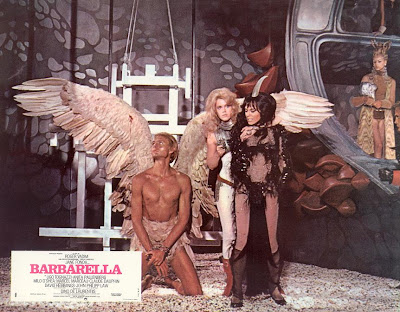
The nest is a huge bowl of sticks (big enough for two) sat on top of one of the Labyrinth walls, filled with feathers and dried grass.


Sogo - City of Night

Pygar sets down in Sogo in this asymmetrical glass corridor.

The corridor leads onto this multi-level street, with various living quarters (or are they shops?) off to one side.

The streets of Sogo are fairly dangerous for the blind, considering the total lack of railings. Note also the dead body bottom left.

Two randy ruffians emerge through a tilting window and drag Barbarella into a basement filled with large transparent pillows, where she meets the One-Eyed Wench.


We've already seen blue rabbits inside Alpha 1, but this detail from the Sogo street offers us purple goats and a huge anteater, which I haven't yet spotted in the finished film.


This platform at the end of the street is where the mob corners Pygar. Note the transparent travel tube at right.

The back wall of this set appears in many publicity photos.


Chamber of Ultimate Solution

Pygar and Barbarella escape into a room which offers them only three exits (the entrance seals behind them with a sliding door). The floor is also transparent, with the bubbling Mathmos underneath. At top left is the raised writing which Pygar reads like braille - like the local language, the writing isn't familiar to someone from Earth.

The Concierge then escorts Barbarella to a travel tube (below) - note his black segmented cummerbund and the leather guards' 'whip hands'.


Throne Room of the Black Queen

Down a travel tube, Barbarella meets the evil twins again, in a casino.

The segmented backdrop to this set is re-used in several scenes around the palace. It first appears here, as the Queen appears from within a gigantic bursting balloon.


It's here that Pygar has been crucified, hung from the ceiling on an abstract cross, back in the casino room. The brown segments, in the central cluster on the wall, look similar to the bedding in Dildano's couch, and the styling of Durand-Durand's positronic chair.


"Take her to the birds"

Barbarella is taken to a huge bird-headed birdcage, to be fed to the carniverous occupants.


Dildano's Secret Headquarters

This set looks very different in the two versions that were filmed - compare the light-up maps of Sogo at the back. This indicates that the set was rethought and rebuilt for the David Hemmings' reshoot.


Dildano's hideout is a mess of travel tubes and malfunctioning equipment. Under the segments of his bed/couch is a secret transmitter.


The Nightclub


Barbarella hits a nightclub. Note the rooms at the back are full of inflatable pillows and half-naked women. Also, the woman hanging from the ceiling at left, with a group on the floor lighting a fire under her!


These backrooms provided many opportunities for publicity photos of nudity, which barely appears in the film.


Barbarella tries 'essence of man', through a pipe hooked up to a large glass hookah with a man swimming in it (below right).


The Excess Machine

The Concierge tortures Barbarella in his Excess Machine. Note the throne room background again and the discarded bodies lying around.


The Chamber of Dreams

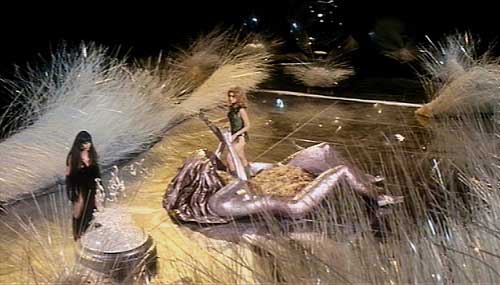
The approach to the Queen's Chamber of Dreams is a largely black set with shiny polished floors, weird spiky sculptures and huge swinging lenses hung from the ceiling.

Inside, huge psychedelic patterns on the walls either help the Queen sleep, or represent her dreams. The back wall is a front-projection screen.

The Queen's bed is a sculpture of a giant open-armed female figure, the pillow is inside its hollow head.

The control levers to the Mathmos are near the bed.


The Positronic Ray

The positronic ray is controlled from this cool chair!


On The Rocks

The final set is this rock ledge - the black backing is the front-projection screen.


Some recurring elements in the design include the extensive use of transparent plastics (also used in costumes), segmented assembly (the Guards' costumes, the Concierge's 'Sydney Opera House' cummerbund and the throne room set), objects (lights, lenses) and people swinging slowly from the ceiling, horns (the Queen's hairstyle, the sailboat sails) and tubing. Almost all the designs use non-symmetrical patterns and structure.

Some incidental pieces of furniture are copies of body parts, particularly the Queen's bed. Phallic and breast-like motifs are of course abundant, extending even to the vehicles - like the three pulsing knobs of Alpha 7's engines. The breastlike double-cockpits of the guards' airships echo the see-through breast windows in several costumes.

Lastly, there are a few animals around - like goats and rabbits dyed bright colours. I think there's also an owl and an anteater in there somewhere!