Showing posts with label true story. Show all posts

October 18, 2013

COUNTESS DRACULA - reading up on Elizabeth Bathory


True crime?


The legend of Countess Dracula has inspired several movies, though I've only seen the Hammer version (soon to be available on blu-ray). Based on the story of Elisabeth Bathory, charged with being a serial killer who bathed in the blood of her female victims in order to retain her youthful looks. Ripe in allegory about the ruling class, it makes a superb story. But like Vlad Tepes, the ruler who inspired Dracula, was she actually a monster?


My earliest guides on the roots of vampire legends were 'The Natural History of the Vampire' (Anthony Masters, 1974) and McNally & Florescu's 1972 'In Search Of Dracula' (revised and updated in 1992). These didn't dissuade me that vampires could exist and that Count Dracula was indeed Vlad The Impaler (as depicted in Francis Ford Coppola's Bram Stoker's Dracula). Their popular research meant that any castles that Vlad Tepes once lived, or even (possibly) visited, are now nicknamed 'Castle Dracula' (despite Bram Stoker never having visited the country) and provided a huge boost for tourism in Romania. But holidaymakers are actually getting a disrespectful fantasy about that country's revered warrior-leader, since Vlad orchestrated the defence and uniting of their country.


Cover art uses the same painting as the title card of Countess Dracula
Raymond McNally later explored the story of Countess Dracula, finding just as many elements of Bram Stoker's character and mythology in her story. Vlad Tepes may have decapitated his enemies and impaled them on stakes, but that's the opposite of what a vampire does. There's more in Elisabeth Bathory's story to inspire the habits of the Count, and McNally finds proof in Stoker's private notes while researching Dracula, that he'd referred to Sabine Baring-Gould's 'The Book of Werewolves' which included an account of her legend as well. This is the crux of his 1983 book 'Dracula Was A Woman'.

The first half recounts the legends of 'Countess Dracula' and the highlights of the transcript of Elisabeth Bathory's trial. Allegations that the countess drank the blood of virgins to retain her youth are mirrored in Stoker's novel, as the Count becomes younger during the story. The stories of her also eating flesh could have been transposed (and diluted) to Renfield's habit of consuming live animals. He scrutinises every aspect of the history books to find parallels in Stoker's novel and other aspects of vampire lore, but was Countess Bathory actually like this?

It's still more even-handed that Valentine Penrose's 1962 'Bloody Countess', which I didn't realise was written so long ago from such an opinionated viewpoint (he refers to lesbians as "perverted"...)


I started into Tony Thorne's book 'Countess Dracula' (also published as 'Blood Countess') expecting the full horrendous tale of medieval ghastliness. But the crimes described are only what was alleged at the trial - that up to 650 girls were tortured, killed, drained of blood and partially eaten. Their bodies were hidden or strewn across the countryside, this being a time of war when it was possible to get away with murder. Her aristocratic position also meant that she was the law in her own estate. Who'd dare challenge her?

Thorne methodically looks at the surviving records, which aren't many. Because of the wars in that part of Europe, many records have been destroyed. The remaining clues point to a mass murderess, or, an innocent woman defrauded by neighbouring countries for her lands and wealth. With a superstitious population, it would be easy to accuse her of witchcraft and vampirism than to disprove it. With painful capital punishment awaiting anyone who didn't cooperate, there were plenty of witnesses around to point the finger of blame away from themselves.


Ingrid Pitt and Sandor Eles in Countess Dracula
Many famous horror films start with a title or voice announcing that it's "based on a true story". The Texas Chain Saw Massacre, Picnic At Hanging Rock, Wolf Creek... Or their publicity machine says it for them - The Exorcist, The Amityville Horror... But once you get down to the original story, you've not been shown anything that actually happened. Millions read the poster. Thousands see the films. Not many bother with the truth. 

In the case of the countess, we don't know what happened, but the accusations and legends make a better story. At the very least, the accusations must be wildly exaggerated. To assume that the gossip and surviving court testimonies are all true is to accept only one side of the story, political subterfuge and ancient superstition.


September 03, 2011

BAREFOOT GEN (1983) - he saw the bombing of Hiroshima


BAREFOOT GEN
(1983, Japan, Hadashi no Gen)

A terrifying account of the atomic bombing of Hiroshima, for children...

Disaster movies are currently all about meteor collisions and climate change. But for decades, the most likely apocalypse was nuclear war. In the 1980s, I was seriously worried it might become a reality, with Ronald Reagan constantly talking tough with the Russians. For all I knew, they all had their fingers on big shiny red buttons ready to launch hundreds of missiles at each other. It was hard to imagine what might happen.


Post-apocalyptic movies portrayed nuclear-ravaged worlds (usually as desert, as in Damnation Alley and Mad Max 2) and sidestepped showing the disaster itself, except for increasingly familiar stock footage of nuclear test explosions. But what was it like to be in a city at ground zero? This wasn't shown - the effects of radiation had only been hinted at with deformed humanoid monsters and giant animal mutations. (The original Godzilla (1954) had carefully portrayed the many effects of a nuclear blast in a work of fiction, but I didn't get to see that until the mid-1990s).


Despite being decried as anti-government propaganda, realistic depictions of what a nuclear war could look like crept onto TV in the 1980s. The first that I saw was a short, shocking clip from Peter Watkins' The War Game (1965) made by the BBC but too realistic to be transmitted for several decades. The BBC however produced and transmitted the dramatic imagining of a nuclear strike on England in Threads (1984), just after America saw The Day After (1983), also made for TV. Both made sobering viewing - any country launching nuclear weapons would also automatically become a target. The fates of the USA and the UK would have been the same. Raymond Briggs' (The Snowman, Fungus The Bogeyman) graphic novel When The Wind Blows was then adapted as an animated film in 1986, describing how a suburban couple might cope with a nearby nuclear explosion if they follow the official government information booklet.

But I still had little idea of what the people in Hiroshima and Nagasaki had actually experienced during and after the nuclear blasts in 1945. The only depiction in a movie I saw in the 90s was a brief scene in Black Rain (Japan, 1989), shown on TV.


Eventually there was Barefoot Gen. I first saw a clip from the anime movie on Japanorama, a 2002 Jonathan Ross TV show about Japanese pop culture. The moment the bomb detonates over Hiroshima was incredibly shocking. It was simply-drawn animation, but depicted horrendous and graphic events. A nightmare on Earth. It's even more horrifying because the author had personally witnessed it all. To see the film I bought a secondhand VHS from the US, where it had been originally released.


Keiji Nakazawa was six years old when the bomb dropped, as he was on his way to school in the centre of Hiroshima. A split-second quirk of fate saved his life. In an instant, everything around him changed. The city was levelled, there were very few buildings with foundations of steel and stone. Anyone who wasn't instantly vaporised had been hit by the explosive blast and then a firestorm. The survivors could then die from the effects of radiation in the next few minutes, months or years... Keiji stayed on the outskirts of Hiroshima as it started to rebuild itself.


He became a manga writer, but wasn't able to publish the first volume of his most famous work until 1973 when Japan started to talk about Hiroshima and Nagasaki again. The stories of Barefoot Gen are dramatised versions of reality, but were "70 percent" (his words) based on Keiji's actual childhood experiences. Immediately popular, they soon inspired three live-action films at the end of the decade. But the manga proved a better way to spread the story overseas, being translated into many languages. An anime adaption was a logical extension.


However the animated film (produced by Madhouse) is strangely aimed at children, the title music is fiercely corny and upbeat. It even starts like a Ghibli movie following boisterous six-year old Gen (pronounced with a hard 'g', as in 'begin') and his younger brother trying to scrape fun and food out of the rural war-torn Japanese countryside. Gen's father struggles to feed his family and decries the rulers of Japan for not surrendering. But the boys still have fun together and little mischievous adventures - the children even look like typical Ghibli creations, the youngest child has a huge mouth and a big grin. The animation is fairly simple but well-observed. Occasionally, there's a brief voiceover about the state of the war and the bomb being prepared.

The first half of the movie takes time to set up what life was like around the city in 1945, and then the bomb drops.


In an instant, 80,000 civilians die instantly. Gen accidentally survives, finding himself in the middle of a nightmare. Some of the walking wounded are partially melted, many of them are better off dead. It looks like hell on Earth. Corpses are everywhere and the rubble is still on fire.


The next scene is just as upsetting as the explosion, as Gen discovers what has happened to his family.


In the days that follow, as Gen is struggling to find food and shelter, people are still slowly and painfully dying of the effects of radiation. (Decades later, that exposure to radiation is still killing the survivors of the bombings of Hiroshima and Nagasaki - Keiji Nakazawa himself is currently battling cancer).

The story continues to follow Gen through the initial dark days after the bomb, until he starts a new life, staying in Hiroshima, making his way anyway he can, with nothing. Against all odds, Keiji wants the story to be an optimistic one. This is where the perspective of a six-year old actually helps, when nothing is impossible and humour can be found in the simplest things in life.


It's an extraordinary film, with a deceptively comic start. I've not seen such an explicit, realistic vision of what it was like on that day. It's horrific, even depicted with simple drawings. I still don't think it's possible for a live-action equivalent of the same sequence. A recent Japanese TV adaption expanded the story to three hours, spending more time with Gen's family, but the scene of the bombing is quite short, treated in a similar way to The Day After.

Gen's story continued in another animated movie set three years later. Barefoot Gen 2 (1986) shows Hiroshima slowly recovering, but with orphans roaming the streets and the black market thriving. It's similar to other post-war stories, but with the characters dealing with the continuing effects of radiation. The doctors are trying to deal with radiation sickness, when no research or treatment yet exists. Understandably, with all the dead still not buried, there's resentment of the occupying American forces.

Again, the story strives for optimism and the chirpy opening title song seems inappropriate, but the story is gritty and memorable, still refusing to pull punches. The sequel is included as a double-bill on the DVDs.

The atomic dome in modern Hiroshima
(photo by Hirotsugu Mori, 2006)
Barefoot Gen prepared me for my own visit to Hiroshima in 2004. A day trip included a visit to the iconic 'atomic dome', one of the only recognisable landmarks left standing close to the centre of the blast. Rubble lies around the skeletal building as if it had been destroyed the day before. A short walk through the memorial park took us to the huge museum which traces the events of how the bomb came to be dropped on Hiroshima and the devastation it caused. There are two huge scale models of the city as it looked before and after the explosion. An exhibit of photographs of the effect of radiation burns was simply too much to look at.


In the anime, as Gen runs to school just before the blast, there's a series of seemingly inconsequential images that resonate with some of the artifacts in the museum. He passes a pile of bottles and a woman sitting on a doorstep. You can see these bottles all fused together from the heat of the blast, as well as the shadow of the woman vaporised into the stonework of the wall she was sitting in front of. The grim events are of course in complete contrast to the vibrant modern city that Hiroshima is again today. My most vivid memory of the day was the tribute of hundreds of fresh flowers still being laid out at the memorial arch.


In 2005, Barefoot Gen and the sequel were released in the UK on DVD from Optimum Asia (at top), in Japanese with English subtitles. The 4:3 aspect ratio looks accurate. They're now on DVD in the USA as well, from Geneon (above). Through the efforts of Project Gen, the manga has also been widely translated and published. More about the original manga, and some pages from it, here, with spoilers.


I've not seen the three live-action Japanese films made in the 1970s (directed by Tengo Yamada), but here are some screengrabs from the first film, made in 1976 .


The 2007 two-part TV series expands on the events portrayed in the anime, including more about Gen's older brother joining the army. Only available with English subtitles on this Hong Kong DVD (from Amazon USA here).


Of course now the Japanese nightmare of deadly invisible radiation is no longer confined to World War 2. The recent earthquake damage to the nuclear power station at Fukushima has again spread radioactivity into the ground, the sea and the air, with little information as to where it is and what the effects can be, short term or long term. It's like a slow-motion replay of the aftermath of Hiroshima.

Keiji Nakazawa is finding a new audience as he attempts to dispel the myths about the effects of radiation. After a lifetime of campaigning against the use of nuclear power and weapons, he's also currently participating in a new documentary. News article and a recent photo of Keiji.
February 13, 2011

AFTERSHOCK (2010) - heart-rending disaster movie from China


AFTERSHOCK
(2010, China, Tangshan dadizhen)

The psychological debris from a natural disaster

The city of Tangshan in China suffered a devastating earthquake in 1976 that left 240,000 dead. But Aftershock doesn't exploit the extent of the devastation, but homes in on the lasting effects of the disaster on one family.

Early in the story, the quake is shown from the perspective of a few people in one neighbourhood (rather than an overview of the city), as a mother and father race to protect their children. The amazing scene is a seamless mix of CGI and large-scale sets. But unlike the disaster movies that I'm used to, the accent wasn't on spectacular destruction. The deaths had more emotional impact, helped by the random victims being played by actors rather than 'digital stuntmen'.


The story really begins when the dust settles and it emerges who survived. As rescuers dig through the rubble, the mother is forced to decide between the lives of her son and her daughter. A natural disaster has forced her to make the most difficult decision of her life, and could ruin the rest of it. She reluctantly chooses to save her son. Without her knowing, her daughter has miraculously survived, but heard her mother decide against saving her. Also completely traumatised, she walks away from the city to a new life.


The story then repeatedly leaps forward to see how these survivors lead their lives, still haunted by the day of the quake, right up to the present day, 32 years later. Some of these 'fast-forward' fades-to-black avoid many events that are ripe for melodrama. The director avoids many of the cliches, often leaving the viewer to deduce some of the major changes in the characters' lives.


In the background, there's a summary of the last thirty years of life in China. It's interesting to see the similarities and differences between western life and communist society. I've read that this film didn't get an Oscar nomination because it didn't appeal enough to an international audience, but it's far from inaccessible. There are very few important references to historic events or unfamiliar places.


There also seemed to be a conscious decision to appeal internationally. An orphan being fostered by both parents in Red Army uniform looked like it was aimed at non-Chinese viewers, trying to counter decades of negative depiction of communism.

The opening shot had me a little worried, a swooping helicopter shot of Tangshan, filled with unconvincing CGI dragonflies, (an illustration of the kinds of natural warnings China had before the quake). Understandably, there were also CGI establishing shots of Tangshan as it was before the quake. But soon the film settled down as a very high-quality production, with the exception of one non-Chinese actor who spoiled a later scene.

Xiaogang Feng, director of Assembly (2007) and The Banquet (2006) assembled a fantastic cast who convey some truly heart-rending scenes. Though apart from the quake itself, the many intimate dramatic scenes were hardly an obvious choice for an IMAX presentation, as it was in China.


With so many regular natural disasters around the world, and so many people affected, it's hard to let yourself be affected by each new catastrophe. Hollywood disaster movies also maintain this distance, rarely depicting death tolls, permanent injuries and lasting emotional effects.

For a disaster movie, this unleashed a huge emotional impact on me, emphasising the personal tragedies that last for decades after the funerals are over.


I watched a DVD from Hong Kong, released by Media Star, with good subtitles and widescreen anamorphic aspect. The extras were deleted scenes, cast interviews and a trailer, but these had no English subtitles. The USA has yet to release this, but there was a limited run in the UK and there's now a DVD, with cover art misleadingly showing skyscrapers in the background (above) - compare it to the Chinese DVD art (at top).

An extensive, spoilery review on
Asia Pacific Arts.

An original trailer on YouTube...


February 05, 2011

TENDERNESS OF THE WOLVES (1973) - still shocking?


TENDERNESS OF THE WOLVES
(1973, West Germany, Die Zärtlichkeit der Wölfe)

A recreation of the exploits of a German serial killer who attacked young men with vampirism, cannibalism and necrophilia. Watching it again, I've changed my mind about this film.


In post-war Germany (the film moves the setting from the end of the First World War, to the end of the Second), two petty crooks find a new way to find meat to sell to their bankrupt neighbours. Fritz Haarmann murders young homeless men, then sells pieces of their bodies to a local cafe. His lover helps dispose of the remains and cashes in the victims' belongings on the black market.

One of Haarmann's neighbours notices that young men go to his flat but are never seen again. But his reputation as a generous do-gooder and his job as a deputised police inspector help hide his crimes from the authorities...


I've always regarded this as a similarly taboo movie as I Spit On Your Grave, Straw Dogs and Last House On The Left. A 1970s' horror that pushed the envelope too far. An experiment in bad taste that history wouldn't repeat. Viewing it again, my knee-jerk reactions started kicking in again, critical that this was a worst-case representation of gay men. A weird-looking outcast who preys on young straight men for sex, sucks their blood, kills them and eats them... but not necessarily in that order. If that's not enough stigma-by-association for you, some of the victims were under-aged.

More objectively, I imagined the film with female victims, and it became more typical of seventies Euro-horror. The extreme elements of the murders are mostly implied and not shown. The most explicit angle of the film is the sexuality of the killer, and by explicit I mean kissing his boyfriend and the nudity of his prey. Compared to other films of the era, there's little difference in pushing the boundaries, besides gender. In Martin, the bloody victims and the nudity are female. Blood On Satan's Claw and To The Devil a Daughter both had full-frontal nudity of young women.


Admittedly many of the naked young men in Tenderness of the Wolves are gratuitous to the plot, once Haarmann's obsessions have been established. This casual and unflattering male nudity is surprising today, as it continues to be rare in horror or any other genre. I think it's this aspect that makes it relatively obscure, excluding it from it's two genres. Horror and gay-themed cinema continue to keep a mutually-exclusive distance.

I'm accepting the film now, but my paranoid defences originally made me back away, writing it off as indefensible back in the 80s when I first saw it. The theme of gay vampirism was too perfect for providing fuel for demonisation in the decade of AIDS hysteria. But Tenderness of the Wolves was made a decade before the AIDS crisis and might even have been considered relevant had it been released a few years later. It unhelpfully mixed the genre of lurid 'true crime' exploitation with the story of a gay love affair going sour. While it's a truthful and sympathetic depiction of a gay relationship, this isn't a great genre for making positive political statements. But what should you expect from director Ulli Lommel, collaborating with producer Rainer Werner Fassbinder (who also appears in the film as a sleazy pimp)?


Anyone frightened off by the recent quality of Lommel's films can be assured that this early work is well-produced and dramatically convincing. Though it's less of a narrative than a timeline of case history highlights. Even the detective work, usually the focus of true crime dramas, is sidelined as music replaces their dialogue. The corruption angle is hardly exploited, despite Haarmann working for the police while they're also hunting for him.


There are homages to Fritz Lang's M in quoted imagery and Haarmann being as completely bald as Peter Lorre's character, even though the real Haarmann had hair. M was also based on a different serial killer - Peter Kürten, the 'Vampire of Düsseldorf', whose most horrific crimes involved very young girls. The two films and their subjects are often confused, the original cases both being from Germany in the 1920s. Fritz Haarmann was known as the 'Butcher of Hanover', and his victims were young men between 13 and 20.

The shaven-headed Kurt Raab gives a relatively restrained performance as the killer (imagine Klaus Kinski in the same role), charming his neighbours and evoking sympathy when his boyfriend leaves him. Raab only lived to be three years older than Haarmann, ironically dying of AIDS-related illnesses. He'd had a full career as a screenwriter and actor, one of his last appearances was in Escape from Sobibor with Rutger Hauer.


I watched the Connoisseur Video VHS release from the UK (with a slight variation of the English title), which has good subtitles and a 1.66 widescreen aspect. The Anchor Bay release DVD is still available in the US.

September 17, 2010

OUT OF THE BLUE (2006) - a tragedy in New Zealand


OUT OF THE BLUE
(2006, New Zealand)

Realistic, beautifully-observed approach to a real-life spree-killing

Karl Urban was outstanding in JJ Abrams' Star Trek reboot, but I initially didn't recognise him in this, filmed in his native New Zealand. It's completely different from his heavily-armed characters in Lord of the Rings, Doom and The Chronicles of Riddick.


Urban plays a smalltown policeman in a poor backwater village, where all that usually goes on is burglary. It's the story of an actual tragedy that struck the village of Aramoana back in 1990. A series of trivial events that tipped an unemployed gun enthusiast towards a killing spree, the worst New Zealand has ever seen.


This is very different from the overly dramatised TV movies or cold docudrama restagings. Director Robert Sarkies concentrates on the local people drawn into the day's events while also meticulously recreating the facts. He doesn't show much bloodshed, echoing the way that murders rarely have witnesses, instead contrasting the pain and chaos with the natural beauty of this coastal area. There's no cliched theorising about the killer's motives, and no flashback guesswork about his past. He's just one character in the day's events.

Unlike the spree killers of Elephant (2003) where the duo had a definite plan, this genuinely mad man is completely unpredictable, making it up as he goes along, repeatedly defying any urge to escape. The emergency services are frustratingly slow to move in - presumably because the area is still unsafe for them to do so. The local police on the scene have to do what little they can against a killer with a cache of automatic weapons.


The cinematography vividly depicts the beautiful coastal location in wide static shots. The action is often shown very closely, sometimes abstractly, with very precise focusing leading our eyes through the story. This isn't as arthouse an approach as Elephant, but still a carefully paced view of the community and the tragedy. While it's understandably respectful, the director makes edgy choices in what he shows, particularly at the climax.

I'd not heard of these events, so the unfolding story was extremely suspenseful. I'd not even heard of the film despite always being on the lookout for Karl Urban's work. A meticulously well made film, with naturalistic performances - a stark contrast to the TV cops who deal with similar situations quickly and tidily. Here, not everyone one knows what's going on, mistaking what they see or hear, and not always knowing what to do in such an unfamiliar situation. The fact that several children were among the victims makes it all the more upsetting.


New Zealand has a great film industry, but isn't famous for many stories about itself, though Peter Jackson's first dramatic film springs to mind, also a recreation of a famous New Zealand murder, the excellent Heavenly Creatures (1994).

Be careful when you're searching for this film because, although apt, it's already been used by several other films and TV shows...

Karl Urban can next be seen in the remake of Robert Fuest's And Soon The Darkness and is up for the lead role in the Judge Dredd reboot. I also hope that Matthew Sunderland will also get more work after his quiet but frightening portrayal of the deranged gunman.


The region 2 UK DVD I watched was no-frills. But
the US region 1 and Australian region 4 releases definitely have generous extras, all of which I'd really like to see, to fill out the details of what happened that day, back in November 1990.


Here's an official trailer on YouTube...


August 13, 2010

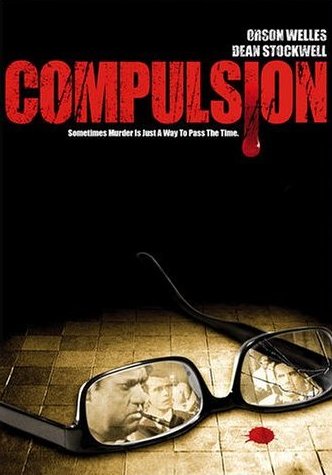
COMPULSION (1959) - re-enacting the story of Leopold and Loeb


COMPULSION
(1959, USA)

They're loaded, and they wanna have a good time...

This is a taut fictionalisation of a famous murder case from 1924. Leopold and Loeb, two wealthy and intelligent Chicago students, thought they were clever enough to plan a perfect crime, and of superior enough intellect to be above the law. While it lead to 'the trial of the century' at the time, fellow student Meyer Levin later told their story in his 1956 book, Compulsion, which stuck to the facts but changed the names of everyone in the case - I'm not clear why. This early true-crime novel predates Truman Capote's 'ground-breaking'
In Cold Blood which has been heralded as the first of its kind.


After the book of Compulsion came a hit play and then in 1959 a hit movie, monopolising on the renewed publicity from the release of one of the murderers on parole (after 33 years in prison).
The movie is gritty for the time, struggling with teenage sex, rape, and child murder, not to mention the killers' homosexual relationship. Many of the elements that Hitchcock loved to spice up his plots with - he used two (subtly gay) murderers who thought they were above the law in his 1948 film Rope. The image of polite college boy killers may have informed the character of Norman Bates in Psycho.

Remember that in Robert Bloch's book, Norman is overweight and middle-aged, and that the real-life inspiration for the character was Ed Gein, a dishevelled old hermit. The young Anthony Perkins couldn't be further from the source material if he tried. Another thematic link between Compulsion and Psycho is Judd Steiner's (Dean Stockwell) hobby of bird-watching and taxidermy, a perfect match for Norman Bates' favourite past-times.


While not nearly as modern or edgy as the movie of In Cold Blood, Compulsion is still fascinating because it follows the events and twists of the real-life case so closely. While it's set in the 1920s, apart from the car and a scene set in a prohibition speakeasy, it's not aggressively a period film and feels very 1950s, with Dean Stockwell rebelling against his family ties and scorning the teachings of his college professor.


The majority of the film shows the killers at large and the cops trailing far behind, don't let the photos here make you think this is only a courtroom drama. The inevitable trial doesn't dominate the film, though the renaming of all the characters robs the courtroom scenes of their historical power. In that I didn't realise that Orson Welles, as the defence lawyer, was in fact portraying Clarence Darrow, also famously fictionalised in Inherit The Wind. Welles steals every scene once he arrives, though his character is an unlikely figure for sympathy, because he looks too much like his most villainous portrayal, in Touch of Evil, released the previous year. It's a far cry from
the image of upstanding legal do-gooders played by Gregory Peck and Spencer Tracy.


Dean Stockwell (above) is always interesting to watch, even as far back as his child roles, like The Boy With Green Hair (1948, a simple but early parable about race relations) and the beautiful 1949 version of The Secret Garden. I also love his later sixties' drop-out roles, especially The Dunwich Horror, and his sublime performance in Blue Velvet (1986). His astonishingly long career continues to fascinate, continuing with his long-running character in the recent Battlestar Galactica remake.


Stockwell's partner-in-crime is played by Bradford Dillman (Bug, Escape from the Planet of the Apes),
pictured above on the right. He's a familiar face to me from many seventies' roles, but had no more parts as high profile as this. Of current interest, he was great as the leading man in Roger Corman's original Piranha (1978), which has just had a big budget 3D remake.

Dillman and Stockwell's screen relationship is not only hinted as being homosexual, but sado-masochistic as well. This is inferred in their performances and the direction, plus a few sneaky coded hints in the dialogue. The tortured but unspoken gay undercurrent heightens the drama throughout. A later adaption of the same case, Swoon (1992), was explicit in showing the sexual relationship as well as the boy's murder. But as a film, it's lacking in drama, looking more like a Madonna video, right down to the buff leading men.


Director Richard Fleischer (Soylent Green, Fantastic Voyage, Blind Terror) uses subtly skewed angles to insinuate the power struggle between the two, and their unbalanced morality. We even get Dillman hiding in a closet - subtle! Fleischer landed two more adaptions of real-life murders later in his career - The Boston Strangler (1968) and 10 Rillington Place (1971).


The US DVD (pictured) has a crisp black-and-white transfer
, in 2.35 anamorphic widescreen. The only extra is a trailer. I don't find the cover art very inspiring, considering the weighty cast and subject matter. They're even the wrong kind of glasses...

Another Compulsion review here, with screengrabs, at
The Sheila Variations.

Cool interview with Bradford Dillman over at Cinema Retro.


A rather sensationalistic trailer, considering the comparatively subtle style of the movie...


July 16, 2010

WIRED (1989) - and bad movies about movie stars


WIRED
(1989, US)

Michael Chiklis IS John Belushi...

This isn't about recommending good movies. This is about movies that I've watched because I couldn't believe that Hollywood had dared to make them. When taste and logic have flown right out of the window, really exceptionally fast.

A case in point. 1978, hot off Saturday Night Live John Belushi was becoming Hollywood's hottest comedy actor. I'd never even seen Saturday Night Live (we've never had it on TV in the UK), but I was immediately won over by his performance in National Lampoon's Animal House and I wanted to see him in many more movies. He was priceless as Bluto, the legendary student anti-hero slob, a prototype of the overweight slacker that's currently in favour. The next film of his I saw was Spielberg's 1941, which he wasn't in for enough time for my liking. And then there was the role he's best remembered for, as Jake 'Joliet' Blues, in The Blues Brothers (1980). I didn't see his later films (like Continental Divide, Neighbors) which can't have had a wide release, if any, in the UK. And then he was gone. March, 1982. Dead from a speedball overdose. He was at the forefront of 'comedy as the new rock 'n' roll' but didn't live nearly long enough to reap the benefits.


Movie biographies about movie people, living or recently deceased, have to be done extremely carefully and cleverly. Wired (1989) isn't one of them. John Belushi's life and death was poorly dramatised and drained of humour. The complete opposite of a fitting tribute. I haven't seen it in years, and I always like to watch movies afresh for Black Hole reviews. Problem is, I haven't got a copy any more.

Last time I watched my VHS of Wired, I decided I'd never watch it again. I keep getting that wrong. (Don't be like Mark - don't get rid of stuff). There's always a reason for going back, but please remember the ravenous way that VHS tapes ate up shelf space. In short, I'm relying on memory here.

I originally wanted to see if Wired shed any light on why and how Belushi died. This was definitely the kind of project that Hollywood unites in avoiding, blacklisting actors who dared to show up show business under a bad light. By bad light, I mean a drug-fuelled system with no means of support to prevent their brightest stars from imploding. (Little seems to have changed, except the same self-destructive results are now possible with 'prescription drug' abuse).


Besides the cast risking the ends of their careers appearing in a controversial tragedy literally in the heart of Hollywood, on Sunset Boulevard, it was double jeopardy because they were also in a badly flawed film that was destined to be a critical and financial flop.

Wired uses the movie Sunset Boulevard as a starting point, having it narrated by a corpse, and borrowing the opening that Billy Wilder couldn't use, with a dead man sitting up in a morgue. The character of Belushi then looks back at the highlights of his life. But with so little material legally allowed, and so few actors and movie-makers allowing their names to be used in the story, the recreations of his famous sketches and behind-the-scenes dramas are almost unrecognisable.


Unsurprisingly, Wired was last seen on VHS and has never surfaced on DVD.

Wired was too abstract in its story-telling, so I tried the book, written and researched by no less than Bob Woodward, co-author of All The President's Men which blew the lid on the Watergate scandal of President Nixon's administration. But the totally uninvolving style reads like a court transcript - dense with legally-approved facts, but lacking subtext, opinion or conclusions. (A fictional representation of Woodward is played by the late J.T. Walsh).


Because it was so widely reviled, I honestly thought I'd never see the star of Wired ever, ever again. But that's why I'd like to see it again. I was halfway through watching the first season of The Shield when I looked up the previous credits of Michael Chiklis (who plays the lead, Vic Mackey). I was shocked to see he was the one, the unfunny guy who'd dared to play Belushi. I'd not seen him in anything else, having missed his heavily disguised turn in the series The Commish. Quite a career turnaround - maybe even worthy of a TV movie...


In fact, before he nabbed The Shield, Michael Chiklis again tempted fate with another celebrity impersonation. While Hollywood is now attempting to tackle a big screen version of the lives of the beloved Three Stooges, Chiklis has already appeared in a similar TV movie, as Curly. More details and pics on this are here on As Seen On TV. The Three Stooges (2000) was sort of interesting, but again, couldn't expect to be funny like the originals.


Worse still. Much, much worse. The epitome of disastrous casting in an impersonation movie is the (presumably) deliberately humorous casting of Patsy Kensit as Mia Farrow. In a TV movie made to cash in on the media storm that surrounded Woody Allen and Mia's spectacularly public bust-up, entitled Love and Betrayal: The Mia Farrow Story, I shit you not.