Showing posts with label Blu Ray. Show all posts

August 18, 2012

JOURNEY TO THE CENTER OF THE EARTH (1959) - now on Blu


Twilight Time only started releasing DVDs and Blu-rays last year, aiming for classic older movies that the big studios have neglected. Their remit has stretched to titles as recent as As Good As It Gets (1997) and the original Fright Night. It's surprising that the studios don't think Ray Harryhausen films still sell, for instance.

Twilight Time are particularly interested in the widest of widescreen movies getting the best presentation possible, on Blu-ray. In the 1950s and 1960s, hugely expensive epics were filmed in the new process of Cinerama and other aspect ratios of around 2.35:1, to make movie-going more immersive with bigger-than-ever screens (to combat the rivalry from television). The spectacle wasn't just used on westerns and Roman historical epics, but action (like Grand Prix) and comedy (Those Magnificent Men In Their Flying Machines, It's A Mad Mad Mad Mad World). Viewed on a big screen, DVDs struggle to offer enough detail for these aspect ratios, and for some movies these Blu-rays offer their widescreen debuts on home video.


Obviously I've pounced on their monster movies. Journey to the Center of the Earth (1959) can't compete with Jurassic Park, but was the equivalent family adventure of the time. Some, not all, of the special effects still work. The spectacular production design offers imaginative large-scale sets, expanded by imaginative matte paintings. For two hours you can almost believe it's possible to hike to the Earth's core!


This science-fantasy is a fairly faithful adaption of Jules Verne's novel. But pandering to fans of the book means a fairly slow slog before the journey downwards begins and the small-scale melodrama turns into a unique cinematic adventure. Bizarrely, there's even a song to clog up the early proceedings, reflecting perhaps what was then expected of family entertainment.


Disney had previously made 20,000 Leagues Under The Sea (1954), epitomising the approach to family adventure stories for years to come. Another Verne adaption, it starred James Mason as Captain Nemo, no doubt making him a must for the leading role of Lindenbrook.

Amongst the colourful stalactites and giant mushrooms, there are dinosaurs and a rival expedition to compete with. I was surprised to see a couple of story details pre-empting Raiders of the Lost Ark. A configuration of the Sun's rays leading the way, and a large rolling boulder chasing our heroes.
As the unlikely band of explorers descend into the Earth, I'm pleased to say there are no children or teenagers in the ranks. But bizarrely there's a duck. Called Gertrude. Somewhat of a trendsetter, later pioneers took pets with them - the visitors to The Lost World (1960) a poodle, and The City Under The Sea (1965) a chicken...


Like The Lost World adaption the following year, the dinosaurs are portrayed by live lizards, but here a little more convincingly. The dimetrodon attack still looks pretty frightening. Am I going soft!


To contrast with the family-friendly wholesomeness, the amount of beefcake is a little surprising. As the expedition gets closer to the Earth's core, it gets pretty warm, so both Pat Boone and Peter Ronson get half-naked, revealing a smouldering amount of tanned manflesh, and get racily drawn towards the maternal figure of Arlene Dahl.
 
The experience is that much more impressive due to an awesome soundtrack from Bernard Herrmann, only a year after he scored Vertigo. The drama is certainly lightweight, but mounted on such an impressive scale that it remains epic fun!


Stranger still, this Ray Harryhausen spectacular, Mysterious Island (1961) should also be released by an independent. It features a wide range of iconic Harryhausen creations - the giant crab, giant bees, a prehistoric chicken (a phororhacos) and more! Like many unknown island stories, the plot is skimpy, building up with episodic encounters. The lengthy set-up of the explorers escaping from a military prison during the American Civil War has no real bearing on the rest of the story. But there's an enjoyable twist, a tremendous Bernard Herrmann soundtrack and many examples of Harryhausen's unique special effects sequences.

This release improves on the cramped aspect ratio of the previous (2002) DVD release, with fuller colour and more picture visible at the top and bottom of frame, closer to the 1.66 aspect ratio. And of course it's now high-definition. Sorry to tell you that both Mysterious Island and Journey to the Center of the Earth are now sold out.
A longer review of Mysterious Island on Blu-ray over at Black Gate.

Can't wait to see what else Twilight Time release...

January 25, 2012

Classic 3-D horror films... not for sale in 3-D, mostly


3-D movies wish-list, or, I've got a 3-D TV and I want to use it

(Updated November, 2013)


3-D movies are back in the cinemas, having appeared in various incarnations for over a hundred years. But for the first time, a high quality 3-D experience is available at home. Until this new wave of 3-D televisions were available, we've only been able to use cardboard red/blue or red/green glasses to watch DVDs and videotapes for a fairly poor 3-D experience. Watching a blurry VHS of Freddy's Dead: The Final Nightmare in 'Freddy Vision' wasn't an immersive experience. But now that there are new 3-D systems, in high definition, I think 3-D is here to stay, especially with its use in video games...

I've always enjoyed 3-D cinema, and was especially excited to discover that some classic horror movies had been made that way. I've hunted down various special screenings over the years and have seen all my favourites in 3-D (the BFI ran several 3-D seasons in London, for instance).


The new incarnation of 3-D movies has been the biggest ever, though I've mostly enjoyed animation, like Ice Age 3. The process has been used and abused in many action films where it's at odds with fast editing and juddery camera movement. Even more variable are the 'faked' 3-D movies that post-produce dimensional effects from 2-D image recording. Post-produced 3-D has been effectively revitalising older animated feature films. The first 'unflattened' Disney films I saw in the cinema was The Nightmare Before Christmas (now 3-D on Blu-ray) in 2008 (though it was first released in 2007), and it gave us false hope that all 'fake' 3-D was going to look as good.


Of the recent live-action films, 3-D works best for me with a slow-moving or static camera looking at deep sets. Joe Dante's The Hole (2009) is a lightweight horror for youngsters with some effective Japanese ghostly apparitions, but the constant and inventive 3-D visuals are wonderfully designed.

For the first years of this new 3-D wave, Hollywood studios seemed to reach an across-the-board agreement not to remind present audiences that, visually, this isn't much different from the previous 3-D crazes (that all rapidly faded away). They've released very few of the old 3-D movies using this new technology, no matter how good the 3-D effects were. Obviously, with two prints or negatives involved, twice as much costly restoration work is needed.

But here's a rundown of the classic, older, 3-D movies that could and should be on 3-D blu-ray, including the few that already are.


In the 1950's, the movie business was terrified by the erosion of audiences by that new gadget, TV. People could stay at home and watch movies, so why go to the cinema? So studios had to offer what TV couldn't. Wider screens, bigger screens, stereo sound and 3-D - all innovations that appeared at great expense to keep the industry thriving.

3-D movies were shot with two cameras, presented on their first run in cinemas on two synchronised projectors, and viewed with polaroid spectacles. It's a myth that the first big audiences for 3-D wore red-and-green glasses in the 1950s - they were seeing sharp 3-D images using a very similar process as we get now.

Only on re-release would the single-strip red-and-green prints be distributed. Small cinemas and even colleges could then show the slightly inferior 'anaglyph' version of 3-D. I don't think I've ever seen a polaroid presentation of a classic film - it's always been with two-coloured glasses. All the more reason that I'd like to see these films in HD and 3-D.


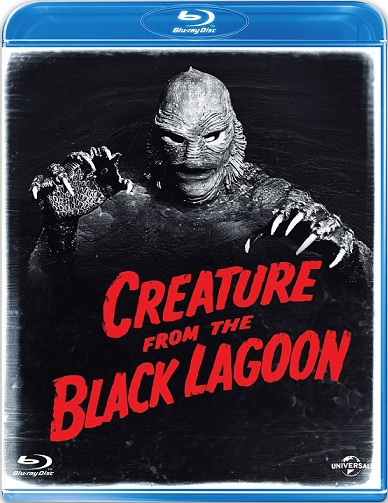
Like now, not all 3-D movies are good, but Creature From The Black Lagoon (1954) is still great fun, even when viewed 'flat'. In 3-D, it uses some great 'grabs' at the audience with its huge razor claws, and some fantastic dimensional scenes underwater. It's also a classic monster movie with a fantastically well-designed creature suit. The underwater version of the suit didn't have an air supply - diver Ricou Browning had to hold his breath for each take.


This is now available in the newly remastered HD Universal Horror range, both in the boxset and on an individual blu-ray release. The disc contains both a 2-D and 3-D version of the entire film in high-definition.


Creature From The Black Lagoon was a roaring success, so the first sequel Revenge Of The Creature (1955) was also shot in 3-D. The second sequel, The Creature Walks Among Us, was made after the 1950s' 3-D boom went bust, and was shot 'flat'.


An early close encounter, based on a Ray Bradbury story, is the frankly scary It Came From Outer Space (1953), which even hurls flaming meteors at the 3-D camera to make audiences duck and cover. All three of the above films were directed by Jack Arnold. It has an eerie 'body snatchers' plot with aliens victimising a remote town in the desert.


I must also mention The Maze (1953), even though it's yet to surface even on DVD. It stars Richard Carlson who's also in all three of the Jack Arnold 3-D movies! This is a mystery that takes place in a Scottish castle. The 3-D is effectively planned by legendary production designer-turned-director, William Cameron Menzies, who also made Invaders From Mars the same year. The 3-D effects are especially good when wandering around the maze itself. I first enjoyed this in one of the BBC's Saturday night horror double-bills in the 1970s and have been waiting for it to be rediscovered ever since. More about The Maze here.


So far, the movies I've mentioned are all black-and-white, but an expensive colour film launched the 3-D format in America. The original House of Wax (1953) starred Vincent Price at the start of his horror career. Charles Bronson also makes an early appearance as his mute assistant. The 3-D highlights of the film include the hooded killer stalking the foggy streets, the camera prowling through the wax museum, and, ahem, the guy with the paddle ball...


House of Wax is now on 3-D blu-ray in the US. The disc also includes a 2-D version and the 1933 movie Mystery of the Wax Museum, on which it was based. There's also a thorough appreciation of the film, including interviews with Joe Dante and Martin Scorsese about the use of 3-D in this innovative production.


Even Alfred Hitchcock made a 3-D movie during this period, Dial M For Murder (1954). Surprisingly, his use of the third dimension was quite restrained and the story suffers from obviously being based on the confined shenanigans of a stage play. Still, Grace Kelly in 3-D...


This was released in late 2012 on 3-D blu-ray by Warner Home Video.


The 1950s' 3-D bubble burst after only a few years, making 3-D a rare oddity until the 1980s. An exception was The Mask (1961). Most of the story is filmed flat, in more ways than one, but the 'dream sequences' are exceptionally well-filmed in 3-D, with trippy scary scenes revolving around a sacrificial netherworld. There was an anaglyph (red/blue) release recently on DVD. The film is black and white and cited as Canada's first horror film! More about The Mask here.


I've had a few arguments online about the use of 3-D in I, Monster (1971) the Amicus Films adaption of Dr Jekyll and Mr Hyde starring Peter Cushing and Christopher Lee. This began filming using a very different method of 3-D that only works with specific left-right camera movement. There's a debate about how much of the film was shot correctly but, to me, it works in almost every scene. The director was at odds with the producer over the 3-D effect and the film wasn't given a 3-D release. But...


Any version of the film will still work in 3-D, on VHS, DVD or whatever, but a different kind of glasses are needed, where the right lens is darker than the left. I bought some proper 'Pulfrich effect' glasses online, but knocking the left lens out of a pair of sunglasses is a cheaper option. More about I, Monster here...


Ahead of the next 3-D wave is one of the greatest 3-D horror movies. Andy Warhol's Flesh For Frankenstein (1973) was filmed in 3-D, presumably to add extra kitsch value. This benefited from a new film format that made it possible to halve the cost of shooting in 3-D, with both images shot on the same strip of film. Besides saving money by only needing one camera, this meant that older issues of alignment (two cameras having to be perfectly positioned) and synchronisation (film damage on one print might make it slightly out of synch with the other) were now also solved. This is also why the best 3-D that followed was all 2.35 widescreen - both widescreen images were stacked in the space of where one 35mm image normally was.  


Director Paul Morrissey gave us the first in excessive 3-D gore, which pre-empts and exceeds much of the blood-letting in the 3-D Friday the 13th movie that followed. Bad taste, bad acting, great 3-D. This outrageousness tops my wishlist for a proper 3-D release. There was a single, blurry 3-D transmission of this on Channel 4.


The 1980s brought the next 3-D boom, using the over/under 2.35 process to great effect for Jaws 3-D and Friday the 13th Part 3 3D. While they're not the greatest movies, the 3-D is very sharply presented. This Friday really deserves a great 3-D release to show how good they could make it back then. It's also the best way to understand why everyone is firing stuff at the camera.


While I was preparing this article, the good news was that Friday the 13th Part 3 3D is getting a 3-D release on Blu-ray. The bad news is... it won't be using the new 3-D technology, but the old red/blue 'anaglyph' process. Therefore you won't need a 3-D television to enjoy it. It's also available on DVD, again in anaglyph 3-D.


Jaws 3-D has also been announced for a Blu-ray release later in 2012 and again won't be using the new 3-D technology, the same as the Friday the 13th Part 3 3D release. Glasses will be provided with the Blu-ray. No artwork is available yet.


Finally, Freddy's Dead - The Final Nightmare cheated (in many ways) by only having a 3-D finale, by the time my eyes had adjusted, the scene was over! It looked even worse in 3-D on VHS (above). I'm mentioning this for Freddy fans, I don't actually want to see this again...


FURTHER READING:


3-D Movies by R. M. Hayes.
Chunky textbook attempting to document every single movie or short film released in the first 100 years of 3-D cinema.


Fantastic 3-D - A Starlog Photo Guidebook.
An easy reference guide, lots of colour photos, but published before the end of the 1980s 3-D boom.

A concise history of cinema 3-D - on the Wide Screen Movies site.


3-D Online Magazine horror special...


November 20, 2011

QUATERMASS AND THE PIT (1967) - invades Blu-ray


QUATERMASS AND THE PIT
(1967, UK, Five Million Years To Earth)

A unified theory that explains everything that's wrong with the world...

For Halloween, we watched all three Hammer films featuring that unlikely sci-fi hero Professor Bernard Quatermass, prompted by the arrival of the new Blu-ray release of Quatermass and the Pit (above).

Although it's the third of the films and adapted from a BBC TV series, this low-budget movie pushes ideas that rival and even mingle with the extra-terrestrial plot of 2001: A Space Odyssey. As alien visitations go, it looks small scale, not showing the global reaction but just a few streets and buildings in the centre of London. Even so, its claustrophobic approach is still largely effective today, mixing up apocalypse, sci-fi and horror into a unique, fantastic story.


With three hours of TV scripts to cut down into a fairly short film, the story rips along, throwing up some very grand ideas along the way. An Underground subway extension project hits a wall when a large metal object is found buried in the clay. A huge futuristic missile that appears to have landed before the Stone Age. Archaeologists and military experts can only guess what it might be. The more clues they get, the less sense it makes. Only Quatermass's wild theories can explain it all. But while he tries to warn everyone away, curiosity and the need for public transport unleashes forces that threaten to destroy the whole city.

Thankfully, Nigel Kneale gets to adapt his best story for the big screen (unlike Hammer's The Quatermass Xperiment and Quatermass II). Besides original scripts, Kneale was excellent at adapting other people's work for the screen, such as 1984 and The Woman In Black for TV, and HG Wells' First Men In The Moon for the Ray Harryhausen movie.


Andrew Keir (Dracula - Prince of Darkness) provides Quatermass's most rounded characterisation, better than even Sir John Mills in The Quatermass Conclusion. Besides his usual bullish attitude, the rocket scientist here shows warmth and even vulnerability. He's teamed up with a pair of experts as inquisitive and open-minded as himself, James Donald (The Bridge On The River Kwai, The Great Escape) and Barbara Shelley (also Dracula - Prince of Darkness, Village of the Damned), both of whom steal several scenes when it's their turn.


After her startling transformation from prim and proper wife into a ravening vampire, it was hard to imagine Shelley could top that. But she convinces us that she's possessed in several scary scenes that purely work due to her performance. A telekinetic troublemaker, years before Carrie.


In another brief scene that gives me the chills, a timid victim is cut down by the uncaring power of the silent majority. As chaos spreads through the city, blank-faced crowds mindlessly kill any 'others' with their telekinetic powers. It's like the Children of the Damned have all grown up and gone on a rampage. 

Admittedly, the special effects are stretched to their limits, considering it's a low Hammer budget trying to put on a Lifeforce city-wide catastrophe. Some of the exterior sets look too much like a backlot, but the London Underground station interior at the core of the story still looks excellent. On Blu-ray you can now check out all the Hammer movie posters lining the walls! It's clever the way that so much happens on the same street - every house, door and alleyway outside the station entrance gets its own scene.


Wires are occasionally visible, you can see them if you look for them, but not if you're following the story. Barbara's 'vision' is the lowpoint of the film in an over-ambitious scene.


After a lifetime of immediately unravelling every single movie special effect that has fooled my eyes, I now avoid certain 'making of' reveals. I want the creatures of The Mist and Monsters to continue to mystify me. I like to think of Teddy in A.I. as a character rather an effect, so I've avoided any behind-the-scenes footage or articles. I want to remember them the way they were in the story. Similarly, the final ethereal apparition in Quatermass and The Pit. I've no idea quite what I'm looking at - it might as well be real. I don't want to know how they did it - to me I'm looking at the thing from the pit.


While it was regularly shown on late night TV throughout the seventies and eighties, Quatermass and the Pit gathered a growing hive of fans through the years and its continuing popularity has inspired well-produced editions on every home video format.

The new Blu-ray, from Optimum UK, looks superb - it's never looked so sharp, so clean and colourful. The aspect ratio refrains from cropping the original 1.66 image down to the standard Blu-ray 1.77:1 (16:9) shape. So with the 1.66 ratio, there are thin black 'pillars' at the sides of the image, but these might not even be visible on a screen set to 'overscan'. I'd have liked even a little more headroom, but this is the best aspect ratio presentation for the film that I've seen for many years.


In the extras (only on the Blu-ray) there's sadly no archive footage behind the scenes, but there is a commentary track from the late writer Nigel Kneale and the late director Roy Ward Baker. Plus a group of insightful and often funny new reflections on the Quatermass phenomenon, with The Pit being everyone's favourite. There are valuable stories from Kneale's widow Judith Kerr, some set recollections from star Julian Glover (Colonel Breen), reminiscences from expert horror fans Kim Newman and Mark Gatiss, (who made me laugh out loud with their descriptions of Brian Donlevy's acting), Hammer expert Marcus Hearn and an American perspective from Joe Dante. The US didn't get the TV series so the name Quatermass didn't mean anything, so it was renamed Five Million Years to Earth (a title which I still confuse with Harryhausen's Twenty Million Miles to Earth).


Several of the commentators tease the idea that Arthur C. Clarke's 1954 novel Childhood's End (to which I'd also add his 1951 short story The Sentinel) may have influenced this Quatermass story. There are several echoes and parallels between The Pit and 2001: A Space Odyssey, but as Newman observes, Kneale deals with the immense ideas a lot less pretentiously!

SPOILER-FRENZY: AVOID THE U.S. TRAILER IF YOU HAVEN'T SEEN THE FILM BEFORE! It's also included in the extras.


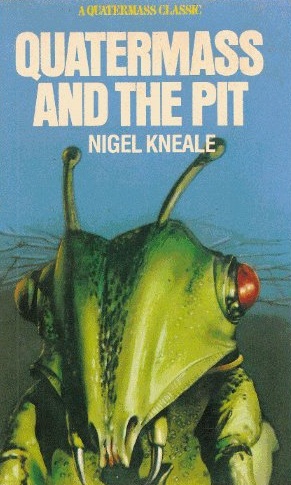
All six episodes of the original BBC TV series (from 1958) are also out on DVD - a low-budget TV production recorded as it went out live on air! The surviving episodes of The Quatermass Experiment and all of Quatermass II is also in this DVD set. The series expand on many of the ideas and scenes in the films. It maybe less distracting to read the TV scripts, which have also been re-published through the years (like the editions below).


Tristram Cary's scary electronic soundtrack offered in many scenes instead of an orchestral score were released on a couple of CDs (the best is pictured below, and includes a couple of surviving tracks from the first two films). The haunting closing track provides a fantastic end to the story, but was in fact a library track.


June 17, 2009

AKIRA (1988) - Blu-Ray release of the anime that started it all


Couldn't let the new release of this classic not get a mention in the blog-a-thon...


AKIRA
(1988, Japan)

The movie that woke the world up to anime

For those of who haven't seen it, Akira is set after a third world war, when a new Tokyo has been rebuilt over the ruins of the old. It's a towering, over-populated city similar to the dysfunctional metropolis of Blade Runner. Kaneda and Tetsuo are a couple of young punks in a motorbike gang. When they challenge rivals to a messy high-speed race, their lives change forever. Amidst citywide rioting, Tetsuo swerves to avoid a child in the road. An army helicopter swoops in and picks them both up. His friend Kaneda then has to find why the military don't return Tetsuo from their hospital... From a random street fight, the scale of the story grows alarmingly into a sci-fi story of epic proportions.

Seeing this back in 1991, when Akira was first shown in London's ICA cinema (which is still very dedicated to Asian cinema), I was new to all things Japan. I was floundering among the cultural references, attitudes to feminism, religion and the police, (the anime film Jin-Roh also begins with widespread rioting, making me wonder what it was really like in Japan). But the scale of the story, the humour, the imagination and the animation made it unforgettable.

The heavyweight science fiction story, and the adult content in Akira drew older audiences back to animation. International interest in Japanese anime exploded and never looked back. The same way Ring (1998) ignited worldwide interest in Japanese horror.

Nearly twenty years later, I've not been very cost-effective with my favourite movies. I don't like to watch them too much and 'wear them out'. By the time I'm ready to see them again, they're usually out on a new format. I bought Akira on VHS, laserdisc, DVD, and now fully remastered on Blu-Ray. Returning to Neo-Tokyo was almost like watching it again for the first time.


I'd forgotten the nightmarish shock moments, the network of characters, the uncanny animation of smoke, the use of silence during jaw-dropping plot twists, the amount of blood... It looks and sounds amazing.

Akira was a concerted effort to show that anime wasn't just for kids, and demonstrated that the medium was (then) the only possible way to tell certain stories. Even today, it'll take a huge budget to visualise. The latest news is that a American live-action remake has stalled.

I was also trying to second-guess what it's like for a new audience to see Akira nowadays. The limited use of computer-generated animation in the film (used for one simple, recurring effect) might date the film. But at times it's hard to believe it was made using multi-planed hand-painted cel animation.

Here's a good, technical review of the new release on Blu-Ray.com. Interesting to learn that the capacity of this Blu-Ray release has nearly been filled up by the movie alone, with little room for extras. Good to see that they're dedicated to delivering quality.

The writer of the original manga and director of Akira is Katsuhiro Otomo. Although he hasn't directed as many films as fans would like (Steamboy and the live-action Mushi-shi are his most recent), Otomo's name on anything instantly generates keen interest, like his design work on Freedom Project.


April 17, 2009

THE FALL (2006) - when, will it, will it be famous?


THE FALL
(2006, India/UK/USA)

It’s possible to fall in love with new Hollywood movies that cost millions of dollars but no-one has heard of. These can be box-office flops that were killed by word of mouth and/or negative critical reaction. I think The Fall just never got a good enough launch. Looking at the reviews and reactions of anyone who's seen it, there's a potentially large audience out there. An audience that is having to discover the film for themselves. Logically, this is a bizarre phenomenon for an epic film. Sort of similarly, another film slowly gaining an audience is last year's Speed Racer, which had a huge marketing push that somehow failed to attract an adult audience. Speed Racer was special effects-heavy, as in every single scene, while The Fall is also spectacularly beautiful, but naturally so.


Last year, after a telling delay, it was finally released in the UK. I was very interested because of director Tarsem Singh’s previous film The Cell (2000), a mixture of imaginatively lush visuals and dark subject matter - a journey into the mind of a serial killer. I suspect that more people would have gotten to see The Fall if the story hadn’t taken such a late hairpin turn into the dark side, because it's almost a children's film... for all ages.


It's Hollywood, 1915. A stuntman is recovering in hospital from a broken leg. Another patient, a little girl, happens to visit him one day and he starts making up a story for her. A swashbuckling tale full of colourful characters in even more colourful, fantastic locations. The little girl has to imagine it all, but we see everything as he describes it. A band of skilled adventurers from far-flung lands, teaming up against a common foe in a mysterious desert kingdom. The little girl visits him every day for a little more of the story. But as the stuntman’s luck goes bad in real life, he evokes his troubles on the characters in his story, much to the distress of the little girl. Will there be a happy ending to his story?


The Fall starts off as a good-natured, multi-cultural adventure intercut with the light-hearted friendship of the stuntman and the little girl, a slightly unusual and different-looking family film. But towards the end, the tone shifts and gets very dark very quickly, making the film rough for young children and adults expecting to chill out. This leaves the film in a niche category of adult-biased dark fairytales. Presumably this made the film too hard a sell but shouldn't have sunk it completely. It's hopefully being discovered on DVD and, especially, Blu-Ray which is perfect for spectaculars like this.


Director Tarsem (as he now calls himself) has carefully picked beautiful and astonishing locations that I’ve not seen before, though I suspect that some may have already appeared in Indian cinema. Of the many other countries used in the film, he's also revisited a few choice locations from Baraka (1992), a mix of startling images and music from the cinematographer of Koyaanisqatsi (1982). With Tarsem's flair for cinematographic splendour and outlandish fashions, the movie regularly looks surreal, though the marvellous vistas actually exist.


The international cast is led by the charismatic Lee Pace (star of Pushing Daisies). Whenever I see an actor successfully play two entirely different roles, I’m very impressed. Pace impresses as the attractive romantic action hero, but he was also totally convincing as a male-to-female transsexual in A Soldier’s Story! Anyone who can succeed in polar-opposite roles can surely play a whole range between.

While the climax is problematic, The Fall is still the most sumptuous, FX-lite, eye candy of last year, and likely to fuel holiday ideas for decades to come.

DVD Beaver has more screengrabs here, and the promotional website is still live.


After a clue in the end credits, it turned out that the story has been filmed before, on a much lower budget. Yo Ho Ho (1981) is a Bulgarian film that's provided the inspiration here. Though Tarsem has made The Fall very much his own, it would be interesting to compare it. There's a plot description and some useful screengrabs here at Gotterdammerung.