Showing posts with label Germany. Show all posts

May 06, 2012

THE CABINET OF DR CALIGARI (1920) - fundamental horror

THE CABINET OF DR. CALIGARI
(1920, Germany, Das Cabinet des Dr. Caligari)

A man in black with murder in his eyes creeps into a beautiful woman's bedroom at night. A mad doctor uses his expertise for his own evil ends. A serial killer has a town in panic.


These are all regular elements of horror films, but in 1920 feature-length horror films were rare (I can only think of The Student of Prague, 1913, before it). The Cabinet of Dr Caligari heralded the start of a wave of horror films made in Germany for the next few years, including The Golem, Nosferatu and The Hands of Orlac. While they continued on from themes and characters in horror literature and the production designs of stage plays, these were among the very first to present sustained supernatural terror on film.

The influence of these silent movies inspired and influenced much of the far more famous 'golden age of horror' of early 1930s Hollywood, and predate most of the American silent horrors. 
Many of the key creative talents, actors, directors and production designers, soon moved to America where their ideas and style fed into that pre-code horror boom. Much like today, if something was a success abroad, Hollywood were happy to invite in the talent responsible.

Basically, these are very rewarding films for fans of horror, 
seeing the genre being born and taking shape. Despite their age, they're also unique nightmares, wildly creative and beautifully crafted. The make-up for the creatures in Nosferatu and The Golem is hugely effective. The set designs for The Cabinet of Dr Caligari are wildly surreal, and bravely presented for almost the whole length of the story. The question is, are these warped surroundings also part of the story...


A murder in a small village coincides with the arrival of a new attraction at the local carnival  - Dr Caligari and his mysterious assistant, who sleeps all day and night in a coffin-like cabinet. The murdered man's friend is determined to track down the killer, spurring the police (who spend most of their time at their desks) to make an arrest before it happens again...


While many of the first horror films were based on classic stories, this has an original script, inspired by a real murder and fuelled by public desperation at the end of the Great War. It has a social message, critical of mental health institutions. The surreal presentation may have disguised their sentiments, but the metaphors were all too clear. A late rewrite (which I thought I had been enforced on them) changed the story's message by means of an added prologue and epilogue.


This isn't just a story of murder and madness, everything about it looks psychotic. The whole film takes place on angular e
xpressionistic sets. Like above, instead of a rooftop, the set merely suggests a rooftop - the only recognisable shapes here are two rough windows and a surreal chimney stack.


Besides the wild scenery, the acting is also exaggerated. To watch this without seeing other silent films of the time will give the impression that they're acting is wild, but they're trying to convey 'expressionism' in their performances. (For example, compare it to Paul Wegener's naturalistic acting in The Student of Prague, 1913). The benchmark of this style is Dr Caligari himself. Werner Krauss is brilliant - menacing, unhinged, random. In comparison, I could only tink of the head of the family in the dinner scene in David Lynch's Eraserhead - with his unpredictable, extreme emotions.


Conrad Veidt is the iconic 'monster' - tall, stealthy, with the ability to look demonic. An excellent and versatile actor, he's an early horror star, with leading roles in Waxworks, The Hands of Orlac,
The Man Who Laughed and a remake of The Student of Prague (1926) again opposite Werner Krauss. He then made a fairly smooth transition to roles in 'talkies', appearing in Michael Powell's The Spy In Black and The Thief of Baghdad (as Jaffar!) with one of his last roles being in Michael Curtiz' Casablanca.

For years it was very hard to see these early films on anything but very scratchy prints (often with truncated or missing shots). Bootlegs, videotapes, public domain DVDs and YouTube compression have compounded the film faults making these movies very hard to appreciate. But now that some have been carefully restored and released on DVD, I've finally been able to understand their 'classic' status.


I think the best versions are currently the Kino International restoration on DVD in the US, and in the UK, an earlier restoration from Eureka, which is commended for it's orchestral score and subtle colour tinting.


While the Eureka DVD is the best quality I've ever seen, many scenes are spoilt by a dark horizontal 'join' running across the top of frame, often through the actors' faces. The Kino International DVD apparently doesn't have this fault, though the first five minutes are said to be of inferior quality to the Eureka version. The choice is yours. More details in the following link...


DVD Beaver compares the Kino version to the 1996 restoration used by Eureka (illustrated with screengrabs)...


Also, don't get this silent movie confused with the 1962 American remake with a very similar name, The Cabinet of Caligari. This rather straightforward version of one of the subplots amps up the sexual element of Freudian psychiatry (as much as was possible at the time - i.e. not very much). It's always a joy to see and hear Glynis Johns (Vault of HorrorMary PoppinsMiranda), but this more closely resembles a William Castle film without the gimmicks, than a German expressionistic nightmare.


January 01, 2012

THE GOLEM (1920) - a must-see for horror historians


THE GOLEM
(HOW HE CAME INTO THE WORLD)
(1920, Germany, Der Golem - Wie Er In Die Welt Kam)

A classic of German silent cinema and a highly influential early horror film, especially on James Whale's Frankenstein. The superhuman, lumbering, mute monster on the rampage owes more to this movie than Mary Shelley.

The Golem is activated by an old Rabbi to persuade the King to give the Jewish community a break. But while his intentions are good, the power of such a creature is tough to control... The Medieval age of this legend reminds us that Jewish people have been relegated to ghettos for centuries. The Golem movies served as a reminder that it was happening again.


Paul Wegener is one of the earliest icons of horror movies, also starring in The Student of Prague (1913) as The Devil, and in The Magician (1926) as an Aleister Crowley/Dr Frankenstein combo. Here Wegener appears as the Golem for the third time - the earlier films only survive in fragments (see my overview of the other early Golem movies). His portrayal is a prototype of 'the robot who develops human feelings'. The make-up looks convincingly like clay, even from a distance.


The Rabbi summons the Golem to life by invoking a demon with what looks suspiciously like black magic (can all Rabbis do this?). Other key players are his frisky daughter, the sorcerer's apprentice and the King's emissary, who does more than deliver messages...


I'd not been very impressed with this film after watching it on VHS, initially drawn in by evocative production photos. I foolishly assumed that there was a German village somewhere that actually looked like this! I hadn't counted on an old European silent movie really going to town on the construction of entire streets, towers, archways and a colossal main gate. It starts as a small fable but builds up into an epic!


Finally seeing a decent restoration, on DVD, I could more easily follow the complexity of the story and enjoy the detail of the production design. For instance, in the Rabbi's house, there's a staircase shaped like the inside of a huge seashell, that somehow doesn't look out of place.


The set design isn't as expressionistic as The Cabinet of Dr Caligari, but there isn't a straight line in sight, recalling hand-sculpted, primitive architecture, but with a menacing edge. It could easily be a full-size corner of Halloweentown from Tim Burton's The Nightmare Before Christmas.


The cinematography is impressive, besides the visual effects (probably done in-camera). One static shot starts on a wide shot, then a character creeps right up to the camera to show us something hidden in his hands, only a few inches from the lens, and then returns to the back of the set. An impressive follow-focus just to avoid cutting to a close-up.


Comparing the Eureka DVD (at top) to the UK VHS release (above), the intertitles are certainly an improvement on simple electronic white captions. While they're now elaborate, gothic and suitably scratchy, they aren't original. This is probably unavoidable because of the age of the film, but a note to explain what is from 1920 and what isn't would have been appreciated. Especially as they use elaborate CGI tricks that place text into the action - on pages of old books, as letters and a fluttering parchment, all digitally constructed and animated, but not as strict recreations of the original shots. These new close-ups of text also crucially miss out the character's signatures so we don't know who they're from.


Another difference from the VHS version was a scene during the invocation ritual - lightning flashes are now visible (reminiscent of the arcing electricity in Frankenstein's lab). Also, a crucial close-up of the Golem smelling a flower has been changed to a frontal angle that catches the action better. A fly lands on him in both of the angles, indicating that two cameras were used in filming (usually one negative for Europe, one for overseas markets). The DVD restoration also adds a welcome coloured tint that changes with every scene.


The UK region 2 DVD from Eureka also includes an impressive overview on expressionism in silent German cinema, illustrated with wall-to-wall clips. Overall it's an impressive-looking restoration, but I'd have wished for some pointers as to what had been reconstructed and what was original, especially as the film is a touchstone for film study.


August 13, 2011

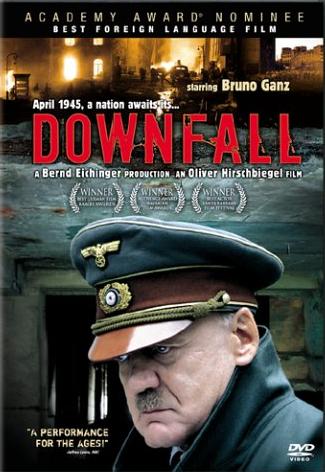
DOWNFALL (2004) - the horror of Hitler


DOWNFALL
(2004, Germany, DER UNTERGANG)

Who knew Hitler could be a YouTube hit? The stream of variations of 'Hitler is angry' and 'Hitler is informed...' recycles movie clips, but rewrites the English subtitles so that the Dictator appears to vent about lightweight grievances of modern life, ranging from iPads to football transfers. These are actually scenes from the 2004 film Downfall, usually when Hitler blames his staff for not informing him how much his troops have lost ground to the Allied forces.


I was prompted to see Downfall when I realised that producer/writer Bernd Eichinger and actor Bruno Ganz had worked together on this before The Baader-Meinhof Complex (2008). I also wanted to see if the YouTube phenomenon might affect newcomers to the movie. I found it engrossing, but also a doom-laden, claustrophobic experience. While I've always sought out horror movies, recently I'm finding well-made reality-based dramas far more horrifying than fiction.

It's not the first portrayal of Hitler's final days. There's been Hitler: The Last Ten Days starring Alec Guinness, and The Bunker starring Anthony Hopkins. It's a temptingly dramatic story. The dictator's death signalled the end of the Third Reich, Nazi Germany and World War II in Europe (Japan held out a little longer). Downfall is the latest version, and the first to be made by Germany, with the added benefit of a new and thorough eyewitness account from Hitler's secretary, Traudl Junge.


The story uses her as a central thread to the narrative, from when she first joins Hitler's staff in his reinforced concrete bunker. Crucially, Junge worked with him as the Russian forces finally approached the hideout, and were simultaneously closing in on Berlin. As commander of Germany's forces, Hitler refuses to surrender even though it means the continuing deaths of his outnumbered troops, as well as the civilians left in the city. Despite the desperate situation, his loyalty to his own extreme ideals threaten to drag everyone down with him.


Hitler is undeniably a complex role to portray in any depth, with the added challenge of having to distance the portrayal from every comedian's manic impression. Previous adaptions usually had actors speaking English with a German accent. But Downfall benefits from everyone speaking German. Bruno Ganz (Harker in Herzog's Nosferatu, lead angel in Wim Wenders' Wings of Desire) even had access to a rare recording of Hitler in conversation, in order to accurately mimic his ordinary speaking voice.

Hitler's secretary, Traudl Junge, had remained silent about the events she witnessed for much of her life. In her last years she helped write an account and appear in a documentary about her time with Hitler, when she was living and working in close quarters with him and transcribing his thoughts, right until his final testimonies.

The publicity emphasised this new account, though Downfall uses several other accounts, adding perspectives on what was happening elsewhere, particularly in Berlin. The production was controversial because the German people were still very afraid that any realistic portrayal of Hitler would show him as a human being, and therefore sympathetically.


But of course he was human, and Downfall dares to show the Hitler we don't usually see. Not grainy footage of of him shouting and gesticulating his speeches to the troops. Here he can be quiet, considerate, good with children and animals... But it's carefully presented as a paradox, showing that he was capable of compassion, even though he abhorred it as a weakness in anyone else. Under increasing pressure, his beliefs look like insanity to even his most trusted believers.

Downfall isn't just about historical events, but also an insight into the mentality of the Nazi leadership, and the strength of loyalty that enabled them to commit their crimes. Their lack of compassion extended to German civilians and their own families. The last nightmarish events in the bunker, on Chancellor and Frau Goebbels' final day, are even more as horrifying than the carnage on the streets of Berlin.


I started watching with a sense of dread, that reminded me of Titanic. I knew roughly what was going to happen eventually, and dreaded when and what I was going to see. The two and a half hours running time was a fascinating education and a haunting experience. The grim siege atmosphere where people coldly contemplate suicide over dinner. The horrible tension that the killing will continue as long as he's alive.


It's useful to know a little about the end of World War II beforehand, as there's little historical context included for newcomers. Knowing a little from a few documentaries didn't ready me for how powerful it was as a drama, rather than simply summarised in a voiceover.

The YouTube spoofs didn't spoil the film as I feared. I was already completely drawn into the story by the time that scene appeared. Don't get me wrong, I find them very funny. But I'm conscious that we only see Hitler played for laughs now - like when he pops up in Family Guy. He shouldn't just be a comedy character. Inglorious Basterds was a welcome change, to see a more visceral and emotional response to him.


The narrative is careful to show pivotal events from the perspectives of people we know survived the war to tell their story. In most scenes, it's carefully established which witness was around. I'm in awe of Bernd Eichinger's script having to distilling so much information, while including so much detail. It was a shock back in January when Eichinger passed away at the age of 61. Check out his production credits, you might be surprised at how many of his films you know.


Bruno Ganz's performance as Hitler is easily a career best. But there are many exceptional performances, especially from the women: Juliane Köhler as Eva Braun, and Corinna Harfouch as Magda Goebbels have extremely difficult scenes, but are utterly convincing. Alexandra Maria Lara, as Hitler's secretary Traudl Junge, has the central role, though is maybe a little too wise in some of her reactions.


The UK blu-ray from Momentum shows up a lot of film grain, but the 5.1 soundtrack adds to the feeling of being surrounded by a constant enemy bombardment. There are commentary tracks, making-of featurettes, some very interesting interviews with the main cast and an insightful summary from Traudl Junge's biographer of how her full story came to light.


I then watched the documentary Blind Spot: Hitler's Secretary (2002) as a test of Downfall's accuracy. It consists solely of filmed interviews with Junge, shortly before she passed away. It was a surprise to see a couple of contradictions between her accounts and some of the events in Downfall, like how she escapes, which proved that it had exercised some dramatic license. But I was very impressed at how the accurately the film portrayed the atmosphere that Junge describes in the final days in the bunker.

Junge talks about her life after the war, apparently dismayed how she was so close to Hitler for so long, while ignorant of what he'd been implementing. Her testimony is fascinating and not all of her stories are dramatised in Downfall, including an account of how his own men tried to kill Hitler (dramatised in Valkyrie) which actually ends up as funny.

Publicity for Downfall says this was the first dramatisation of Hitler in a German film. But interestingly there was another German-language portrayal, which Traudl Junge also advised on, in 1955. Der Letzte Akt (The Last Ten Days) was directed by the G.W. Pabst (Pandora's Box), but made in Austria. I can't find this available anywhere though.


Blind Spot: Hitler's Secretary was shown as part of BBC's Storyville documentary strand, and has been on DVD in the UK and US. Melissa Muller's book, written with Traudl Junge, is still widely available.

February 05, 2011

TENDERNESS OF THE WOLVES (1973) - still shocking?


TENDERNESS OF THE WOLVES
(1973, West Germany, Die Zärtlichkeit der Wölfe)

A recreation of the exploits of a German serial killer who attacked young men with vampirism, cannibalism and necrophilia. Watching it again, I've changed my mind about this film.


In post-war Germany (the film moves the setting from the end of the First World War, to the end of the Second), two petty crooks find a new way to find meat to sell to their bankrupt neighbours. Fritz Haarmann murders young homeless men, then sells pieces of their bodies to a local cafe. His lover helps dispose of the remains and cashes in the victims' belongings on the black market.

One of Haarmann's neighbours notices that young men go to his flat but are never seen again. But his reputation as a generous do-gooder and his job as a deputised police inspector help hide his crimes from the authorities...


I've always regarded this as a similarly taboo movie as I Spit On Your Grave, Straw Dogs and Last House On The Left. A 1970s' horror that pushed the envelope too far. An experiment in bad taste that history wouldn't repeat. Viewing it again, my knee-jerk reactions started kicking in again, critical that this was a worst-case representation of gay men. A weird-looking outcast who preys on young straight men for sex, sucks their blood, kills them and eats them... but not necessarily in that order. If that's not enough stigma-by-association for you, some of the victims were under-aged.

More objectively, I imagined the film with female victims, and it became more typical of seventies Euro-horror. The extreme elements of the murders are mostly implied and not shown. The most explicit angle of the film is the sexuality of the killer, and by explicit I mean kissing his boyfriend and the nudity of his prey. Compared to other films of the era, there's little difference in pushing the boundaries, besides gender. In Martin, the bloody victims and the nudity are female. Blood On Satan's Claw and To The Devil a Daughter both had full-frontal nudity of young women.


Admittedly many of the naked young men in Tenderness of the Wolves are gratuitous to the plot, once Haarmann's obsessions have been established. This casual and unflattering male nudity is surprising today, as it continues to be rare in horror or any other genre. I think it's this aspect that makes it relatively obscure, excluding it from it's two genres. Horror and gay-themed cinema continue to keep a mutually-exclusive distance.

I'm accepting the film now, but my paranoid defences originally made me back away, writing it off as indefensible back in the 80s when I first saw it. The theme of gay vampirism was too perfect for providing fuel for demonisation in the decade of AIDS hysteria. But Tenderness of the Wolves was made a decade before the AIDS crisis and might even have been considered relevant had it been released a few years later. It unhelpfully mixed the genre of lurid 'true crime' exploitation with the story of a gay love affair going sour. While it's a truthful and sympathetic depiction of a gay relationship, this isn't a great genre for making positive political statements. But what should you expect from director Ulli Lommel, collaborating with producer Rainer Werner Fassbinder (who also appears in the film as a sleazy pimp)?


Anyone frightened off by the recent quality of Lommel's films can be assured that this early work is well-produced and dramatically convincing. Though it's less of a narrative than a timeline of case history highlights. Even the detective work, usually the focus of true crime dramas, is sidelined as music replaces their dialogue. The corruption angle is hardly exploited, despite Haarmann working for the police while they're also hunting for him.


There are homages to Fritz Lang's M in quoted imagery and Haarmann being as completely bald as Peter Lorre's character, even though the real Haarmann had hair. M was also based on a different serial killer - Peter Kürten, the 'Vampire of Düsseldorf', whose most horrific crimes involved very young girls. The two films and their subjects are often confused, the original cases both being from Germany in the 1920s. Fritz Haarmann was known as the 'Butcher of Hanover', and his victims were young men between 13 and 20.

The shaven-headed Kurt Raab gives a relatively restrained performance as the killer (imagine Klaus Kinski in the same role), charming his neighbours and evoking sympathy when his boyfriend leaves him. Raab only lived to be three years older than Haarmann, ironically dying of AIDS-related illnesses. He'd had a full career as a screenwriter and actor, one of his last appearances was in Escape from Sobibor with Rutger Hauer.


I watched the Connoisseur Video VHS release from the UK (with a slight variation of the English title), which has good subtitles and a 1.66 widescreen aspect. The Anchor Bay release DVD is still available in the US.

September 03, 2010

METROPOLIS (1927) - the 2010 restoration


METROPOLIS
(1927, Germany)

Longest ever restoration of this early epic sci-fi.

I was excited to see a near-complete restoration of Fritz Lang’s Metropolis, which premiered in the UK last week. It was also my first time seeing any version on the big screen. The same way German silent films like The Golem (1920) and Nosferatu (1922) inspired the golden age of US horror in the 1930s, the silent epic Metropolis influenced science-fiction films for decades to come. Blade Runner (1982) is perhaps the most famous vision of the future that drew on Metropolis which, ironically, was also an expensive flop on its first release.


With a humanoid robot passing as human, impossibly high buildings, the underclass of society existing in the lower levels... there weren't many films that Ridley Scott could have looked to that were thematically similar and visually inspirational. I was surprised by a scene in Metropolis where the hero runs through a dark mass of gridlocked cars, an uncanny reminder of the central chase scene in Blade Runner. All that was missing was the rain. The climax of Metropolis also reminded me just how much Tim Burton borrowed for the ending of Batman (1989) – more than just a homage!


The story pivots on Joh Fredersen, the master of a futuristic city, his idealistic son Freder, and a young woman, Maria, dedicated to improving the plight of the hard-working underclass. Fredersen wants to sabotage her revolutionary work and turns to Rotwang, a (really quite mad) scientist. He’s impressively built a humanoid robot. Better still, he can perfectly disguise it as Maria, so that she can mislead the rebel workers. But this complex and sneaky plan could backfire on Federsen’s empire and the city of Metropolis itself...


While the skyscraping city was a projected glimpse of the future inspired by a trip that the director took to Manhattan, the story reads more like children’s fable than sci-fi. Huge crowds of citizens, like the factory workers, surreally act with a ‘hive mind’ even when they're off-duty. This simplistic unity of purpose reminded me of communist Russian cinema of the same era. While the swarms of extras are undeniably impressive, it’s tough to believe all those people would all make the same mistake (like forgetting about their children behind during a disaster).


The plot isn’t as strong as the striking visuals of men and machines, (men as machines), and the production design of a future city life and science. Some of the shots made me feel that I was being hit in the eye, a powerful overdose of visual imagination - the bizarre garden, the rare close-ups of the robot, the dreamlike mini-epic tale of Babel… are all powerful as still photos, but deserve to be seen brought to life.


Like Blade Runner and 2001 - A Space Odyssey, the visual effects set a high standard for science-fiction for decades. Using extensive large-scale modelwork, matte paintings and huge working sets, many seamlessly combined with models (using the in-camera Schufftan process). I’m also still impressed by the superb make-up work on the living statue of death, besides the iconic ‘robot Maria’. Talking of visual effects, her phenomenal near-nude dance is so powerful a scene, it’s still risqué today. Not for her costume, but the reaction of the panting crowd.


Metropolis premiered in Germany in January 1927. It had cost over a million dollars (back then). But within months, it was released in the US in a much shorter version, with its dialogue and narrative intertitle cards rewritten. This US version remained the worldwide template for decades, with the original German negative presumably destroyed in WW2.


A series of restorations have gradually clawed back footage, minute by minute, up to a running time of two hours for the 2002 restoration, (released on DVD by Kino as the Restored Authorised Edition). This version was in the process of being remastered for a Blu-Ray release, when most of the remaining footage was dramatically re-discovered in Argentina. The film is almost complete now, at 147 minutes out of the original 152.


The retrieved footage fleshes out almost every scene, but particularly clarifies Rotwang’s motives, and restores the part of Federsen’s creepy spy (Fritz Rasp), who strongly reminded me of film critic and Exorcist-fanatic Mark Kermode. Rasp was also the leering baddie who victimised Louise Brooks in Diary of a Lost Girl. He went on to appear in Lang’s more predictive sci-fi Woman in the Moon the same year (1929).

The downside is that this 25 minutes of newly recovered footage is heavily scratched and taken from 16mm film. It carries the missing narrative and reveals what we’ve been missing, but pales in comparison with the startling detail of the renovated 35mm footage. This can now be appreciated in more detail in the cinema and on the forthcoming Blu-Rays.


Misleadingly called ‘The Complete Metropolis’, it’s a miraculous restoration. The new recording of the original orchestral accompaniment helps the film enormously, adding to the energy and pace and sounding remarkably modern.

To me, the action still looks ‘sped up’. Some of the actors’ movements verge on comical, especially when young Feder is running around trying to save the day - at times he resembles The Flash. There are conflicting reports about the original projection and recording speed, but if it were slowed down to show more realistic motion, the running time would of course be even longer.


The new (almost-complete) Metropolis opens across UK cinemas on September 10th. There are also two special screenings with a live orchestra playing the original score at The Roundhouse on October 10th and 11th, details here. The BFI will continue to screen the film in November and December. In November the Blu-Ray lands in the US, then later in the UK.

The new restoration trailer, with a taste of the re-recorded original music is here on YouTube...


Running nearly two and half hours, 'The Complete Metropolis' may challenge the patience of anyone unused to black-and-white, let alone silent cinema. While I’m dedicated to the director’s original vision, I’ll also recommend a possibly more accessible version, the 1984 restoration. It offered colour tinting, an 87 minute duration, a cavalcade of eighties 'soft rock' music (including Freddie Mercury, Pat Benatar and Giorgio Moroder), and all the best highlights and visuals. The intertitles were transformed into subtitles and the framerate slowed to 24fps. But good luck trying to find it... last seen on VHS and laserdisc.


Another fan review with some great photos from missing scenes on the Libertas site.

Rare behind the scenes photos on this German site StyleMag....

Some before and after films of restoration of the new footage by Scientific Media.