Showing posts with label anthology horror. Show all posts

September 28, 2012

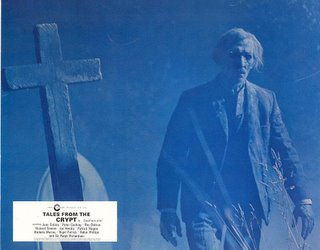
TALES FROM THE CRYPT (1972) - 40 years old and now on Blu-ray


TALES FROM THE CRYPT
(1972, UK)

Another look at the first EC horror comics movie

To mark the 40th year of Amicus Films' Tales From The Crypt, I watched the recently released Australian blu-ray, a very welcome HD upgrade. With so many darkly-lit horror films, there's sometimes 'picture lag' on DVD, where the shadows and darker areas freeze and shift, moving differently to the lighter foreground. Probably a combination of DVD compression and viewing it on an LCD screen, made even more noticeable by a larger screen-size. Blu-ray lessens the problems with its higher storage capacity.

Roy Ashton make-up study
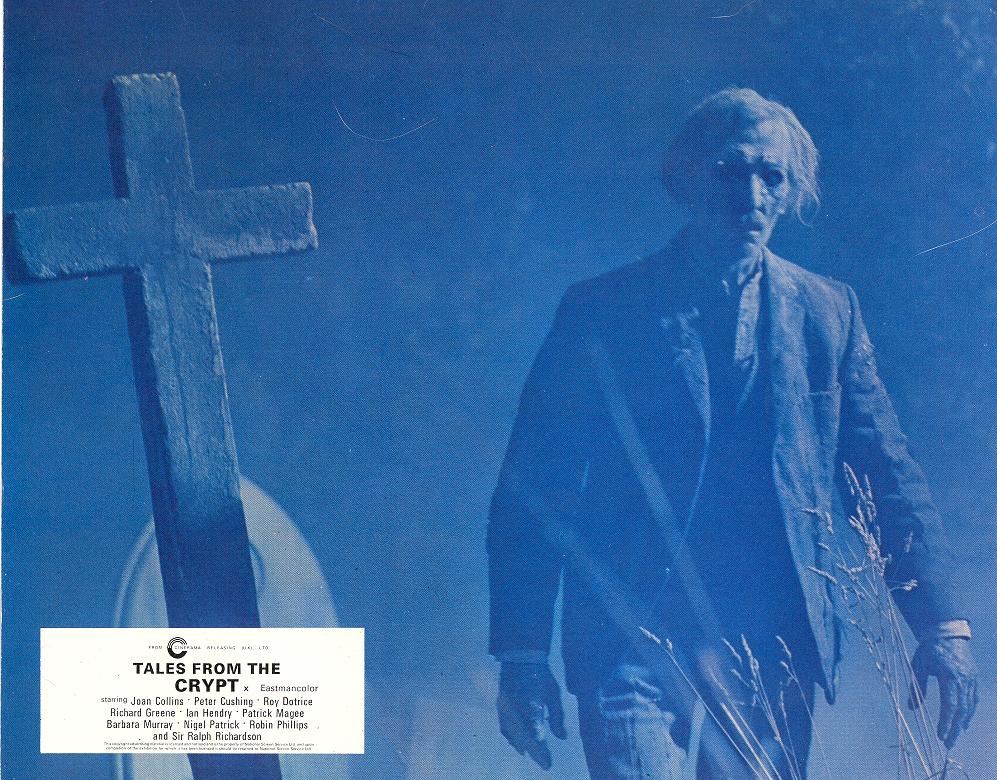
There's a little grain, as expected, and the print seems to have been in good condition. It's a slightly lighter presentation than I'm used to, Peter Cushing's 'black eye' masks are even more noticeable now. Of course, it's easy enough to adjust the contrast and brightness at home to make the scene suitably murky. Grimsdyke's scenes are so brief, I wish they'd just painted his eyes black and guided Cushing into doing the scenes completely blind. Okay, I think about that scene too much... but it's still one of the greatest-looking zombie make-ups.

The dead walks!
Tales From The Crypt of course has other undead characters... Plus of course the glorious, restored, censor cut that appeared in all the DVD versions. It used to be a huge jumpy film splice when it screened on TV in the 70s and 80s.

Late 1970s TV Times clipping
The Joan Collins segment really grabbed me. My first taste of a yet-to-be-named 'home invasion' story. Almost a silent movie, the story unfolds as we share her character's thoughts, communicated through some great visual storytelling. She discovers there's a raving lunatic just outside the house (dressed as Santa Claus), and quickly has to secure the house, barring the windows as he stalks around looking for a way in. All this is conveyed through her eyes and reactions. There's no dialogue, just an ironic roster of jolly Christmas carols playing on the radio.

Publicity foldout, and the original paperback novelisation
It's not the only story with effective, lengthy, wordless scenes. Ian Hendry's Maitland stalks around after a car crash, but we only see the horror develop through his point-of-view. In the final story, Major Rogers runs a home for the blind by skimming the money for himself. He pays for his crimes, locked in a solitary cell, again with no-one to talk to. Along with him, we experience his punishment gradually and silently.


While the original EC Comics stories would have a cruelly witty captioned commentary from the Crypt Keeper, the film presents him as a character inside the action, rather than a TV host. He's presented as a marvellously mysterious and ambivalent figure. What's missing in this early visualisation of Tales From The Crypt is humour, but that's certainly a benefit. Without the release of laughter, each ghastly twisted ending remains more haunting.

What a knight for a Crypt Keeper...
While IMDB currently lists the UK release as "October 1972", the UK premiere was September 28th (according to a contemporary issue of Films & Filming). In London that month, Crypt was up against John Boorman's wilderness classic Deliverance, Michael Ritchie's brutal Prime Cut and Ken Russell's angrily artful Savage Messiah. Tough, grim competition, but Crypt continued the success of the many short story horror films from Amicus Productions.

Australian Blu-ray, but the title heading is from the TV series
I was initially reluctant to order this Australian blu-ray, released by Shock Entertainment, because of the mixture of right and wrong artwork on the sleeve. There are photos from both the 1972 film and the 1990s US TV series. On the front cover is the poster from the film, but the typeface and green gloopy art is from the TV series. The front cover gives 50/50 odds as to which movie it contains. Thankfully, it's the Amicus film, but these confusing errors must have lost them sales.

More lobby cards, more facts, more of a review about Tales From The Crypt in Black Hole Movies here

The 1964 Ballantine reprint
In other trivia, the Wikipedia piece on the movie reports that writer/producer Milton Subotsky based most of his script on this 1964 volume of reprints because the original comics weren't available. Explaining the coincidence of why this paperback (published in the UK and US) has four out of the five original comic strips. (The fifth story was picked from the 1965 Vault of Horror reprint).

More about Grimsdyke's simple but effective make-up on the Peter Cushing blogspot and Grimsdyke rises again (publicity photo)...

Tales from the Crypt is uncut on DVD in the US and UK
Tales From The Crypt on DVD in the UK, pictured at the top

Tales From the Crypt on DVD in the USA, double-bill with Vault of Horror

1972 Jack Oleck novelisation, back cover


June 01, 2009

4bia (2008) - patchy Thai horror anthology


4bia
(2008, Thailand, See Prang)

I'm quite reluctant to write this review. I want to encourage Thai movies internationally, especially since the country is so keen on the supernatural genre. But I'm duty bound to write an honest review, to compensate for the growing hype, from both the east and the west. 4bia may have been successful in Thailand, with a sequel in the works already, but most of the good reviews seem to be saying 'this is very good... for a Thai movie'. Yes, 4bia has elements that are rare in Thai cinema - car stunts and CGI characters, for instance. While this might be impressive in Thailand, I don't honestly think it'll be at all satisfying for regular horror fans. 4bia only has one story out of four that I can recommend.

It's made up of four short horror stories, all by different Thai directors. While the title is a twist on phobia, the common thread is ghosts, as is usual with Thai horror.


The first segment is called Loneliness (though the onscreen title on the Malay DVD was Happiness). I was disappointed that the story centred on a mobile phone, now a ragged Asian horror cliche. The pace also started quite slowly, as a young woman with her leg in a cast starts getting text messages from a mysterious admirer. Just as I was getting restless, the tale started to get successfully creepy. This was interesting considering the director's previous films included The Iron Ladies films, basically feelgood comedies. But the carefully built atmosphere was shattered by a clumsy shock moment from a shoddy video effect and a confusing sting in the tale.


Second up was Tit For Tat, an example of the more gruesome wave of Thai horror that aspires to ladle out bloody shock effects. A schoolboy is victimised by a nasty gang of bullies and takes revenge using black magic. But this is presented with fast-cutting, shaky camerawork, pumped-up colours and a barrage of computer-generated effects, some successful (a whirlwind of paper) and some definitely not (CGI characters). The uneven special effects distracted me from the already flimsy story.

Best of the lot is the third story, In The Middle. Directed with a sure hand, from a director of Alone and the superb Shutter, Banjong Pisanthanakun. This is well-paced, well-acted and largely original. Four boys are on a camping trip in the forest, scaring each other with ghost stories in the tent at night and teasing each other about which horror films they've seen, (cue some smart in-jokes). But next day they have a Deliverance-style accident and the trip turns into a nightmare. This was easily the best - well made, scary and didn't insult horror fans.


Lastly is Last Fright where a stewardess attends to royalty on a specially chartered flight. But the princess starts ill-treating the attendant and everything escalates rather alarmingly. In the story's mission to scare, logic goes completely out the window in order to create any scares. Like part two, the director cheats the viewer every whichway, in order to get the shocks. The premise of royalty of any country (in this case a fictitious one) hiring a huge passenger jet all for one person is far-fetched to begin with. An appalling CGI plane sabotaged the segment, while the interior set was just about convincing.

So, a mixed bag, above average horror for Thailand, just about good enough as a TV film, OK for DVD. It's an accurate overview of Thai approaches to horror, with some over-familiar subjects. I'd like to see the directors of Dorm and Victim invited to the next batch.

The Malay DVD from Golden Satellite (pictured at top) is non-anamorphic widescreen. The English subtitles were well-translated but non-removable. Any curse words were censored with a silly black blob over the offending words. This could indicate that the gore had also been cut down for Malaysia. Maybe the promised UK DVD release later this year will have more gore (in the second story?).

As I'm still feeling guilty, in the name of balance here's the gushy review that inspired me to write this, and a far more balanced and informative review from Wise Kwai.

October 07, 2007

TALES FROM THE CRYPT (1972) - finally on DVD


TALES FROM THE CRYPT
(UK, 1972)


Updated November 2007
One of the best Amicus films and certainly the most consistent 'portmanteau' horror from that period. Thankfully, there are no 'comedy relief' segments included here - just solid non-stop scares.

The film's five tales are all based on stories from the original EC horror comics Tales from the Crypt and Vault of Horror. Linking the tales is Sir Ralph Richardson as the first screen incarnation of the Crypt-keeper. His piercing and accusatory questioning suitably transfixes the five tourists lost in his catacombs. As the Crypt-keeper asks each lost soul why they have come here, they tell their stories in turn - tales of deception, murder and life beyond death...


Among the cult British cast are Patrick Magee, (shortly after his appearance in Kubrick's A Clockwork Orange), Roy Dotrice, Ian Hendry and Joan Collins. The film's standout performance is from Peter Cushing, playing a victimised widower - it's very sad to watch him here, as he had recently lost his own wife. He won one of his few awards for this role and, without spoiling it too much, this is also a rare occasion when Cushing appears in 'monster' make-up, sparingly but brilliantly applied by Roy Ashton. The brief scenes of his 'little walk' provided some of the best publicity stills.


Cushing's role typifies the film's approach - to turn characters that were originally comic strip stereotypes into real people. In addition, the pervading grim atmosphere makes this 'compendium' horror far more successful than Vault of Horror or The House That Dripped Blood, both of which have comedic episodes.

The poster for the film also included my favourite scary movie skull - it was also on the cover of the paperback novelisation - the only merchandise from the film. The skull warns potential viewers of the pervasive atmosphere of premature death and is a visual link with the deathmask motorbike rider in 'The Monkey's Paw' segment.


It's been released on a double-bill with another short-story structured Amicus film, Vault of Horror, which is also widescreen, but unfortunately censored. Tales of the Crypt on the other hand, is not only the first time on DVD, but also the first time uncensored on home video.


An original trailer for Tales from the Crypt...


Here's the cover of the novelisation, and the 1964 paperback of EC Comic reprints which luckily includes four of the five stories adapted for this film!

The movie's opening theme is Bach's 'Toccata and Fugue in D minor' - this was a much overused tune in the horror genre - the most likely music to be played by any villain who owns a church organ - but this is my favourite rendition.


Presumably the delay getting Tales From The Crypt onto DVD was because of conflicting rights issues? Surely there was enough leeway not to confuse it with the nineties movies and the TV series?


Coincidentally, both the 1972 and 1989 films start off with an adaption of the same 'psycho-Santa' story ('And All Through The House'). You are therefore invited to make a side-by-side comparison and choose whether you like your EC horror played straight, or for laughs...


November 09, 2006

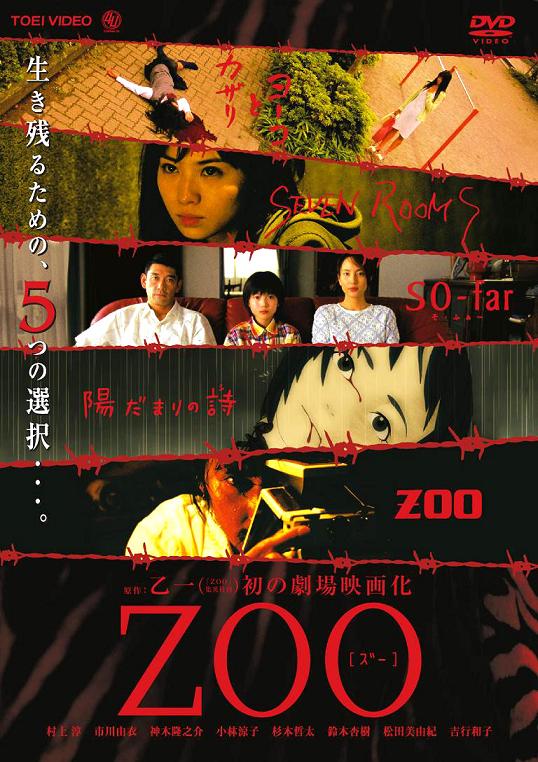
ZOO (2005) Japanese horror omnibus on DVD

ZOO (2005, Japan)
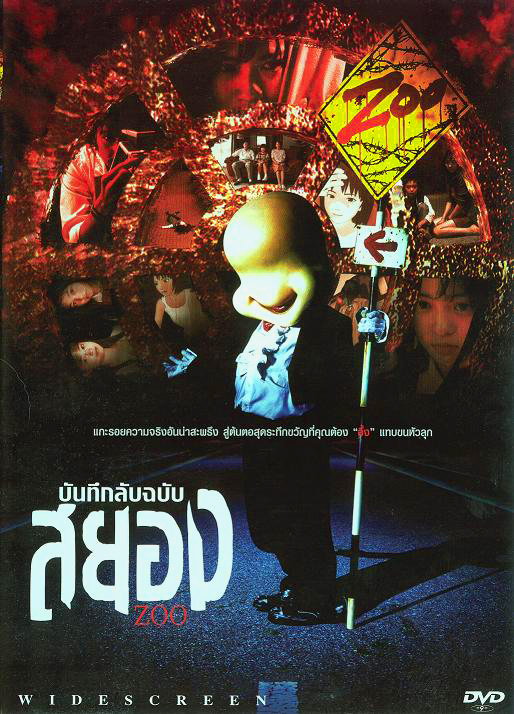
Thai PAL region 3 DVD (Cinema 4U)

UPDATE: Media Blasters to release Zoo on Region 1 early 2007

Zoo consists of 5 short films, all based on stories by author Otsuichi. Each story has a different cast, a different director and even a different scriptwriter. The result is unsurprisingly uneven.

Two Japanese books of Otsuichi's short stories

There’s no linking material, just a creepy, creeping red title graphic. The cheeky, eyeless character in the evocative poster and DVD art unfortunately doesn’t appear in the film. I was expecting that little figure to be a linking device.

I guess though that the stories are loosely linked by the themes of death and cruelty.


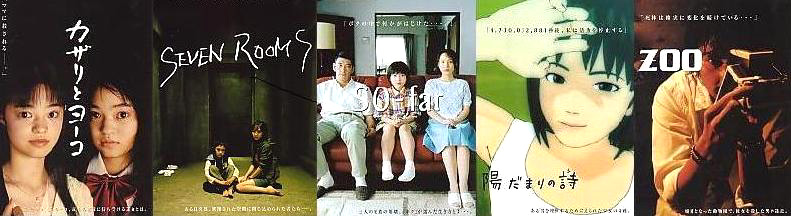
Japanese flyers for the five segments

1. Katari and Yoko
The film opens with a horrifyingly realistic image of a girl falling backwards from a block of flats. She has not jumped forwards, she’s been pushed back. We’re not sure whether it’s a flash-forward or a dream.

Ryoko Kobayashi (also from Hinokio) has a difficult dual role as two teenage sisters – one treated like a princess by their mother, one kept in a cupboard and forced to live like a dog, being beaten whenever she slightly annoys her mum.

Strangely, Yoko’s abuse seems to go unnoticed and ignored by the outside world. Surely, if she was taken to the school nurse, her many bruises would be seen. Also, her sister’s reactions to the violence, physical and otherwise, are vague – it’s implied that Katari is complicit and complacent. There’s many aspects of the story that are frustrating. But then there wouldn’t be a story.

As Yoko reunites a lost dog with its owner, she makes a friend, and perhaps she has finally found refuge from mother…

This first segment is still interesting as a horror tale, but it’s the performances that are the weakest here. Such meaty characters have been, as usual, given to a young pop star rather than a trained actor.

2. Seven Rooms

This is more intriguing. Mirroring situations familiar from Saw and Hostel (but without the gore), a young woman and her little brother, Satoshi, wake up in a stone cell. There’s a plate of food by the door and a concrete gutter of running water for a toilet.

The little boy finds he can push along the gutter to six other cells. Talking to the other prisoners, they discover that one disappears each day, then there’s a new arrival the next.

This should have been more frightening than it was – how many directors could foul up the arrival of a dark figure with a chainsaw in an enclosed space? Again the performances and the direction could have been a lot stronger here, but the story reaches a very satisfying conclusion. Like the claustrophobic Haze, I wished this could have been longer!

3. So fa

Thankfully this story has stronger performances. But this time the story is weaker.

A young boy (Great Yokai War’s Ryunosuke Kamiki) is left alone in family the apartment one evening, he hears about a fatal car crash on the radio. When he wakes up, his parents are back in the flat, but cannot see each other. Only he can see both of them.

Because story telling can be subtle in Japan, it’s not unusual not to see the crucial incident – we hear the crash, it’s more tragic and less sensational that way. It’s also cheaper to film - but I didn’t think of it as a cheat. In western films, if we didn’t see the crash we’d immediately know it was a story point. In Japan, it could just be the way the story is told.

Anyway, is the boy seeing dead people? We don’t know if just one of them is dead, or what. This short scenario doesn’t really develop until the pay-off.

4. When the Sun Shines

This was my favourite - it’s a short 3D CGI anime about a scientist and the female android he’s created. He’s created it for company, but has to teach it how to behave. Set in a house in the countryside, the android also has to learn about life and death...

Beautifully animated and directed, it’s not just the twist that’s enjoyable here.

5. Zoo

Lastly. Another nasty tale, of a photographer’s obsession with taking polaroids of his girlfriend, even after she’s dead! A pivotal scene takes place at a Zoo, but I wasn’t so impressed with the story.

But each to their own – with five different directors, casts and stories – this is a grab bag where each tale could appeal differently. They’re certainly unpredictable and miles better than many of the Japanese scary tales of terror and horror that have actually been released in the States. I'll certainly be revisiting this in the future.

Zoo has crept out on Thai DVD with unpublicised english subtitles. Initially heralded by TwitchFilm over a year ago - it’s yet another Japanese title that’s in limbo, much like the cover art depicts.

eThaiCD provided my copy – their website is innaccurate in saying there’s no english subs. They’re correct in saying it’s got Japanese 5.1 audio and an anamorphic widescreen aspect.

UPDATE 12th November 2006: SciFiJapan reports Zoo to get a US DVD release early 2007.


- - - - - - -


August 19, 2006

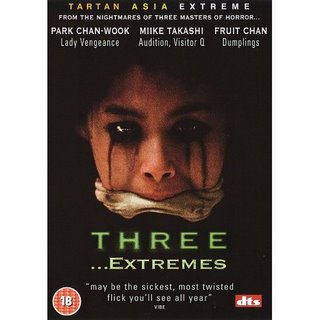
THREE: EXTREMES (2004) a trilogy of terror, blood and art

THREE: EXTREMES
Again, much has been said about this instant classic already, but after seeing so many insipid Asian ‘horror’ films lately, I was greatly rewarded by Three: Extremes. I watched the Hong Kong release (above) which has very good English subtitles.

It’s an anthology of three short horror stories by different directors, Fruit Chan from Hong Kong, Chan-Wook Park from South Korea, and Takashi Miike from Japan.

It's also a follow-up to the less successful Three (aka Three: Memories) made in 2002. Confusingly this previous film is about to be released on DVD as a sequel and called Three Extremes 2.

There’s also a spin-off movie which expanded one of the short tales into feature-length, called Three Extremes: Dumplings. Got all that? Together with different release titles in different countries, it’s not surprising that there's confusion.

It’s also strange that three different Asian countries should be lumped together, but that’s the nature of the West’s perception of Asian horror, I guess.

BOX
The first story in Three: Extremes is called 'Box', Takashi Miike’s most adult film since Audition. Artistically beautiful to look at, and impeccably acted. The story soon turns to a dark sexual side that shows the extremes that this Three is prepared to deal with.

It begins with a young novelist, haunted by dreams of being buried in a small box, discovering that she’s being haunted in real life by her twin sister. They used to be a double act in a small circus, but jealous that her sister was getting more attention from a magician, she tries to even the score, with tragic results. Mostly taking place in the winter, the snow makes her torment very picturesque.

Miike makes this effortlessly creepy almost straightaway. It’s also sensual, in a disturbing way, beautiful and distressing at the same time, creepy and alarming. A compelling short film. Possibly my favourite.

DUMPLINGS
The second, 'Dumplings', directed by Hong Kong’s Fruit Chan, is the most famous and sickest of the three, becoming so popular that the producers soon released an expanded feature-length version. The subject matter is almost unbelievable, but entirely possible.

A rich but fading TV actress tries to fight off middle-age by visiting Aunt Mei, a modern day witch who makes the most expensive dumplings in town. What can she possibly cook that will return youthful looks? The answer is pretty awful, and has to do Mei's previous profession as an abortionist...

The ghastly tale is beautifully rendered by Christopher Doyle’s colourful cinematography. The tale is also rich with subtexts about the differences between Hong Kong and China, superstitions transcending class, and the pressures on women deserted by their husbands for younger women. It’s a multi-layered story and understandably easy to expand (unlike the other two tales).

CUT
The third 'Cut' is the first disappointing film that I’ve seen from Chan-Wook Park, whose 'Vengeance' trilogy I rate as being my favourite films from South Korea (Sympathy for Mr Vengeance, Oldboy and Lady Vengeance). It felt to me like he was trying way too hard, including flashy one-take, impossible tracking shots (inspired by Panic Room, no doubt).


A movie director is held hostage on the set of his latest production. He's tied to the wall, his wife is superglued to a piano (!). If he doesn't comply, his wife is going to start losing fingers...

I found the premise for the hostage-taker's grievance unconvincing, and the final outcome didn't feel logical. It’s a great set-up and there’s some genius flourishes and twists, but in the company of the other two tales, it looked like the weakest.

Having said that, the climax made me feel the queasiest due to the amount of bloodshed!


So, if you like your horror films extreme (like the prolonged agony of Audition's climax), but thought it was slow, here’s a tale that delivers much, much faster. Creepy, gory, well-made, almost full marks!

Bravo!


Do you want to know more?

There’s a longer synopsis, full of screengrabs and spoilers at Dragon's Den UK...


Three: Extremes is out on Region 2 PAL DVD, with Three Extremes 2 due out later in the year.