Showing posts with label zombies. Show all posts
June 10, 2013
THE RETURNED - now showing on Channel 4
Just a quick, late reminder that the superbly-made creepy French drama The Returned has started this week on Channel 4. Eight one-hour episodes charts the startling return of a group of dead inhabitants of a remote French village. Technically they're zombies, but they look human enough and walk and talk normally.
Each family deals with the sudden return of a dead relative in a different way, each of them causing their own problems, not to mention that a series of killings has resumed in the village...
Beautifully filmed, subtly judged performances, music from Mogwai and a fresh take on the undead. Adult, occasionally violent, often sexual, the quality of the series has obviously won over Channel 4 into showing a programme from overseas with English subtitles for the first time in twenty years.
In the UK, you can catch up with the first episode on 4OD.
The Returned is known as Les Revenants in France and is a reimagining of an earlier French film from 2004. Full details and a look at the failed American pilot are here in my guide to all things Revenants.
February 02, 2013
LES REVENANTS - THEY CAME BACK again and again
LES REVENANTS
(2004 movie, France)
Low-key zombie movie rises again and again as several TV series...
(Updated June 10th, 2013)
Nine years ago, there was an unusual zombie movie made in France. More sci-fi than horror, more arthouse than mainstream, it didn't cause much of a stir. But Les Revenants (2004) won't stay dead.
The film portrays a quiet resurrection day, realistically portrayed except for the fact that the recent dead have inexplicably returned to life. They parade quietly out of the cemetery and want to return to their old lives. No flesh-eating, no scratching, no biting... they just want their old jobs back. Most of them are past retirement age and want to return home.
Local government move (extremely) quickly to the sudden crisis with emergency housing and rounding up the new citizens to be identified and reintegrated back into society. Their living relatives are treated carefully, to help them gradually overcome the shock. The reactions of the living characters are very touching, their mourning suddenly has to be reversed.
While their body temperatures are slightly low (allowing the authorities to track them with thermal cameras), they display no signs of decay. Director Robin Campillo (in this his only film) uses a wide variety of subtle techniques to make them stand out. Lit and made-up slightly differently, keeping them still, they gently stand out in every scene. The actors had to feel their way into a new kind of undead behaviour.
A very different addition to the genre, it remains a welcome change from the Romero blueprint. Knowing these characters were dead remains constantly gently eerie. It's never played as horror, but as mystery, an exercise in pure 'what if', beautifully judged and photographed.
There's no scientific or religious explanation for the phenomenon, though it could possibly be read as commenting about mental health, with the returned being carefully herded, watched and even drugged to make them more manageable.
Besides the central mystery itself, there's no other strong storyline, just a set of relationships. The phenomenon and its implications are presented in a relaxed but fascinating way. I enjoyed it as a zombie chill-out movie and also welcome further diverse approaches to the undead. Zombie drama, zombie comedy (Fido), whatever next?
But I didn't expect to hear of Les Revenants again...
LES REVENANTS
(2012, French TV series)
Just before Christmas, I learnt from Belgium-based writer Anne Billson (on Twitter) that there was a new TV series called Les Revenants (2012), based on a similar premise to the movie, on French TV. Eight one-hour episodes set in a small French village in the mountains.
This time it's a remote location, the mountains and a huge dam make for impressive visuals. The phenomenon of the dead rising isn't shown, just accepted. The performances make it believable. A young girl wanders home, back from the place she died. She's been missing for four years. Her memory is hazy and she doesn't realise that she's been dead. Her family are very, very shocked - in a brilliant scene when they first meet her.
Here, 'the returned' are less easy to tell apart from the living, so the news takes longer to circulate. Along with the reappearance of the dead, there's a murderer back in town...
A more violent variation on the film, the first episode teases interlocking mysteries and a townful of characters. I can't wait to see it all. The series has proved to be Canal Plus 'most watched' ever, meaning that there'll be a second season in 2014. The soundtrack by Mogwai makes it even more interesting.
We'll get a chance to see this creepy series on TV in the UK in June, the first foreign-language drama for Channel 4 in twenty years. Also, like many non-English-language TV imports, such as The Killing and Wallander, a remake is also on the way.
The rights to produce Les Revenants as an English TV series are now in the hands of Paul Abbott, the creator of Shameless, now in its eleventh and final season in the UK, with a third season in its US incarnation. This news reported here in The Hollywood Reporter in January.
BABYLON FIELDS
(2007, USA, TV pilot)
But there's already been an attempt at a series with a similar concept to Les Revenants made for American TV. In 2007, an impressive pilot episode called Babylon Fields narrowly failed to be turned into a series. It's worth seeing as an hour of powerful, edgy television, re-imagining the premise for a gun-toting, zombie-literate society. That is, some people are quick to shoot them in the head. But the Romero rules don't apply here...
The accent is very cop-centric. There's even a dead cop character, which could easily stray into the previously explored realm of Dead Heat (1988). The scene where the crowds of dead start leaving the graveyard are impressively and widely staged, The slightly-rotted look of the dead uses extensive make-up and slightly opaque contact lenses.
From the opening point-of-view scene of someone clawing their way out of the ground, to the shock of the first family to meet a living corpse is horrifying, panicky and suitably realistic. But it's less successful when it later adds a little comedy, when zombie neighbours try to pick up where they left off. It's good as long as it takes itself seriously.
Interesting that this didn't become a series considering the success of The Walking Dead soon afterwards. Not sure where the story could have gone, but it's a powerful opening episode. Maybe it could have become The Talking Dead...
Les Revenants - first season of the French TV series (2012, 8 x 50mins) is on DVD in France, but I doubt that the set has English subtitles. Channel 4 have announced that it will be aired in the UK in June, 2013 under the title The Returned. Amazon have ear-marked a page for a DVD release from Universal UK, but no firm details yet.
Babylon Fields - the US pilot episode (2007) is online to view here (42 mins).
They Came Back is the working title for Paul Abbott's new TV project to remake the French series...
May 27, 2011
DOCTOR BLOOD'S COFFIN (1961) - now on DVD
(1961, UK)
Zombie tale or Frankenstein story? You decide...
(Updated in 2014, for DVD releases)
I enjoy this more each time I see it. Originally sought it out after seeing a spooky photo of a man fighting something moulderingly undead in Denis Gifford's Movie Monsters. Seeing it, at first on late-night TV, the story was disappointing in that the punchline doesn't appear sooner. But a recent less-cut version on TV added just enough to make this a low-budget b-movie nasty, with the spectacular Hazel Court sealing the deal for fans of sixties' Brit horror.
A string of disappearances from a small village in Cornwall. The local police are stumped but we can easily guess what's going on, even though the assailant attacks from the shadows, the bloody title completely gives it away. Doctor Blood is up to no good.
Yes, it's Kieron Moore (he doesn't smile like this in the movie) who usually plays a shouty, grumpy, no-nonsense hero, is more realistically cast as a shouty, grumpy, no-nonsense villain. (You're all wrong, I'm right, I can do what I like. To hell with medical ethics and human lives...)
Before even the opening titles, only thirty seconds pass before Kieron starts shouting. This isn't to say I don't find him watchable. This lack of charisma in a leading man is as unintentionally entertaining as it is a mystery. Here he's a serial murderer who radically experiments on his subjects while they're not only alive, but still awake! The clumsy storyline reveals his morally-bankrupt identity before he starts wooing the heroine. How are we supposed enjoy their romantic day out? It's not played as suspense, like Hitchcock would have done, but as a budding new relationship.
There's another amusing mis-step when one of the kidnapped spends a long twenty minutes clawing his way out of a subterranean surgery. The narrative keeps returning to the crawling character like a running gag - nope, still not getting anywhere. In addition, if this had been a Roger Corman flick, the abductees would be the scantily-clad daughters of the village, not a bunch of wheezy old extras.
The bad doctor is so focused on his 'work' that he doesn't even widen his hunting ground, leaving the police in a spin as to which kidnap victim they're supposed to be looking for. Also, anyone who gets in his way quickly winds up in Dr. Blood's coffin. He never thinks through the details, like alibis. His trail of clues is clumsy and inefficient, much like his wooing.
The picturesque Cornish locations make a welcome change from Black Park and the suburbs of London and, despite the interiors being shot in a London studio, the sets look authentic and blend in well.
Hand-coloured lobby card - not the colour he is in the film!
There's blood and even a little gore, which would have leapt off the screen in Eastmancolour at the time, presuming it wasn't snipped by the censor. The special make-up for the result of Blood's experiments (above) looks really very good, more convincing than anything that later appeared in Night of the Living Dead, and it was duly splashed across the publicity art.
To compensate for Kieron Moore's heartless lack of charisma, Hazel Court amply warms up the screen as Nurse (Nosey) Parker. The late actress is so utterly professional that she can answer the phone with, "Dr. Blood's surgery", without a hint of camp or irony. Court appears here just after starring in Hammer's The Curse of Frankenstein and The Man Who Could Cheat Death, and just before a winning run of American horrors, appearing in three of Roger Corman's Edgar Allan Poe cycle - The Premature Burial, The Raven and The Masque of the Red Death.
Interesting to see future director Nicolas Roeg (Don't Look Now) rise from camera operator on Doctor Blood's Coffin, to director of photography on The Masque of the Red Death three years later. Visually there are a few interesting slants - low camera angles, deep focus, peeking through things and sometimes tilting the action (known as 'dutch angles'). Director Sidney J. Furie repeated and exaggerated this style for his best movie The Ipcress File (1965).
Dr. Blood is one sick little bunny - you don't see everything he gets up to, but he's a sadistic, vengeful, oblivious fan of human experimentation. He's nastier and less likeable than many of the movie Dr Frankensteins. His carelessness indicates he's more psychopathic than calculating. While the direction and script are slack, there's enough here to make it worth a look.
Doctor Blood's Coffin was very late getting an official DVD release anywhere, debuting on MGM's made-on-demand service in November 2011. While the restoration was good, the image was spoilt by being slightly horizontally squeezed. The 1.66 framing within a 16:9 anamorphic presentation, should have been stretched out to a standard 16:9 to correct the appearance of taller, thinner actors.
In July 2014, there was a DVD release in the UK, which unfortunately repeats the 'visual squeezing' fault. This is so close to the MGM release that it's even an NTSC picture, but coded for the UK as a region 2 disc.
Also, here's my quick chat with the man behind Doctor Blood's zombie, actor Paul Stockman, mid-2014.
This fantastic French poster is from sci-fi/horror poster site Wrong Side Of The Art.
November 13, 2010
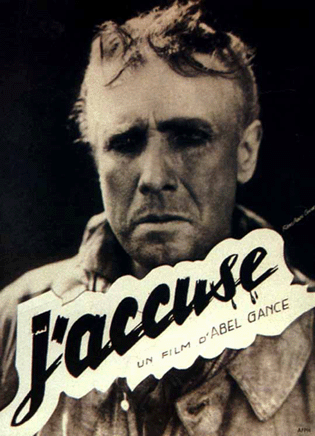
J'ACCUSE (1919 and 1938) - return of the war dead

J'ACCUSE
(France, silent version 1919, sound remake 1938)
Powerful pleas for an end to war
Never thinking I'd get to see it, I was fascinated by the images from J'accuse in the 1975 book Catastrophe: The End of Cinema (an illustrated guide to visions of the apocalypse that predated the 70's 'disaster movie' craze, and also anticipated the climax of Inglourious Basterds). I saw my first clip in David Gill and Kevin Brownlow's brilliant 1996 documentary The Other Hollywood (which looked at six European countries that once had film industries to rival America, before they were all put on hold by the two World Wars - enough time for Hollywood to dominate the market).

Director Abel Gance rose to command the country's biggest budget for a silent film with the epic Napoleon (1927), pushing the medium to its technological limits. A James Cameron for silent cinema, Gance attempted to include a sequence shot in every film format yet devised, including his famous triptych of three side-by-side sequences, and even a 3D section (removed from the final cut).
But Gance's two versions of J'accuse interest me more, for their early anti-war theme and horror-themed climaxes, where the war dead rise up and march on the living. A zombie fantasy to convey the real horrors of war. But the supernatural isn't the central premise to the films by any means. Gance is trying to convey many aspects of the impact of war through emotion rather than shock, through reality rather than fantasy.
Such bold statements from a famous director, I thought these films would be easy to see. But the 1919 film has only just hit DVD (as a special edition restoration from Flicker Alley), and the 1938 remake was restored and last released on VHS in 1991 in the US. Such sparse access through the years has meant that films like All Quiet on the Western Front (1930, 1979) are better known for representing World War One.
Abel Gance wrote and directed both versions, and even shot actual fighting during the end of the war. I'd love to know how on Earth he was allowed to borrow thousands of soldiers for the climactic marching scenes, during wartime, for an anti-war film! The splendid photography, lighting and rapid editing help the film look ahead of its time.
The story starts in a small French village, where idealistic poet Jean Diaz (Romuald Joubé), and brutish huntsman Francois (the impressive Séverin-Mars) are both in love with the same woman. Their rivalry is interrupted when they enlist to defend France from the German invasion. I was then surprised by a little comedy as both rivals find themselves in the same regiment.

When their beloved Edith is captured by the advancing enemy, both men are driven to the edge of sanity amidst the bullets and missiles of the trenches of 'the western front'. The war-torn love triangle reminded me of Pearl Harbor (2001).
Eventually Jean is discharged from the army with shell shock, leaving Francois tortured that Jean can now see his wife, who is actually hiding another more terrible secret from her husband.

When the war finally ends, Jean dares the townspeople not to forget their dead relatives and friends. He tries to convince them that the dead soldiers will rise up and revisit them unless their consciences are clear. Is that really going to happen, or has he been driven mad?

For the most part this is more melodrama than war film, but it benefits from being made at the time. There's realism in the emotional effects of war on the families and soldiers alike. Even small details ring horrifyingly true - the extended scenes of families saying farewell to sons, fathers and friends as they head for almost certain death, the soldiers' growing immunity to being around corpses, Francois thinking of his hunting dog as he lies in hospital... all well-observed and still uncliched.
Gance demonstrates his skill in directing actors, using choice close-ups, symbolic superimpositions and even rapidfire editing, I found his overuse of the iris effect the only dated visual device. But this remains an accessible and sophisticated film for 1919, helped by a good score, authentic tinted scenes and a realistic projection speed. It's still very watchable, owing to the relatively natural performances.

The new DVD presents an often scratchy, jumpy print, but one that gives us the original version of the story. Despite being 90 years old, many of the film elements still look good today, preserving the carefully lit cinematography. The montage that visualises Jean's poem to the Sun is particularly beautiful.
The remake is a very different film, a far more emotional and direct plea, albeit a mysterious one. When he completed the 1919 film the war had just ended, but in 1938 Gance was desperate to prevent it happening again.
It plunges straight into the war, eliminating practically the first two hours of his original story. The rest of the scenario is drastically altered and tightened. I only spotted a couple of shots recycled from the first film, and that was actual war footage.
Jean and Francois are still rivalling for Edith's affections. But in an attempt to settle their differences, Francois makes Jean swear that if he dies, Jean won't hook up with his wife. Victor Francen (as Jean) is so intense when promising his friend, it's almost hypnotic, and frighteningly convincing. Throughout the story, Francen repeatedly and passionately laments the dead with enough tears and conviction for a dozen Oscars. I'm surprised that the only other film I've noticed him in was as the ailing concert pianist in the Hollywood horror The Beast With Five Fingers (1945).
Gance is harsher, angrier, inter-cutting between the actual victory parade in Paris through the Arch De Triomphe, and shots of graves and corpses, all while upbeat marching music blares out. As the world gets back to normal after the war, Jean returns to live on the site of the battleground, near the graves of his comrades. His only friend, the cafe owner who kept the soldiers spirits high during the war.

The centre section of the story then tries to rush through the love triangle plot of the first film, adding a second more unsettling triangle between his beloved Edith and her daughter (who confusingly look the same age)! The narrative then skips forward twenty years to the eve of World War Two, suddenly introducing that Jean works at a glass factory where new war technology is being prepared.
One night, in the only passage of the film that deliberately looks like a horror film, his hair turns white while he's off tunnelling among the tombs. What has he seen? What has he learnt? He hints that he's now tense about what's going to happen and the power he now has...
I wish the core of the film was Jean's promise to his fallen comrades and his progressively more mysterious connection with their graveyard, as the scenes in his hometown appear to be far less relevant here. He appears to have been driven insane by his connection with the dead, rather than by shell shock in the first film.
This is a much darker film, with many evocative passages pleading for sanity. The climax is far longer, more elaborate, a little confusing and pregnant with unused possibilities. The march of the war dead is realised both by stony (clay?) make-up and hundreds of actual war veterans who had been maimed and disfigured in the war, at a time when plastic surgery and prosthetic replacement were in still their infancy.

I suppose it's not important how Jean calls the dead back - it appears to be by sheer force of will - but with a two-hour running time, a little more time spent on his methods would have been welcome. For such a monumental build-up, the final pay-off is powerful, but relatively short and ultimately too simple. Obviously, the dead want the living to remember their sacrifice, nothing more. I'd like a sequel to see what the dead did next! With all the rage and sacrifice, I'd have expected more anger and choicer targets. In a similar vein, Joe Dante's Masters of Horror episode 'Homecoming' (2005) brilliantly brought all the dead soldiers back to life... to vote!
Again Gance uses real war footage, but by 1938 film projection speeds had changed, resulting in a marked difference in quality and far too 'sped up'. His use of cross-cutting is more jarring as a result. But I'd have thought this version of J'accuse was one to deserve a special edition DVD. The only copy I could find was this 20 year old VHS from Connoisseur Video.

I'd also recommend The Great War (1964) as a first hand guide to the First World War. Using only documentary and newsreel footage, as well as eyewitness testimonials from both sides, this BBC series exhaustively described the harrowing history of 'the war to end all wars'. It was recently released on DVD in the UK.
The World At War (1973) is an epic documentary series about the Second World War, and has just been restored and released on Blu-Ray. It's a harrowing and thorough history lesson, that I'd be reluctant to see again in any greater visual detail. Some of it is so gruesome and tragic.
January 29, 2010
THE LIVING DEAD AT THE MANCHESTER MORGUE (1974) - bloody Italian zombie horror!

THE LIVING DEAD AT THE MANCHESTER MORGUE
(1974, Italy/Spain, aka Let Sleeping Corpses Lie,
Non si deve profanare il sonno dei morti)
(1974, Italy/Spain, aka Let Sleeping Corpses Lie,
Non si deve profanare il sonno dei morti)
Slow-moving undead, outbursts of graphic gore, gothic atmosphere... the next step forward from Night of the Living Dead in the evolution of zombie movies!
For years, Italian movies were seen as thinly-disguised remakes of popular US hits. Certainly the intention here was to remake Night of the Living Dead, (according to an interview in the DVD extras), but the result is a very different zombie movie, mostly because director Jorge Frau wanted something more original.
The result is similar in setting to Lucio Fulci's City of the Living Dead (1980) and is at times as violent as Dawn, or even Day of the Dead. But crucially Manchester Morgue predates these films by several years. This is one of the first high-strength zombie films made in colour. Only Tombs of the Blind Dead (1971) comes close for creepy and gory action, but there the undead are more skeletal than zombie.
It begins with a young man riding a bike into the British countryside for a weekend trip. Looking for directions, he encounters a farmer experimenting with machinery designed to eliminate pests from his crops. The huge gadget amplifies the insects' desire to destroy each other... Soon after a young woman wrecks his bike, and together they meet more trouble in the form of a corpse roaming the countryside...
The result is similar in setting to Lucio Fulci's City of the Living Dead (1980) and is at times as violent as Dawn, or even Day of the Dead. But crucially Manchester Morgue predates these films by several years. This is one of the first high-strength zombie films made in colour. Only Tombs of the Blind Dead (1971) comes close for creepy and gory action, but there the undead are more skeletal than zombie.
It begins with a young man riding a bike into the British countryside for a weekend trip. Looking for directions, he encounters a farmer experimenting with machinery designed to eliminate pests from his crops. The huge gadget amplifies the insects' desire to destroy each other... Soon after a young woman wrecks his bike, and together they meet more trouble in the form of a corpse roaming the countryside...
I was very aware of the film when it was released in the UK in 1975, because of the spread in World of Horror magazine (issue 7), which made it look rather fierce! But I only got to see it years later when it appeared on VHS, and then it didn't look so essential, with all the gore missing, a cropped aspect and a murky transfer. Since then, the film kept re-emerging in different countries, in various formats, under different titles with different amounts of uncensored gore.

Seeing the new Blue Underground Special Edition has really opened my eyes to this movie. It's now not only a great zombie movie to watch, it's really early in the 'modern zombie' timeline, that started with Night of the Living Dead. The explicit brightly-coloured gut-ripping took zombie cinema to a new level, making it essential viewing. This was notably released halfway between Night and Dawn of the Dead, stealing some of Romero's thunder, not to mention leading the Italian zombie movie genre by several years. Dare I say, I might have been less impressed with Dawn of the Dead, if I'd seen Manchester Morgue when it was released.
Instead of Night of the Living Dead's Vietnam subtext and the underlying racial conflict, the main theme of Manchester Morgue is the very wide generation gap of the seventies, where the young (well, youngish) people mistrusted authority, especially the police, and the feeling was mutual. Here the detective in charge of the murder case (Arthur Kennedy)suspects the young couple for committing Manson-style black magic ritual killings. Certainly a more plausible theory than reanimated corpses...
One of the most distracting things about Italian horrors is usually the dubbing. Here is a rare case where the revoicing improves the film. Ray Lovelock's Italian accent is replaced with a London one with a sarcastic tone that would feel at home in Shaun of the Dead. I'd really like to know who the voice actor is who dubbed him, he really helps the character. Like Al Cliver in Zombie Flesh Eaters, Lovelock (who can be seen beardless in The Cassandra Crossing) looks the part, acts the part more than convincingly, but their new voices seal the illusion that they're actually English-speaking! The combination results in a uniquely short-tempered, anti-establishment zombie fighter!
The other unusual aspect that I really love is the use of the British countryside and the city of Manchester. It's always a thrill to see classic European horror films shot in England, an honour really! The key locations of the hospital and the church are made to look like the scariest places on Earth. I'd always thought that the interiors were filmed in real buildings until I saw the DVD extras, which confirm they were actually shot in Italy.
A whole disc of DVD extras includes very watchable interviews about the making of the film and the make-up effects. There's an extensive tour of the original locations with the director himself. It's also great to finally have the film with the original UK title that I know and love (I already have the Anchor Bay edition called Let Sleeping Corpses Lie - here's a DVD Active review comparing the two releases). Blue Underground have also now released this new special edition on Blu-Ray.
An original trailer is here on youTube...
October 11, 2009
DAY OF THE DEAD (1986) - George Romero's best zombies
DAY OF THE DEAD
(1986, USA)
I'm a huge fan of Dawn, but Day is a better film(1986, USA)
I find it hard to review my very favourite films objectively, but here goes.
After being seriously wowed by George Romero's classic Zombies: Dawn of the Dead (1978), even in the censored form that hit UK cinemas and then home video, I was anticipating that this follow-up would be a huge draw. I saw Day of the Dead at one of the hugest screens in the country (the Odeon, Norwich) and was vastly impressed, though it was a largely empty cinema. It was a shock to see it so poorly received, at a time when the country was booming with VHS rentals rather than cinema-going.
The 'living dead trilogy' (as it was called before Land of the Dead ushered in Romero's new batch of Deads) marked three decades with a progression in the zombie's history of mindless world domination. The first was a local phenomenon, the second was when the tide turned, and in the third the Dead rule the planet.

These were the days when zombies only shuffled (though they seem to move a little faster when a meal is close). They may be slow, but win through force of numbers. Another method Romero used to add zombie threat was by placing victims in confined spaces, like a basement, an apartment block or the corridors of a shopping mall.
It was all the more claustrophobic in Day of the Dead, when our heroes are trapped underground in a maze of caverns with only one entrance. I thought the corral, the cave where the zombie 'guinea pigs' await experimentation, was the ultimate in zombie nightmares - being trapped in the dark with hungry flesh-eaters hidden in a maze of tunnels - I still get tense when the soldiers have to use the corral gates to retrieve zombies for experimentation, under orders to get real close to them.
In each film in the trilogy, Romero's film-making skills evolved, as did his female characters. The leading women went from traumatised victim, to equality-seeking girlfriend, to level-headed alpha female. Here Lori Cardille represents the strongest female lead in the first Dead cycle (tricycle?) as a scientist who's also handy with a rifle. The movie starts with an excellent scene (shot in Fort Myers, Florida) showing a town over-run with zombies. I'd liked to have seen more scenes of city life, a taster of how I'd wished I Am Legend had been made.
As the dwindling numbers in a military project, to solve the zombie problem medically, lose another member, tensions rise between the soldiers and the scientists. Are they on the brink of a discovery, and are they going to be able to hold out long enough?
Dr 'Frankenstein' Logan (Richard Liberty) plays an obsessed but amusing mad scientist. He blinds the military with logic, defending himself from the trigger-happy Captain Rhodes (Joe Pilato), who's impatiently in charge of what's left of the sex-starved soldiers. John Amplas (the star of Romero's Martin) provides sturdy support as one of the few sane minds left on the planet.
A special mention goes to Howard Sherman as Bub, the greatest ever zombie character of the movies, the first (slightly) domesticated zombie. A possible key to the survival of the human race... co-existence!

To me, Day of the Dead has Romero's most consistent cast, the best characters, the tightest story and script, and the goriest effects. Though the blood is used more sparingly, the shock effects are startling, setting a high benchmark for the genre.
While there's nothing quite as memorable to match the iconic shopping mall of Dawn of the Dead, the story flows logically as the remainder of humankind continue to tear each itself apart.
Make-up king Tom Savini excels at engineering the effects for Dr Frankenstein's nasty experiments, as he tries to surgically isolate what makes zombies tick. The gore is unbearably real, the zombies are by now in an advanced state of decay, the deaths are the nastiest yet.
The only false note for me was that the music was far less memorable. It did the job, but i was expecting another iconic Dawn of the Dead strength soundtrack. To me, the music of Goblin will always be the official theme tune for any post-apocalyptic zombie invasion.

I've got the Anchor Bay Divimax DVD edition (pictured), which has great extras, especially the documentary. Not sure that I want to see the gore any more clearly though, in the new Blu-Ray edition, but I bet Savini's FX remain undetectable.
The original widescreen trailer is here on YouTube, or here's a subtle teaser...
March 05, 2009
RAUMPATROUILLE (1966) - Germany's SPACE PATROL
(1966, West Germany, TV, Space Patrol))
'The fantastic adventures of the Spaceship Orion'
Some sixties sci-fi that used to look futuristic, now doesn't. But those retro-predictions now provide glimpses of alternate futures of varying optimisms. I've now seen most of what the fifties and sixties offered and am currently in the mood for black-and-white TV shows, like Fireball XL5. There are still a few films from the period that I haven't seen - I only recently caught Planeta Bur from Russia, for instance.
So, if you want to see spaceships taking off from an underwater base via a whirlpool, ironclad beehive hair-dos, space cardigans, and invading aliens (called Frogs), you're in luck. Raumpatrouille (literally Space Patrol) was the first major German sci-fi TV show. It threw a big budget at huge sets and major special effects. As a result of the cost, it only ran for seven one-hour shows, but achieved a unique look - another future that never was. A future where spaceships are spacious, and unnecessarily huge. When Earth is no longer divided up into countries (and, apparently, everyone is now German).
Some sixties sci-fi that used to look futuristic, now doesn't. But those retro-predictions now provide glimpses of alternate futures of varying optimisms. I've now seen most of what the fifties and sixties offered and am currently in the mood for black-and-white TV shows, like Fireball XL5. There are still a few films from the period that I haven't seen - I only recently caught Planeta Bur from Russia, for instance.
So, if you want to see spaceships taking off from an underwater base via a whirlpool, ironclad beehive hair-dos, space cardigans, and invading aliens (called Frogs), you're in luck. Raumpatrouille (literally Space Patrol) was the first major German sci-fi TV show. It threw a big budget at huge sets and major special effects. As a result of the cost, it only ran for seven one-hour shows, but achieved a unique look - another future that never was. A future where spaceships are spacious, and unnecessarily huge. When Earth is no longer divided up into countries (and, apparently, everyone is now German).

My introduction to the show was through the lounge music par excellence of Peter Thomas, also famous in Germany for his TV themes and krimi movie scores. A European answer to Vic Mizzy, his enthusiastic and eccentric electric tunes aimed at being catchy enough to turn into hit singles. During the lounge revival of the 1990s, several CDs featured his work and the soundtrack for Raumpatrouille even got its own CD release. Not to be confused with the American Space Patrol TV series of 1950, or the British Space Patrol puppet series of 1963, the German series was released on DVD in 1999, and I had to see it.

Now, I've just bought the German three-disc boxset, of 2005 (pictured at top). The first two discs are exactly the same as the 1999 2-disc release (pictured here), which also had all seven episodes, remastered 5.1 audio, plus a few extras. The difference now being a third disc, with additional extras and a 2003 'movie', condensing the series into a single 90 minute storyline. Because of the series' kitsch value in Germany, this re-edited 'redux' adds newly shot scenes of a newscaster setting the scene and filling in the story gaps, but for laughs. It's an easy target to lampoon, but viewers could easily work out for themselves that the hairstyles and dance moves look bizarre. This unwelcome additional footage is intrusive but fairly brief.

The best aspect of the movie version is that it is subtitled in English. Amazon.de lists the 2005 boxset as having English subtitles, but these only appear on the movie condensation, and unfortunately not on the individual episodes. At least we can now it's possible to understand the important plot points of the series. Usefully, this movie version, sometimes called 'the producers cut' is also available as a separate release (pictured here).
The series was digitally remastered for the DVDs and looks brand new. It appears to have been made on 35mm film, but some of the visual effects appear to have been composited electronically - this could either have been pioneering work, or recently added. In any case, there's much to admire. The spaceship is as impressive for its manoeuvrability as its design, though the enemy Frog ships are less convincing as they dart about. Any rare personal appearances by the Frog aliens are ethereal. A haunting effect, seen as barely humanoid, sparkling shadows.

The huge, solid sets, alive with built-in lighting, backlit plastic, and shiny surfaces date from when silver in sci-fi was compulsory. The spaceship interior features control panel designs that defy description and gravity, much like the floating multi-armed robots (see below). The centrepiece is the commander's impressive circular table-top viewscreen, displaying intricate navigational information, (stop-frame animation and back-projected into the set, presumably from below).

But for many, watching the series without subtitles won't be tempting, especially when it's so talky, but the 1999 boxset is now sold for under 10 euros - that's seven hours of future Euro retro, people.
In Germany, the story of the Spaceship Orion and its crew lived on in over 100 paperback novels. The popular Perry Rhodan was more famous for a similar space adventure premise, and ran into hundreds of novels (and two movies, which are also rare outside Germany).

I've not seen any other German sci-fi, except for Star Maidens (1976), a co-production with the UK, where more was spent on hair-styles than special effects. Again, the soundtrack was the series' most memorable legacy.
Do you want to know more?
There are some great stills and memorabilia on this English Peter Thomas site, and there's this extensive German Raumpatrouille fansite - the Starlight Casino.
Here's the opening of episode two, including the original theme tune, on YouTube...
...and here's a recent remix of the theme tune, with clips from the show...
October 25, 2008
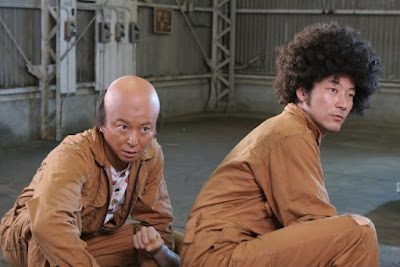
TOKYO ZOMBIE (2005) - Tadanobu Asano in a funny wig
Finally got to see this, now that it’s been released in the UK on region 2 DVD. It’s a shock to see Tadanobu Asano in an afro wig in a zombie comedy - his latest appearance is as the young Genghis Khan in the first instalment of the epic Russian trilogy, Mongol!
I always think of Tadanobu Asano as appearing in slightly quirky, quality drama (Zatoichi), with some offbeat arthouse (Invisible Waves, The Last Life in the Universe) and the occasional offbeat horror (Gemini). But I guess Ichi The Killer should have clued me in that the actor is up for anything.

Tokyo Zombie starts off well enough, with Asano and Sho Aikawa as two amoral slackers on the frontline of a new zombie outbreak. This is caused by dumping too many corpses in with too much toxic rubbish on the outskirts of Tokyo, and named Black Fuji because it’s such a big pile. In reality this could have been filmed anywhere in Japan – for instance the early action takes place in a grotty factory and at a rubbish tip. This disappointed me because I was expecting Tokyo to feature in Tokyo Zombie.
The accent is on the stupidity of the two friends who are more interested in practising jiu-jitsu than working, or fighting zombies. I first thought that the wrestling was a long set-up for a later gag, but it’s more like the core of the story! The early scenes of people dumping bodies are unusual, irreverent, and edgy. Though a sub-plot about a lecherous teacher is more mercilessly aggressive than funny, and ties in with an insecurity about the duo's preoccupation with denying they are gay, despite their close and physical friendship. This dated much of the humour and pitched it about the level of schoolboy comedy.

Taking to the road to escape the growing zombie horde, the two literally pick up a young woman, but then around halfway in, the story comes to a dead halt, and goes in a completely new direction. Nowhere. Stalling for too long in an obviously small set and a not very elegant story contrivance. This is where the film lost me, by throwing away all the gathered momentum and never recovered.
I'm probably missing a lot of the humour, but the story also chooses to explore the sketchy characters like they could actually exist, and also introduces other eccentrics with even thinner motivations.

The zombie action is fun when it's allowed to interrupt, and there are a few well-staged and elaborate visual gags. Adana seems to be enjoying himself, though his acting isn't even stretched as much as Aikawa. It’s all bizarre and quirky, rather than funny. So if you want something different, it's certainly a very different scenario. But the story looks to me like the first and last chapter of a manga, with the middle torn out.
It’s in the same tournament, but not in the same league, as Shaun of the Dead.
UPDATE 13th April 2009
Tokyo Zombie is also out now on DVD in the USA...
Subscribe to:
Posts (Atom)