
Japanese horror meets children's anime - forty years and still going strong
UPDATED - November 2013
Gegege no Kitaro is a popular anime series that first appeared in 1968, and as a manga before that. Wildly imaginative, it visualises a parade of bizarre creatures and mythologies with roots in ancient Japanese and Chinese ghost stories. I'm hoping this character will one day gain popularity in the west.
I stumbled on a Gegege no Kitaro exhibition atop the Sunshine Tower skyscraper in Tokyo in 2004. Drawings and cels were on display, as well as vintage memorabilia. I returned to England wanting to know more about the one-eyed boy who was surrounded by monsters.
 |
| An original Japanese manga compilation |
The 'ghost boy'
Kitaro and his friends are 'yokai', a Japanese word for monsters, goblins, ghosts and demons. Together, they help sort out problems between humans and mischievous, aggrieved or downright evil yokai monsters.
Usually the stories are of human beings who upset a yokai, or its resting place. The yokai then victimise humans - they can swallow them whole, steal souls, kidnap children, melt faces... all sorts of unpleasantness and rather scary for a young audience. Slightly heavy-handedly, they are also being taught not to litter, not to disrespect their ancestors, staying out of graveyards at night etc.).
Kitaro is the last of an ancient 'ghost tribe'. He's undead, often introduced as emerging from a graveyard, and being half-human (it's complicated) he has many special powers - such as yokai-detecting hair, projectile wooden sandals and a protective yellow and black waistcoat.
He is aided by his father, who has withered away to just an eyeball with a tiny body! Medami Oyaji is very knowledgeable, and travels around hidden away under Kitaro's hair (actually living in his vacant eyesocket - though this is only inferred in the TV series). He likes to bathe in a hot bowl of water (much like the Japanese spas).
 |
| The smelly Nezumi Otoko (from the 1996 title sequence) |
Kitaro has a gang of allies that have accumulated through the years, the first of which was the untrustworthy Nezumi Otoko - an often traitorous trouble-maker (much like Dr. Zachary Smith in Lost in Space). He's lecherous, greedy, two-faced and his powers derive from his body odours, gasses and foul breath.
Kitaro lives a simple life in the forest up in a treehouse, amongst the woodland creatures with which he can also communicate. When he's not flying around on Itamomen, he can be sky-lifted by a flock of crows. Kitaro is quite poor possessing only a treehouse and the clothes on his back. But unlike half-man, half-rat, Nezumi Otoko, he's content with what he's got, dedicated to keeping the peace between humans and yokai.
The characters have spawned a ton of merchandise - I like the toys, action figures, CDs, and manga. But Kitaro is probably best known for the many spin-off video games in Japan.
The King of the Yokai
Shigeru Mizuki is the author and illustrator of the original Kitaro manga stories, and has also single-handedly kept many ancient ghost stories alive. He has written encyclopedic guides about the many ghosts and goblins from local legends all over Japan.
His stories share yokai characters with the Japanese 100 Ghost Stories film trilogy of the 1960s. Indeed Mizuki was heavily involved in the recent remake Yokai Daisenso, and even had a cameo as the King of the Yokai. Like that film, Kitaro also has a modern day setting, alongside ancient demons that have only previously appeared in period-costume ghost stories (like Kwaidan).

This huge volume of early Kitaro manga was published, in English in 2013, along with several other volumes of Shigeru Mizuki's work. To celebrate the author's 90th birthday, his complete life's work of manga is being republished in Japan, but we've only just started seeing it in English!

Among Mizuki's other manga work is an autobiographical account of his World War II experiences in the South Sea Islands, in which he lost an arm during a bombing raid. This has also just been published in English for the first time, under the title 'Onward Towards Our Humble Deaths'.
Japan’s love for Mizuki is most evident in his home town of Sakaiminato where there is a museum dedicated to him (a scene was filmed there for Yokai Daisenso) on a street where there are bronze statues of many of his most famous characters. What a tribute! (See some of the statues and a guide to the town in a tourist website here).
 While Shigeru Mizuki's many reference books about yokai monsters have only been published in Japanese, I found this recent publication to be immensely useful - Yokai Attack!: The Japanese Monster Survival Guide (on Amazon here). It lists the most famous yokai, their appearances and habits and answers an awful lot of questions I had about Japanese monsters and superstition. Manga-translator Zach Davisson also has a blog about the many original yokai stories here.
The TV Shows
Mizuki's popular manga about 'ghost-boy' Kitaro have been turned into long-running TV anime series in every decade from the 1960s onwards, totalling over 400 animated episodes!
In 2006, all the older series started being restored and released in huge (expensive) DVD boxsets in Japan, as 1960s, 1970s and 1980s collections. In 2007, the 1997 series boxset followed, as well as a low budget 1980s live-action movie. An anime movies boxset collected the short supporting films that were made for cinemas.
Though most of these boxsets are now out of print, individual DVD volumes are being released in Japan of all the series, including the new one that started airing in 2007. None of these have any English subtitles on them. In 2013, the 1970s series was being reissued on DVD as part of a regular fortnightly Kitaro magazine (see below for an example).

I was hoping that maybe the live-action films of 2007 and 2008 would open the way for some subtitled DVD releases of the anime in the west. But despite the lack of translation, I'd still recommend them. They're great for yokai fans, though another good place to start would be the movie versions, because they're nearly all action.
So here’s a brief guide to the anime series so far, and how to tell them apart (thanks to Anime News Network):
Season 1 (1968) 65 episodes
The opening titles start in a graveyard full of woodland animals singing the theme tune, conducted by Kitaro. Nezumi Otoko and Kitaro also appear sitting in a car. (See YouTube for these opening titles).
This is a black-and-white anime series. primarily involving just Kitaro, his father (the eyeball) and Nezumi Otoko (like the early manga stories). The episodes I've seen are interesting examples of early TV anime. Faithful to the manga, they are scary and occasionally brutal, by modern standards.
 Season 2 (1971) 45 episodes
The title sequence again opens in a graveyard, this time in colour. There are lightning flashes and Kitaro, his father and Nezumi Otoko are again the only regular characters in the titles.
This was the first colour series, and has more action in it. It's still quite creepy, like the 'Queen of skeletons' episodes demonstrate. Nezumi Otoko is still driving around in his old car, unlike the later series.
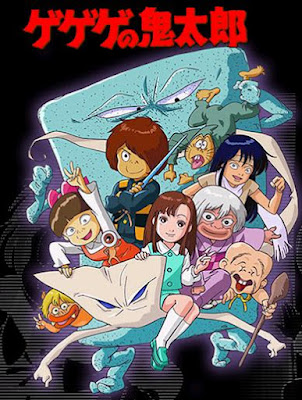
Season 3 (1985) 108 episodes
This title sequence opens with skyscrapers, and tilts down to Nezumi Otoko and (for the first time) all the other regular yokai singing the familiar theme tune, with everyone pretending to be rock stars. The titles end with Kitaro rescuing a human girl (Yumiko) with his flying wooden sandals.
Yumiko is a new regular character for this series. I thought she would signal that this anime would soften, but it's as scary as ever. Nezumi Otoko even makes hugely objectionable advances on her as well as Neko Musume, the Catgirl! Sesame Street, this is not.
The regular cast now features a half-dozen yokai synonymous with the franchise. Sunakake Babaa is an old witch who has can control sand - in this series, her robes are purple instead of white. Konaki Jijii is another old yokai, but looks like a baby, and he can turn himself into a very heavy statue.
Less human, is Ittan-Momen, a flying roll of cloth, strong enough to transport several of the gang at once. Nurikabe is a huge wall of stone (with little eyes) that can stop most anything.
This series spawned four short movies (each around 40 minutes long) shown in cinemas in 1985 and 1986. They would each have been part of a school-holiday programme that included other cartoons and live-action short films also produced by Toei Studios.
There were also seven extra TV episodes in 1988 (which are included in the 1980s DVD boxset) - and have something to do with 'jigoku' (hell).

Season 4 (1996) 114 episodes
This theme opens with crows flapping. They scatter to reveal a graveyard, from which Kitaro emerges. Besides shots of woodland animals, there are shots of a modern city and a school building being menaced by yokai. The Sand-Witch is dressed in white robes.
With the most advanced animation yet, this series seemed to have a significantly higher budget, with more detailed layouts and special animation effects.

Beside spinning off two 25 minute short films for the cinema (a baseball showdown called Monster Night, and an airbourne battle aboard the Ghost Express Train), there was an 50 minute animated 'film' called Great Sea Monster, which is well-worth seeing. Based on an early epic manga serial, Kitaro stomps Tokyo whilst trapped in the form of a gigantic whale-monster. This has also adapted in two episodes of the first series.
The short, Ghost Express Train, unusually features western monsters, namely the Frankenstein creature, the Wolfman, a witch and a bizarre version of Dracula, who trap Kitaro and crew on a flying train.

Season 5 (2007) 102 episodes
This title sequence features the traditional theme music but without the song being sung. Sand-Witch is dressed in purple again. Besides Kitaro, the emphasis in the titles isn't on the regular characters, so much as the hundreds of other different yokai monsters in a huge procession through a ghostly city, reminiscent of Spirited Away.

I'm delighted that this anime series was made to coincide with the live-action film of 2007. The anime is presented 16:9 widescreen, and the episodes feel substantially different to the older ones - Kitaro's character-design looks quite different and far from spooky. Also, the use of complex colour schemes, and twistier plots compensate for revisiting the same monster adversaries again.
The series continued into a second year, released on DVD under the title Gegege No Kitaro - Dai 2 Ya ('Second Night') referring to the second season - episode 52 onwards.
Besides individual DVD volumes, there were Japanese boxsets of both seasons. Again, these releases have no English subtitles.
 GEGEGE NO KITARO: THE MOVIE
(2007)
This was first major live-action movie, my full review here, relied on CGI for the characters like Medami Oyaji, Ittan-Momen (the flying roll of cloth) and Nurikabe the wall-yokai. The film builds on the success of Takeshi Miike’s Great Yokai War (2005, which also featured brief cameos from those last two).
While we were clued in to the Great Yokai War by the 1960s Yokai Monsters film trilogy, not many westerners know about Kitaro, making this a harder movie to sell. But now here he stood the best chance of 'crossing over' and becoming recognised internationally.
Various editions of the Japanese DVD release had English subtitles, but this movie actually got a region 1 DVD (and Blu-Ray) in the U.S.A. - the character's debut on any home video format in America.
GEGEGE NO KITARO 2 - THE MILLENNIUM CURSE
(2008, Gegege no Kitarô: Sennen noroi uta)
GEGEGE NO KITARO: JAPAN EXPLODES
(2008, Gegege No Kitaro: Nippon Bakuretsu)
The first ever feature-length, animated Kitaro movie was released in Japan for this the anime's 40th anniversary. Made in the same style as the 2007 TV series, it's more enjoyable and exciting than the second live-action movie. My review here.
GRAVEYARD KITARO
(2008, Hakaba Kitaro, 11 episodes)
Lastly, there's this short anime series, produced for DVD only (an 'OVA'). It matches the more gruesome look that Kitaro had when he was first drawn, taking its name from the earliest incarnation of the character, Graveyard Kitaro. Aimed at teenagers (and adults?), the aim is to scare, and tell the full grisly story of Kitaro's early days. The story spans 11 episodes, and for once the opening theme has been dropped in favour of a modern song by the excellent electro band Denki Groove. Series review here.
Here's a regular blog on the original yokai legends that inspire the monsters of Gegege No Kitaro written by Zach Davisson, the translator of the new volumes of Shigeru Mizuki's manga.



 Thankfully, the story gets more serious and complex past the first few episodes and the creative blood-letting and imaginative monsters warrant seeing it through to the bloody end.
  The dynamic animation and artistic layouts are up to Production I.G's usual high standards. Like previous series, the music is lush and orchestral.


 Impressively, in Japan, there's already an entire series boxset of
  More exciting still, is the announcement that the revised CGI-enhanced version of the original movie, released to Japanese cinemas earlier this year as Ghost in the Shell 2.0, will appear on Blu-Ray in November. CD Japan only lists English subtitles on the
  While Freedom was only releassed on the HD-DVD format in America (
 A reissue of the Japanese
  As for movies from Thailand, Vengeance (


 The film is very faithful to the manga and anime stories, except for Kitaro himself. He's now both grey-haired and teenaged (instead of brown-haired and ten years old). I suppose grey hair suits his being 350 years old, but doesn’t remind you at all of his usual appearance. You can also glimpse the actor’s left-eye behind his hair in several scenes - it's supposed to be an empty eye socket.
 The success of the film is that the regular characters, Kitaro's crew of friends, are faithfully recreated. Yo Oizumi, as the unreliable and smelly Ratman (‘Nezumi Otoko’), delivers a fantastic comedy performance, though he's sadly missing from the second half of the movie. The beautiful Rena Tanaka plays a likeable Cat-Girl, breathing as much into her role as possible, but like in the anime, she's very underused.
 The plot elements are all familiar from a dozen different old Kitaro stories – a desecrated shrine, greedy humans, quarreling yokai, even a flying ghost train. It succeeds in creating an alternate world, where even the human characters appear to be stylised, carefully made up to look like artist Shigeru Mizuki's original stock characters of salarymen, police detectives and careless businessmen.


