Showing posts with label 3D movie. Show all posts

January 25, 2012

Classic 3-D horror films... not for sale in 3-D, mostly


3-D movies wish-list, or, I've got a 3-D TV and I want to use it

(Updated November, 2013)


3-D movies are back in the cinemas, having appeared in various incarnations for over a hundred years. But for the first time, a high quality 3-D experience is available at home. Until this new wave of 3-D televisions were available, we've only been able to use cardboard red/blue or red/green glasses to watch DVDs and videotapes for a fairly poor 3-D experience. Watching a blurry VHS of Freddy's Dead: The Final Nightmare in 'Freddy Vision' wasn't an immersive experience. But now that there are new 3-D systems, in high definition, I think 3-D is here to stay, especially with its use in video games...

I've always enjoyed 3-D cinema, and was especially excited to discover that some classic horror movies had been made that way. I've hunted down various special screenings over the years and have seen all my favourites in 3-D (the BFI ran several 3-D seasons in London, for instance).


The new incarnation of 3-D movies has been the biggest ever, though I've mostly enjoyed animation, like Ice Age 3. The process has been used and abused in many action films where it's at odds with fast editing and juddery camera movement. Even more variable are the 'faked' 3-D movies that post-produce dimensional effects from 2-D image recording. Post-produced 3-D has been effectively revitalising older animated feature films. The first 'unflattened' Disney films I saw in the cinema was The Nightmare Before Christmas (now 3-D on Blu-ray) in 2008 (though it was first released in 2007), and it gave us false hope that all 'fake' 3-D was going to look as good.


Of the recent live-action films, 3-D works best for me with a slow-moving or static camera looking at deep sets. Joe Dante's The Hole (2009) is a lightweight horror for youngsters with some effective Japanese ghostly apparitions, but the constant and inventive 3-D visuals are wonderfully designed.

For the first years of this new 3-D wave, Hollywood studios seemed to reach an across-the-board agreement not to remind present audiences that, visually, this isn't much different from the previous 3-D crazes (that all rapidly faded away). They've released very few of the old 3-D movies using this new technology, no matter how good the 3-D effects were. Obviously, with two prints or negatives involved, twice as much costly restoration work is needed.

But here's a rundown of the classic, older, 3-D movies that could and should be on 3-D blu-ray, including the few that already are.


In the 1950's, the movie business was terrified by the erosion of audiences by that new gadget, TV. People could stay at home and watch movies, so why go to the cinema? So studios had to offer what TV couldn't. Wider screens, bigger screens, stereo sound and 3-D - all innovations that appeared at great expense to keep the industry thriving.

3-D movies were shot with two cameras, presented on their first run in cinemas on two synchronised projectors, and viewed with polaroid spectacles. It's a myth that the first big audiences for 3-D wore red-and-green glasses in the 1950s - they were seeing sharp 3-D images using a very similar process as we get now.

Only on re-release would the single-strip red-and-green prints be distributed. Small cinemas and even colleges could then show the slightly inferior 'anaglyph' version of 3-D. I don't think I've ever seen a polaroid presentation of a classic film - it's always been with two-coloured glasses. All the more reason that I'd like to see these films in HD and 3-D.


Like now, not all 3-D movies are good, but Creature From The Black Lagoon (1954) is still great fun, even when viewed 'flat'. In 3-D, it uses some great 'grabs' at the audience with its huge razor claws, and some fantastic dimensional scenes underwater. It's also a classic monster movie with a fantastically well-designed creature suit. The underwater version of the suit didn't have an air supply - diver Ricou Browning had to hold his breath for each take.
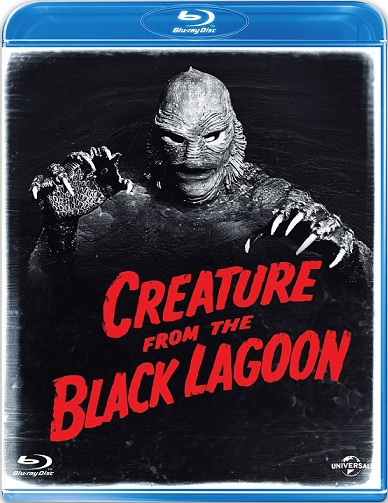


This is now available in the newly remastered HD Universal Horror range, both in the boxset and on an individual blu-ray release. The disc contains both a 2-D and 3-D version of the entire film in high-definition.


Creature From The Black Lagoon was a roaring success, so the first sequel Revenge Of The Creature (1955) was also shot in 3-D. The second sequel, The Creature Walks Among Us, was made after the 1950s' 3-D boom went bust, and was shot 'flat'.


An early close encounter, based on a Ray Bradbury story, is the frankly scary It Came From Outer Space (1953), which even hurls flaming meteors at the 3-D camera to make audiences duck and cover. All three of the above films were directed by Jack Arnold. It has an eerie 'body snatchers' plot with aliens victimising a remote town in the desert.


I must also mention The Maze (1953), even though it's yet to surface even on DVD. It stars Richard Carlson who's also in all three of the Jack Arnold 3-D movies! This is a mystery that takes place in a Scottish castle. The 3-D is effectively planned by legendary production designer-turned-director, William Cameron Menzies, who also made Invaders From Mars the same year. The 3-D effects are especially good when wandering around the maze itself. I first enjoyed this in one of the BBC's Saturday night horror double-bills in the 1970s and have been waiting for it to be rediscovered ever since. More about The Maze here.


So far, the movies I've mentioned are all black-and-white, but an expensive colour film launched the 3-D format in America. The original House of Wax (1953) starred Vincent Price at the start of his horror career. Charles Bronson also makes an early appearance as his mute assistant. The 3-D highlights of the film include the hooded killer stalking the foggy streets, the camera prowling through the wax museum, and, ahem, the guy with the paddle ball...


House of Wax is now on 3-D blu-ray in the US. The disc also includes a 2-D version and the 1933 movie Mystery of the Wax Museum, on which it was based. There's also a thorough appreciation of the film, including interviews with Joe Dante and Martin Scorsese about the use of 3-D in this innovative production.


Even Alfred Hitchcock made a 3-D movie during this period, Dial M For Murder (1954). Surprisingly, his use of the third dimension was quite restrained and the story suffers from obviously being based on the confined shenanigans of a stage play. Still, Grace Kelly in 3-D...


This was released in late 2012 on 3-D blu-ray by Warner Home Video.


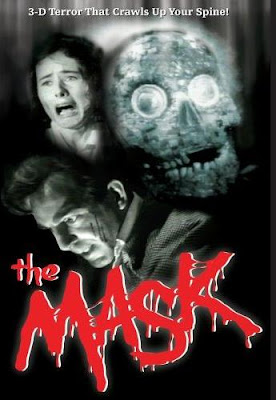
The 1950s' 3-D bubble burst after only a few years, making 3-D a rare oddity until the 1980s. An exception was The Mask (1961). Most of the story is filmed flat, in more ways than one, but the 'dream sequences' are exceptionally well-filmed in 3-D, with trippy scary scenes revolving around a sacrificial netherworld. There was an anaglyph (red/blue) release recently on DVD. The film is black and white and cited as Canada's first horror film! More about The Mask here.


I've had a few arguments online about the use of 3-D in I, Monster (1971) the Amicus Films adaption of Dr Jekyll and Mr Hyde starring Peter Cushing and Christopher Lee. This began filming using a very different method of 3-D that only works with specific left-right camera movement. There's a debate about how much of the film was shot correctly but, to me, it works in almost every scene. The director was at odds with the producer over the 3-D effect and the film wasn't given a 3-D release. But...


Any version of the film will still work in 3-D, on VHS, DVD or whatever, but a different kind of glasses are needed, where the right lens is darker than the left. I bought some proper 'Pulfrich effect' glasses online, but knocking the left lens out of a pair of sunglasses is a cheaper option. More about I, Monster here...


Ahead of the next 3-D wave is one of the greatest 3-D horror movies. Andy Warhol's Flesh For Frankenstein (1973) was filmed in 3-D, presumably to add extra kitsch value. This benefited from a new film format that made it possible to halve the cost of shooting in 3-D, with both images shot on the same strip of film. Besides saving money by only needing one camera, this meant that older issues of alignment (two cameras having to be perfectly positioned) and synchronisation (film damage on one print might make it slightly out of synch with the other) were now also solved. This is also why the best 3-D that followed was all 2.35 widescreen - both widescreen images were stacked in the space of where one 35mm image normally was.  


Director Paul Morrissey gave us the first in excessive 3-D gore, which pre-empts and exceeds much of the blood-letting in the 3-D Friday the 13th movie that followed. Bad taste, bad acting, great 3-D. This outrageousness tops my wishlist for a proper 3-D release. There was a single, blurry 3-D transmission of this on Channel 4.


The 1980s brought the next 3-D boom, using the over/under 2.35 process to great effect for Jaws 3-D and Friday the 13th Part 3 3D. While they're not the greatest movies, the 3-D is very sharply presented. This Friday really deserves a great 3-D release to show how good they could make it back then. It's also the best way to understand why everyone is firing stuff at the camera.


While I was preparing this article, the good news was that Friday the 13th Part 3 3D is getting a 3-D release on Blu-ray. The bad news is... it won't be using the new 3-D technology, but the old red/blue 'anaglyph' process. Therefore you won't need a 3-D television to enjoy it. It's also available on DVD, again in anaglyph 3-D.


Jaws 3-D has also been announced for a Blu-ray release later in 2012 and again won't be using the new 3-D technology, the same as the Friday the 13th Part 3 3D release. Glasses will be provided with the Blu-ray. No artwork is available yet.


Finally, Freddy's Dead - The Final Nightmare cheated (in many ways) by only having a 3-D finale, by the time my eyes had adjusted, the scene was over! It looked even worse in 3-D on VHS (above). I'm mentioning this for Freddy fans, I don't actually want to see this again...


FURTHER READING:


3-D Movies by R. M. Hayes.
Chunky textbook attempting to document every single movie or short film released in the first 100 years of 3-D cinema.


Fantastic 3-D - A Starlog Photo Guidebook.
An easy reference guide, lots of colour photos, but published before the end of the 1980s 3-D boom.

A concise history of cinema 3-D - on the Wide Screen Movies site.


3-D Online Magazine horror special...


May 14, 2011

I, MONSTER (1971) - Cushing and Lee do Jekyll and Hyde... in 3D


I, MONSTER
(1971, UK)

Amicus Studios try horror in 3D...

The title is presumably a pun on Roger Corman's I, Mobster, missing out on the opportunity to sell the movie as Christopher Lee and Peter Cushing in a classic horror tale, with Lee adding to his formidable gallery of monsters. Besides the veiled title, the central characters' names have been changed from Jekyll and Hyde (to Marlowe and Blake), but Robert Louis Stevenson still gets a screen credit - a strange case indeed.

Lee enjoys the dual role, but plays Dr Marlowe (Jekyll) as uptight and boring, whereas Fredric March and Spencer Tracy played the character as relaxed and normal. As Blake (Mr Hyde), his appearance degenerates, bordering on comical. Perhaps it's the nasty teeth or the nasty wig. The transformations are mostly cheated, either instantaneous or seen only as shadows. This is disappointing because it's the most anticipated part of the story. More interesting is a 'no-face' make-up (below in a scene not in the final cut) used only in a nightmare.


Peter Cushing is excellent as always, though he could easily have managed the reams of dialogue pointlessly handed over to non-actor Mike Raven (Crucible of Terror). Stephen Weeks was only 22 when he directed this, but made a much better job of the eccentric Ghost Story (1974), recently reissued on DVD. The producer, Milton Subotsky, cheekily blamed all the shortcomings of this film on him.

There are some slight twists in this version. Marlowe is a Freudian psychiatrist rather than a medical doctor. Instead of drinking his experimental drugs, he injects them into a well-used vein, getting addicted in the process. But the story is overly simplified by removing the character of Dr Jekyll's wife, making his midnight wenching hardly transgressive at all. Any new angles in the script aren't as important as the way the story was filmed.


The production was originally designed to be released in 3D, using a lesser-
known process which didn't need special cameras (and therefore cheaper to make). Instead it was the camera moves and layers of action that were orchestrated to trigger 'the Pulfrich effect'. This method of 3D has occasionally been used on TV in the past, long before the new specially-built screens. All that was needed to view the action in 3D were glasses with the right eye slightly darkened. The cheapest Pulfrich glasses would be a pair of sunglasses with the left lens popped out.

When the producers looked at the rushes during the filming, they didn't think the 3D effect was working and abandoned the idea of releasing it 3D. How many scenes were actually shot for Pulfrich 3D has long been debated or dismissed. To me, a majority of the film was shot for 3D and can still be enjoyed. The few static 'flat' scenes start appearing about half an hour into the running time. The three basic types of 3D scene are as follows...

Basically, any time a character (or object) moves left-to-right across a static background, it will pop-out in Pulfrich 3D. Even if you just watch the film 'flat', you'll notice a dozen scenes of characters walking down the long corridor to Lee's study, moving left to right. The whole title scene is also filmed this way. There's even a bizarre scene in a pub where Lee is talking to a potential wench in a pub and the crowd is jostling them along the bar from left to right. The complex choreography of the scene is all for the 3D.

If the camera circles around the scene from right-to-left, the 3D works very well. The most spectacular 3D is in the daylight scenes (a misfire because most of the film takes place in the shadows of night and Lee's dingy house) when the camera circles a huge birdcage in a park. A variation is where the subject spins around - like the scene where Lee holds the mirror up to look at himself.

The third main example is Dr Marlowe's study, dominated by a long desk stacked high with a wall of chemical lab equipment - this layer of glass between the actors and the camera is the central example of the layered, deep-focus sets, carefully laid out for Pulfrich 3D. Any movement between the subject and the camera (like a knife) will 'kick out' in 3D.


While there's plenty of 3D around at the moment, I've been particularly interested in the 3D effects in I, Monster because they're the only example of British horror in this period to be shot this way, and certainly an unusual treat for fans of Cushing and Lee. Much has been written about what everyone involved thought of the 3D process, but I've not seen any writers trying it out for themselves. To me, the 3D works well for most of the film and brings many scenes to life, which the movie certainly needs.

The Optimum DVD from the UK in 2007 (pictured at top) is a sharp, clean-looking anamorphic widescreen presentation. This version was longer than my TV recordings of the film, adding several early scenes of Dr Marlowe in his study and some of Mike Raven's pontificating.

But many of the night-time scenes have been transferred far too darkly. All of Blake's night-time shenanigans are crushed into darkness compared to the TV version I was used to. When Blake stalks the wench emerging from the pub, the cobblestones are completely invisible in the shadows. This darkening of some of the film's action, also diminishes the 3D effects in the film. Perhaps we'll never see the day where I, Monster gets released with 3D glasses.


If you want to see it properly, Pulfrich 3D glasses are available online, for instance here...

February 16, 2010

THE MASK (1961) - vintage 3D horror finally on DVD

THE MASK
also called EYES FROM HELL
(1961, Canada)

Definitely a cult movie, early Canadian horror The Mask is finally out on DVD. In 3D!

I was going to include this in the Not On DVD movies. But after another viewing, I couldn't recommend it as a must-see. It's a cheap, dull story for the most part, only the 3D 'dream sequences' are really worth seeing.


Really very good 3D effects and wild, horrific imagery, presumably shot by a different director. The 3D benefits from long tracking shots. I still think that the best 3D effects allow the viewer to 'get their bearings', like a camera moving through a deep hallway of cobwebs. The set designs and make-up effects are uniquely nightmarish and the shocks are carefully designed for 3D. A giant Aztec skull floating over a sacrificial ritual, a phantom firing fireballs from its palms, druids with razor-gloves... The stills you see from The Mask are always from these scenes, which tell their own dream-logic story. Joined together, they would make a far more famous 3D short film.


The Mask is OK to watch if you're used to low-budget fifties sci-fi. Most of the talky action takes place in small, functional three-wall sets. Where an archaeologist starts hearing voices coming from one of his artefacts, demanding that he wears it. When he does, he has nightmares about an ancient ritual... If you want a chance to see what a great 3D horror, or even LSD horror could look like, try out the dream sequences of The Mask...


The DVD is from Cheezy Flicks. It's a black and white fullscreen movie (this lobby card was hand-coloured). It's misleadingly listed as colour, because it's presented in the red/green 3D process. From the reviews, it doesn't appear to have been digitally remastered.


"Put the mask on, now..."


December 07, 2008

Not On DVD: THE MAZE (1953) - a missing 3D thriller


THE MAZE
(1953, USA)

What about getting the 3D films of the 1950's on DVD?

Many of the fantasy movies from the 1950's 3D boom are out on DVD (House of Wax, Creature From The Black Lagoon, It Came From Outer Space...), but none are viewable in 3D as yet. Here's a movie, with many of the same elements as those classics, that hasn't been available on home video for many years.

A man inherits a scottish castle and then severs his ties with friends and his new fiance. As they come to visit him, expressly against his wishes, they discover a changed man, newly greyed hair, bearing a heavy burden - a family secret involving a forbidden room in the castle and a large maze outside in the castle grounds...

One midnight in the late 1970s, I’d been prompted by a chapter in William K Everson’s Classics of the Horror Film, to stay up late to see The Maze. Of course i wasn't going to see it in the original 3-D, but some of the scenes made more sense knowing it had been filmed that way. Sure there are shock effects thrown at the camera, like the nightclub dancers being hurled around, but I still think 3-D works best when the eye can get it's bearings. Long slow moves along deeply-focussed sets use 3-D to the best effect. Luckily, years after first seeing it on tv, I had a chance to see it in 3D at London’s BFI cinema.


Director William Cameron Menzies excelled at production design, integrating sets with story and atmosphere. This is most evident in the huge castle interiors that dwarf the guests, and the maze itself is perfect for 3-D. This was released the same year as Menzie’s better known sci-fi nightmare classic Invaders From Mars which also had off-beat compositional framing and exaggerated perspectives, as well as being an early sci-fi in colour.

Leading man Richard Carlson was a recurrent 3-D star in the 1950s - he also heads Creature from the Black Lagoon (1954) and It Came from Outer Space (1953). Making it more of a mystery why this has never been on home video - it should be on DVD.


Trivia-fans take note that the creepy butler is played by Michael Pate (with the white hair in the Radio Times clipping), the late Australian actor-turned-director, who cast a young Mel Gibson in an early starring role as Tim (1979) opposite Piper Laurie.

The climactic secret of the house doesn’t fully explain all the bizarre and secretive behaviour. But the ending is certainly unique, and another opportunity for 3-D effects. Though the tragedy of the scenario can easily lapse into laughter with a cinema audience.


This isn’t essential viewing for horror fans, but is good for 3-D fans and friends of the fifties. It's pace is slow-moving compared to today, but I've always thought that a slower editing pace and steady tracking shots are the best use of 3D. The slow tracking shots moving slowly around the maze are extremely effective. I'd love to see a modern Japanese horror film in 3D. Note that the BBC (in a 1970s review above) possessed a "left-eye and a right-eye print".

Here's the trailer on YouTube...


Here's the trailer in 3D (needs red and green glasses), pointed out by a member of The Classic Horror Film forum...