Showing posts with label Ultraman. Show all posts

April 30, 2010

ULTRAMAN (1966) - perfect for Godzilla addicts


ULTRAMAN
(1966, Japan, TV)

Godzilla meets Thunderbirds...

A giant superhero who fights a different giant monster every week is the basis for this slightly futuristic live-action Japanese series made in 1966. It gave birth to an entire genre of Japanese TV.

Special effects supervisor Eiji Tsuburaya wanted to translate the success of Toho's sci-fi spectaculars, headed by the
Godzilla films, into a TV series. Ultra Q was the result, a team of paranormal investigators who often meet giant monsters. The format was improved on in Ultraman, by having a giant hero better able to fight the gigantic problems.


They also introduced the Science Patrol, a better equipped squad than the Ultra Q team. They've a huge base, special cars, the latest weapons and a VTOL aircraft. One of the patrol members secretly has the ability to transform into visiting alien, Ultraman.
Despite the rigid format - Ultraman must fight a monster every episode - the stories are very varied, as are the locations. The continuing draw of these two dozen series, for me, is the wide variety of monsters.


Yes, it's two men in suits throwing each other around, but for anyone who's run out of Godzilla movies to watch, Ultraman is the next best thing. Modified Godzilla suits even appear in the series, with added frills and paint jobs.
The colourful, often fanciful, monster designs naturally lent themselves to extensive ranges of toys and merchandise. The most popular monsters re-appear in later series, a few becoming familiar icons in Japanese pop culture.

The first series of Ultraman is aimed at children, with hammy crew member Ide as a childish comedy relief, and a young boy in the regular cast. Ultraman sometimes even plays around with the monsters during fights, like riding on their backs (which just looks wrong to my fertile mind).

Like early Doctor Who, which influenced the series, there are a few quite frightening monsters (glowing eyes in the dark always work for me) and many incidental characters even die. Ultraman also disfigures, blinds or tears limbs off his monster opponents before killing them! These occasionally bloody displays seem at odds with the otherwise childish tone. The creatures sometimes die slowly, twitching in their death throes before finding peace. Later series would be far kinder to monsters (except the really bad ones), even relocating them back home, and very few human characters died.


Ultraman has beautiful miniature sets for the monsters to roam around in, but the aircraft models are far less intricate than Thunderbirds, shot in the UK the same year. I guess that having to keep the aircraft in scale with Ultraman meant that the model couldn't be as large as the Thunderbird models.

The budgets are quite large compared to many later series, with lots of extras running around, varied locations
, and widescale action scenes.

A huge success, it lead to many more Ultraman TV series, which are still being produced, and some span off into movies, like Ultraman Next. It also inspired a boom in similar superhero shows from other studios, like Spectreman. Toei Studios' biggest hit scaled down the monster fights to human-size, pitching a roster of alien creatures against the beetleman biker hero, Kamen Rider.


Ultraman was dubbed into English and transmitted in the US. So the region 1 DVD set offers the English dub as well as an option for Japanese with subtitles. The picture looks extremely good, digitally remastered and restored, not looking its age at all. The set of 40 episodes was first released on six DVDs as two boxsets, but has already been re-released at a lower price on four DVDs.


It's a rare example of Ultraman on US DVD (Ultraman Tiga is the only other). I'd love to see the early follow-up, Ultraseven, with its tougher tone.


We never saw any Ultraman in the UK. So I first started watching it after discovering dozens of episodes on VCDs in Chinatown. While the earlier series have their charms, I prefer the revitalisation of the format that began with Ultraman Tiga, with it's better special FX and sleeker designs for the greatly expanded Earth defence fleet. With a variety of bases and launch procedures, the influence of Thunderbirds is still very evident.


Since Tiga, there's been a regular Ultraman series almost yearly, with year-round episodes. Last year there was another movie spin-off that brought back every previous incarnation of Ultraman for a Mega Monster Battle! It's just been released on DVD and Blu-Ray in Japan and Hong Kong.


May 03, 2009

ULTRA-Q (1966) - Japanese monster TV series, before ULTRAMAN


ULTRA-Q(1966, Japan, TV)


I first heard of this TV series as I was tracing back to the first of the Ultraman series, and assumed this was another show about 'a man in a suit fighting monsters'. But while Ultra-Q lead up to the first, classic Ultraman of 1966, it's a very different format. A trio of young investigators who face outbreaks of the unknown, usually involving giant monsters. This entertaining black-and-white series has now been reissued in Japan on DVD, crucially at a new lower price per disc.

It was dreamt up by the special effects mastermind behind the Godzilla films, Eiji Tsuburaya, as he was trying to find a format for his special effects techniques in a TV show. He was aiming for the same mixture of fantasy and mystery as the US hit The Twilight Zone, but because of his visual effects for Toho sci-fi films, like the Godzilla series, and possibly because they knew he owned all the monster suits, each episode of Ultra-Q usually has a giant monster in it.

In much the same way the producers of The Outer Limits insisted on a 'bear' every week, a scary monster or alien that would add a visual hook, Tsuburaya ended up switching formats to Ultraman, where his giant humanoid alien would fight a different monster every week. This UItra-format has been popular ever since, involving hundreds of live-action TV series and movies. The rights to the superhero were even sold internationally to the US, Australia and Thailand who shot their own versions.

But I really wanted to see Ultra-Q, to see more of Tsuburaya's special effects and unique monsters, some of whom have reappeared in later Ultraman series. There was even a recent update of Ultra-Q called Dark Fantasy, but it was a fairly cheap tribute, shot on video, and didn't look as nearly as impressive as the 1966 show, when the special effects rival his film work.


Ultra-Q episodes can either be mini-monster movies, short disaster epics, or surreal childhood fantasies. But the imagination and extensive special effects, not to mention the lively camerawork, fast editing and jazzy score, make it enjoyable even without subtitles. The series was made in black-and-white, unlike Ultraman, which helps makes the composite visual effects and back projection look more convincing, which adds to the charm.

While the series ended up being aimed at children, the high production values, adult cast and scary weirdness makes it as interesting to adult fans as sixties Godzilla movies, for instance.

Indeed, watch out for guest appearances from movie monsters Godzilla, King Kong, Manda and the gang, sometimes dressed up in disguise, and marvel at the new creations such as a giant snail with glowing eyes - a ridiculous and unique creature that still manages to creep me out. How'd you like to see that staring through your window at night?


I baulked at paying for the Japanese boxset that was issued in 2005, but in 2008 the same DVDs were reissued at a far more affordable price. There are seven volumes, each with four episodes on. CD Japan and YesAsia sell them, but be careful not to order the recent remake Ultra Q - Dark Fantasy, or the 2005 editions (they have black and white covers) as they cost twice as much as the new issues. Japanese DVDs are all NTSC, but coded region 2. There are no English subtitles on either release.


For more about the life and works of visual effects mastermind Eiji Tsuburaya, August Ragone's extensive and superbly illustrated biography is still in the shops.


Update November 2013
Shout Factory have released the entire series with English subtitles for English-speaking fans to finally enjoy this unique series. Despite Japan releasing the series yet again, but colorised, it was relief to see this American boxset presents all episodes in the original black-and-white, over five discs.


April 27, 2007

HANUMAN vs 7 ULTRAMANS (1974) Thai Ultraman movie madness

Hanuman vs 7 Ultramans
(1974, Thailand/Japan)
aka The 6 Ultra Brothers Vs. the Monster Army


If I’d gone on holiday to Thailand, immersed myself in the usual tourist sights of monkeys, temples and statues of Buddha, got a bit homesick for my usual diet of Japanese TV, then taken some bad acid, I might have dreamt something looking like Hanuman vs 7 Ultramans.

It’s psychedelic, often makes no sense, and fuses the Japanese Ultraman universe with Thai mythology. You couldn’t make this stuff up anywhere else.

Ultraman is very popular in Thailand, so much so that this film was specially shot with the cooperation of Japan's Tsuburaya Productions, which extended to lending out the Ultraman suits and monster suits and helping with the special effects. Unwittingly, this started an international battle over the rights to the Ultraman characters outside of Japan. The lawsuit has only just been settled (see this Sci-Fi Japan news item for a July 2007 update and some great Hanuman v Ultraman posters).

The plot, if you must... 2 young Thai boys try to stop 3 nasty crooks from stealing the head off a statue of Buddha from a ruined temple. (Shades of Ong Bak). One of the boys is killed, but instead of going to heaven, he becomes the monkey king Hanuman in giant form, or something like that. (It looks like two of the boys can transform into giant Hanuman - it’s confusing, and all in Thai.) Thus Hanuman takes his bloody revenge on the nasty crooks. Slow fade to black.

But that's not all! Nearby, scientists are testing rockets that could spark rainfall in areas of drought. All very noble, but not very wise to have thirty fully fuelled rockets all on launchpads so close to the mission control buildings… in an earthquake zone.

We inevitably get a spectacular rocket accident that causes an earthquake and wakes up five monsters who were living underground. Six (or is it seven) Ultramen then join Hanuman to save the day. Cue fighting, explosions and more monkey-dancing.

It’s almost like the plot of two TV episodes stretched over 100 minutes. Especially because there is a LOT of padding. At the start there are two unfunny soldiers mucking around in a jeep, acting like circus clowns and going for a swim in what look like girls bathing suits. More padding comes from the boys and their friends doing a lot of Hanuman-type monkey-dancing at the temple.


More padding comes from Hanuman himself doing a victory monkey-dance in front of the six bored Ultramen. At the end of it all, Hanuman kisses every Ultraman goodbye. All very friendly but they don’t look at all impressed.

I enjoyed the psychedelic special effects. All the intricate optical compositing and trippy backgrounds looked to me like they were done by the Japanese crew. On the other hand, the modelwork is not at all convincing, the rocket base looks exactly like a model. In fact, some of the outer space sequences look so bizarre, using no slow-motion at all, that the effects look like a George Melies fantasy from 100 years ago.


The action gets pretty extreme. One of the boys gets shot in the face! In close up! The baddies get their come-uppance in a bloody style too – getting squished or stomped by the giant. For something I presumed was aimed at 5 year olds.

The music stretches the patience – sounding exactly like a Thai tourist trap cultural evening (been there, done that), rather than a superhero action film. Similarly, Hanuman looks exactly like the famous statues in the Kings’ Palace in Bangkok, no effort has been made to tweak the character into an action hero. It’s a traditional Thai character, traditional music, traditional monkey-dancing.

Like many Hong Kong films (up until the late eighties) all the dialogue is post-synched. That is, no location sound is recorded. All the voices are synchronised in later in a sound studio. This makes every scene sound like a small radio play. The acoustics are of a small room, the lip-synch is loose, the sound effects are sparse. The impressive-looking Hanuman and a sky god he meets in space have no processing on their voices – they just sound like normal people. Lazily, one of the monsters sounds exactly like Godzilla.

There’s also stock footage from the TV series to pad out the Air Force attacks on the monsters. Though the film has been shot in a very wide 2.35 anamorphic widescreen format (which has been crammed onto this DVD without letterboxing), the TV shots haven’t been cropped at all. The resulting effect is that shots intercut between normal-looking widescreen footage, and some very flat looking airplanes.

Hanuman transforms in the usual air-punching Ultraman style - though the mask is scary in the extreme!

It’s a staggeringly strange film. I’m still don't get how all that monkey-dancing rates as entertainment. But, for fans of Thai pop culture, Ultraman completists, or seekers of the truly way-out, this is for you.

It must have been popular too, in Hanuman's next movie he met the 5 Kamen Riders.

Chaos at the rocket base


Hanuman vs 7 Ultramans (don't blame me - that's how they spell it on the cover) is still available on Thai PAL DVD in a very, very ropey transfer more suitable for VideoCD. It has obviously been mastered on a multi-generational VHS tape, though because it’s Thailand, it still might be an official release! The picture is very soft and dupey, and there are lots of tape creases thoughout.

Like I said, the 2.35 aspect has been squeezed into a normal 4:3 frame, resulting in very tall thin-looking people. But, because of the legal status of this title, I don’t think it’ll be digitally remastered any time soon...

The VCD version, split over two discs, is available from eThaiCD. I got the DVD from Max Renn's eBay shop, which I've visited online many, many times.

By the way, I've unsqueezed the frame-grabs above, to show you how wide the picture has to be. It looks wrong even on a widescreen TV.

Do you want to know more?

Asian movie expert, Mark Simpson has a fuller plot summary, and much more enthusiasm for the film - read his review here...

- - - - - -

March 17, 2007

KAMEN RIDER KABUTO (2006) hyper-action TV series

KAMEN RIDER KABUTO (2006, Japan)
TV episodes: 49 x 25mins

Recommended action series!

In the near future, a meteor destroys the Tokyo district of Shibuya. Soon afterwards, monstous alien beings secretly start killing people and disguising themselves as the victims. Undercover organisation ZECT trace these alien "worms" and combat them with ZECT soldiers who have special anti-alien machine guns. If that fails, a special operative has been chosen to wears a high-tech belt that transforms into Kamen Rider armour and gives him an array of powers to defeat the aliens. Things get complicated as ZECT operatives bicker as to who gets to wear the belt, and other Kamen Riders start appearing in Tokyo...

Kamen Rider is a Japanese live-action TV series that's been on the go since 1971. Like Ultraman, each series features a slightly different hero, with a different costume. He rides a motor bike and transforms into a superhero whose helmet resembles the head of a beetle, hence the antennae! The baddies are nasty-looking monsters, usually controlled by an evil alien villain, who also has an army of black-clad guards. Unlike Ultraman, all the action is human-sized, rather than giant-sized.

Until I saw the latest series, I've always avoided the many Kamen Rider series, because they were quite childish, and resembled Mighty Morphin Power Rangers in terms of fighting and acting. The costumes looked like they were from pantomimes, the fights were mainly acrobatics, and the villain's army of guards all made annoying squeaky noises like the Monty Python Knights-who-say-"ni".

But with Kamen Rider Kabuto, the format has been seriously upgraded. The series is more adult, the baddies more deadly, and the action is incredible. Certainly, the special effects are only for a weekly TV series, but it usually looks fantastic. Great costumes, surreal humour (especially the master of make-up!) and high-speed action. The black guards now work for the heroes, and have suitably slick costumes.

The Kamen Rider costumes have the ability to transform into more powerful versions, (an excuse for flashy special effects) and for 60 seconds Kabuto can kick into an accelerated fighting speed, called the "Clock Up". While he's fighting in this mode, rain, crashing cars and exploding buildings are all halted into slow motion. Visually, it looks startling.

There are usually new monsters every episode, and all have the ability to disguise themselves as humans (having killed the original in a squishy way). The monster costumes are elaborate and inventive as always. The only regular monster is the green "worm" - which has a vaguely Giger-esgue skull-like face.

There is of course a fair amount of padding involving the human characters, some of it dramatic, some of it silly, with a steady preoccupation with food and the perfect herring miso soup - I'm not joking. One of the heroes thinks he's perfect and tends to preach, another can make anyone beautiful with his make-up box in under a minute - he also seems to wear a little too much face powder himself. Much of the action takes place around the Tokyo Tower, the spectacular red-and-white landmark that is usually the first to go when Godzilla is in town.

The series was shot 16:9 widescreen and lasted 49 episodes. There was also a Hyper-Battle straight-to-video DVD episode and a movie, called Kamen Rider Kabuto - God Speed Love, released in Japanese cinemas in August 2006 and set in an alternate universe.

You can maybe find fragments of the series on YouTube, or there is now a badly subtitled Hong Kong DVD release, (Part 01 pictured above contains eps 1 to 26), but the Japanese DVDs have no subs at all.

Do you want to know more?

- Superb site with more details and loads more photos at the Unofficial Kamen Rider Kabuto Homepage.

- For more info on the entire history of Kamen Rider TV series, here's the Wikipedia page to start you off.

- Opening theme tune here on YouTube - marvellous!

- First episode here on YouTube - but for how long?


- - - - - - -

June 21, 2006

ULTRAMAN MEBIUS (2006) New series, new movie

ULTRAMAN MEBIUS (TV, 2006)

A TV Ultraman deliberately played for laughs

(Note, when you're Googling for this, it's also spelt Mobius or Moebius.)

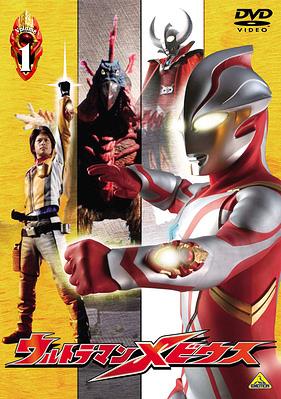
Only seen a couple of episodes of this so far - the first DVD of 4 episodes has been released in Japan (pictured above) - but this series looks like a lot of fun, almost at Ultraman's expense. The series (like the Ultraman Zearth specials) doubles as a send up of the giant hero genre, with plenty of contemporary in-jokes. Looks like the tongue-in-cheek tone of Ultraman Max has encouraged the producers to proceed to an all-out comedy.

Ultraman Mebius is sent to help Earth by his Ultra-Father (who overdramatically likes swishing his cape around). Earth's space defence squad are a bunch of impossible active young people (including a motorbike racer and a footballer). Two of the GUYS have slightly exaggerated ridiculously high hairstyles (like the recent Young Kindaichis).


As a giant monster invades, the GUYS rush to the rescue to evacuate a city of people, children and bunny rabbits. Their boss is informed of the emergency (while he's out playing golf) but he fails to reach headquarters because his car breaks down.

Meanwhile, as Ultraman leaps into action, the crowds all start taking his picture on their camera phones. After a destructive fight with the monster, most of the city is completely smashed down - "You've failed, everything's destroyed, Ultraman!"

Even the modelwork has been made to look silly - the models are slightly too small and intended not to fool anyone. The missiles look more like fireworks.


ULTRAMAN MEBIUS AND ULTRAMAN BROTHERS (2006)
In Japan, this Summer's Ultraman movie will feature Mebius, but whether it will stay quite as silly remains to be seen. It's the 40th Anniversary of the birth of Ultraman, so there's going to be homage a-plenty. Here's the advance flyer...


Mark H

ULTRAMAN MAX (2005) Seriously action-packed TV


ULTRAMAN MAX (TV, 2005)

I'm amazed at how the Tsuburaya Production Company keep taking a limited formula for a show and making it work so well. For every poor Ultraman series there are several great ones.


After the childishness of Ultraman Cosmos, Ultraman Max is a return to form. Not that the format is that much different, it's the more mature characters and the teen target audience that matter.

The series sits between the much more serious Ultraman Nexus and the latest, Ultraman Mebius. Max is invigorated by fast, inventive action. It's great to see their patrol cars finally fitted with useful gadgets - they can even fly out of trouble!

There's an emphasis on special guests and guest directors. None other than Takashi Miike came in to direct two episodes (15 and 16), wishing to take to any job offered to him. I've even recognised some of the guest actors, recruited from some recent, classic monster movies. For example, Steven Seagal's daughter Ayako Fujitani, and comedy relief maestro Yukijiro Hotaru, who both featured in the three recent Gamera movies, both star in episodes.

It's not dark like Nexus, Max has got tongue-in-cheek humour together with a remit for fast-moving action, making it a series that's enjoyable for adults too. The very silly episodes (like the Bad Scanners concert, where rock 'n' roll saves the world), is successfully funny. The series seemed to be veering towards self-parody to prepare audiences for the next series Ultraman Mebius.

On an irrelevant note, I don't understand it when someone in Earth defences spots a new monster they've never seen before, how in blazes do they know it's name?

The entire series of Ultraman Max is out on Hong Kong DVDs (examples pictured above) with English subtitles. There are also 2 CD albums of the soundtrack music.

Mark H

ULTRAMAN COSMOS (2001) Ultra TV series with 3 movie spin-offs


ULTRAMAN COSMOS - TV Series (2001 - 2002)
Over the years, the Japanese Ultraman series have veered between two extremes - from the hardnosed gritty action where characters even die in Ultraman Nexus, to the childish acting and cute monsters of Ultraman Cosmos.

As always, every episode, Japan gets threatened by a giant monster.and in this series it's the EYES team that fly to the rescue from their special island base. They usually stall the monster long enough until Ultraman sorts it all out. Unbeknownst to the members of EYES, one of their young pilots, Musashi, is actually a living host to Ultraman - whenever there's danger, he can transform into the giant alien defender for a few minutes in order to save the day.

There's a flimsy narrative that runs through the series about an outer space force that 'possesses' otherwise peace-loving (giant) monsters. It's not like the complex story arc of Ultraman Nexus. Neither is it adult, violent or creepy like Nexus, which was my previous favourite series. Cosmos is a real slog to get through, and is really only for the very young.

Many of the monsters are too cute, and the EYES team are dedicated more to conservation rather than obliteration. This means less fighting and more silliness. The EYES Task Force are all adults, but they act like they're in a classroom. The idea that this crowd could be entrusted to save the world is constantly ridiculous. The likeable cast are made to act like naughty schoolchildren. They rarely get a chance for any serious acting or even subtle comedy. Fubuki looks the most convincing as a pilot, rather than the rather wet lead, Musashi.

The FX are fun, the monster suits are excellently made, better so than Ultraman's, which are more creasy and ill-fitting than usual.

The climactic fights are slowly staged and constantly fall back on poor video tricks. Also the emphasis is on defensive fighting - Ultraman tries to push opponents away rather than harming them, it's honourably pacifistic, but limits his variety of moves.

Admittedly the very first Ultraman in 1966 was aimed squarely at the whole family, even having a young boy help out Earth's anti-monster task force. But the extended run of Cosmos (at 64 episodes) has been a hard slog to get through. I watched the whole thing to see if the tone changed at all. There's a couple of stand-out episodes, but they're pretty rare.

Towards the end of the series, many monster suits from the series are re-used - it's rare in Ultraman for this to happen, usually a brand new foe arrives every episode. This lack of ideas or new monsters makes the series look like its run was extended late in the day.

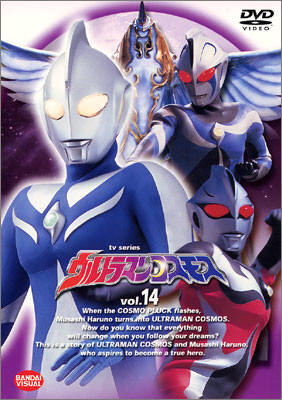
If you really want it, the entire series is available from Hong Kong on 8 DVD volumes that contain between 4 and 8 episodes each (an example of the cover art is shown above). The English subtitles are sometimes pretty vague but help you follow the action. There are also behind-the-scenes clips from each episode as DVD extras.

You can also get the series from Japan but without English subtitles.

ULTRAMAN COSMOS - THE MOVIES
On the other hand, the series spawned 3 feature films which were the best of their kind, until Ultraman Next was released. I'd recommend any Ultra-fans out there to give the Cosmos series a miss and check out the movies instead. They were all out on subtitled DVDs from Hong Kong.
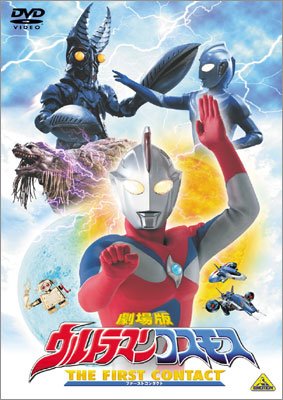
ULTRAMAN COSMOS: FIRST CONTACT (2001)

First Contact sets up the Ultraman Cosmos series by showing us how Mushashi, as a young boy, becomes Ultraman. The effects are OK (apart from the opening fight in space between CGI characters), including a startling transparent Ultraman. Once again, it's the monster Baltan who's the main foe - Baltan was the very first adversary for Ultraman in the first episode of the 1966 series.

The monster-friendly theme of the TV series is established in the film in a scene where the EYES team try to fend off a giant monster by punching it gently on the nose (with giant boxing gloves that have inflated out of their Thunder vehicles)! Similarly silly is an attempt to sing Baltan a lullaby (out of huge speakers that have sprouted from their planes) and send him to sleep. Also, there's a lot of kids charging about in this one, a stereotyped grandad/inventor and a flying toy robot.


ULTRAMAN COSMOS 2: BLUE PLANET (2002)

The other 2 movies are more action-packed, with solid effects and imaginative storylines, which are far more enjoyable for older audiences. In Blue Planet, there'a whole undersea race of humanoid aliens and some marvellously realised CGI alien 'whales'. The island locations (in Southern Japan) release the characters from the small, claustrophobic sets of the TV series. This film takes place after the series timeline has ended, but also doubles as a direct sequel to the first film. But you don't have to see the series to understand the films.

The ambitious storyline packs in UFOs, worldwide destruction, and a fleet of marauding giant monsters that look like a cross between Meganeuron (from the Godzilla film) and Legion (from Gamera 2). The monster suits are awesome-looking, and there's many action-scenes with plenty of large-scale model work. Some cast members and characters appear from the Ultraman Tiga series, and there's even a special guest Ultraman late in the action.

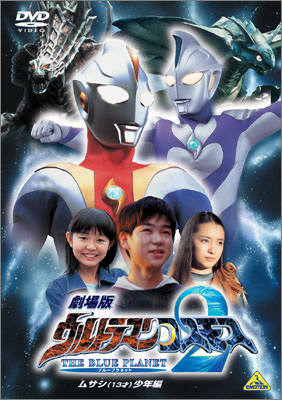
The DVD cover (above) is from the region 3 Hong Kong release. I'm not sure who the kids are on the front cover though - they seem to have strayed in from the first film and don't appear in the second - it's an all adult cast. The widescreen picture is letterbox and not anamorphic. The english subtitles are generally OK. There are trailers and TV spots as extras, as well as some behind the scenes footage and an extra scene (but these are not subtitled).

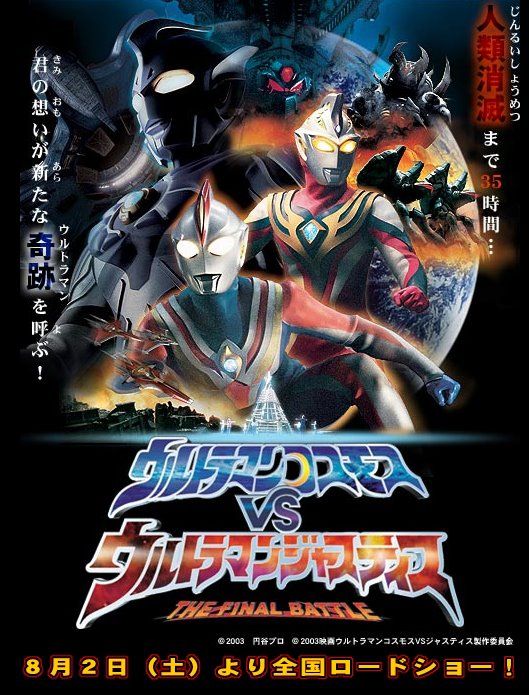
ULTRAMAN COSMOS VS ULTRAMAN JUSTICE - THE FINAL BATTLE (2003)

Finally, this third part of the movie trilogy keeps on referencing the previous two movies, virtually recalling everyone in the casts for a reunion.

Our soppy hero, Musashi, is about to transplant some of his favourite creatures from Monster Island to a new life on other planets. He is thwarted on the launch pad by an unseen bunch of aggressive aliens and their giant robots - the awesomely designed 'Glokers'. Shock horror, Ultraman Justice (who briefly appeared in Blue Planet) is fighting on their side!

After a catastrophic defeat, can Earth summon a defence against the alien fleet of spaceships, an army of heavily armed robots and a mother of a mothership!

The human counterpart of Ultraman Justice is revealed to be a woman, played by Kazue Fukiishi who, dressed in black leather and heavy eye shadow, looks like a living prototype for Lil Mayer, the lead character in Ergo Proxy. She gets all the best dramatic scenes and a great gravity-defying fight at the foot of Tokyo's Rainbow Bridge.

The action here is non-stop, Tokyo takes a heavy beating, and there's a tremendous outer space finale. The traditional large-scale miniatures and monster suits are aided by flawless compositing and some subtle CGI FX.

The script's repetitive and preachy 'love conquers all' messages running throughout the film make it not as good as Blue Planet, but just as short (about 76 minutes). But the pros outweigh the cons, making this an Ultraman movie that I keep on revisiting.

The
region 3 Hong Kong DVD again has a letterbox picture but not anamorphic. The english subtitles are generally OK. There are trailers and TV spots as extras, as well as a little behind-the-scenes footage.

Mark H

April 06, 2006

SPECTREMAN (1971) - Gorilla TV

SPECTREMAN
(1971, Japan)

An outrageously bad seventies live-action superhero TV show from Japan

Thai PAL VideoCD review

Hells bells! I thought there were a couple of dodgy special effects in the early Ultraman series. Wait till you see Spectreman. The opening title sequence alone packs in dodgy animation, dodgy models and dodgy, well, drawings - and that's the good stuff.

Spectreman himself looks OK, with his golden helmet and snazzy boiler suit (unlike Ultraman's expensive-looking, figure-hugging rubber outfit). But the baddies are, well, a guy in a gorilla mask wearing shiny pink and a blond wig - his sidekick is a guy in a gorilla suit wearing a lot of jewellery. I know Planet of the Apes was all the rage at the time, but this looks truly ridiculous.

The two Space Apemen sit in a flying saucer and try and wreak havoc by activating a load of really weird monsters.
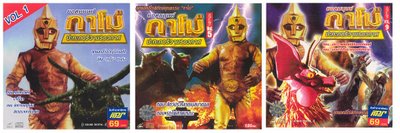
The saving grace of the whole enterprise is that the monsters are fun because their designs are so way out. For instance the black furball with two foxes heads (on the cover of volume 5, pictured at centre) is unlike any real animal, but still lively enough for action-packed biting and fighting.

Spectreman's transformation involves a lot of rapid cuting between the guy in the suit and a drawing (apparently done in felt tip). His flying sequences involve close ups of him with his arms in the air, and a model of him swinging around on wires. His back-up team are 5 people crammed into a car - so no need for an expensive secret base.

Because of the bad special effects, the mad monsters and everyone taking it so seriously, it's an awful lot of fun in an Ed Wood sort of way. There's a fair amount of bad taste violence (bystanders being stomped by the monsters) to top it all off.

But I can't say it isn't entertaining... because it really is.

I found three double-episode VideoCDs (pictured at top) going for under a dollar each. The video quality is good, but the Thai dubbing is atrocious, adding to the hilarity. Strangely the theme tune remains in Japanese while all the dialogue has been replaced by Thai, obliterating all music and sound effects whenever anyone speaks!

UPDATE - JUNE 2007
Another way to see Spectreman in action is to hunt around on YouTube. At the moment, you should at least be able
to see the theme tune to the series, even though the entire episodes have been taken off the site.

UPDATE - JULY 2007
A Spectreman DVD boxset is now available in Japan... see the CDjapan website for details.


- - - - - - -

November 07, 2005

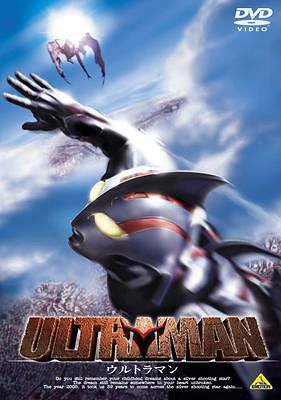
ULTRAMAN NEXT (2004) - R2 DVD review


ULTRAMAN NEXT - THE MOVIE (2004) - Japanese R2 DVD review
(Released by Emotion dvds)

OK, to recap. To coincide with 2004's ULTRAMAN NEXUS tv series, a movie, simply called ULTRAMAN, was released in Japan in November. The events in the movie helped to clarify (slightly) the climax of the NEXUS TV series. Popular in the cinemas, and even warmly received by critics, this is one of the most successful ULTRAMAN movies. I would argue that, even on their low budgets, the ULTRAMAN COSMOS movies had been of a very high standard too.

In ULTRAMAN NEXT, our new Ultra-hero starts as a humble fighter pilot for the Japanese self-defence forces. Before you can say "electrical storm", his jet hits a UFO and he melds with ULTRAMAN. Another evil UFO has already claimed a victim which keeps on absorbing animals, until he becomes the lizard-like monster baddie...

The ULTRAMAN NEXT suit looks more organic than usual, more 'Guyver'. I think this biological look works better for the various stages of monster rather than Ultraman himself (he looks his usual fantastic, shiny metallic self in the series though). In the early, moody low-light scenes, you can't tell when the lizardy monster is CGI or 'suitmation', it's very well done. The monster also has human eyes, another touch that really works. Towards the climax, the CGI stuff gets annoying, painstaking though it is - it just seems to me that once they use high-speed CGI representations, they throw out the idea of slow-motion to represent giant size creatures.

Thankfully, the Japanese DVD release has English subtitles, well-translated, for the feature only. Extras include a 20 minute featurette (with enough behind-the-scenes footage to explain the FX involved), trailers and TV spots. The film is presented 16:9 anamorphic, the audio is 5.1 dolby digital.

Max

October 17, 2005

Takashi Miike's ZEBRAMAN (2004) - review


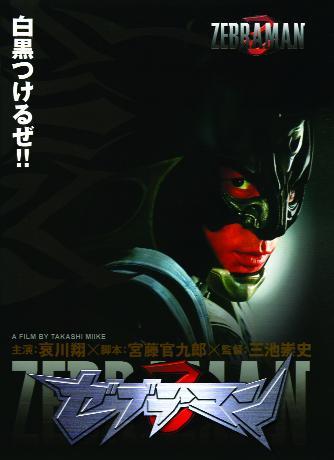
ZEBRAMAN
(2004, Japan)

Well, given the choice, I'd rather watch a low, low budget Asian film over a Hollywood blockbuster. This film was just so much fun, beautifully acted, eccentrically mad plot, great visual gags, killer fight scenes... It's like an episode of ULTRAMAN or KAMEN RIDER, but aimed at an adult audience.

It's 2010. ZEBRAMAN is a seventies TV superhero idolised by a Yokohama school teacher. When strange men in masks start a series of local rapes and murders, who you gonna call..?


Director Takashi Miike is so versatile that his films can never be predictable, given the extremes he's gone to in the recent past. You're never sure how far he's going to go in terms of plot twists or sexual or violent extremes. He might even start telling the story with CGI, stick-figure animation or plasticine figures.

ZEBRAMAN is of course very restrained for Miike, that doesn't mean to say the film would be rated at less than an 'R' for violence and sexual content. On many occasions, it looks like it's going to get very dark, very quickly...


DVD UPDATE March 2008
Zebraman finally gets a release in the US on region 1 DVD from Tokyo Shock...


September 14, 2005

THE CALAMARI WRESTLER (2004) – Region 1 DVD review

THE CALAMARI WRESTLER
(2004, Japan)

Region 1 US DVD (
Pathfinder Video release)

It started with an action figure... which I bought in Japan when this film had just come out. I've since waited a year to get to see this film with English subtitles. Some of my friends couldn't believe the DVD existed. They thought the cover art was a leg-pull!


THE CALAMARI WRESTLER turns out to be a comedy with drama, pro-wrestling, religion and a lot of seafood.

Film Review (no spoilers):
The Japanese wrestling scene is turned on its head when the reigning champion is challenged by a man-sized squid. Where did it come from? Why does it wrestle? What does it eat? Can it find true love between bouts?

Despite the low, low budget, the production is successfully ambitious. The tight, twisting plot is large-scale and full of ideas (behind the scenes footage, in the DVD extras, shows the crew improvising on set and create an excellent shot of 'Calamari' on an exercise machine). The drama and occasional melodrama becomes instantly entertaining because one of the characters is a giant squid!

The comedy walks a very fine line, but they've nailed it. The actor playing the fantastic lead character, makes no effort to walk like a squid! He just walks down the street with a slight swagger, shopping basket over one tentacle! Superb. Not even a mention of how a squid can walk around - his abilities are just taken for granted. It looks like a fantastic suit - but no matter what FX budget you threw at it, you'd still know it was a special effect - what makes the whole concept work is the script, the director and the cast. I believe the director got the idea while working on the ULTRAMAN TIGA TV series (around 1997).


THE CALAMARI WRESTLER is full of surprises, and I thought it was going to be a one-joke film. The director has his tongue in his cheek, but has the cast play it totally straight – I find the Japanese are fantastic at playing in fantasy situations (be it ghosts, giant monsters or superheroes of any size). A couple of the lead actors wrestle as well as act. There are many presumably famous commentators and wrestlers scattered throughout the film, not least the pundit who insists on sticking a drinks can to his forehead. All these celebrities (?) mean nothing to me, as a clueless but inquisitive westerner - the monks, the religion, the seafood are all part of Japanese culture, in a film presumably intended for a local audience. For me it's a stretch to take it all on board - but it's funny, as well as fascinating.


DVD REVIEW:
The English subtitles are very well done, which is crucial for comedy. The transfer is good, but don’t ask me whether it was shot on film or video – I’m guessing it was shot on a mixture of video and film and then edited on video (which would make it V-Cinema). The worst technical aspect is the under-produced audio mix, which is occasionally distracting. But I guess that was due to budget rather than the mastering of the DVD.

There aren’t many extras – the best trailer I’ve seen online is missing here. Thankfully there’s a good behind-the-scenes featurette (which is a bit short on subs) which shows the suit actors, the sets, and a generous glimpse of how much fun they had shooting it all.

I’m extremely thankful that this film ever got released at all – this is the only DVD I’ve found with subtitles, and it’s the only release outside of Japan.