August 17, 2006
Finally on DVD: CURSE OF THE FLY (1965) Third of The Fly's
Finally on DVD:
CURSE OF THE FLY (1965)
Region 2 PAL DVD (20th Century Fox)
“Half-human monsters from the fourth dimension…”
The malfunctioning matter-transporter appeared again in this rare British incarnation.
The Delambre family are at it again, this time with transporters on both sides of the Atlantic. As usual, there are disastrous side-effects from disintegrating and reintegrating human test subjects. As a young woman marries into the family, she discovers that probing the secrets in their remote mansion, isn’t the best way to recover from a nervous breakdown. What’s kept behind the four locked doors behind the garage? Why does the electricity keep dimming in the evenings? Who plays the piano in the middle of the night?
Here, Shepperton Studios stands in for Canada. Apart from Brian Donlevy, the British actors are pretty good at North American accents (to these ears), but the locations give the game away – we’re back at Hammer Film’s favourite location Black Park, once again.
As you can tell, I’ve been distracted from all the horror and the plot by other trivial details. I also found myself scrutinising Donlevy’s faultless toupee, and his ability to act whilst drunk.
The film, like it’s predecessors The Fly (1958) and Return of the Fly (1959), is filmed in 2.35 widescreen, yet the frame is barely filled by the sparse sets.
What passed for horror in the early sixties is watchable by 12 year olds now, though now it’s questionable for other reasons. The two bodies reintegrated as one is a ghastly sight, but what really made me squirm was the British actress made up as Chinese, and using an inscrutably evil accent.
Also, way back then, facial and physical disfigurement automatically made you a ‘horror creature’. Nowadays, similar real-life disfigurement is now widely depicted in documentaries and is of course reason for scientific interest and sympathy, not horror. If the motivation for the creatures could be explained other than ‘I’m a monster and I’m going to stalk the heroine’, it might make more sense.
The film stars Carole Gray, a beauty who also livened up Island of Terror (Night of the Silicates), George Baker (Sir Hillary Bray in On Her Majesty’s Secret Service, and TV’s The Prisoner), and of course token ‘Yank’ Brian Donlevy (twice times Professor Quatermass in Hammer’s The Quatermass Xperiment and Quatermass II). The director
Don Sharp, also notably brought us the 'Hell’s Angels from Hell' movie, Psychomania – a mad sixties horror that’s still watchable today for all the wrong reasons.
The DVD of Curse of the Fly has finally been released, no frills. But it’s in a beautiful 2.35 anamorphic widescreen release.
Black-and-white films shot 2.35 widescreen were a crossover phenomenon when b/w film was much cheaper than colour. Jack Clayton's The Innocents is probably the best example of this ‘genre’, yet The Alligator People, The Land Unknown, and Hammer Film’s These are the Damned, Nightmare and Paranoiac are also worth a look.
The DVD has a reversible cover, one representative of the film, the other side a tie-in with the other four Fly films – which is a bit of a cheat because it’s so dissimilar from the rest of the series. Oh yes, there’s no half-man, fly-head monster in this one!
Mark H
August 16, 2006
KAZUO UMEZZ'S HORROR THEATER - VOLUME 1 (2005)
KAZUO UMEZU's HORROR THEATER
(2005, Japanese TV, 'Kazuo Umezu Kyofu Gekijo')
Volume 1: 'House of Bugs' (Mushitachi no Ie) and 'Diet' (Zesshoku)
Inside the mind of crazy Kazz...
Having watched Snake-Girl and the Silver-Haired Witch, I’ve been learning a lot more about the manga artist Kazuo Umezu. This TV series ambitiously marked 50 years of his horror stories.
Ever since TwitchFilm first showcased the Japanese release of Horror Theater last year, I’ve been looking forward to it. They posted trailers for each episode, which had catchy backing music (by Rurutia) which turns out to be the series theme tune - images of Kazuo Umezu himself superimposed over some of his grisly illustrations.
At last, all six one-hour episodes have been released on Region 1 DVD, two per DVD. I’ll just mention that despite the similar titles, these DVDs are not to be confused with the J-Horror Theater series of films (released in the US as Infection, Premonition and Reincarnation with a fourth on the way).
Having watched volume 1, the images and atmosphere are still sinking in. They weren’t as graphic as I was expecting – this isn’t schlock horror, it’s more psychological horror that sometimes lapses into the extreme.
Also, like most Japanese drama, these are made on video – a very unusual medium for Western horror fans to get into. The ‘TV look’ combined with the exceedingly slow pace could easily disappoint. The horror elements are almost sleight – it’s more like creepy drama, than horror theater!
Plotwise, a young husband appears to be cheating on his wife, he thinks she is having an affair with her cousin. She retreats to a large upstairs room covered in cobwebs, and is willing herself to become an insect, just like the character in Kafka’s Metamorphosis…
House of Bugs is an impressively constructed tale, flashing forwards and backwards in time as well as dodging between different character’s viewpoints. It’s beautfully acted and slowly builds to a creepy dream-like climax.
The episode is impressive in many ways. And works on several levels, as it was intended. The brief CG special effects aren’t totally realistic but certainly work for the piece.
Dramatically it makes an impression – Tomoko is a schoolgirl who blames her lack of luck in love on her weight. She has a distorted view of herself when looking in the mirror, and keeps misreading the bathroom scales. Tomoko’s mother keeps on feeding her up, while her best friend starts homing in on the boy who dumped her…
This was a very unusual drama, but once the stage had been set, didn’t seem to develop enough – it certainly didn’t lead me to understand the horrifying climax. That seemed to come out of nowhere – perhaps if I watch it again…
DVD
The Horror Theater series is brimming with potential, so I’ll stick with it and watch the rest. But I won’t recommend this particular DVD title for horror.
From the two remaining DVDs, I’ll be expecting more manic stories and more graphic horror, to be able to capture the distressed tone of Umezu’s original manga.
Lastly, if I was Tamaki Ogawa, I'd be horrified by the photo on the DVD cover - it doesn't make her look good at all.
- - - - - - -
August 15, 2006
VENGEANCE (2006) Thai cursed jungle horror
VENGEANCE (2006, Thailand)
Thai All-region PAL DVD (from Premium Digital Entertainment)
After a confusing first few minutes, Vengeance settles down to become a half-decent thriller as a team of Thai policemen sets off into the jungle in pursuit of a gang of escaped convicts. The locations reminded me of the lush rainforest atmosphere of Lost World: Jurassic Park 2, but with temples. Both sides start to take casualties in the crossfire and then the forest starts to claim victims of its own.
The first hostile creatures they encounter are a nasty swarm of 'tiger wasps' (according to the subtitles), who deliver more interesting action than ever appeared in disastrous seventies movie The Swarm.
The next creatures are rather more mystical and live in the 'ladyfruit' tree… Some marvellous little crocodile/gekko creatures are next - the CGI effects are beautifully composited into the action.
As the two sides bump into a group of forest-dwellers, we also meet a giant snake, that's when the CGI fails to convince, the modelling and animation is far from convincing and kicks off the effects-heavy part of the film which the budget can’t really endure.
If the producers had stuck with the subtler effects of the mid-section of the film and kept up with the three-handed game of police/convicts/forest people, it could have played as a tight thriller.
Unfortunately, the FX get over-ambitious and so does the plot – there's lots of action, little reason, and it ends with a rushed, botched finale.
So please don't think you're getting a giant snake movie, (which the posters might lead you to believe) you’ll be disappointed. The snake actually lets it down as the dodgiest effect in the film. The benchmark for snake FX has been set by the Anaconda sequels – we’re talking straight-to-video – if you can’t match the quality of those, stay out of the jungle!
I'd lazily call Vengeance a cop thriller, jungle adventure, fantasy horror.
The acting is convincing, not something you can say about many horror films from Thialand. There's a sexy cast, plenty of action, plot twists, a little gore, and some glimpses of creatures you haven’t seen before… But I just wanted it to make more sense.
If you want a fuller plot synopsis (with spoilers) hike on over to Wise Kwai’s marvellous Thai movie site, part of the Rotten Tomatoes gang.
My enjoyment of the film was slightly hampered by this Thai DVD release (pictured), which is annoyingly censored – adults smoking, knives held to the throat and guns pointing at people’s heads were all blurred out (see below). I also thought I spotted some jumpy edits dring some of the fights – I suspect there’s a stronger cut somewhere out there.
Worse still, the framing of the film felt like the 16:9 image had been cropped down from 2.35, leaving characters leaning out of the sides of the frame or even speaking off screen.
The main plus point is that there are decent english subtitles. The other plus is that official Thai DVD releases are exceedingly cheap. For instance eThaiCD supply this title, if you’re interested.
Lastly, Vengeance has an English side to its website. Check it out for stuff like the wallpapers and a better look at the creatures...
Mark H
August 13, 2006
TETSUJIN 28 - THE MOVIE (2005) live-action giant robot mayhem
TETSUJIN 28 – THE MOVIE (Japan, 2005)
Already primed by the recent anime series, I wanted to like this live-action feature film version, honest! Well OK, I liked it, but I wanted it to be much better. I've got the toy robot, I wanted a cool movie to go with it!
In a nutshell, if you like giant robots (or as the Japanese call them, 'Mecha'), you’ll probably want to see this. The special effects are superb, but it’s severely lacking in drama.
The film peaks early when ‘bad robot’ Black Ox makes its spectacular appearance and beats up the Tokyo Tower, while its still filled with people.
It’s a marvellous scene, but there’s little else like it for the remainder of the film. If there’d been more robot-interaction with people, like you get with the Godzilla films, it could’ve saved the film for me.
The CGI FX are seamless, and the compositing is uncanny, like the placing of robots into the Tokyo landscape from constantly shifting helicopter shots. Close-up, the robots' original manga designs have been turned into 3D CGI and look wonderful.
But we’re starved of drama on a human or a robot level. The adults haven’t much to do but run around, and the robots don’t even do that. When Black Ox meets Tetsujin 28, they have a dull boxing match, even sticking to the Marquis of Queensbury rules (no punching below the belt). Where’s Ultraman’s fight choreographer when you need him most?
Rather than set the story in post-war Japan, it's set modern day, meaning that many of the original plot elements have had to be lost. At least, the film-makers pay homage by having some of the characters in retro outfits (or hats) to hark back to the characters' original looks.
Stripping too many sub-plots away have left the story virtually plotless, and all uncontroversial enough to be a family film. It’s interesting that in Japan, family movies are made less violent than their cartoon counterparts, whereas in America the live-action movies based on comics are more violent (I’m thinking of the Batman and Spiderman films specifically).
It's basically good robot versus bad robot, and I must have blinked because I missed the whole reason why the baddie was making the bad robot do bad things.
The cast is good, especially Sosuke Ikematsu as Shotaro, the boy who operates Tetsujin's remote control. A couple of the adults overact a little, but it’s in keeping with their characters’ anime counterparts.
To elaborate more on what I thought was lacking would mean piling into the plotline, but I won’t spoil it for you.
Out now on Region 1 US DVD (the cover is shown above) and coming soon to Region 2 UK - hopefully early October.
Mark H
JAWS (1975) a classic horror movie
JAWS
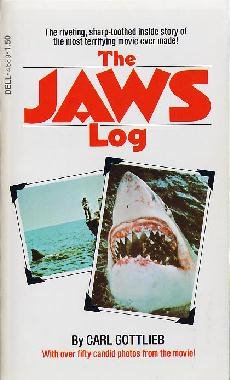
I’ll try not to repeat what has already been written, I’d just like to add a few personal notes. If you want to swot up, make sure you catch the two paperbacks that covered the production at the time. Carl Gottlieb’s The Jaws Log and Edith Blake’s The Making of Jaws – both written way before ‘Making of’ books became formulaic, and amongst the very first to devote whole volumes to a single film. At the time, I only recall Live and Let Die and 2001: A Space Odyssey being covered this way.
Now, there’s a feature-length documentary almost as entertaining as the movie itself – on the DVD special edition – candid interviews, rare footage and Richard Dreyfuss in fine form, make this one DVD extra you should take time to watch. It could be my current nostalgia for 70’s cinema, but I presently hold Jaws as my favourite Spielberg film.
It’s also my favourite John Williams soundtrack. I listen to movie soundtracks all the time, but out of all of his scores, I can only listen to Jurassic Park and Jaws all the way through without wanting to skip tracks. Besides the main iconic theme of the approaching shark, the rest of the score is pure music rather than ‘theme’ based repetition.
Having repeatedly watched the film, the shocks no longer surprise but other pleasures rise to the surface. For instance, even the editing is enjoyable (you could even argue that Verna Fields’ work is as important as the direction): Police Chief Brody’s vigil in the beach-chair ends with the famous tour-de-force reverse zoom – but it’s the ‘editless’ build up of false alarms that makes the sequence so powerful.
Also, the cinematography: Bill Butler achieves beautifully composed shots, despite having to depend on large-scale and difficult special effects. There are with individual shots of beauty and horror, that could work in isolation – the high-angled shot of Brody enjoying the thrill of the chase with the sun glistening on the sea behind him, and another high shot of the stuntman flailing besides his upturned rowing boat, as the underwater shadow of the shark glides towards him with its mouth gaping open. His camerawork almost takes you into the action, with numerous point-of-view shots, particularly the ones at water level.
The cast all seem irreplaceable. But there’s one performance I particularly look forward to – Murray Hamilton as the shifty Mayor. He takes us on a steady decline from being the island's Number 1 Mr Big, to a bumbling wreck with blood on his hands.
At the time, Jaws was classed as being part of the disaster movie cycle. Fair enough, besides worrying about tall buildings burning down, jumbo jets, earthquakes and ocean voyages, it also made me frightened of swimming. But today, it can classify as a monster movie or a horror movie, one of the best.
August 10, 2006
Not on DVD: RING: KANZENBAN (1995) - first of the Rings
RING: KANZENBAN
(TV Movie, 1995, Japan)
a.k.a. 'Ring: The Complete Edition'
The Ring Phenomenon
I’ve said it before, but I’m grateful that my love of horror films were re-energised by Japanese films. Ring (1998) kick-started a new cycle of effective horror films in the East, and started me off on a journey into Asian cinema both new and old.
Ring or Ringu is not just a film, but a very potent story rich with possiblities. Which is why, each time it’s remade, it’s different. This happens all the time with remakes, but it astonishes me how often Ring has been remade in only ten years.
Before Gore Verbinski’s American version The Ring (2002), the original book had already been filmed four times in the East, there had already been two TV series and three movie sequels! Talk about lagging behind! This is before we get into the rip-offs.
Ring: Kanzenban
The very first filmed version of Ring was a TV movie made in 1995, three years before the hit Japanese movie was released! Ring: Kanzenban was shown on Fuji TV as a movie of the week, then later released in a soft-porn version on videotape (of course). I’m confused as to whether ‘Kanzenban’ (which translates as ‘The Complete Edition’) refers to the TV movie being ‘complete’ and faithful to the novel (which it pretty much is), or to the complete, uncut sexed-up version on video.
I’ve seen very scathing reviews which lead me to think this was low budget, but it’s really quite impressive, with a wide range of location filming and some cleverly faked flashback footage and an intricate attempt at the cursed video itself.
It starts with a very familiar death scene, a young girl alone at home, dying in a locked room. (But in this version, there’s no phone ringing). A news reporter, Asakawa, witnesses a motorcyclist keel over and die and realises that four mysterious deaths have happened all at the same time. He soon traces the four victims’ movements back to a remote holiday lodge in the mountains, where he learns they have all watched a videotape exactly a week before they died. He finds and watches the tape and soon wishes he hadn’t…
This version of Ring is quite faithful to the plot of the novel. The problem isn’t the budget, but the cliched approach. It’s fascinating to watch one of the greatest ever ghost stories being treated like a bad horror movie. Over-the-top camerawork, flashing lights, and exaggerated acting all demonstrate perfectly how not to film Ring. Instead of subtlety, it relies on young, attractive stars and female nudity to get attention. From the Friday the 13th school of horror, where young women dress only in t-shirts or nothing at all. The TV version has nudity and an attempted rape, apparently the video release version has more graphic sex scenes as well.
But it’s not scary.
It works as a story, a mystery, a race against time. But imagine Ring not being a horror film!
We should thank Ring: Kanzenban for at least generating sufficient interest in getting the novel filmed properly. (At this time, the novel still wasn’t a hit). It’s script was also influential on the interpretations that followed – again, Meikle’s book explains this all in detail.
For Ring fans, it’s interesting to see familiar scenes being filmed differently – particularly the playing of the cursed video – very close to the description of the book, the images seem to invade the whole room, not just the person watching.
Sadako’s death scene involves rape and a different murder weapon. Each version I’ve seen, she gets raped or attacked by a different person and killed in a different way. But, the iconic well in this version is square! Sadako herself is rendered far from scary, by being young, beautiful and naked, (there’s even frequent nude scenes in the TV version).
Interesting, not essential and far from available. Ring: Kanzenban was only released on VHS and VideoCD in the East (see various covers, above). It’s not been officially subtitled anywhere and wasn’t released on DVD.
August 09, 2006
HAZE (2005) Latest film from the director of Tetsuo: Iron Man
HAZE (2005, Japan)
Region 2 DVD (Terra)
A cross between Cube and Hostel
A man awakes to find himself trapped in a dirty, confined crawlspace. He barely has enough room to move. He also has no memory of why he’s there, or why he’s bleeding from a stomach wound. Apparently drugged, he occasionally ‘zones out’ of his surroundings as he tries to edge towards his way to freedom. But the more he explores, the more pain he has to endure, and the more frightening his predicament becomes.
Haze immediately reminded me of a scene in the film (and the book) of Dr No, where James Bond is imprisoned and thinks he can escape through a ventilation shaft. In fact he’s crawling into a modern day torture chamber. The metal conduit gets very hot, then very cold. Then Bond gets hit by boiling water, and then (in the book) he has to break through a grill, in complete darkness, to find the tunnel filled with large spiders… Little does Bond know, he’s being watched by the Doctor, and the shaft is leading him to a deadly trap…
In the extras, the director explains how he was actually inspired by a scene from The Great Escape where Charles Bronson has to fight his claustrophobia while digging a tunnel.
Shinya Tsukamoto not only directs but stars in this film. In the extras we also see him help build the sets! In an interview he talks at length about the freedom and speed of shooting digitally. He sticks with his trademark intentionally-shaky camerawork, and the stylised look of the film may be digital, but it’s still very filmic.
My only reservation is that Haze is short – 49 minutes. I loved the atmosphere and the ‘predicament’ of the movie and would have liked a few more clues as to what was going on. It’s a brave film anyway, and would have needed courage to make a whole feature in such a confined space, but it felt like it was over too soon.
It’s intentionally painful and claustrophobic to watch, occasionally lyrical, and sometimes very gory. It also reminded me of the look and disorientation of Eraserhead.
Tsukamoto is definitely a consistent and interesting auteur director. I also really enjoyed Gemini and Hiruko the Goblin. Although the other films he has made aren't horror stories, like Tokyo Fist and Bullet Ballet, his unusal approach and visual style make me want to seek them out too.
Mark H
August 04, 2006
THE SNAKE-GIRL AND THE SILVER-HAIRED WITCH (1968) vintage Japanese nightmare movie
Based on manga by Kazuo Umezu
Region 2 NTSC Japanese DVD release (no English subtitles)
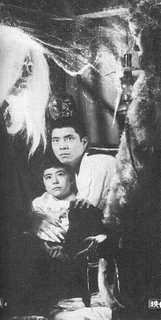
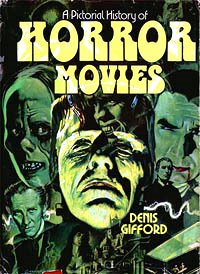
I sought out this film because, like Living Skeleton, (also released in 1968), I’d been intrigued by the photograph (at top) in Denis Gifford’s seminal book A Pictorial History of Horror Movies (1973). (For years in the UK, I barely got to see any of Famous Monsters of Filmland. At the time this book, David Pirie’s Heritage of Horror and Alan Frank’s Horror Movies were my only info on horror films). In the photo (above), was a fascinating scene, but the film was unobtainable.
KAZUO UMEZU
So, not only did I find a film that I thought I’d never see, but it revitalised my interest in Umezu. I’m not the only one - Umezu’s works are being reimagined as a series of films, under the banner Kazuo Umezz's Horror Theater. These are currently being released on region 1 DVDs (I’ll review Volume 1: House of Bugs, the DVD and the manga shortly). Also, at last, a large selection of his manga are now being translated as a series of graphic novels, called Scary Books (from Dark Horse Comics). The third volume in the series is about to be published. His epic, Drifting Classroom, is also being serialised in English by Viz Media.

(I’m a little confused as to why the manga are listed under Kazuo Umezu, and the DVDs are branded Kazuo Umezz – this will surely miss out on cross-promotion and efficient Googling. His name is Umezu but I think his self-chosen nick-name is Umezz or Kazz. Both names feature on his Japanese homepage.)
Umezu’s work has been patchily adapted for TV and film until now. I’m pleased that he is still around to see his work rediscovered and distributed more widely than ever. There was recently a TV series based on his manga Long Love Letter and there's a forthcoming film called Sukeban Boy. Hopefully, these older adaptions will also finally find a wider audience - this one certainly deserves it...
Sayuri, a young girl with a short boyish haircut, leaves the care of an orphanage to return to her family home (I read that there was a mix-up at birth and the family got the wrong baby). Though the nun who was looking after her seems to be unhappy about the reunion…
Things get off to a bad start as Sayori arrives home, the dead maid is just being carted off to the morgue! Her new found family consists of Mum, Dad and the senior maid, Shige. Their house is large, almost a stone mansion. (There’s an impressive shot from out of the front gate - the sky isn’t visible, there’s just a gigantic facade of scaffolding, a huge new slab of building being constructed).
Inside the house, Mum seems a little odd, Dad is never around, and someone is peeping at Sayori through a hole in her bedroom ceiling. Worse still, someone drops a live snake on her while she’s sleeping! Then a snake-faced girl appears in her bedroom.
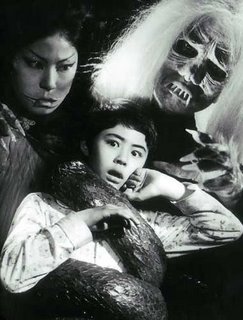
Sayori soon discovers that there’s a second girl in the house, called Tamami. I guess she’s explained away as adopted, but we know her as the step-sister from hell. Tamami is the rudest, cruellest, nastiest little girl you’d care to share a house with. It was Tamami who dropped the snake on Sayori from her bedroom in the loft. Now that she’s no longer a secret, the girls share the bedroom, but Sayori thinks there’s something wrong with Tamami’s face. She has a strange waxy appearance. As she lies down to go to sleep, her hair falls away and there seems to be a crack down the side…
Eventually, Sayori is all but imprisoned in the loft (full of scary masks) which is haunted by a white-haired crone with a skeletal face and murder in mind. What the hell is going on? Are her nightmares coming to life? Will they succeed in killing her?
REVIEW
To give you some idea, I’d compare this to a sixties psychological Hammer film, one of the black-and-white ones with the driving-the-heroine-mad-in-a-big-house plot (like Taste of Fear - 1961), mixed in with the plot of The Reptile (1966), but for kids! It resembles one long children’s nightmare, but that’s like calling Jaws a fishing trip. It’s nightmare bordering on full-on Japanese horror film.
It’s also kept interesting by the blurring of Sayori’s imagination. Much of the horror is in her dreams, but she also sees the snake-girl when she’s wide awake. The movie is fast-paced and interesting, even sub-textually. The characters motivations keep you guessing and the dream sequences are full of effects and are probably Freudian too!
I found it entertaining and surprisingly violent, probably because I thought it was going to be for kids. Tamami’s escalating cruelty fails to break the gutsy spirit of the young heroine, but provides us with many jaw-dropping moments – not least of which is when she tears Sayori’s pet toad in half! She’s full of surprises like that.
There’s another marvellous moment when Sayori catches Tamami looking at a natural history book, staring and mumbling at a page full of frogs. It reminded me of a similar moment when an adult is obsessing over some newly found spirals in Uzumaki. There’s also some apparent Christianity-bashing going on, just like in Living Skeleton. Let’s just say the nun gets payback for placing Sayori in such an awful household.
Whilst the film isn’t as lavish, gritty or sexual as the more famous sixties ghost stories like Onibaba, this is certainly faster-paced, more inventive and eventful. Its atmosphere of nightmare and sadism are certainly unique.
BEHIND THE SCENES
This was directed by Noriaki Yuasa, who also helmed the original Gamera movies. He must have been one of Daiei Studio’s top directors of FX films. It’s a pity that Daiei went bust in 1970, relegating Yuasa to directing TV for the rest of his career (including Ultraman 80).
Despite his expertise, (and probably due to the budget) there’s occasionally some obvious model work, and some fakey spiders and snakes. But that’s countered by the imaginative scenarios and great make-up effects – Tamami’s waxy mask is as eerie as the visage in Eyes Without A Face, and there’s a glimpse of the snake-girl’s hinged jaw (with cheek-splitting action, just like Ichi the Killer). The witch’s face also looks effectively undead.
The small cast are super, with the young actress Yachie Matsui, playing Sayuri, in her only film (according to Imdb). Kazuo Umezo himself scores a cameo as a taxi driver. He has since appeared in other adaptions of his work, such as Drifting Classroom (1987) and the forthcoming God's Left Hand, Devil's Right Hand. He also has a cameo in the promising Tokyo Zombie (2005) which is hopefully being released on DVD in the US later this year.
Amongst the extras are three more trailers, one for Warning From Space (1956, Japan’s first colour sci-fi film), one for a historical tale about islanders hunting whales with spears, another about an invisible samurai!!!
In the extras and in the foldout booklet, there are tantalising glimpses of Umezu’s original manga illustrations, that are even more graphic than the film. Let’s keep our fingers crossed for a translation in the near future.
I’m guessing that the ‘snake-girl’ segment in the forthcoming US DVD Horror Theater Volume 2, is also based on the same source material. I’ll update this page as I find out.
August 02, 2006
SUKEBAN DEKA (1991) animated yoyo action
SUKEBAN DEKA (OVA, 1991, Japan)Region 1 NTSC US DVD (ADV Films)
2 x 50minute episodes
After the three live action series and the 2 movies, this was a late entry to the Sukeban Deka saga. A straight-to-video (OVA) anime that takes us back to the start of the story, retelling the tale of Saki Asamiya as she returns to Takanoha High School from the Reformatory, on a secret mission for the police. If Saki does some undercover work, the Government will pardon her and her Mother, (who's on death row)!
This time around, we're treated to an adaption of the early manga stories - something the live-action series couldn't really afford to do. The plot is noticeably more lavish - the rich, powerful (corrupt) Mizuchi family and their three evil daughters all crave more power, fame and fortune. They set their sights on Saki's old school and begin manipulating and extorting the students and the school board.
Instead of low-budget family-friendly action of the tv series, this OVA takes a more brutal approach - with rape, female nudity, drugs and a nasty mass murder (which pre-empts the opening scene of Battle Royale, when a school coach is gassed). The fight scenes also get increasingly vicious and bloody - this is definitely an animation for adults not children.
But once Sukeban Deka is transposed to anime, it becomes just another martial arts girlfight - there are dozens of anime adventures that provide similar thrills. Certainly it's above-average animation, with fast paced plotting, but it's lacking in the distinctive and creative yoyo fights - the only element that really makes this story original.
Still, this is a better intro to the Sukeban Deka universe than piling straight into the movies - it would have explained an awful lot if I'd watched this beforehand. So until, the TV series get released (if ever), either start with this, or get up to speed with this Sukeban Deka Fansite before enjoying the movies...
The anime has the same characters and format as the live-action TV series, even the music is the same chugging electro-pop.
But their are huge differences in appearances - like hairstyles, Saki's is bright pink, her controller Jin has long blond hair! And she's lost her red socks! (Jin's lost his nasty bright yellow porsche, too). Perhaps these were the original details of the manga, but it's a big change from the series. With a strangely angular character design, Saki looks like a trained assassin, rather than a schoolkid. In the finale, she's not even in school uniform - which was another enjoyable element of the series. Again, without these elements, it look less original and more like all the rest.
Picky, picky! I actually enjoyed it, and I don't like most anime (browse the blog to find the series that I do). It was action-packed, the story moves along, with several surprises, the fights are exciting, there's even humour, pathos... what more do you want? I wanted more yoyos! Also, it didn't feel as outrageous as the series - because in anime, anything is possible.
The DVD looks good and runs feature-length. The original titles and end credits have been replaced with unsophisticated captions. Also, there's no 'making of' feature that the Japanese DVD had. The English subtitles are good, but not quite in line with the movies. for instance, the 'Dark Director' (Saki's mysterious boss) is here called the 'Dark Detective' and the 'Dark Inspector'. Make up your minds!
The DVD is widely available and can be picked up cheaply from most region 1 distributors.
Mark H
July 29, 2006
ONE MISSED CALL - the TV Series (2005) on DVD

(TV, 2005, Japan, Chakushin Ari)
TV series - 10 x 47 mins episodes
Takashi Miike’s hugely enjoyable One Missed Call (2004) was a successful late entry in the Ring ‘genre’ of Japanese horror. Taking the familiar plot of a series of cursed mobile phone calls, triggered by a vengeful (long black-haired, crawling) female ghost, Miike demonstrated that there was still fun to be had.
As One Missed Call - Final, the third movie, is released in Japan, I thought I’d mention the TV series that’s now out on DVD.
As a TV thriller, this is less serious in tone than the similar Ring: The Final Chapter series, in fact this is even more tongue-in-cheek than the One Missed Call movies – there’s a sort of Mulder and Scully pair of detectives, backed up by a posse of Lone Gunmen net detectives. The bloodless death scenes include homages to horror movie death scenes lifted from classics like The Omen and even Ju-on. But this is for TV and quite a low budget affair, so apart from the spectacular fire stunt in an early episode, the action relies mostly on editing and ingenuity rather than FX.
The series works at a tangent to the mythos of the movies, but provides just enough drama and horror to entertain.
Again, if you haven’t seen Japanese TV drama before, the series doesn’t look as slick as, say, UK drama. The series was shot on video and much of the action takes place on location (meaning that fewer sets have to be built). The initial ‘feel’ is more like a regular soap, than a filmic drama.
DVD
The entire series is out in Japan (without english subs) in a 5 DVD set called Chakushin Ari - the TV series.
July 27, 2006
LIVING SKELETON (1968) Japanese ghost ship madness
Region 2 NTSC Japanese DVD (Shochiku)
Delirious horror film from the writer of Goke Bodysnatcher from Hell
In the early seventies, there were only a few books about horror films. Denis Gifford’s Pictorial History of Horror Movies didn’t analyse the genre, it simply tried to list the films. I studied and re-read the plot descriptions and memorised the many publicity photos. Subsequently, I’ve tried to see all the films. 30 years later, I’m still tracking them down.
A tip-off from the Classic Horror Film Board (full of guys who write today’s books about horror films) led me to this recent Japanese DVD release. A sixties horror that I read about in the seventies. But wouldn’t you just know it – the photo that made me want to see it (above) isn’t anywhere in the film – and it looked like it was really grabbing her too (grumble).
IMDB lists Living Skeleton (the US release title) as director Hiroshi Matsuno's only film! Tellingly, screenwriter Kyuzo Kobayashi also wrote Goke Bodysnatcher from Hell – another mix of social critique and shock value. From my armchair, I’d put my money on the writer for being the driving force behind the mad mix of genres.
It’s an occupational hazard for horror film reviewers to endure the repetition of sub-genres – this is a ghost ship movie. Most films in this genre are usually called Ghost Ship, or Death Ship. Living Skeleton avoided this trap rather cheekily, seeing as there isn’t a living skeleton in the film! We must blame the US for the misleading misnomer. The actual translation isn’t as catchy – something like Bloodsucking Skeleton Ship or Bloodsucking Pirates.
Most ghost ship movies stick boringly to the concept dictated by the title and have people trapped on a ship, with ghosts. Even the recent US Ghost Ship (2002) did that. Living Skeleton pre-empts that film by starting off with a massacre onboard, but chooses instead to take the story into unpredictable directions.
Obviously I won’t spoil it for you but, for instance, the ship manages to haunt people on the land – quite an achievement. There’s also a double dose of necrophilia, echoes of Psycho in one of the film’s best shock moments, dodgy model ship FX way before Horror of the Zombies (from the Blind Dead films) came up with an even less convincing model ship. There’s even a scene straight out of Alien! This film has everything! Did I mention it has a female ghost with long black hair? The soundtrack emulates doleful harmonicas from Sergio Leone westerns, and fuzzbox guitars out of Barbarella.
Oh, and we’re in the sixties, when mechanical bats on wires were still state-of-the-art. There’s lots of those. But they’re far better than Kiss of the Vampire.
If I spoiled the plot I could start listing similarities with the best ‘ghost ship’ story of them all, the original The Fog. I previously thought that John Carpenter's film was a rip of Horror of the Zombies, now I’m not so sure.
Anyhow, there’s also some spooky underwater scenes with skeletons, all quite surreal, and these show off the 2.35 black and white photography the best. Elsewhere, many of the camera compositions look so cramped, I’d swear they were framing it to look good on TV. But, even in black and white, the film manages to be pretty gory.
A brisk pace, shocks, gore, nudity, mechanical bats and a plot you’ll never guess. This ghost ship outruns many of its successors in entertainment value. Now if only there were English subtitles…
This recent DVD release uses misleading cover art (pictured) that looks like a modern ghost story – if they slapped some original publicity stills on the cover, I’m sure they’d shift more copies. It looks and sounds very good - a 2.35 widescreen anamorphic picture, optional mono or 5.1 audio. The film has obviously been lovingly restored, gore and all. Pity there’s no trailer. There is an interview with actor Okada Masumi (who plays the priest). Filmed in 2003, I’m sorry to say that he recently passed away after a long career in film and TV, Takeshi Kitano’s Izo being one of his last appearances.
The back catalogue of Japanese horror fantasy has barely been plundered in the west – and it looks like we’re missing out. Matango Fungus of Terror and Goke Bodysnatcher from Hell are a very good start, but let’s not forget monochome movies. I’d happily trade this B/W gem for the entire Lake of Dracula trilogy, for instance.
July 26, 2006
DAMEKKO DOUBUTSU (2005) Useless Animals - nutty anime
DAMEKKO DOUBUTSU
(2005, TV anime, Japan, "Useless Animals")
26 x 5 minute episodes
A strange, slapstick series of very short stories with a catchy theme tune.
These tales are simple, but I'm still fathoming out the premise! "Useless Animals" are people dressed as animals living in the forest, I think. Also I'm not sure whether they are adults or children. Sometimes they have grown-up, realistic faces, sometimes child-like. Each character is a different animal - there's a wolf who loves an accident-prone leopard. There's a grumpy chain-smoking rabbit, a short-sighted owl, and two brothers - a strange, effete unicorn and a shy "pegasus" (a flying horse).
They all think that they're animals, but walk around like people in costumes. As usual, part of the fun is figuring out what's going on, but the stories are concerned with how they all get along. The especially useless wolf usually tries to chat up the leopard, fails, and exhausts the patience of the rabbit. He then gets kicked over the horizon - in one spectacularly animated shot, we see his point of view as he flies a high arc over the forest!
Original, funny and infectious. Whatever next?
Episode one is on YouTube with English subtitles.
MYLENE FARMER goes anime
One of my favourite singers, one of my favourite animation houses -working together! I'd forgotten just how crazy the French are about anime.
You can see the entire promo here on YouTube. (Thanks to Twitch for the mini tip-off).
Also, there's loads of beautiful screengrabs here - on a French fansite called 'Ettocdemac'.
The track is off her latest album Avant Que l'Ombre ... I was lucky enough to see her perform it in concert in January. There are camcorder clips from the concert also on YouTube, but the entire concert was filmed for a DVD being released in December.
July 23, 2006
SPEED GRAPHER (2005) Debauched violent anime fun

SPEED GRAPHER (2005, Japan TV)
24 x 25 minute episodes
A Gonzo Production
Highly recommended mutant thriller anime
With Duran Duran's "Girls on Film" as its theme tune, we're immediately plunged back into the atmosphere of the excesses of the eighties, (even though the story is set in the near future).
Opening with an orgiastic scenario out of Eyes Wide Shut, freelance photographer Saiga infiltrates a secret club for super-rich V.I.P.s, and discovers everything is for sale - sex, pain and your darkest fantasies made real. By accident he discovers the secret of 'the Goddess' and then things really kick off...
Kinky, blood-spattered, debauched - with a fast-paced story and some killer characters (you won't see many female detectives dressed like Ginza), this has very original action scenes and a wicked sense of humour - fun!
There's not many anime with regular gay characters in (albeit eighties stereotypes) or fight scenes with drag queens. There's also not many series that run to 24 episodes without any padding - but Speed Grapher rips along, it always seems to be moving, plot-twisting, or fighting.
The imaginative and genuinely scary, genetically self-mutated assassins in Speed Grapher make the X-Men look like Dennis the Menace. Imagine if your dentist turned into a giant spider-thing and each of his legs had a drill built into each foot..
Animation house Gonzo makes the future look sexy and the baddies look demonic, and it's in widescreen too. Can't wait to see their upcoming adaption of the classic Dario Argento horror film Suspiria...
More Speed Grapher screengrabs and a heap of spoilers at Memento, here.
Here's the Japanese SPEED GRAPHER title sequence on YouTube, with the Girls on Film music (which will apparently not be used on the western DVD releases), and without the title captions...
- - - - - - -
Finally on DVD: ANTARCTICA (1983) with english subs
ANTARCTICA (1983, Japan)
HK region 3 NTSC DVD (CN Entertainment)
Out of the blue, I was surprised to discover this DVD was out now in Hong Kong. It's 16:9 anamorphic widescreen with a DTS 5.1 soundtrack. The main drawback is that the english subtitles aren't perfectly subtitled - the translations are a little stilted, and worse still they share the screen with chinese subtitles too - you can't select english subs only, despite there being two other chinese subtitle options! But until this gets a release in the west, this is the best DVD version out there.
I'd been impressed by the film, for the harrowing cinematography and fantastic score by Vangelis (the year after his magnificent Blade Runner soundtrack).
I reviewed Antarctica (off a dubbed US VHS release) a few months ago and wasn't expecting a DVD release with subtitles anytime soon - see review here.
July 19, 2006
New CHIAKI KURIYAMA DVD - Kindaichi TV Movie with subs
"Queen Bee" aka "Joubachi"
starring Goro Inagaki as Kousuke Kindaichi
and guest starring Chiaki Kuriyama
All Region Malaysian DVD - with English, Chinese and Malay subtitles
Had to spotlight this release, mainly because of the guest star. This is the first thing that I've seen Chiaki in since The Great Yokai War. It's a feature-length murder mystery made for TV, part of the ongoing series of light-hearted thrillers featuring fictional detective Kindaichi.
Set in post-war Japan, Joubachi features Chiaki as the title character, 'Queen Bee', a privileged young lady who occasionally flips out and brains her suitors with a biwa (a sort of lute). The period setting gives Chiaki a chance to wear an assortment of traditional period costumes, reminiscent of her outfits in the 1999 ghost movie Shikoku.
It's interesting to see what a big-budget Japanese drama looks like, but not nearly as big-budget as US television, so don't expect Lost. This is still a handsomely mounted and acted drama that occasionally tips towards psychological thriller, with Chiaki playing a central role.
Unlike the Japanese DVD, this Malaysian release has english subtitles, but they are really 'cracked' - like a bad automatic translator programme has been used. I suppose the subs give enough clues as to what's going on, but you need to concentrate, laterally. On the plus side this DVD release has the original Japanese audio and it's widescreen - shot for High Definition TV.
I got my copy from ZoomDvd.com, here's a link. Be careful which title you get though. All the releases in this series have the same photograph of Kindaichi on the cover (see top photo) and they don't mention which story it is in the text. So look at the details of the actors to work out which story is on the DVD.
If you want to know more about further murder cases of this fictional Japanese detective, I tried to list the various Kindaichi movie series in a recent entry, here.
July 16, 2006
DORM - Special Edition DVD - out now but no subs
A reasonably-priced deluxe region 3, 2-disc DVD boxset (pictured) has just been released in Thailand. This is my favourite Thai film so far and I've raved about it here . Problem is that there's no English subtitles. Doh! So I'll just tell you what else is in this set - if it does get released in the west, it probably won't have all these extras.
There's a beautifully produced booklet and an extra DVD full of, um, extras. There's a dozen deleted or expanded scenes, a thorough making-of documentary, featurettes on the special FX, photo galleries, trailers, and the original soundtrack (that doesn't appear to have been released on CD). There's also TV coverage of what looks like a cast-and-crew preview with lots of interviews happening while the film clips play in the background - how disrespectful! "Here's my new film, let's talk through it".
I'd love to hear just how much of the film is based on actual events in writer/director Songyos Sugmakanan's (pictured on the left) own schooldays, but of course everyone's talking in Thai.
Best of the extras is the uncut six-minute pastiche of Mr Vampire. A specially-filmed homage that plays during the schoolboys' 'movie night' scene. It uses lookalike actors and recreates footage of the best gags from Ricky Lau's superb 1985 Hong Kong comedy horror.
Child star Charlie Trairat even has a pop video, though he doesn't seem to be too comfortable singing.
I got mine from eThaiCD.com.
UPDATE APRIL 9th 2007:Dorm is now out region 3 Hong Kong with a no-frills release but with anamorphic widescreen, 5.1 audio and decent English subtitles. It's coming soon for a region 1 USA release at the end of May 2007.
PIRATES OF THE CARIBBEAN 2 - zombie epic!
Yes, yes, it's overlong and hasn't got the non-stop pacing of the first film, but Pirates of the Caribbean: Dead Man's Chest still has much to offer. I hadn't read any reviews, just to avoid spoilers, but I've heard a lot of negative stuff. If you're a fan of dark fantasy adventure comedies, you're in for a treat.
Most of the characters are undead, the crew of the Flying Dutchman are also spectacularly mixed-up with underseas creatures, (like if Jeff Goldblum had accidentally taken an aquarium into his matter-transporter). There's hammerhead shark-man, hermit crab-man and best of all octopus-faced Bill Nighy. I wandered why I was seeing his photo everywhere (like the one above) - to understand it better you have to see it move. That's when the make-up becomes spectacular - a living beard made up of tentacles. I'm guessing it's an effect that uses physical prosthetic appliances, keeping the effects computer-aided, rather than computer-reliant.
Indeed, it's been a long time since I've been in a cinema and not thought "computer-generated". Despite the fact that there's impossible stunts and the best giant sea-monster ever, it never looks fakey - just spectacular.
I won't give a full review - there's plenty of them out there. I'll just say that I thought it was impressive, with an intricately funny script and a stream of original action scenes. Oh yes, and an almost totally British cast. Arrr!
July 15, 2006
SUKEBAN DEKA - THE MOVIE 2 - more schoolgirls, fewer yoyos
COUNTER-ATTACK OF THE KAZAMA SISTERS (1988, Japan)
Region 1 DVD (Tokyo Shock)
A brief look at the second Schoolgirl Cop movie.
This film followed the third and final TV series. But with more characters and a more involved plot, this film is not nearly as much fun.
Having debuted in the first movie, 17 yr-old Yui (the Sukeban Deka III) shares this movie with her two older sisters, Yuka and Yuma. She is now working for a the Juvenile Security Bureau, a student police force tackling juvenile crime with vicious triple-bladed yoyos!
But Yui rebels against the heavy-handed tactics and quits the force. Teaming up with her sisters and a gang of young outcasts, she tries to prove that the bureau is corrupt - creating crimes to justify their own existence...
The overly complex and political plot doesn't sit well with the patently silly array of weapons our heroines have to use - Yui's sisters have only got knitting needles and a metal origami crane!
Also, there are fewer opportunities for hand-to-hand fighting - there's more cars, tanks, boats and even a blimp - but less time for karate and Yo-yo action! Because of the more complex stunts, the girls are obviously stunt-doubled too.
The fight scenes are also less convincing. The first has Yui leaping out of a river (how?) and diving single-handed into a fist fight with 6 henchmen.
The behind-the-scenes programme makes more sense of the set-up, when we learn that "the Kazama sisters" are a singing trio in real life, performing concerts between shooting days! We also see how they've done a very good job of making actresss Yui Asaka look so young.
The movie lacks much of the originality and simplicity of the first, more low-rent action, but fewer memorable characters.
Mark H
July 07, 2006
SUKEBAN DEKA - THE MOVIE (1987) deadly yoyo action on DVD
SUKEBAN DEKA - THE MOVIE
(1987, Japan)
Region 1 DVD (Tokyo Shock)
She's the Schoolgirl Special Agent with a deadly steel yoyo!
This is ridiculous, but an awful lot of fun. I thought I was just going to watch a movie. Once again there was homework to be done. Sukeban Deka, according to Wikipedia, translates as something like “delinquent girl detective”.
I also didn’t realise Sukeban Deka was a franchise, rather than a pair of stand-alone movies…
Watching it, I felt that I was missing something, plotwise. All the characters seemed to know each other and I didn’t know why. There were flashbacks, too. That’s because this movie followed on from two TV series. Seeing as we’re unlikely to see the TV series, you’ll need to know this before the first film…
Sukeban Deka - The Backstory
What I needed to know before I started watching was... that the Japanese government were training delinquent schoolgirls to become special agents, giving them weapons disguised as stuff you’d find in a satchel (like yo-yos) and training them to fight (with sharpened fingernails or glass marbles). After a year (or a series) of hazardous missions, Sukeban Deka 2 has resigned and separated from her chums…
Sukeban Deka - The Plot
Asamiya Saki has forsaken her special agent status and has re-entered normal life. She accidentally bumps into a young man trying to escape some thugs and decides to help him. He’s escaped from Hell’s Castle (!), a madman headmaster, Hattori, is trying to brainwash young students into helping him stage a coup d’etat (shades of Yukio Mishima). She reforms the gang and asks her old boss for her weapon – the deadly steel yoyo. Taking on a helicopter gunship (with her yoyo) and teaming up with the newly-appointed Sukeban Deka 3, Saki and the Red Rangers have to storm Hell’s Castle to stop the villain. Luckily she’s been given the Ultimate Yoyo…
Sukeban Deka - The Review
A nutty set-up like this, playing like a low-budget remake of Enter the Dragon with schoolgirls, is nothing but fun all the way. You have to cheer when the heroine finally swaps her nasty cardigan for the schoolgirl uniform. You suspend your disbelief as the girls defeat armed guards with yoyos and marbles. You gasp when you see The Terminator so blatantly ripped off.
Released in 1987, it looks like it was made in the seventies. Grainy film stock, lots of location shooting, helicopter action, poor model work and a TV cast. The only thing that dates it is the electro eighties pop songs, also sung by the actress who plays Saki. The rest of the soundtrack is repetetive, catchy and over-the-top.
Toei studios made two films around the three TV series. Director Hideo Tanaka keeps the action moving along briskly, riding roughshod over logic, but getting the girls to look as convincing in action as possible. Yoko Minamino, as Saki, performs most of her stunts and does much of her own fighting (and yoyo work). She’s a real find and it’s no surprise to learn that she’s still working as an actress today.
The chief baddie, Hattori, is cleverly underplayed by Masato Ibu, who recently starred as the head Xillian in Godzilla Final Wars. He was also in Azumi and Spielberg’s Empire of the Sun!
Sukeban Deka - The DVDs
The two films are out in the US from Tokyo Shock. Sukeban Deka - The Movie (pictured above) also includes trailers and a marvellous behind-the-scenes TV programme that looks like it could have been made yesterday. The lead actress Yoko, is honest about her worries and stress about carrying a movie, and we see her bravely performing stunts as well as singing the theme tune!
Besides the sequel, there is also a 1994 OVA anime of Sukeban Deka, available on Region 1 DVD. The 3 TV series are all out in DVD boxsets in Japan, but without any English subtitles.
If you'd like to learn even more about the phenomenon that is Sukeban Deka, check out this superb fansite for screengrabs, guides and lots lots more...
But the latest news is that YoYo Girl Cop is the name of a new movie remake, in the pipeline for next year! Twitch Film have reported that this new adventure is on the way! Check the link out for more details, teasers and the new poster.