May 31, 2006

RING - THE FINAL CHAPTER (1999) Sadako on TV again

RING - THE FINAL CHAPTER
(1999, Japanese TV series, IMDB title - Ringu: Saishusho)

All-region DVD (HK Video)

Long-winded TV series adaption of the Japanese horror classic

The solitary stone well, sitting in a clearing at the edge of the woods, in the movie version of Ring inspired me to seek out more horror films from the east. The TV series wouldn't have.

I finally finished watching this 12-episode live-action TV series. I was prompted to persevere by the observations of Denis Meikle in his substantial book on the subject - THE RING COMPANION. In it, he not only examines all the adaptions of the Ring books as films and TV shows, but also looks at the roots of Koji Suzuki's novels, in the tradition of Japanese horror stories and earlier ghost films.

He notes that the TV series Ring: The Final Chapter takes Suzuki's first 2 books (Ring and Spiral) as source material (after both books had already been turned into films), blending the video curse with a biological origin. Admittedly the script has to pad out 11 x 45-minute episodes and a 75-minute finale.


Once again there's a journalist investigating a number of heart-attack victims who all died simultaneously. A cursed videotape seems to be involved, but he watches it before learning that it has the power to kill. He's helped by two women, one a reporter, the other a friend who just happens to be a professor in a medical university. He only has 13 days to unravel the mystery of the video before his time is up.

The scriptwriters manage to mangle all sorts of mad theories together, insistent that every element of the curse can be explained scientifically. This makes a lot of the plot sound like a stretch, and demystifies the supernatural element, making it ludicrous rather than frightening.

They add numerous new plotlines and characters, and rewrite Sadako's backstory (once more), but still include her joining a theatre group - a scenario that was filmed again in the film Ring 0: Birthday (2000).

The only familiar face in the cast is Hitomi Kuroki, playing Rieko, the scientist. She starred in the original Dark Water, as well as appearing in Senrigan and Haunted School 3.

Even as television drama, it's hard to get involved because of the production values - this Japanese TV series is shot on video (which is very apt considering the central premise). But this is a 'look' that went out with the 80's. Most western drama is shot on film, with only soap operas shooting on video. This could distance the audience, or at least make them think the production is a lot older than it is.

Despite the running time, there are relatively few locations and only occasional action. It works well dramatically, most of the cliffhangers may make you come back for more, but the main problem is that it's rarely scary - another example of how the film trilogy got it right, while using the same source material.

Another annoying sign of the tight budget is the music, many of the cues being reused endlessly, even within an episode.

The DVDs (pictured above) squeeze all 12 episodes onto 2 discs, the picture looking a little soft, but it hardly matters. The English subtitles are removable and well-translated. There are a few newspaper headlines and signs that aren't translated and there's occasional spelling mistakes, but they don't spoil your understanding.


But I'd only really recommend this series to Ring completists who insist on seeing every incarnation of Sadako (who actually hardly appears here) and want to take another yet trip down that well...

If you'd like to learn more about the many other films, books, manga and TV that make up the world of the Ring, then go to
The Ringworld. It's a very helpful and expansive website that I find myself constantly refering to, as I try and track down every last version of this modern legend.

May 17, 2006

KAMIKAZE GIRLS (2004) - HK DVD review

KAMIKAZE GIRLS (Japan, 2004)
HK region 3 NTSC DVD (released by Widesight)


Truly bonkers, both visually and plotwise, this Japanese comedy crosses Clueless with The Odd Couple

I say Clueless because the central character pretty much puts style and decorum over anything else - Momoko is an offbeat 20 year old who dresses 'Lolita-style' in frilly dresses befitting a six-year old's party outfit. Due to her hopeless father's defection from the lowest echelon of the yakuza, she lives a good 2-hour journey away from her favourite dress shop in Tokyo. In order to fuel her outrageous outfit habit, Momoko decides to sell off some of her Dad's old fake designer wear. Enter prospective buyer, Ichigo, a trashy biker chick (well, she's more of a scooter chick, really) who's happy enough wearing clothes from the (gasp!) supermarket. An unlikely friendship begins, resulting in a series of off-beat adventures.


It's a frothy comedy, but with headbutting. It's very Japanese but you don't need to know that much about Japan - gangsters, track-suits and stupid haircuts are surprisingly universal themes! Unlike American teen-comedies, there are few references to sex, despite the characters both being 20 - the humour is so polite that there's not even any lesbian jokes aimed at the biker chicks. It's still sufficiently bizarre and violent to engage, though.

Although it looks like it's shot on video (my guess is High Definition), Kamikaze Girls belongs in the cinema, with its flamboyant visual style constantly flashing back to the characters' pasts. Eye-popping animation also tones down the violent excesses of the biker gangs, punctuating the film in much the same way Tank Girl did, if you'll excuse the comparison.

Kyoko Fukada nails the part of Momoko perfectly and ably carries the movie, making asides to the camera when people around her break her rules of etiquette. I look forward to rewatching the Japanese Ring 2 to see her in something different. Newcomer Anna Tsuchiya rises to the challenge of playing bad girl Ichigo, but while she may be extremely rude for a Japanese audience, she doesn't fully convince that she's really that tough. Her character is still an awful lot of fun, and I look forward to seeing the actress in her following film, the cult classic A Taste of Tea.

Comedian Hiroyuki Miyasako plays Momoko's useless father - the following year he landed the pivotal role (as Sada the reporter) in Yokai Daisenso (2005). Sadao Abe starred in the same film (as the marvellous Kappa) but here plays the ludicrous love interest with a D.A. haircut that could take your eye out. Boy, does he think he's cool. Abe is a creative chameleon of an actor who seems to maximize the potential of any of the surreal roles he's given. He keeps turning up in my favourite Japanese films, Uzumaki being the first I saw him in.

Anyhow, this DVD from Hong Kong (pictured top left) has a great set of removable English subtitles, that ably capture the humour of the dialogue. The Japanese audio is optionally presented in DTS, and the picture is anamorphic, for those of you with widescreen TVs. Strangely, the DVD is no-frills, which is ironic considering the frilly nature of the film.

Mark H

May 16, 2006

ZEE-OUI (2004) - Thai DVD horror review

ZEE-OUI (Thailand, 2004, aka THE MAN EATER)
Region 3 PAL Thai DVD


A famous serial-murder case gets a bloody re-telling

Li Hui, a Chinese farmer, arrives in Thailand in 1946 and gets renamed 'Zee-Oui' by a short-tempered immigration official. His uncle finds him a job, but the new name has to stick because it matches his work visa. Zee-Oui soon discovers that being a foreigner means getting bullied by everyone, even children. He works hard, but suffers poor health - a constant cough that he thinks is asthma. After much bad luck with his jobs, and as we learn more of his harrowing life in China, he takes to murder.

The subject matter here is problematic to say the least - a serial child-murderer who eats the hearts of his victims! It's especially tricky for western audiences to enter the fray with this particular version of an infamous true-life murder case. It's apparently been portrayed many times before in Thailand, but this time we're getting a revisionist version of the events, showing the murderer in a more sympathetic light.

Zee Oui, you see, is apparently a boogey man in Thailand - his trademark cough and cannibalistic traits make him a monstrous figure to threaten naughty kids with. It's also a justification for xenophobes to fear foreigners. Presumably, the two directors were trying to redress the balance.

As a viewer completely unfamiliar with the case, the film's opening scene gives away the conclusion to the story, before telling the whole tale in flashback. Without a good grasp of local history (the war between China and Thailand) and Thai geography, I was at a disadvantage in following the fractured timeline of the plot - not always realising when the story had shifted backwards in time. But this is something that other films manage successfully, despite cultural differences (I'm thinking of the backwards-and-forwards structure of the Japanese JU-ON films, for example).

Crucially, a brilliant scene where bullies cause Zee-Oui to visibly 'crack' is positioned after we've already seen murder victims. Whether I misunderstood the order of events, or whether the directors were saying that he was being blamed for murders he did not commit, I'm still not certain.

Another handicap to the structure of the story is the inclusion of several scenes interspersed among the end credits, that crucially fill us in with more details of Li Hui's upbringing. To introduce this information, after the film has finished, further hampers our understanding of the film's message.

Lead actor, Long Duan, almost succeeds in an impossible role, to make us sympathise for this man, but we're obviously constantly distanced from him by the brutality of his onscreen crimes. The directors intend for us to better understand his motivations - but besides listing the possible causes of his serial killings, many other political points are clumsily made about racism, sexism and government cover-ups. Overall, the naive script and convoluted timeline undermine most points they wanted to make.

While this may be award-winning material in Thailand, it's a difficult film to recommend to an international audience. The tone veers between over-the-top depictions of child murder and simplistic drama. The performances are sincere enough, but are undermined by sloppy plotting. Shortcuts taken by the script keep the story moving by using unbelievable coincidences. Moving the detective story along a little slower could have made for more intrigue and suspense, which are lacking.

So, without a strong story, and with glimpses of gore at the murder scenes, this can only be placed in horror film section. Presumably on a shelf with the other real-life murder cases that were turned into crass horror films.

Even so, despite the sensationalist subject, I didn't find the film nearly as shocking as it should have been. The crimes in The Untold Story (Hong Kong, 1993) also managed to produce sympathy for a cannibalistic child-murderer, but were far more effectively portrayed, and with a much lower budget. I guess, though, that Thai audiences may be more horrified by the desecration of holy sites and even a Buddhist shrine.

Technically, the film looks very good, with a large scale that convinces us of the many locations and periods depicted. If anything, the film looks too good - for instance Li Hui's early job slaughtering chickens takes place in a beautifully lit, colourful backyard, sending out mixed messages about what's occurring - is he in a good or a bad place? If it's such a nasty job, why does the place look so picturesque?

The Thai DVD (pictured above) has a sharp anamorphic transfer that shows off the film's crisp and colourful cinematography. There's a solid 5.1 audio track in the original Thai language, with optional English subtitles (that are well-translated and only occasionally misspelled).

There are some brief extras, a trailer, a teaser and two short 'Scoop' items (presumably prepared for TV publicity) - these include extra shots that aren't in the film, and some grainy, but grisly real-life photos of the original case. However this material is all untranslated.

Zee-Oui is an interesting film, entertaining even, it's certainly not dull. Technically it's one of the best movies I've seen from Thailand, and certainly isn't aiming for an obvious 'horror film' formula like many other Thai films. But it doesn't succeed as a drama or a reliable vers
ion of what really happened. I'd hesitate to recommend it to fans of Asian cinema or Asian horror - it's too gory to be taken seriously, but not horrific enough to be frightening.

Mark H

May 06, 2006

DINOCROC and THE BRUTAL RIVER - A couple of huge crocs!

DINOCROC (2005, USA)
and
THE BRUTAL RIVER (2005, Thailand)


2 recent films with monster CGI crocodiles on the loose


I enjoy monster movies, and I want more than anything to tell you about two exciting, action-packed movies with marvellous monsters in them - movies that deliver what their promotional artwork promises...

Instead, this is yet another warning to the curious...


DINOCROC

Evil scientists mucking around with accelerated growth drugs and inadequate containment procedures, loose DINOCROC on the world. It's a monster crocodile spliced with a two-legged dinosaur. It swims, it runs, it kills a few people. In between meals we get a turgid love story and some inept scientists trying to work out what the evil scientists are up to.

It's a rip on the plot of PIRANHA, but fails to rip the wit, the gore and the suspense of that 1978 classic, which was itself a Roger Corman produced Jaws-rip, directed with gusto by Joe Dante and written by John Sayles.

Nowadays the name, Roger Corman, above the title is alas not a seal of quality. But still DINOCROC suckered me in - if only the monster looked as good on the DVD cover as it did in the film. Admittedly, it's sort of convincing in the many night-time scenes, but it's back legs look a little too weedy to support its monster body. The attack scenes are mildly engaging, but never convincingly gory.

To be fair, DINOCROC has serviceable direction, a mixed ability cast, and a reasonable soundtrack, but I can't see this will ever be remembered for anything more than the snappy name (ouch). With PIRANHA, Corman attracted a talented team and created something special on a low budget.

Occasional moments of tongue-in-cheek black humour break up the lack of action in the first half of the film. The low-rent action races the second half to a logical if unexciting finale. There's a couple of rule-breaking plot twists, a little satire, but nothing to raise this above the level of an afternoon cable channel time-killer.


I watched the Thai DVD (pictured above) - which is a cheap way to watch a cheap film - but it's only a 4:3 pan-and-scan release. You'll have to get the Region 1 US DVD to see DINOCROC in 16:9 widescreen.


THE BRUTAL RIVER (or KHOHT PHETCHAKHAAT)

Meanwhile, in Thailand, they're still trying to rip off JAWS. New Asian film news website 24FRAMESPERSECOND alerted me to this one. This new movie supposedly tells the story of a monster croc that went on a killing spree in the sixties. First picking on a few isolated villagers deep in the rainforest, the croc went on to defy the best efforts of both holy men and the police force.

Great posters, but... It may be a good idea to make a low-budget monster movie to cut your movie-making teeth on - just don't let anybody see it until you've got something good. This is nicely shot, but completely lacking in suspense or excitement. Even during the 'action' scenes, there's a feeling that the story is treading water. For example, a man gets bitten by the croc - he thrashes around, people look horrified, he thrashes some more, no-one does anything, he keeps thrashing... The scene doesn't develop. Cross-cutting between victim and croc isn't telling a story, it's more like watching ping pong.

Also, the characters and story are really basic (how to establish a love story? - let's have a love song!). The actors only need to look scared, look horrified, or scream in agony (at something offscreen). Okay, there's a little gore, lots of dodgy computer generated monster croc, and no plot twists. I dare anyone to watch this without skipping forwards.


If anything, this is an excellent lesson in how not to make a monster movie. A few shots swiped from JAWS only reminded me that I really should watch JAWS again.

So please, if you think you'll like either of these 'crocs', please watch JAWS, JAWS 2, GRIZZLY, ALLIGATOR and PIRANHA first. If you want to see good CGI monsters, watch any JURASSIC PARK 1, 2 or 3, or even GODZILLA (1998). Then and only then, watch DINOCROC or BRUTAL RIVER.

Mark H

April 27, 2006

VOICE (WHISPERING CORRIDORS 4) Thai DVD review

VOICE - WHISPERING CORRIDORS 4
(2005, Korea, aka 'VOICE LETTER')

PAL all-region Thai DVD (released by Rose)


Fourth in the Whispering Corridors series, Voice has the most lavish budget in the series and delivers a stylish, bloody ghost story

The 4 films are linked by similar themes rather than by ongoing characters. Each film is set in a girls’s high school ‘with a history’, with a story that involves suicide, lesbian relationships, and schoolgirls haunted by their dead friends. Whispering Corridors (1998) got the series off to a shaky start. Memento Mori (1999) however, is a very good drama, with convincing naturalistic performances depicting modern school life. Halfway through, the film then concentrates on the ghost story and becomes less individual. It’s a good film, but not an essential horror. The Wishing Stairs (2003) then fell back on Ring for horror ideas and failed as a drama due to a lower standard of acting. Other films, like Bunshinsaba, were using similar story ideas to greater effect, if horror is what you’re hoping for.

But now, Voice is a giant leap forwards for the series, with fresh new ideas on scares, ghosts and twists. There’s also enough money for some unique visual FX flourishes, like when the ghost tries to piece together her memories. The cinematography is stylish and beautifully realised, adding rich colour to some scenes, defying the muted colours of the school. The cast is fantastic and very watchable. The depiction of school life isn’t as realistic as Memento Mori, but Voice succeeds admirably as a ghost story, with the added slant of having the ghost taking centre stage.

There are some startling death scenes and some extensive FX to depict the various complications of being dead, for instance, the ghost girl being confined to the school. These are ambitious and imaginatively done, but look more scientific than spiritual, as if the afterlife were a natural phenomenon.


It all helps the story take some startling turns and makes for a very different and eventful modern ghost story. The film falters a little towards the end, as the climax is a little drawn out. But if you're after horror, this is the main film in the series to recommend.


The Thai DVD release (pictured at top) is very reasonably priced, but at the expense of the film's extensive sound design. Music and voices are central to the plot, but unfortunately the original Korean mix is only available in stereo. It would certainly be worth getting a version with the 5.1 Korean mix if you have the right audio equipment. Only the Thai dub is in 5.1 on this release. If that’s not a problem, and you’re not expecting any extras, this is a well produced DVD, with great picture quality and well-translated and presented English subtitles. Strangely though, a couple of scenes of a schoolgirl smoking has been digitally blurred out. It’s not crucial to the film, but it is annoying.

November 2007 update: a Korean DVD with English subtitles and 5.1 audio has since been released, available here. Presumably it will have none of the Thai censorship either.


- - - - - - -

April 19, 2006

MUSHISHI (2005) - a wonderful new anime series

[Text UPDATED November Jan 2007]

A new anime without robots or guns or pocket monsters - just a mysterious guy sorting out elemental spirits in rural Japan

Ginko - the quietly spoken lead
in the Mushishi anime

This is my favourite anime at the moment... now concentrate...

Mushi are a strange, largely unknown part of nature - primeval entities in terms of biology, creatures exisiting somewhere between this world and the next.

A
n expert roams the countryside trying to help people who have problems with local mushi. He is Ginko, a Mushishi (or mushi-master), travelling around with a box of herbs on his back. He has a mop of white hair, though he isn't old, and he wears a brown trenchcoat. If it wasn't for Ginko's modern attire, you could easily think the series was set in the 19th century, or even further back. Everyone he meets lives traditionally, wearing kimonos and living in wooden houses.

This premise means that there are no modern distractions, or technological solutions on offer. Ginko solves problems with knowledge, deduction, simple science and occasionally herbs. I'm guessing here, but is it more than a coincidence that he's missing his left eye (hiding it with his hair) just like Mizuki Shigeru's popular character Kitaro the ghost boy? Could be just an homage, but I think Mushishi is very much a Gegege No Kitaro for an older audience. It's beautiful, paced, spiritual and keeps its humour understated.

This isn't to say that the episodes are slow - there's always something going on -usually a mystery or drama is unfolding - and the action frequently becomes spectacular. The artwork is beautiful, with bursts of intricate animation creating a sense of wonder, sometimes horror, of the other dimensions we're sharing space with...

Each episode stands alone as a story, with little need to watch them in order. There are a few links, especially the recurring character of the collector. My favourite episode so far tells of Ginko's childhood and how he became a Mushishi - it's a fascinating episode with many new mushi.


Mushishi
is based on the manga of Yuki Urushibara, whose stories the episodes closely follow - there's a sample of her artwork
on this page. But stories are running out, and the series looks set to end at 26 episodes. I can't get enough! To me it's unique and very different, very calming, very Japanese.

[UPDATE 10th Jan 2007: Translated volumes of the manga have now been published in the US.


The region 2 DVDs in Japan are slowly being released but without english subtitles. There's a new 'grey' release from Hong Kong (pictured left) of the first 13 episodes, but these are not anamorphic, and the subtitles cross the lower edge of the picture. As usual with this type of release, there are plenty of spelling mistakes and the timing is very poor on the first episode, way too fast. Not the perfect way to see a near-perfect series.

November 2007 update: the series was eventually released in 2007 in the UK and US, 16:9 anamorphic with English and Japanese stereo and subtitles.


There are two CD soundtracks available in Japan. The incidental music is made up of quietly beautiful instumentals, but the opening theme song is too drippy for my taste, a love song with wet lyrics is out of keeping with this story, spoiling an otherwise perfect anime. Both CDs are still available from Amazon or CD Japan.

If you're in the mood for spoilers, there's plenty of screengrabs here on the Memento anime blog, with plot recaps and extensive analysis.

Joe Odagiri as Ginko in BUGMASTER, the movie version of MUSHISHI

[UPDATE 10th Jan 2007: this news from Twitch - Mushishi is now also a live-action feature film, known internationally as Bugmaster (not a great title) to be released in Japan in March, 2007. Directed by no less than Katsuhiro Otomo (director of Akira and Steam Boy). It seems to be a fairly low-budget film, simply presenting several episodic stories together. Ginko appears as a young man (like the anime), rather than a teenager (in the manga). I'm not reading the reviews until I've seen it for myself, but I hear they're not as good as those for the series. Midnight Eye online magazine has a rare interview with Otomo about the film.]

DORM (2006) - a coming-of-age story from Thailand, with ghosts

(Updated September 2013)

My coverage of charming Thai ghost story Dorm (Dek Hor) is rather fragmented in Black Hole Reviews, because I used to publish news as it came in. Also, my most thorough review wasn't even in this site, but written for Twitch news. Because that's now mostly disappeared (except for one paragraph!), I'm republishing the original text below, together with my other notes on the main DVD releases of Dorm so far...


DORM
(2006, Thailand, Dek Hor)

Dorm is likely to get caught up among many other horror films from Thailand. But it's not so much horror, as a ghost story. Despite the young cast, it's certainly not childish - it has an uncomfortably dark side, reminiscent of Stand By Me, that makes it unsuitable for a younger audience. Anyhow, while I can't quite categorise it, I can say that it's a great Thai film, though not nearly as creepy as The Eye or Shutter.

While on holiday in Thailand, I was delighted to find that Dorm had just opened, a film I'd been looking forward to (having seen the trailer on Twitch) and better yet, half of the performances had English subtitles! Before the film started, in a large cinema (in Bangkok's MBK Shopping Centre), I was caught out by the whole audience suddenly standing up for the National Anthem accompanied by a photographic montage of their beloved King. We don't even do that in England! 


The film opens with Chatree (Chalee Trairat), being sent to boarding school in his seventh grade. His father justifies the decision by saying it will enable him to study harder. Chatree is very angry, but we don't know why he's unable to complain. His life is made even more miserable because he's a 'new kid', joining the school halfway through term. The teacher who doubles as the school matron, Ms. Pranee (Chintara Sukapatana), does little to make him feel welcome.

All the boys in the school sleep in one huge dormitory. On the first night, a gang of four misfits decide to pick on the new kid by telling him ghost stories. Lying under the covers, they tell Chatree that the school, the dorm, Ms. Pranee, even the very bed he's sleeping in, all have a dark history. They tell him about the school worker who committed suicide, the deserted swimming pool, and a ghostly caretaker. The stories are shown like 'flashbacks', but just how much of it are they making up to scare him? Their ruse works better than expected - Chatree has to get up in the night and visit a deserted toilet. Outside, dozens of dogs are looking up at his window and howling. He's too scared to find out what's scaring them and he rushes back to the dorm. Next morning, everyone sees that he's wet the bed.


Humiliated, and now on the wrong side of Ms. Pranee, Chatree's not interested in schoolwork, or even talking to his Dad on the phone. But at least he makes a friend. Vichien (Sirachat Jiantaworn) shows him the ropes, but also tells him that some of the ghost stories he heard actually have an element of truth. But Chatree about to find out for himself...


Besides ghost stories, Dorm is about coming-of-age, with an atmosphere that changes with the central character's moods. As Chatree discovers more about the history of the school, he becomes less scared of it, and the film's horror tactics relax. The mood remains quite morbid, however, and the carefully coloured cinematography keeps us cautious.

As the lead, Chalee (or Charlie) Trairat ably carries the film, but I'd liked to have found out more about what he's thinking - he's kept too busy with moving the story forward. The gang of boys who scared him have far better, quirkier characters and provide much-needed comedy. It's Chintara Sukapatana, as the matron, who impresses the most, though I failed to recognise her from a major role in Good Morning, Vietnam.


The young director, Songyos Sugmakanan (above left) previously co-directed another Thai hit, My Girl (Fan Chan) also starring Chalee Trairat, but Dorm is his first solo directorial effort. The story is partly based on his own bittersweet experiences of boarding school, and he's taken great pains to capture the atmosphere of the time (around 1985). In interviews, Sugmakanan also voiced his concerns about how the film has been advertised. I think the posters make it look no different from gory Thai horrors out there, such as Hell or Scared.

Though the story may be too much for an audience as young as Chatree. Maybe I'm being over-protective, but I'll warn you that there's a lot of urinating in the film! Close-ups of kids wetting themselves, boys peeing in bushes, lots of scenes in toilets - you don't get this in Harry Potter. (With a Thai audience, all the pee didn't seem to be a problem, but the schoolboys swearing seemed to be unusual.)

Throw in a brief sex scene (not involving the boys) and you've got yourself a censor's headache. There's also a vivid depiction of hanging that would certainly be a problem in the UK. Incidentally, I swear that the long shot of the hanging (glimpsed in the trailer) wasn't in the print I saw in Thailand. A clue to this could be in the two different versions of the film on release in Singapore, each with a different rating.


While it's not my problem to sell the film or decide whether kids should see it, I can recommend it as a beautifully-shot film, with finely-judged performances, and an unusual story set in quite a different culture. It's scary, but also funny, dramatic, suspenseful, sad... but all-round satisfying.

Dorm opened in Thailand in February 2006 and coincidentally had a Special Presentation at the Bangkok International Film Festival the same week. It's been a box office hit domestically and I hope it finds an international audience.


Dorm was then released in the US in 2007, but with a completely misleading cover - this scene doesn't appear in the film, and it's not an 'extreme' movie either. This region 1 DVD has audio commentary, deleted scenes, and a featurette. 


A reasonably-priced deluxe 2-disc DVD boxset (pictured) was released in Thailand, but region 3, and without any English subtitles. Best of the deluxe DVD extras is the uncut six-minute of 'clips' from Mr Vampire. A specially-filmed recreation that plays during the school's 'movie night' scene. It uses lookalike actors and recreates footage of the best gags from Ricky Lau's superb 1985 Hong Kong comedy horror. There is also plenty of behind-the-scenes footage, interviews, a Chalee Trairat pop video, and most of the original soundtrack.


April 17, 2006

DRAGONHEAD (2003) a realistic Japanese disaster movie

DRAGONHEAD (2003, Japan)
Movie review

A downbeat, spectacular, post-apocalyptic drama

Imagine you're on a train on your way back from a school trip. Just as it goes into a tunnel, the train crashes. You wake up in the world of Dragonhead - trapped underground with a hundred corpses, not knowing why you crashed.

Dragonhead is a recent, big-budget disaster movie from Japan. After a slow start in the tunnel with a wrecked bullet-train - the story opens out into a classic apocalypse scenario - a handful of survivors facing what looks like the end of the world. There's plenty of action, but this isn't a gung-ho adventure - it's more realistic, with the survivors usually in a state of despair, facing challenges to their survival and their morale.

Throughout the film, there's a consistent feeling of loneliness too. The survivors are dwarfed by their desolate surroundings. Each place they encounter underlines how easily society can unravel. The mood is similar to earlier downbeat apocalypse movies like The Day the Earth Caught Fire, Crack in the World, Deep Impact, or even The Omega Man.

The special effects are spectacularly realised, offering visions of the results of widespread destruction. This was achieved with seamless digital compositing that combined computer-generated vistas with huge sets and actual locations filmed in Uzbekistan. The film was shot 2.35 widescreen, and appears to have been recorded on High Definition video - the quality is excellent and rarely looks like video (this doesn't look like 'v-cinema', by any means). HD was probably used because of the huge number of digital effects (the same method that George Lucas used for Star Wars 2 and 3).

3 young stars head the cast: pop singer Sayaka, Satoshi Tsumabuki (who rarely seems to be out of work) is here re-united with a co-star from the Waterboys movie, Takayuki Yamada. Satoshi and Sayaka carry the brunt of very demanding, physical roles as the young hapless teenage couple Toru and Ako.

The director is George (or Joji) Iida, whose Rasen (1998) was an under-rated first sequel to the now infamous Ring (also 1998). His sci-fi thriller Another Heaven (2000) was much more successful.

You won't be surprised to hear that Dragonhead was based on a series of manga. Written by Minetarou Mochiduki, his Shark Skin Man and Peach Hip Girl was also made into a film, which I watched yesterday without realising the two were linked!

The quality of special effects rivals Hollywood and the story takes some twists new to the genre, but this film has only just emerged on DVD in the US. I'm constantly amazed at how we miss out on such large-scale movies until years after their release.

Max

SHARK SKIN MAN AND PEACH HIP GIRL (1998) Hip Japanese gangsters

SHARK SKIN MAN AND PEACH HIP GIRL
(1998, Japan, aka Samehada otoko to momojiri onna)

Bloody, good, gangster shootout comedy

Very enjoyable, though I couldn't tell that this was based on a manga. You can usually guess if you're watching something with 'comic book' origins, but this is a well-written script brought to life by adult performances.

Plot time. Bankrobber Samehada tries to cheat money out of his mob. On the run he's rescued by Toshiko, a timid hotel clerk who is also running way - from her lecherous uncle. Heavily armed, the outrageously well-dressed mobsters close in on Samehada, not realising that the uncle has contracted a kidnapper to apprehend Toshiko.

This is one hip movie, though maybe it lays on the cool a little thick: the clothes are designer labels, the guns are big, and if you smoke, you light up in the flashiest way possible.

To be fair, the characters are as memorable as their outlandish outfits, brought to life by an ensemble cast who look like they've been on the road together for years. The way they bicker, constantly assert their pecking order, and kill time together looks very real.

Yet this is a black comedy, not reality. The dialogue aims for a Tarantino quality, successfully so. But while the gangsters amuse us with their trivial preoccupations, we don't forget what they really do, as an early gun battle proves. Likeable characters die, blood gets spattered up the walls. This is as it should be - I'm personally very tired of 'gun-comedies' where hundreds of rounds are fired but no one gets hurt.

The film is fast-paced, yet the director keeps the camera quite distant, usually static. There's no shaky 'action movie' handheld camerawork to fake the excitement. Instead we get carefully framed tableaux within which the characters can perform. This is a method that director David Lynch often uses. Mercifully, we are also kept distant from some of the violence - a beating with a baseball bat looked like it couldn't possibly have been faked!

The cast are uniformly strong, but the female characters are underused (the gangster 'moll' in particular) and the Peach Hip Girl gets plenty of action but none of the juicy dialogue. We start the film almost exclusively in her company, and share her pain and disorientation as events rapidly overtake her. But we then lose her viewpoint as the chaos escalates and the rest of the gang moves in.
But I guess this is more a movie about guys, for guys. It's all about criminals solving situations the violent way. You're forced to identify with the guy who commits the least worst crimes - anti-hero Samehada, played effortlessly by Tadanobu Asano. This actor has appeared in Takeshi Kitano's recent works as well as cult hits like Ichi the Killer. He keeps the tone light without playing it for laughs. He plays Samehada with a wicked smile and the confidence of a bankrobber who rarely loses his cool.

His formidable opponents include bossman Tanuki (Ittoku Kishibe) who wears a black leather overcoat and waistcoat custom-made to hold his collection of throwing-knives. There's Uncle Sonezaki (Youhachi Shimada), a slave to his centre-parting who hires a hitman to sort out his lovelife. My favourite was Yamada (Tatsuya Gashuin), the nerdy hitman, who wears his stripy tank top sweater tucked into his trousers... All these guys only have limited time onscreen, yet you want to see much more of all of them.

The only real disappointment is that the story doesn't keep moving locations, and starts to run in circles. This is the only evidence of the relatively low budget, everything else about the film works.

Shark Skin Man and Peach Hip Girl is a marvellous debut for director Katsuhito Ishii. I can't wait to see his subsequent non-gangster films, starting with Panic 7.

Max

April 15, 2006

VILLAGE OF EIGHT GRAVESTONES (1977) DVD review

VILLAGE OF EIGHT GRAVESTONES
(1977, Japan, aka YATSU HAKA-MURA)

Hong Kong region 3 NTSC DVD review (Panorama Entertainment)

A gory epic murder mystery from Japan

I wish I'd seen this film back in 1977 - I'd have switched on to Japanese cinema far earlier. It's a mystery of the calibre of MURDER ON THE ORIENT EXPRESS intercut with violent flashbacks as gory as THE WILD BUNCH.

From the DVD cover, I thought I was going to get a low-key ghost story where the scariest thing was a close up of an undead samurai (even RING was guilty of blowing its scariest moment on the front cover). How wrong I was. This turns out to be one of the biggest budget Japanese movies of the seventies and one of the most successful. It works as a murder mystery and a ghost story, with generous flashes of violent samurai back stories. It doesn't actually scare, but it constantly manages to shock and intrigue over an epic 150 minute running time.

Briefly, a young airport technician, Tatsuya, working in Tokyo, is sought out by his estranged family via a solictor. He's invited back to his ancestral home, but not before his grandfather dies in mysterious circumstances in the solictor's office. Carrying his grandfather's ashes, and curious to learn more about his mother and his place of birth, Tatsuya returns to a valley deep in the mountains behind Osaka, to a mansion in the 'Village of eight Gravestones'. When another relative dies the same way as his grandfather, Tatsuya hears about an ancient samurai curse...

Most of the film takes place around an entire valley, the centre of which is the huge family home. It appears to have been shot largely on location, spectacularly captured in widescreen. The lush colour occasionally runs red during the nastier sword action, which involves clever and graphic violence that punctuates the detective work.

I'm astonished that this film isn't famous internationally. It's accomplished cinema that doesn't pull its punches. Director Yoshitaro Nomura was one of the mainstays of the Shochiku film studio, delivering over 80 films. His best film is cited as being CASTLE OF SAND which on the strength of VILLAGE, I'm tempted to check out. Sadly, he passed away last year. At least this has inspired retrospectives into the gems in his huge body of work.

It's not just Hollywood, the film was remade in Japan in 1996!

The DVD (pictured above) has reasonably good english subtitles, though they occasionally miss short sentences out and fail to translate signs and text. The mono mix is full and clear. The original 2.35 widescreen is presented cropped to 16:9 after the opening credits, resulting in cramped composition and some characters talking offscreen. The image is non-anamorphic, the subtitles dipping into the lower black bar.

This long film has been split over two DVDs rather than use the dual-layer facility. There are good liner notes and the director's filmography in english. No other extras. Obviously the side-cropped widescreen is annoying, but the film isn't otherwise available, even in Japan! This Hong Kong release is currently advertised on HKflix and DVD Asian.

Max

The DAUGHTER - a Thailand DVD horror

THE DAUGHTER (Thailand, aka Phee thuay kaew)
Thai PAL all-region DVD

Low budget Thai video-movie rips THE EXORCIST the cheapest way possible

This is a warning to the curious - I'm not recommending this movie, just letting you know a bit more about it. If you flick through the DVDs online looking for new Thai horrors, you might be taken in, like me. I bought this on the cover art alone, hoping for a headless ghost at least. Turns out it's the head of a ghost superimposed into the upturned shot glass used for the seance, and not a huge jar with a floating head in it!

Story-wise, a young office-worker is fired after sleeping with her boss. Pregnant and out of work, she wonders what the future will hold. Her friend suggests a seance, but they unfortunately pick a rundown witch's shack to hold it in. During the seance, something happens to her unborn baby... 7 years later, the child starts behaving abnormally and no-one can get in her way.

Shot on video, this looks more like Thai TV than 'v-cinema'. The acting is good enough, but the budget lets down the special effects and the scale of the story. The scares are mishandled. The witch/ghost is simply an old woman with uplighting. There's even an attempt to make her glide (or judder) across the floor (how old is that?). The make-up makes the evil child look as if she's got flu, rather than supernatural problems. The child actor never looks more than angry, when she should be demonic (if you want to see a really demonic-looking child, check out the Korean horror film PHONE). Any murder scenes are implied with blood splattering up the walls, rather than onscreen violence - not much blood either. If you want to be disappointed and non-plussed by a film, then THE DAUGHTER is for you.

The DVD (pictured above) has good english subtitles on it, but is only referred to as THE DAUGHTER on the trailer. It's available online at ThaiCDexpress, who list it as PHEE THUAY KAEW. The DVD comes in a shorter than average size case, not to be confused with the VideoCD release.
thaicdexpress.com

Max

April 09, 2006

HAAN (2005) Pearl Harbor double-agent

HAAN (2005, South Korea, a.k.a. HAN GIL SU)
Korean region 3 NTSC DVD

Disappointing WW2 espionage drama

The premise seemed very promising for this recent movie from Korea. A Korean double-agent playing the Japanese off against the Americans on the islands of Hawaii, just before the attack on Pearl Harbor. Based on a real-life person, not much is actually known about what actually happened, giving the film-makers plenty of licence - unfortunately they don't provide much excitement or suspense in what should have been a nail-biting race against time.

The script clumsily describes contemporary attitudes and current offscreen events through chunks of exposition. The characters' relationships are simple and melodramatic, but without much drama. It's also confusing in places - there's one scene that ends with Haan being tortured and his little finger is about to be guillotined off - the blade descends, the film quickly fades out to black - next shot he's in a hospital bed and you can't see his hands. What just happened? Did he lose a finger or not? A 'non secitur' if you like. Very confusing.

Worse still are the anachronisms in the film. The US Naval HQ building looks like it was built in the 1970's rather than the 1940's, and in one scene they ride around in modern speedboats, jarring the viewer back into modern times.

The film clearly labels which characters are Korean and which are Japanese, using stereotypical signifiers like kimonos, sake drinking and lots of Japanese flags hanging around the rooms. Realistically though, the characters speak in the correct languages.

The climax includes the cheapest recreation of the attack on Pearl Harbor that I've ever seen. A total of 5 American extras are onscreen at any time, and the explosions are all added digitally. A few reasonable shots of CGI Japanese planes have been made, but it's hardly worth trying to visualise this event on such a shoestring.

I'd still like to see a documentary about what was known about Haan and how much American intelligence knew about the impending attack. But this movie fails to convince with its version of events.

The Korean DVD (pictured above) has good, clear english subtitles on the main feature. Annoyingly they continue to appear when english is being spoken. The only extras are a trailer (made on video) and a brief look at one simple indoor scene being shot. You can also listen to 10 tracks from the soundtrack, from the CD option on the main menu.

Max

April 06, 2006

SPECTREMAN (1971) - Gorilla TV

SPECTREMAN
(1971, Japan)

An outrageously bad seventies live-action superhero TV show from Japan

Thai PAL VideoCD review

Hells bells! I thought there were a couple of dodgy special effects in the early Ultraman series. Wait till you see Spectreman. The opening title sequence alone packs in dodgy animation, dodgy models and dodgy, well, drawings - and that's the good stuff.

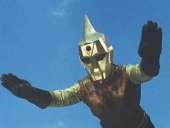
Spectreman himself looks OK, with his golden helmet and snazzy boiler suit (unlike Ultraman's expensive-looking, figure-hugging rubber outfit). But the baddies are, well, a guy in a gorilla mask wearing shiny pink and a blond wig - his sidekick is a guy in a gorilla suit wearing a lot of jewellery. I know Planet of the Apes was all the rage at the time, but this looks truly ridiculous.

The two Space Apemen sit in a flying saucer and try and wreak havoc by activating a load of really weird monsters.
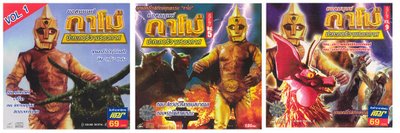
The saving grace of the whole enterprise is that the monsters are fun because their designs are so way out. For instance the black furball with two foxes heads (on the cover of volume 5, pictured at centre) is unlike any real animal, but still lively enough for action-packed biting and fighting.

Spectreman's transformation involves a lot of rapid cuting between the guy in the suit and a drawing (apparently done in felt tip). His flying sequences involve close ups of him with his arms in the air, and a model of him swinging around on wires. His back-up team are 5 people crammed into a car - so no need for an expensive secret base.

Because of the bad special effects, the mad monsters and everyone taking it so seriously, it's an awful lot of fun in an Ed Wood sort of way. There's a fair amount of bad taste violence (bystanders being stomped by the monsters) to top it all off.

But I can't say it isn't entertaining... because it really is.

I found three double-episode VideoCDs (pictured at top) going for under a dollar each. The video quality is good, but the Thai dubbing is atrocious, adding to the hilarity. Strangely the theme tune remains in Japanese while all the dialogue has been replaced by Thai, obliterating all music and sound effects whenever anyone speaks!

UPDATE - JUNE 2007
Another way to see Spectreman in action is to hunt around on YouTube. At the moment, you should at least be able
to see the theme tune to the series, even though the entire episodes have been taken off the site.

UPDATE - JULY 2007
A Spectreman DVD boxset is now available in Japan... see the CDjapan website for details.


- - - - - - -

April 03, 2006

Update: TETSUJIN 28 - Region 2 UK DVD

TETSUJIN 28 is a remake of a classic Japanese anime that was redited as GIGANTOR in the USA. Latest news is that the first 5 episodes of this recent anime will be out on Region 2 PAL DVD in the UK on 24th April. Hopefully it will be presented in widescreen.

Details at play.com...
TETSUJIN 28 - volume 1 on UK DVD

My original review from December 2005, here...
TETSUJIN 28 - on DVD in Hong Kong

There may also be a release of the live-action Japanese movie version on DVD in the UK later this year.


I recently picked up this beautiful Bandai die-cast figure of Tetsujin's opponent Black Ox, in the toys section of the MBK department store in Bangkok. Posable, sturdily-made, with light-up eyes!

Max

March 20, 2006

YOKAI DAISENSO (2005) - Takashi Miike's Great Goblin War

THE GREAT YOKAI WAR (2005, Japan, titled YOKAI DAISENSO)
Hong Kong NTSC Region 3 DVD boxset

I've been waiting for this one for over a year and it's finally out, with english subtitles, on DVD in Hong Kong. I got the 2-disc set (pictured) but there's also a single-disc HK release available.

Ever since I saw photographs from the 1960's Yokai Monsters trilogy I'd wanted to see them (
see the pics here...) - luckily all three movies were released on DVD in the US recently (as 100 Monsters, Spook Warfare, Along With Ghosts). Now one of Japan's top directors has (sort of) remade Spook Warfare, giving us a unique epic monsterfest - but you might want to do a little homework before seeing it...

Tadashi, a 12 year old boy has moved to the countryside away from his home in Tokyo. He starts seeing mischievous demons in a nearby forest. They've been stirred up by a powerful spirit who's preparing to go to war with the human race... first stop, Tokyo.

The cast are spectacular, particularly the young lead, Ryunosuke Kamiki, who's convincing but never cute, in a very tough and physical role as the young hero Tadashi. The baddies Sada and Agi, look stylish and dangerous. Agi is the formidable looking but almost unrecognisable Chiaki Kuriyama, here landing her best role ever as a demon terminatrix. She gets great duels, great make-up, great dresses, great scenes. She's finally matured from her endless schoolgirl roles, wonderful though they were (scene-stealing in Battle Royale, and Kill Bill Vol. 1 in particular).


The actors, together with excellent make-up effects, bring the central band of Yokai to life. The water spirit, Kappa, is particularly endearing as played by Sadao Abe (unrecognisable from his school bully role in Uzumaki). Many venerable actors who don't normally do this sort of thing have been enticed into working with Miike, and also through their own childhood memories of Yokai.


The CGI look of the battle scenes and metal demons is no more annoying than the Harry Potters or Narnia FX. A conscious decision has been made to produce a uniquely Japanese fantasy epic of the same calibre as Hollywood, but without bowing to international tastes.

The main influence on Yokai Daisenso is more Shigeru Mizuki than director, Takashi Miike. Indeed according to the supplemental interviews, Miike was hired as a director after all the main Yokai characters had been picked! Many of the cast and crew name Mizuki as a part of their childhood - his Yokai books, manga, TV series and encyclopedia make up a formidable body of work.


Besides chronicling the historical Japanese tales of ghosts, spirits and demons (some of them inherited from Chinese folkore), Mizuki has single-handedly kept the subject alive by placing the characters in modern settings, for instance through the stories of Kitaro, the ghost boy. I'll be talking more about the Gegege No Kitarou series and movies in another entry - needless to say, after 40 years of manga and anime, with a new yokai every episode, there are an awful lot of demons that the Japanese are familiar with that we've never seen before. We're in danger of missing out on the fun when each Yokai appears in the new movie: there are references, in-jokes and the fun of recognising your favourite monsters. Imagine if Pokemon had been a smash hit for 40 years - how many adults would have it as part of their childhood?


My own favourite is the Rokurokubi, the snake-necked maid. Her main scene in Yokai Daisenso is spectacular and funny... I'll say no more. Miike suceeds in showcasing dozens of major Yokai characters. But there are rather a lot of Yokai to fit in... one scene was shot with a crowd of 500 extras dressed as different monsters, another scene features 20 million CGI monsters!!!

As you can tell, the extras DVD in this set has been subtitled in English - the documentaries and interviews are valuable in understanding the ambitions of the Producers and the Yokai phenomenon. Sometimes though the translations go slightly awry - (unlike the movie subtitles which are very good) - at one point it says that Shigeru Mizuki is 73, when in fact he's 83 - he lost an arm serving in WW2. But, it's wonderful to hear from him and the other members of the cast, like Chiaki Kuriyama. Also, you don't see many press conferences that are punctuated by an earthquake - but it's Japan, they just carry on regardless!

For a complete breakdown of the DVD extras, see the great review at DVD Times, but watch out for the spoilers... DVD Times DVD review

So, overall it's a very, very richly detailed movie. A huge creative effort from everyone involved, including Takashi Miike, who normally knocks out several films a year, here devoted over a year to one film. While it's not as consistent as his recent Zebraman, it's certainly an epic monster rally for fans to treasure.

March 19, 2006

JIGOKU - Visions of bloody HELL

Cinematic depictions of Hell - a starter guide

I've always been fascinated with visions of the afterlife. Having seen some mysterious and spectacular stills, I first sought out the Hollywood versions of Dante's Inferno. Both the 1924 silent movie and the 1935 Spencer Tracy vehicle included tours of the seven levels of Hell according to Dante, visually lead by the intricate engravings of Gustav Dore (whose engravings lent themselves perfectly to black and white cinematic recreation). The 1935 version is worth seeking out for the five minute descent into hell - envisioned using large sets, cavernous models, matte paintings and dozens of half-naked extras.
Incidentally, a new Hollywood remake of Dante's Inferno is about to be unleashed - but this time it's a comedy... It stars Dermot Mulroney as Dante and James Cromwell as his guide, Virgil.

I've searched for films which attempt to depict a different kind of Hell... this time according to Buddha. Three of them Japanese, called Jigoku, only 2 of which I've seen, and a recent Thai remake, called Narok, which also translates literally as Hell...


JIGOKU (1960, Japan)

This is a classic Japanese drama that is practically an arthouse classic, due to its expressionistic underworld sets and earnest acting talent. The first hour sets up a dozen sinners in a rural town, specifically a young man being lead into temptation by an old school friend.

The second hour demonstrates how each sin will be punished in the afterlife - a guided tour is provided by the ruler, Lord Enma. The various areas of Hell are depicted by large apparently wall-less sets (the edges disappear into darkness) and dozens of extras playing the doomed. The strictest of punishments involve being sawn in half while laying face down, or worse still, being flayed alive all the way down to the bone. These bloody make-up effects would have been very strong stuff for 1960, especially since they're in colour.

One scene shows dozens of people buried up to their necks, leaving only a garden of heads visible - this reminded me very much of a similar Hell tableau in What Dreams May Come. I'd highly recommend this 1994 Vincent Ward film for its strong story, as well as it's spectacular visions of Hell, and rare visions of Heaven too.

The 1960 Jigoku is interesting for seeing the differences and similarities in cultures, but is less compelling as a dramatic storyline. Despite its excesses, Hell here is merely stressful rather than frightening.

UPDATE 3rd March 2007 - SciFiJapan has an extensive review, posters and screengrabs from the 2006 Criterion Collection DVD release of this version of Jigoku.

JIGOKU (1999, Japan)

I've not seen the 1979 Japanese remake, but I suspect that the 1960 one was the best, and had the biggest budget. The 1999 Jigoku verges on trashy. Directed by the late Teruo Ishii (Horror of Malformed Men, 1969), it primarily deals with the perpetrators of the 1995 sarin gas attack on the Tokyo subway. We see the cultists plotting and executing the attack, then suffering for their deeds by various punishments, including the customary flaying.

The film is held together by Lord Enma (here played by an actress) approaching a young cultist in Shinjuku and warning her of what could happen to her. Unlike in 1960, we quickly move to Hell early in the film - but it's a tiny set with painted walls, a handful of extras, and only a few demons with inexpressive masks on - the monsters look more like 1960's Ultraman cast-offs. Also the gore looks unconvincing and home-made. The film seems more preoccupied in showing topless girls and unconvincing sex scenes. It also looks like a sly way of restaging and exploiting the sarin gas attack story without identifying the film as such.

For me, it didn't feel like Hell at all, and if you want to learn more about the gas attack, there was a good Channel 5 documentary on recently whose reconstructions were far more convincing - they also talked to survivors of the incident and related why and how it happened.

HELL (2005, Thailand, titled Narok) -
Thai Region 3 PAL DVD

Thankfully, the story has been taken more seriously by a new film from Thailand (a remake of the Japanese Jigoku) and is out now on DVD. Obviously it's an ambitious project and no budget can do Hell full justice, but it's certainly closer to depicting somewhere you really don't want to go - and that, I thought, was the whole point.

Here, a minibus crash sends a group of friends into the afterlife. Through flashbacks we see what sins they've committed, then we see how they are to be punished. Again, Thailand is a sincerely Buddhist nation, so off we go again to Buddhist Hell...

This initially looks like a wasteland of torture - endless bodies being physically set upon by barbaric demons armed with a variety of simple weapons. Again there's the sawing in half, but here the flaying looks almost real... people being bludgeoned with large wooden mallets, stabbed with spears... the punishments seem to be everywhere. Is there no escape?

Instead of sets, outdoor locations are used, but with digitally altered skies to notify that we're seeing a different world. This is a less subterranean vision than the other films, but it's still claustrophobic, because the pain is everywhere - even when the group try to escape they only encounter other tortures.

The demons who police the suffering are almost-human barbarians. They look convincing and obviously enjoy their work. The special make up effects are successfully gory and mostly work, except for a couple of digital dismemberments. Other SFX like the "dimension gates" - huge tornadoes that carry people from one plane of existence to the next - look digital and fakey, but are spectacularly imagined.

All in all, I found this Thai Hell the most compelling. The tone was consistently grim (reminding me somewhat of Cannibal Holocaust - there too, the characters were documentary makers) until a little unwelcome comedy relief breaks the mood halfway through the film. The ending feels a little rushed and, obviously, some of the sins don't seem to warrant the outrageous tortures meted out later. But this film fits nicely into the new wave of slasher films from Thailand (like Scared and Art of the Devil) as well as the new brutality of Hollywood horrors like Saw, Wrong Turn and The Hills Have Eyes.

At present the film is only available on DVD and VCD from Thailand, but without english subtitles. The 16:9 anamorphic widescreen picture is a slightly cramped representation of the original 1.85 cinema aspect. This PAL region 3 DVD (pictured) has a trailer and a brief behind the scenes package included, as well as poster and design art. But, I'm sure the online publicity photographs alone will get this film a wider release soon.

- - - - - -

March 15, 2006

JOYUREI / GHOST ACTRESS / DON'T LOOK UP (1996) from Hideo Nakata

GHOST ACTRESS aka DON'T LOOK UP (1996, Japan, titled JOYUREI)
Directed by Hideo Nakata
Film review

White dress, black hair, haunted film - Hideo Nakata directing ghosts before RING

Ring (or Ringu) launched Japanese horror movies across the globe, based on Koji Suzuki's novels about Sadako wreaking her psychic revenge through cursed videotapes. Despite the fact there had already been a Japanese TV movie in 1995 (Ringu: Kanzen-ban), it was Hideo Nakata who directed the successful movie version - and he probably got the job because he had already made Ghost Actress.

The film centres around the making of a wartime drama at an old movie studio. The director starts running into trouble when the ghost of a young woman starts appearing in the rafters above the movie set, as well as on the filmed rushes. As the cast and begin to get spooked, accidents start to happen on set...

Ring wasn't just effortlessly scary - it didn't come out of nowhere. Hideo Nakata had already been trying out how to scare audiences with a ghost girl all the way through Ghost Actress, which makes it an interesting watch. Strangely, the ghost is seen many more times than in Ring - here she's more active, more vocal and more hands on!

There are a few more parallels, besides the appearence of the ghost - it's mentioned that the very celluloid itself might be haunted. Also, the basic structure of a story within a story is similar to that of Ring 0: Birthday - the 3rd Japanese Ring movie - where a play is in production.

Ghost Actress, is very well-acted, atmospheric, occasionally creepy, but a little too brief at 73 minutes - you're left wanting more story, including a better reason for the haunting. But it's a lively precursor to the terrifying Ring-cycle, and I'm surprised it's not been released properly on DVD - I can only find it on Korean release at the moment, and that's without english subtitles.

Lastly, a special mention of the leading actor playing the movie director - Yûrei Yanagi went on to play the pivotal role of the reporter in Ring and Ring 2, as well as the unlucky schoolteacher in the original 2 v-cinema movies of Ju-on: The Grudge. That must make him one of the most scared actors in Japan! Perhaps in Ghost Actress we're witnessing him originate the falling-over-backwards-to-the-ground-cos-he's-so-scared manoeuvre! He's soon to be seen in the awesome- looking vision of hell, Kidan (check out Twitch film for a trailer), which should hopefully be available in english in the coming months.

If you want to go to the Twitch film site, or learn more about scary Ring movies - check the links on the sidebar to the right.

Max

SF Episode One - SAMURAI FICTION (1998) - DVD Review

SF Episode One - SAMURAI FICTION (1998, Japan)
Korean DVD (NTSC, All Region, Garam Net)

Charming, funky, homage to old-school samurai films - from the director of RED SHADOW


Impressive for its wealth of memorable characters, Samurai Fiction is an ideal companion to Takeshi Kitano's Zatoichi remake, with its fresh and humorous approach. While it's essentially a traditional tale of samurai honour, SF appeals with its progressive ideals, modern soundtrack, and young cast.

This film shows the director's enthusiasm for the samurai movie genre. He based his Stereo Future (2001) around the making of a fictional samurai movie. In the same year, he made the big budget, techno-scored, remake of Red Shadow (or Akakage), which is in the same vein of comedy, action and drama - highly recommended.

Story-wise, SF tells of a headstrong but inexperienced samurai, Heishiro, trying to retrieve his clans' ceremonial sword from a renegade swordsman, Kazamatsuri. When Heishiro is injured in a duel, Hanbei, a local retired swordsman, tries to persuade him to take a different approach from revenge.

While the story is essentially a drama, the cast is made up of expert comedians who make the most of their characters. Heishiro is a fairly good swordsman, but completely inexperienced with women. His long-suffering father, trying to cover up the sword's disappearence, relies on an ageing ninja bodyguard, who refuses to use doors through force of habit (the wobbly ninja is a gag that the director will use again in Red Shadow). Cocky renegade Kazamatsuri disrespects one gang of attacking samurai turning his back on them and taking a leak, a long leak.

Heishiro is impressively played by Mitsuru Fukikoshi, who later played other samurai roles in Red Shadow, and the deadly serious Twilight Samurai. He also played the geeky boyfriend in the superb kaiju movie Gamera 2 - Attack of Legion.

The baddie, Kazamatsuri, is famously played by Tomoyasu Hotei, who also composed the soundtrack. Later, the storming track "Battle Without Honor or Humanity" would make his music internationally famous when it was used in Tarantino's Kill Bill: Vol 1. He briefly reprised his samurai character in Red Shadow.

Morio Kazama deserves a special mention as the level-headed Hanbei, and also Tamaki Ogawa as his radiantly cute daughter.

As a homage to old samurai films, SF stays mostly in black and white, but the little flashes of colour gives away the fact that this must have been shot in colour, then desaturated. This means that some scenes lack the contrast of actual black-and-white film stock. Also, the glimpses of colour make you wonder what the film could have looked like.

Apart from that, SF - Samurai Fiction instantly became one of my favourite Japanese films.

It's well-represented on the Korean DVD (pictured above) on the Garam Net label. The english subtitles are well-translated, inobtrusive and removiable. The aspect ratio is anamorphic and there's a 5.1 Japanese mix option. There's also a trailer and some ageing ninja outtakes.

Max