September 08, 2013

ANTIVIRAL (2012) - body horror and celebrity culture


ANTIVIRAL
(2012, Canada)

All hail to the new Cronenberg!

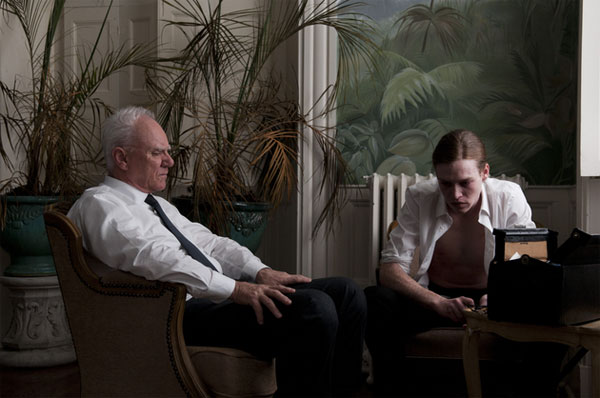
The near future, a young man enters an expensive-looking salon. By appointment only, he meets a strange young salesperson who gives him a long careful pitch. They talk about media celebrities and what it means to get closer to them. The punter makes his choice, receives an injection and leaves.


Dedicated fans of intensely famous people have found a new mania - the chance to feel like their idols... when they're ill. Anyone can now experience exactly the same viruses they've suffered, but without the actual harmful effects. A bizarre, wonderful idea at the core of this intriguing sci-fi thriller.

In this world, the obsession with celebrity has reached the point where TV cameras go inside them during operations, and news constantly reports their state of health. There are big announcements of new mass-produced viruses, as if they were brands of perfume. But fanatics always want what others don't have, and not everyone can afford the exclusive prices. Hence, the murky world of virus bootlegging...


Admittedly, I started watched this out of curiosity, with no great hopes. How often is talent genetically passed down from a famous parent? But I soon found Antiviral, Brandon Cronenberg's first feature film, to be greatly rewarding and very different. While his father's 'body horror' stories were set in the near future, just far enough for science to have made a new breakthrough, they inevitably looked like 'now'. Antiviral looks sufficiently like the future.

David Cronenberg has also stopped making genre films. While Shivers, Rabid, Scanners, Videodrome and The Fly are monuments in sci-fi horror, for over ten years he's stuck with drama. Quality films, but not the genre that originally set him apart. Brandon Cronenberg has begun with a body horror all of his own, and it's a treat to have a similar approach to satirical prediction as, say, Videodrome. But its completely in his own style, and a very different target.

I guess the other trait Antiviral shares with the films of Cronenberg Senior is that the story keeps a steady pace, without needing to resort to action scenes. I guess Gattaca would be a reasonable comparison for its tone, but without anywhere near the flashy budget. This is a great example of how good low-budget can now look, with sparingly-used digital effects, an antiseptic production design and precise 'future-look' cinematography.


The story is anchored by the creepy, extreme, but not exaggerated performance of Caleb Landry Jones, as the salesman who takes his work far too seriously. His pale skin is perfect for making him look really ill. I was recently struck by his resemblance to another intense young actor...

Udo Kier in Blood For Dracula
Malcolm McDowell is one of the familiar faces, but Nicholas Campbell is a welcome link to David Cronenberg's films, having appeared in The Dead Zone, The Brood and even Fast Company.


Antiviral demonstrates that sci-fi can still be original, inventive, predictive, weird and intelligent. And not need spaceships.


(I watched Antiviral on DVD, hired from LoveFilm. As a result, I've bought the region A blu-ray, which includes a commentary track and a 'making of' documentary.)


September 03, 2013

Flashback 1971 - THE DEVILS, DEEP END and bad double-bills...

An online scrapbook, from the pages of defunct British movie magazines published in 1971...


In this issue, Films and Filming interviewed director Mike Sarne about his adventure in Hollywood with Myra Breckinridge, where he talked about his initial plan to cast a male actor to play both Myra and Myron (finally played by Raquel Welch and Rex Reed). In the front cover and in the article there are several photos of one of the unused actors.

Note the price of the magazine is in both shillings and in 'new' pence, just like all pricing throughout the UK, just after decimalisation.


Films and Filming, February
Full page ad for Donald Cammell and Nicolas Roeg's Performance, emphasising Mick Jagger over everyone else in the cast, because The Rolling Stones were huge!


Films and Filming, February
Richard Fleischer directed Compulsion (1959), inspired by the Leopold and Loeb murders and became a natural fit for other true-crime dramatisations like 10 Rillington Place and The Boston Strangler (1968). This full-page advert is more interested in Richard Attenborough playing murderer John Christie than the director. One of John Hurt's many supporting roles before he found fame.

Films about actual crimes are accused of bad taste if they appear too soon to be respectful (for example, The Black Panther was made only three years after the headline-grabbing crimes). Here, twenty years had passed, but this production still attracted criticism for filming on location in the actual 10, Rillington Place before it was demolished.


Films and Filming, February
A couple of double-bills caught my attention in these magazine adverts of 1971 - horror films not being paired with other horror films. Their attraction was surely diluted by offering two completely different genres. Is this a sign that horror movie production was dwindling at the time? I was used to badly-matched double-bills in local cinemas, no doubt determined by what prints were available that week, but to pair up new releases like this seems harmful for business.


Films and Filming, March
I'm glad I found most of Ken Russell's films on late night BBC2, because with posters like this, I wouldn't have bothered. I keep forgetting which one this is, but it's actually another of Russell's classical composer biopics, actually the love life of Tchaikovsky - surely that's a better title?


Films and Filming, March
Now that's what I call a double-bill! The timing of this is so soon after the US premieres, that it looks like they didn't each get solo releases beforehand. Maybe they were twinned because Russ Meyer was unknown to the mainstream and both films had attracted poor (outraged?) reviews.


Films and Filming, March
Another horror classic without a horror B-movie. Amicus famously begged the censor to 'up' the certificate from 'A' to 'X' certificate to make the prospect of The House That Dripped Blood appear more frightening!


Films and Filming, March
Countess Dracula was another horror from Hammer, so why wasn't it teamed with Lust For A Vampire (see January, above). Then Hell's Belles could have teamed up with The Losers. I wasn't old enough to see 'X' films at the time, but if I only wanted to see one of the films on a double-bill, it often put me off going.


After seeing these magazines and hearing about Andy Warhol's adventures in mainstream movie-making, it was somewhat of a shock to first see them in Scala triple-bills in the late '80s. I guess you had to be there (in the '70s), because I found them quite a trial - technically poor and starring anyone who was a Factory name, rather than actors. My only positive from them was the appearance of Joe Dallesandro. I emphasise his appearance rather than his performance, but he got me through some very long movies.


Films and Filming, April
Another British film for director Richard Fleischer, here filming Blind Terror under the working title Buff (as in 'blind man's buff'). Brian Clemens was a scripting powerhouse, turning out weird wonderful weekly stories for The Avengers then a stream of clever, catch-you-out, murderous thrillers for cinema (And Soon The Darkness) and for TV (Thriller).

This twisty survival chiller transplants the premise of Wait Until Dark (a blind woman in peril) to the English countryside and injects it with energy shots. Mia Farrow was the star of a largely British cast. The film is now circulating on DVD as See No Evil, after it's US retitling which obliterates the original UK title from history, and now confuses it with the recent, unrelated horror film, See No Evil.

My full preview of Blind Terror is here.


Films and Filming, April
The Vampire Lovers gets some explicit publicity here, even though this moment is done tighter and faster in the film's prologue. This moment was also cut when first shown on TV.


Films and Filming, April
Deep End advert relies on a list of review quotes, at odds with its visual style.

Films and Filming, April
Luckily, elsewhere in the same issue, Films and Filming gave Deep End a two-page photo-spread. Co-star John Moulder-Brown is still working now, but at the time lucked into a string of cult films that are also still playing today - La Residencia (1969, aka The House That Screamed), Vampire Circus (1972) and this.


Films and Filming, May
Visual proof of Michael Winner directing Marlon Brando. I wouldn't have believed it otherwise. The Nightcomers is a prequel to 'The Turn of the Screw' (adapted as Brit-classic The Innocents) and stars Stephanie Beacham and Thora Hird. And Brando.


Films and Filming, May
Soldier Blue gets a five-page photo-preview, an indication of Films and Filming championing controversial movies.

Films and Filming, May
A reminder of the original poster campaign for Soldier Blue, which probably damaged the film's fortunes by making it look like soft-porn rather than a socially-conscious Civil War western. Not to mention that the image is so dubiously shocking that recent DVD cover art has had to scrabble together ghastlier alternatives. My preview of Soldier Blue is here.


Films and Filming primes the debate on Ken Russell's The Devils with a front cover likely to offend Christians before they even get to any mention of 'naked nuns'.

Films and Filming, July
Inside, a six-page photo-preview fronted by Michael Gothard's groovy exorcist posed before Derek Jarman's gigantic exterior set. While there were anachronisms in the film, these John Lennon steel-rim glasses did apparently exist in the 17th century.

Films and Filming, September
Full page advert with Warner Brothers warning people who might be offended to stay away! This seems more heartfelt than a William Castle pitch. When The Devils hit cinemas across the country, some local councils refused for it to be shown, based on the ensuing controversy.


Films and Filming, August
Meanwhile, subtler horrors were on the way - an early title for The Abominable Dr Phibes appears in print just before its release. The main photo, also used in the poster art, is an example of a publicity photo, rather than a shot of a missing scene. This moment doesn't happen in the film.

Note also, that almost all publicity photos were taken by stills photographers on the sets, rather than any frame blow-ups from the movie's negatives. This explains why they're never quite the same angle as in the film, and often of far better picture quality (usually a 2" x 2" negative, rather than 35mm).


Films and Filming, September
The third of the Planet of the Apes films arrives from the future. These would keep getting re-released together throughout the decade.


Films and Filming, September
I don't remember a poster for Little Big Man, but this doesn't justice to George Roy Hill's epic revisionist western. A similar, parallel premise to Soldier Blue, but by far the more popular.


Films and Filming, September
Richard Burton's character in Villain was a loose portrayal of Ronnie Kray. In the '70s, British gangster movies were finally able to have an edge worthy of the subject matter, with more violence and 'bent' coppers.

This poster demonstrates that there were evil cut-and-paste airbrush monkeys, decades before the present horrors of photoshopped celebrity posters.


More magazine Flashbacks:

Lawrence of Arabia and more from 1963.

Blow Up, The Trip and more from 1967.

Barbarella, Witchfinder General from 1968

Rosemary's Baby, When Dinosaurs Ruled The Earth, Women In Love from 1969

M*A*S*H and more Myra Breckinridge from 1970


(These are all magazines that are no longer in print and, to hamper any reproduction for profit, these are all handheld photos rather than scans. M.H.)


August 28, 2013

ON THE BEACH (1959) - post-apocalyptic waiting game

ON THE BEACH
(1959, USA)

Before 'post-apocalyptic' meant an action movie...

There has just been a nuclear world war. Anyone in the countries involved who didn't get hit by one of the hundreds of direct strikes has succumbed to the deadly radioactive fallout. Most of these were in the northern hemisphere. The winds have yet to carry the invisible danger to Australia, where a lone submarine crew assembles for a mission to check for any remaining life, especially the source of a mysterious radio signal. If nothing can survive on the planet, then there's no hope for anyone...

I'm no scientist, so I don't know whether this scenario is accurate or not. Is there definitely no chance of escape from a release of airborne radiation on that scale? No place to hide while radiation levels drop? Later global catastrophe movies like the biohazard thriller Virus (1980) assume that the North and South poles remain safe. Terminator 3 and Damnation Alley (1977) have faith in nuclear bunkers deep underground, that might enable a few survivors to last out.

In On The Beach, made at the end of the 1950s, the premise is that no-one will escape the fatal levels of radiation that have been released in a nuclear war and it's only a matter of time before the weather circulates it everywhere on Earth. Unlike the atomic mutation movies unleashed throughout that decade, here is an invisible opponent that cannot be blasted with flamethrowers or even more missiles.


Unusually, it doesn't even begin with a montage of stock footage mushroom clouds. If you don't pay attention to a radio broadcast early in the film (or haven't read Nevil Shute's book), you'll not know that there's been a nuclear war! I remember watching this on TV and being puzzled for a while as to what was going on, it's such a subtle set-up. We're in the same shoes as the characters - they've seen no explosions and are waiting for news, or evidence.


There's little to say that this is set in Australia either. The characters are either American actors or have British accents. The clue to the location is the theme of 'Waltzing Mathilda' in the soundtrack. The calm reaction to the inevitable seems very British. This is in complete contrast to the later post-nuclear movies of Oz, particularly the Mad Max trilogy, which is all about heroism, high adventure and car chases. Examples of where the apocalypse is taken for granted. 

There isn't even a breakdown of society, like in The Day The Earth Caught Fire (1961) where the masses get drunk and start killing each other. On The Beach imagines a very resigned, logical mass suicide as the only option. Unless there's any good news from the submarine mission...


In the meantime, everyone goes about their daily routines, keeping civil to the last. A mass resignation to the inevitable. The terrible implications aren't talked about directly, instead there's an acute double-edge to every conversation. Each scene has an implied ironic or tragic kick. The effect is increasingly terrifying. I found it intensely depressing and, even though I'd seen it before, it's stayed with me since.

At this time, director Stanley Kramer was tackling gigantic social issues in major films every year. Race relations in The Defiant Ones (1958), religion versus science in Inherit the Wind (1960) and Nazi war crimes in Judgement at Nuremberg (1962). No wonder he made a comedy in 1963!


For our last days on Earth, we could do far worse than spend it with Gregory Peck, Ava Gardner, Anthony Perkins (just before he was typecast by Psycho) and Fred Astaire (in an early non-singing, non-dancing role). Pleasant company in an awful situation.

On The Beach an early mainstream film to tackle this unthinkable subject, made over twenty years before the TV movies The Day After and Threads showed what a nuclear war could look like. It was also released five years before Fail Safe and Dr. Strangelove, which described how a world war could start. This was produced when the man-made doomsday scenario first loomed large. Now, the concept of nuclear destruction is, strangely, forgotten. Though thousands of warheads still lurk in America and Russia, enough to destroy life on Earth a hundred times over...


I rented the UK DVD release of On The Beach from LoveFilm. It's presented in black & white, 2.35 widescreen from good-looking film elements. But I believe this has yet to be re-released anywhere anamorphically.


(Written, while listening to Philip Glass' soundtrack to 'The Fog of War' and thinking of Jack, who's just left us.)


August 25, 2013

Flashback 1970 - M*A*S*H, MYRA BRECKINRIDGE and Maggie Smith

An online scrapbook selected from the pages of defunct British movie magazines...


Photoplay, January
As you can see, there's a discrepancy between the month on the cover of the magazine (here, January 1970) and the release date of On Her Majesty's Secret Service in the advert (December 18th), indicating that the streetdate for the magazine was weeks ahead of the cover date. I was also surprised that this wasn't a full-page advert for such a major film. Note that even at the Odeon, Leicester Square, the film was showing in 'continuous performances' - you could buy one ticket and keep watching it over and over again for the rest of the day!


Photoplay Film Magazine, February
"The only 'X' rated film to win the Oscar for Best Picture" factoid refers to the US classification which reserved 'X' for porn movies (and the occasional horror film that proved too violent - like Dawn of the Dead). Midnight Cowboy also won Oscars for London-born director John Schlesinger and the screenplay. Amazingly, Jon Voight and Dustin Hoffman weren't the first choices for these iconic roles.


Photoplay, March
I'd never heard of Twinky before seeing this ad and would have passed it over as a dodgy British comedy if not for the cast. Susan George and Charles Bronson playing a sixteen year-old schoolgirl and a thirty-eight year-old porn novelist, respectively. Presumably a riff on Lolita, (it was also called Lola). An astonishing example of how movies were allowed to sell themselves!


Photoplay Film Magazine, August
Another 'X' film, which now seems very harsh. Like Midnight Cowboy, the adult certification wasn't because of violence or graphic sex but, I'm guessing, for the brief nudity, drug use, and sex outside of marriage? This is what I'd call a mainstream 'X' certificate, gently breaking in audiences to the full excesses of the 'new permissiveness'. The full limits of the 'X' certificate would be fully tested over the next few years.


Photoplay Film Magazine, September
A perky publicity shot of Maggie Smith when she starred in The Prime of Miss Jean Brodie. I just wanted it remembered that she hasn't always looked like she does in Harry Potter and Downton Abbey. Maggie won one of her Oscars for this performance, starring opposite her then husband Robert Stephens. Pamela Franklin (the medium in The Legend of Hell House) plays the most vocal of her young students.


Films and Filming, October
Here's a more 'X' worthy movie, that was about to arrive in the UK. Myra Breckinridge still had no nudity, maybe some swearing and a lot of implied outrageousness that you'd probably have to read the book to realise what was going on. The publicity photo gives away more than the scene in the film.

Rex Reed plays Myron who quickly transforms (surgically) into Myra (Raquel Welch), but this isn't a serious look at transitional gender, but rather a satirical revenge comedy drenched in Hollywood back-references. Based on the novel by Gore Vidal, Myra represents a radical assault on the male domination of the world. With musical numbers.


Photoplay, October
I've not seen Goodbye Gemini yet, but it looks interesting and has been remastered and released in the BFI 'Flipside' series. Similarly, Girly has only recently resurfaced after a long absence, with an American DVD release. At his last Q&A at the BFI, director Freddie Francis picked this black comedy as his favourite film that he'd directed. Despite the publicity campaign relying on yet another sexy schoolgirl, the character of Girly is part of a seemingly dysfunctional family getting by in it's own unique and violent way. The full title, used in the UK, was Mumsy, Nanny, Sonny & Girly.


Photoplay Film Magazine, October
I found this advert for Toomorrow shortly after reading about it in Julian Upton's 'Offbeat' (pictured below) and would otherwise have skipped right past. What this advert fails to mention is that one of the young stars is Olivia Newton-John, who also sings several of the songs. Of course she was unknown at the time, and producer Don Kirschner was trying to start up a new version of The Monkees, with another ready-made band again being expected to act in wacky adventures. Olivia, only 21 at the time, is the standout star of the band and a relaxed onscreen presence in Toomorrow, well-prepared after her early TV work in Australia. It's a wacky sci-fi story with Roy Dotrice as a skin-peeling alien in a rather spectacular spaceship. But just as interesting is the nostalgic location work around London - including The Roundhouse in Camden.


A number of hitherto obscure movies like this are, surprisingly, already available on DVD - Toomorrow is a slightly fuzzy transfer, but watchable enough and available cheaply. The 2.35 widescreen, the modelwork and the psychedelic sets even makes me curious what a blu-ray could look like... The songs are even growing on me, it's not Grease but the vinyl soundtrack is still selling for silly prices.


Photoplay, November
As 1970 wears on, the UK was still catching up on American releases that we now refer to as '1969', because that's what IMDB says it is. They Shoot Horses, Don't They? shocked me as a teenager when I saw it on TV, on learning that couples actually entered marathon dances (to dance until they dropped from exhaustion - for a chance to win a cash prize) during the depression following the Wall Street crash in 1929.

Only when I read Tod Browning's biography ('Dark Carnival' by David Skal), did I realise that Horace McCoy's novel was written back in 1935, and that Browning had actually bought the rights to it, intending to film it himself. Browning lived near Venice Beach at the time and had attended some of the 'marathon dances' on the pier, which was eventually used as a filming location in Sydney Pollack's impressive, Oscar-winning film.


Here's Udo Kier looking like a sexpot, rather than the creepy eccentric of Blood For Dracula, Flesh for Frankenstein and Suspiria. The covers of Films and Filming more often featured sexy male actors than female, aiming to keep gay male readers entertained (an almost complete reversal of the current lads' mags controversy). Gay magazines and newspapers weren't sold at the time by 'respectable' newsagents, for that matter male homosexuality had only been decriminalized in the UK in 1967.


Films and Filming, December
These snippets of news intrigued me - did Spike Milligan actually shoot scenes for Ken Russell's The Devils? Boris Sagal's The Omega Man was nearly the first version of Richard Matheson's novel 'I Am Legend' to use that title. And Escape From The Planet Of The Apes nearly had a different title! Yup, I love trivia like this...


More magazine Flashbacks:

Lawrence of Arabia and more from 1963.

Blow Up, The Trip and more from 1967.

Barbarella, Witchfinder General from 1968

Rosemary's Baby, When Dinosaurs Ruled The Earth, Women In Love from 1969


(These flashbacks are for reference and for fun's sake. I'm certainly not going to scan in any entire articles - instead, there are enough details of which magazine they're from - most are easily available on eBay. Some of the full-page ads, and of course the covers, are also worthy of framing! These are magazines that are no longer in print and, to hamper any reproduction for profit, these are all handheld photos rather than scans. M.H.)


August 19, 2013

THE SORCERERS (1967) - a new book with the full story...


The Sorcerers (1967) is best known as the film Michael Reeves directed just before Witchfinder General (1968), and as one of Boris Karloff's last films.

Witchfinder General caused a clash with the censors, despite Reeves being friendly with the chairman of the board. The cut version was still criticised for its violence (this was before The Wild Bunch and A Clockwork Orange). It was also seen as a turning point in horror film and in British cinema, raising high hopes for Reeves' future films. But early in 1969, he accidentally died of an overdose of prescription medication.


David Pirie's excellent 1973 overview of post-war British horror films 'A Heritage of Horror' took the genre seriously and defined its auteurs, devoting a chapter to Michael Reeves. He's rightly been celebrated ever since, with several biographies of a director who only made three complete films. The brilliance of Witchfinder General compensates for the fact that The She-Beast and The Sorcerers were made on very small budgets, though all three are analysed as the body of work of an auteur.


I keep returning to The Sorcerers because it has a good cast and an intriguing story, but it's ageing badly, as was its star, Boris Karloff. Notice that the film has been demoted to DVD-R status in the USA (pictured above). But historically, The Sorcerers is important because its financial success made Witchfinder General possible. It's also a film to be studied, rather than watched. For hunting traces of future greatness from the director.

Johnny Mains' new book 'The Sorcerers' (pictured at top) aids our research with a chance to read John Burke's original script before the director rewrote it, as well as making a plain case that Burke wasn't credited accurately onscreen.

This means that 'A Heritage of Horror' unwittingly got this detail wrong and, being such a rare book on the subject, the mistake was still being repeated nearly twenty years later. For example, in the article on Witchfinder General in Cinefantastique, Aug 1991, Michael Reeves and Tom Baker are credited as writing the script for The Sorcerers, based on a novel by John Burke (the same assumption that Pirie had made). But it had never been a novel, and Burke had written much of the script, but his onscreen credit is only 'From an idea by John Burke', ('an idea' could refer to something as minor as a pub conversation).

Burke had in fact expected to be credited among the scriptwriters, just as he'd seen it printed on the front page of the shooting script. As a result, students of film would credit the ideas in Reeves' films to 'his' scripts. This error was only eventually corrected in 2003, in Benjamin Halligan's biography of Reeves.

This new book provides the proof, with reproductions of letters received by John Burke, as well as a complete reprint of his original story treatment and the version of the script before Reeves and Baker amended it. It also includes the relevant chapter of Halligan's biography to give a complete story of the making of the film.


The producers were interested in horror films made by young new talent - they'd successfully hired Roman Polanski for Repulsion. To try and focus Reeves on a possible project, he was introduced to John Burke, who had two scripts the young director was interested in.

Intriguingly, the one that didn't get made, 'The Devil's Discord', was to star Christopher Lee and Raquel Welch. When that project fell through, and Karloff agreed, Reeves reverted to Burke's other script, 'The Sorcerers'. This could actually have been a lucky break - another gothic horror with Lee could have been lost among the rest.


The Sorcerers' story was originally called 'Terror For Kicks', where a trio of scientists recruit a violent youngster to become an unwitting guinea pig for their experiment. They give him a potion that promises intoxication without a hangover. It works, but while he's under the influence, the telepathic scientists are sharing his every experience. They can also control his actions, literally living vicariously through him, without the risk of getting caught...

Script treatments can be as little as a single page, but John Burke's outline is 21 pages long. His expanded 'original story and screenplay' is 120 pages long, and even includes shot descriptions.


But Karloff wanted a more sympathetic role, so Reeves and his associate Tom Baker (not the actor) rewrote the script to accommodate him, while Burke was by then busy on a TV series. The three scientists became two, now also a husband and wife in conflict over how this new power should be used. The potion became an electronic device (a far more visual, psychedelic scene). The rewrite added more visual elements and diluted others. The level of violence and the scientists enjoying their subject having sex certainly had to be toned down to get past the censor.


Interesting to learn that Reeves' approach to The Sorcerers was influenced by another low-budget British horror that he'd seen, The Projected Man. While he was an avid moviegoer, I thought his tastes were better than that, or perhaps it was just research...

It's fascinating to see how the story evolved and how much of Burke's script made it into the final version. Besides the entire original treatment and script, there are reprints of letters received by John Burke about his fees and credit on the film, if there was any doubt about the injustice here. There's a brief word from Burke's widow, a great contextual introduction to the story by Matthew Sweet, prime trivia from Kim Newman and, touchingly, Johnny Mains' account of the discovery of the script during his friendship with the late author.

The book can be ordered here but is a limited run of 500 copies. Meanwhile, the editor is currently working on compiling the best new British horror stories of 2014! News of that can be tracked here.


(Vangelis' soundtrack to Missing and our cat Willow helped with the writing of this article. Thanks of course to Johnny Mains for giving me an advanced peek at the book.)