July 09, 2010

JU-ON: WHITE GHOST, JU-ON: BLACK GHOST (2009) - a homage to video horror


JU-ON: WHITE GHOST
(2009, Japan, Shiroi Roujo)

JU-ON: BLACK GHOST
(2009, Japan, Kuroi Shoujo)

Two new films for the tenth anniversary of the Grudge saga...

For me, Takashi Shimizu's Japanese Grudge movies provided more scares than the Ring movies. Even the first two shot-on-video films, commonly referred to as Ju-on: the Curse 1 and 2, were creepy as hell. Together with the US remakes, the various different incarnations of The Grudge are easily confused - I laid it all out here.
The story began as a mystery centred on a suburban house. Everyone who visited the house was scared to death - if they left the house before they died, their own homes would become similarly cursed. As the story leapt forwards and backwards in time, following different visitors and their families, a picture emerged of the original events that sparked off the curse, as well as tracking how far it had spread.

Shot in an actual house in the suburbs of Tokyo, Takashi Shimizu's first four films turned everyday surroundings into nightmares. The attic, the landing, windows, cupboards and stairs all became terrifying locations for full-on scary, haunting, gory terror.

Last year, to mark the tenth anniversary of the 'series', two more Ju-on films appeared, produced the same way as the first two, by shooting cheaply on location and on video. With two different directors, the video-look distances these from Shimizu's current movie series. He's still promising a third Grudge movie for Japan, not to be confused with the American The Grudge 3, which wasn't directed by Shimizu. Not confusing at all.


Ju-on: White Ghost
and Black Ghost unfold like the classic Ju-ons, with the narratives shifting back and forth in time, changing with each cut-to-black chapter break. But these new stories aren't closely linked to the old ones. There's a completely new house and I was disappointed that (almost) none of the regular characters appear to link it all back to the original 'grudge'.

In White Ghost, the jumpy scares kick in quickly after a shaky (camerawork) start. But it tries too hard and too often to make us jump, resulting in a series of hit and miss scares. The new 'face' of the grudge verges on the humorous because she keeps popping up repeatedly... and carrying a basketball. Basketballs have never been scary, still aren't.


Other distractions include the Christmas setting which has zero bearing on the story. It doesn't help that the characters put candles on their Christmas cake and blow them out as if making a birthday wish. Why? Now I'm used to characters in horror movies acting illogically, but several of the characters' motivations are quite puzzling. It's especially hard to believe any couple would start French-kissing just after one of them has puked!


Thematically, the method of the Ju-on curse also seems to have shifted, from ghosts killing people, to people killing people, with some unwelcome hints of incestuous paedophilia thrown in.


Black Ghost
is a continuation, but is less intricately cross-connected with White Ghost the way all the previous films intertwined their characters' lives... and deaths. This is scarier, better shot and better paced, but also strays further from the Ju-on mythos into Tomie territory, with the problems of corpse disposal, a mysterious foetal cyst, and even the classic Tomie signature image - the head in the bag!


This new pair isn't essential to the series and indeed lacks many of the core ingredients. I really miss the link back to the original house - and having Kayako lurking in the attic... But it's an interesting experiment, recalling the look, and viciousness, of the earliest chapters of the saga, (as well as some of the J-horrors that first followed
Ring, back when shooting on video was far more common and obvious).

But the lack of quality of performance, creepy pace and intricate structure makes it regrettable that Shimizu isn't writing and directing. So I'll continue to look forward to his third Japanese Grudge movie.


Although released separately in Japan, these are wisely being sold as a double-bill on DVD in the UK, as both films last barely an hour.


Here's a spoilery, subtitled trailer on YouTube...


July 02, 2010

Truman Capote and IN COLD BLOOD - three movies compared

IN COLD BLOOD (1967)
CAPOTE (2005)
INFAMOUS (2006)

It’s not about Capote vs Infamous – the must-see is In Cold Blood


The story so far…

Kansas, 1959. Two men rob a remote farmhouse at night. They kill the entire family in cold blood and flee. The story hits headlines across the country and a manhunt begins. Celebrated author Truman Capote takes an interest in the story and travels to Kansas to begin documenting every aspect of the case, interviewing the police, detectives, as well as friends and relatives of the victims. When the killers are finally caught, Capote interviews them, at length. The resulting book is a unique, narrative presentation of a crime. It’s widely lauded as a critical success. Two years later, In Cold Blood becomes a hit film.

Almost forty years later, two more movies are being made, Capote and Infamous, based on different books. But both telling very similar stories about the killings and how the writing of the book affects the author. Capote is released to wide acclaim in 2005 and gets five Oscar nominations, including Best Picture. But Infamous has its release delayed until 2006 - the reviews are good, but it barely competes with the Oscar-winner (Best Actor for Philip Seymour Hoffman) that beat it into cinemas.


Capote and me

I first saw Truman Capote in his suitably bizarre role in the Neil Simon comedy Murder By Death back in 1978. I knew he was famous, but not that he’d written Breakfast at Tiffany’s. Seeing photos of him at Studio 54 and reading stories about him in Gore Vidal’s books, I built an image of a short, loud, unique, gossipy gay individualist who wrote fluffy comedies about New York society. That he’d also written the best screen adaption of The Turn of the Screw (filmed as The Innocents) and a tough documentary novel about mass murder didn’t quite fit that image.

When I later saw Michael Mann’s Manhunter, I thought the opening hook, that a serial killer would kill an entire family, was a new idea. I eventually tried to read In Cold Blood, but thought it a long, dry presentation of endless facts.

So now, Capote and Infamous come along, I had two chances to learn more about Capote and his reasons for writing In Cold Blood.
To try and get a different angle I watched Infamous first, to give the underdog a chance. Then Capote, and finally In Cold Blood, the reverse order of their original release dates.

INFAMOUS
(2005, US)

At least, Hollywood didn’t remake In Cold Blood (there was already a 1996 TV movie) opting instead to tell the story of how Capote wrote it. Unfortunately for Infamous, a rival production was filming the same story.


It starts off well, as a comedy, Truman in fine form amongst the jet-set of Manhattan society. I was surprised by the added starpower of Sigourney Weaver and Isabella Rossellini in cameo roles. The comedy continues as Capote (Toby Jones) travels to Kansas with Nelle Harper Lee (an excellent performance from Sandra Bullock) who has crucially just written To Kill A Mockingbird.

Even in a small farming town, Truman doesn’t tone down his extravagant, out-gay personality even a notch. Even though he’s constantly mistaken for a woman. Respectfully he becomes more serious as he attempts to talk to the townsfolk, in a tight community that’s been shaken by the tragedy.


When the killers are captured, Capote manages to talk to them and stays in Kansas, developing a long-standing and increasingly close relationship with one in particular (played by Daniel Craig). Though it’s not clear why he focuses on only one of them, Capote needs to build his trust in order to find out what happened that night, but if he confesses it could affect both their sentences…


As the case draws out over the years, the stress takes its toll on Capote as he struggles to complete the book. He’s not shown in a perfect light, when he lies to his friends. The story gets a little fragmented, looking more like they've skipped to all the juiciest bits from the book, rather than keeping to a narrative.


Infamous successfully depicts the effect the murders have on the town, and even the country. But the murderers also get sympathy, sitting on death row. Truman says that the title of his book is as much about the death penalty as the original crime. However, this could be another lie to keep the killers’ cooperation, and therefore keep the flow of material for the book. But the fate of the murderers looks as brutal as their crimes.


CAPOTE
(2005, US)

Watching this a few weeks after Infamous, the story was far too similar. The story based on exactly the same events. I felt that many scenes were too short, not including as much background information. Important supporting characters were given far more time in Infamous, especially the Detective in charge (Chris Cooper) and Nelle Harper Lee (Catherine Keener).


Also, a couple of pivotal scenes have little dialogue, the audience supposedly settling for Philip Seymour Hoffman just standing there acting... (like the bizarre scene, above). Hoffman is also allowed to indulge his impersonation of Capote’s mumbling lisp to the point of inaudibility.

Toby Jones’ Capote in Infamous, is more sympathetic and more audible, not to mention the closer physical resemblance. I’d first seen Jones in The Mist and then learnt he’s the son of Freddie Jones, one of my favourite British character actors. Not only did his dad play the best Frankenstein experiment (Frankenstein Must Be Destroyed) but is a regular collaborator with David Lynch (Dune, The Elephant Man). Not much bearing on Toby Jones as an actor, but interesting trivia.

Capote focuses on Truman manipulating the situation for his own ends, which admittedly was affecting his life drastically. While concentrating on his more controversial decisions, it also presents less context for the viewer to decide for themselves. Infamous concentrates on Capote’s developing relationship with one of the killers, which I thought was more interesting, as long as it was true.


In comparison, Capote felt like it had more money up on the screen, with more extras in the crowd scenes and wider shots in the historical recreations of settings, like the courtroom. It’s also noteworthy for the beautiful but bleak cinematography, emphasising the wide open spaces of flat Kansas farmland.

Whichever you see first, the other will seem like a close copy. Two too similar versions of the same events. It’s almost unbelievable that both got made.


IN COLD BLOOD
(1967, US)

Wow. The film of the book, released only two years after it was published. A book and a murder case that the whole country had been talking about, but Richard Brook’s movie doesn’t play it safe. Like the book, it’s a meticulous recreation of the events, but also one of the best true-crime movies. It takes risks with the narrative and the cinematography, with edgy language and superb performances.

It starts with Quincy Jones’ exciting offbeat music and stays gripping to the end. It felt like they were trying to cram in as much detail from the book as possible. I was particularly impressed with the transitions between scenes, locations and time frames. Sometimes visual links, sometimes stream of consciousness logic. It keeps the audience concentrating - blink and you might miss a switch to a different location, or a different month.


The black and white photography is superb, even Vegas looks good. The look of monochrome in 2.35 widescreen was short-lived but I really like it. It was by the late Conrad Hall, an award-winning cinematographer who also filmed many episodes of classic The Outer Limits, Marathon Man (1975) and American Beauty (1998).
At the time, shooting in black and white would have been cheaper, as well as a less bloody choice, but it would also be more familiar to 1967 audiences as ‘the look’ of the 1950s. Only the handheld camerawork and zoom lenses identify it as late 1960's.

Paul Newman and Steve McQueen were offered the roles of the killers. This was obviously a prestigious project, but casting the most handsome and charismatic actors in Hollywood would have glamourised the killers.


I already knew Robert Blake (Electra Glide In Blue, Lost Highway) played one of the killers, but was surprised to see Scott Wilson as the other. I’d known Wilson from The Ninth Configuration and Exorcist III, not to mention his recent cameo in South Korea’s The Host. I never knew he was in this. His character is enthusiastic, sleazy and dangerous - usually he plays paranoid and downbeat.

The late John Forsythe (Scrooged, The Trouble with Harry, Dynasty) is the detective in charge of the murder hunt. The strongest performance I've seen him give. A dogged and professional policeman, a level-headed choice to nail one of America’s most sensational murder cases.

Of the three movies, this is very different. Truman Capote isn’t represented at all, which feels strange knowing the amount of his involvment. There’s just a small role, a detective, who subtly represents ‘a writer’. But this is really just the story of the killers, not about the writing of the book. While the effect of the murders on the local community isn’t shown as much as Infamous, this is the only version that fleshes out the family of victims as characters. Something I felt lacking in both the recent films.

The script for In Cold Blood still feels modern - tough-talking, swearing even, interested in psychiatry (and psychics) for clues to the murderers’ identities, with a weary cynicism about press involvement.


Afterwards, I discovered that In Cold Blood was shot in many of the actual locations, including the house where the murders took place! A rather ghoulish and cold-blooded attention to detail which occurs in other murder recreations (like 10 Rillington Place and Peter Jackson’s Heavenly Creatures). Maybe it helped sell the film, but surely it’s in poor taste for such a major work.

The exceptional Quincy Jones’ soundtrack sounds like it’s been influenced by Henry Mancini and Lalo Schifrin. I can’t believe it’s never been on CD.

In Cold Blood was all the more impressive because I’d watched it last of the three and it was still fresh and compelling. If you only watch one film, watch this one.


In Cold Blood was a big deal in 1967, but 'true crime' is now a whole department in bookstores, and we’re spoiled for murder documentaries and crime movies 'based on a true story'. It’s still rare that an acclaimed writer interviews the murderers, and an artist directs the movie. While it's a very impressive entertainment, I still feel guilty that if they hadn't murdered anyone, we wouldn't be so interested in their lives. If only they hadn't forgotten to buy that pair of black stockings...


Conclusion

Whichever you watch first, of Infamous or Capote, will probably be the one that impresses you the most. I watched Infamous first, and it was the more rewarding of the two. But In Cold Blood is the movie you mustn’t miss. You can even watch it after either of the others. It’s really that strong. And there isn’t a Truman Capote impersonator in it.


Capote
and In Cold Blood are out now on a 2-disc Blu-Ray double bill. Details and screengrabs here on the exceedingly thorough DVD Beaver.


In Cold Blood trailer on YouTube...


June 30, 2010

ROBOGEISHA (2009) - not quite a cult classic

ROBOGEISHA
(2009, Japan)

This should have been a winner...

Cross the polite, subservient world of Japanese geisha with the high-tech armaments of Robocop and this is what you get. Two wannabe geishas turned robot assassins, recruited into an army of… even more robot assassins, all working for an evil mastermind who wants to… well, you’ll have to watch to find out.

But I can’t quite explain it. This movie is packed with everything that I usually enjoy in a movie: killer robots, unnecessary gore, hidden weapons, girls with guns… even a giant monster. Admittedly the fantastic trailer had raised my expectations, but the movie didn’t deliver any more entertainment. I was a little wary because I hadn't enjoyed Machine Girl, and had skipped over Tokyo Gore Police completely. All three films are from the same production team.


I was also cautious because these are Japanese films that have been made specifically for a US audience. Presumably that meant more women in bikinis, no sex, loads of knives and guns, and plenty of blood. All perfectly understandable elements for the exploitation genre, but I think RoboGeisha misjudges what passes for American humour.

It’s good to treat this amount of cartoon violence with humour, but it’s mostly a Japanese sense of humour which really doesn’t translate. I appreciated the excessive number of weapons springing out of every item of clothing and bodily orifice, but that's all in the trailer. The overkill of a long, slow-motion gun battle is also very dull if every gunshot is a CGI flash, and every bullet-hit is a CGI blood splatter.


When FX make-up is used, it’s impressive, like the throwing stars in the face (above). There’s also some Savini-style blood-letting. I just wish they’d used these physical effects more, with one exception. ‘The samurai sword in the ass’ is too realistic and downright nasty to be funny (it’s in the trailer).

The constant switching between practical FX and computer wounds is very distracting. RoboGeisha has plenty of weapons, but many have no visible effect, meaning there's no threat. Even when the effect was just to have a little steam rising from someone’s acid-scarred face, why superimpose it later when they could have just blown some smoke up her shirt?


When there isn’t fighting, there’s drama. Mainly the rivalry between the two sisters, which is rather an unimaginative relationship, but well-acted. Both lead actresses are also good at comedy, but a cartoon tale of mayhem has no room for lengthy scenes of dialogue. This overplotting lengthens RoboGeisha to over 100 minutes, way too long for such a silly idea. It also takes the first half of the film to bring us up to speed with RoboGeisha’s origin.

This isn’t nearly as bad a let down as MegaShark vs Giant Octopus, with it’s similarly promising bonkers trailer. RoboGeisha delivers what it promises, but with too much repetition, too much plot and not enough laughs…


RoboGeisha is out on DVD and Blu-Ray in the UK, from CineAsia Extreme.

Here's the trailer...


June 25, 2010

Farewell, Frank Sidebottom - the death of a clown


Monday evening, I was shocked and saddened by the sudden death of Chris Sievey, a man whose face I'd never seen.

To the world he was mainly known as an alter-ego, his true identity as successfully shielded as Batman, for many years. Frank Sidebottom was his comedy creation, first on radio, then stage then TV. The characters he created for Manchester's Piccadilly Radio were as inventive and funny as those Kenny Everett created for London's Capital Radio. But Frank was even more anarchic, never pretending that his sidekick, the demented Little Frank, was anything more than a puppet made of cardboard.

Their adventures in space, football, pop music (Little Frank released records as well) and Sherwood Forest were little more than sound effects and library music, with Chris and a few friends ("Lard!") doing the voices, but they were as evocative as any radio play, and side-splittingly funny.

Having fronted bands before, notably The Freshies ('I Can't Get Bouncing Babies by The Teardrop Explodes'), it was easy for Chris to take Frank on stage to sing his songs, play his banjo or cheap synthesizer, and argue with Little Frank. The best joke was that Sidebottom's skills at ventriloquism were completely hidden by his mask. The huge proportion of Frank's head was due to the character originally being a schoolboy, broadcasting Timperley Radio from his mum's garden shed.

Frank's crap puppetry was all part of the fun. But if he invented a new character, the audience expected to see them up on stage too. Even Breville Toaster Puppet could make a grand entrance, riding in an Action Man jeep.

Frank's escalating popularity seemed to peak when he hit National Children's TV, like as a regular part of Saturday Morning's TX, presented by Tony Slattery. I thought this was the start of the big time for Frank, but no.


He continued touring, (supporting John Cooper Clarke earlier this year) but his music is only represented as a couple of belated compilation CDs, of his best songs and unforgettable medleys (A Tribute to Queen). Apparently, he had fans in the US and I'm pleased to hear his appeal travelled so far. Now that he's gone, I expect to fill in the gaps of just what he got upto through the years.

My fondest memory isn't of seeing Frank in concert, but when he recreating the madness of his radio sketches in one of his Christmas Pantomimes at a packed Timperley Labour Club. Effortlessly funny, he could create a whole evening's entertainment out of cardboard. If anything went wrong, he could improvise his way out, or simply blame Little Frank.

I was hoping one day to see an interview with the man behind the mask, and see Chris actually doing 'that voice', finally linking up the man to the character. But perhaps it's better this way.

Sadder news came later in the week, in that Chris was flat broke at the end.
But his many fans are making sure he'll get a fitting send-off. Here's a fuller career obituary from The Independent. A picture gallery from The Guardian. Frank's blog is brimfull of all his recent works and remains online.

One of my favourite records was this medley of Frank's favourite sci-fi shows, bashed together into a medley.


There's still plenty of Frank Sidebottom on YouTube - clips of his TV shows, pop videos, live performances and even an animated visualisation of Frank's world, entirely made of cardboard.

Chris, Frank, I thank you.


June 23, 2010

OSS 117: LOST IN RIO (2009) - a very welcome sequel


OSS 117: LOST IN RIO
(2009, France, OSS 117: Rio Ne Repond Plus...)

France's most oblivious secret agent in the summer of love...

This is last year's sequel to the highly enjoyable
OSS 117: Cairo - Nest of Spies (2006). OSS 117 was originally a serious character in books and films, a French secret agent who first appeared in 1949. These new films spoof the old OSS 117, James Bond films and, this time, even Hitchcock.


The year is 1968. Once again, France's best secret agent, (the best at vanity and pig-headedness) is on the case. Besides an important mission to Rio to deal with Nazi blackmailers, he's also being targeted by Chinese assassins. Going undercover to team up with the American and Israeli secret services, tracking the blackmailer leads him around some of Brazil's most spectacular tourist spots.


The fun begins from the very first second, with a spoof of the late 1960s use of complicated split screen images (think Grand Prix or The Thomas Crown Affair), filling the widescreen frame with a brilliantly co-ordinated overuse of parallel action. If you think you know split-screen from Brian De Palma films, when the image is neatly divided down the middle, prepare to be dazzled.

While I thought there wasn't quite enough action in the first film, there's no shortage of gun battles here. While the hail of bullets manage to miss our hero, he never, ever empties his clip.


OSS 117's ignorance of world politics and history missed the point of the entire Muslim nation while he was in Cairo. Now working with Israeli agents, it's similarly excruciating as he, gulp, only seems to remember the Nazis because of Hitler, rather than their treatment of Jewish people. Added to this are his complete insensitivity to the equality of women, the hippy revolution or innocent bystanders. There are very few back references to the first film and thankfully few repeated gags from the first film.

With advanced digital compositing, it's hard to say how much of Lost In Rio was actually shot there. But I recognised a few nods to the Bond film Moonraker (1979) which used some of the same Brazilian locations. Jean-Paul Belmondo's That Man From Rio (1964) may have been a reference too, which also visited Brasilia, while the city was still being built.

Thankfully OSS 117 gets to dance again. Once more, actor/comedian Jean DuJardin is effortlessly funny, and I'd like to see more of his films, comedy or otherwise, but none seem to be subtitled anywhere else in the world.


I also really liked the soundtrack, a very catchy mix of contemporary crooners and modern lounge pastiche, incorporating nods to John Barry, Henry Mancini and Bernard Herrmann. I can't find it on CD anywhere, but can be downloaded from iTunes and Amazon.

While a third film is supposed to be in production at the moment,
OSS 117: Lost In Rio is out now on DVD in the UK from ICA Films, and coming soon to the US. The region 2 DVD only has English subtitles, with no dubbed audio track.


Here's the movie trailer on YouTube...


June 18, 2010

STREET HAWK (1985) - finally on DVD


STREET HAWK
(1985, TV, USA)

The man... the machine... Street Hawk (rrrm rrrm)


I never missed an episode when this went out, and have been waiting years to get this on DVD. But a warning to newcomers - it's soooo 1980s...

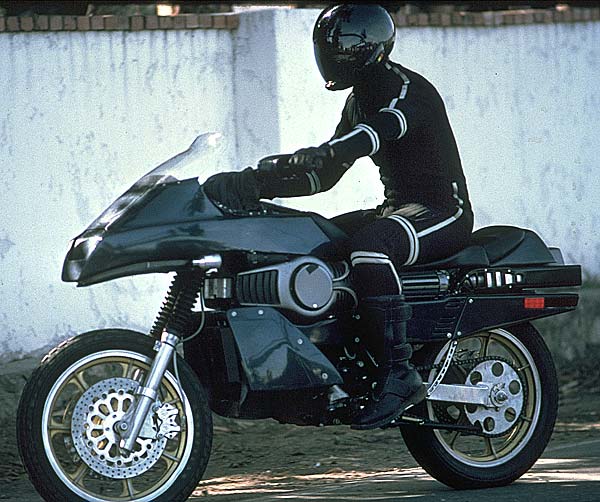
A top secret government experiment involves a souped-up attack-motorbike to fight crime. Jesse Mach (Rex Smith) can't tell a soul that he's secretly the rider of the mysterious Street Hawk. He has a 'co-pilot', who co-ordinates Street Hawk's missions back at their hidden base, inventor Norman Tuttle (Joe Regalbuto). The secret street exit was hidden behind a sliding billboard in an alleyway, which always reminded me of Batgirl's similar Batbike exit. Can't have been much of a secret location because Mach's flashy bright yellow Mustang was always parked outside, next to Tuttle's station wagon...

The short-lived TV show had storylines and dialogue that a five-year old could follow, which didn't really sit comfortably with its atrocious lessons in road safety in road safety. Yes kids, try and jump your bike over police cars, through windows, and ride as fast as you can - you'll never hit anything, honestly you won't...


Like so many other family-friendly action shows, the characters are two-dimensional (grumpy police chief, geeky engineer), and the comedy relief is goofy rather than funny. I only ever saw Rex Smith (Jesse Mach) in TV bit parts after this, which was a real waste of a leading man - his half-naked turn in the foam-filled, suit-moulding tube (glimpsed in the theme tune) made me an instant fan. Joe Regalbuto (Norman) had previously been in the bonkers Conan knock-off The Sword and the Sorceror (1982) - he was good, funny, but looked rather out of place amongst all the barbarian mullets.


The technology is fantasy, rather than reality-based. A bike with jet thrusters, a laser, missiles! It's a comic strip, but at least it's an original custom-made concept, rather than an adaption. Despite the high-tech dressing, (when technology meant flashing lights and dry ice, and animation poses as computer displays) the thrills are not from the visual effects (like the 'particle beam') but from car chases and explosions, placing this in similar territory to Airwolf and Knight Rider.


BUT. For all its faults, where else can you get so many car and bike (and boat and helicopter) stunts in a weekly TV show today? In every episode, there's never a shortage of genuinely exciting stuntwork. Street Hawk actually deserved slow-motion for its leaps and crashes. From the high jump through a (closed) window, to chasing a helicopter at high speed.


The fake sped-up 'hyperthrust' mode wasn't as dangerous, but fired-up every episode - as Street Hawk was cleared to travel at 200 mph through Los Angeles at all times of the day. How traffic could be stopped for a stretch of twenty miles, with a guarantee of zero jaywalkers, was beside the point. The effect took a visual cue from Koyaanisqatsi - headlights and neon at night, flashing past as streaks.


Guest stars included Christopher Lloyd playing almost too nasty a villain to square up to such cartoony heroes. There's also Bianca Jagger, Sybil Danning (Battle Beyond the Stars) and Marjoe Gortner (Earthquake, Food of the Gods), but famously this was George Clooney's second-ever featured role.
Rex Smith was making much of that episode, on his recent UK publicity tour for the DVD launch, saying that Clooney owed him a return favour for Smith giving Clooney his big break in Hollywood...


Another aspect that helps me rank this over Knight Rider, is the synthesizer soundtrack. Tangerine Dream's track Le Parc was used as the theme tune and the band provided the background score throughout. This is the same year they were brought in to score Ridley Scott's Legend for the re-edited US version, replacing Jerry Goldsmith's soundtrack.

The movie-length pilot episode (well, barely 75 minutes long) appeared on laserdisc, but this UK region 2 set is Street Hawk's world debut on DVD - the entire series runs only 13 episodes. It's coming to the US in July.


For absolutely everything else about Street Hawk, there's an extensive fansite here.

The theme tune is here on YouTube...


June 04, 2010

ZARDOZ (1974) - Sean Connery in a post-apocalyptic parable


ZARDOZ
(1974, UK)

Ye gods!

This might have been better if they'd tried for serious sci-fi, instead of opting for a preachy parable, free of logic or science. It's certainly entertaining, but often unintentionally amusing. The overload of pretentiousness is offset by Sean Connery trying to keep it believable. This also shows just how much he wanted give up the role of James Bond, turning down Live and Let Die with its offer of $5.5 million dollars, compared to the $200,000 he got for Zardoz.

At times, it's like watching the death of the British film industry. I would have loved to see the faces of the 20th Century Fox marketing team as they watched, (how the hell are we going to sell this?). Indeed, that would be high on my list of things to do with a time machine.

Halfway through watching Zardoz in widescreen for the first time, I thought it was about to end, a buried memory of where I'd given up watching it so many times before. I was too young to see this in the cinema, but remember many impressive publicity photos during the release, and reading the novel (based on the script). I recently heard that director John Boorman (Deliverance, Point Blank, Excalibur) considered that after filming it, Zardoz would perhaps have been better as a book. Certainly the novel didn't have the daft acting or unforgivable fashion statements.

As Zardoz crept onto late night TV in the 80s, I remember watching it with flatmates, struggling to take it all seriously and attempting to understand what the hell the director was thinking. Now, I think it's fun to unravel as a philosophical puzzle on your own, or to enjoy it as a comedy with a blitzed gang of friends. A film that could happily co-exist with the world of The Mighty Boosh.


A huge stone head floats over desolate grasslands, landing to receive sacks of grain from armed horsemen, spewing out a reward of guns and ammo from its open mouth. They savages worship Zardoz, literally a god-head. When it flies back home, one of the raiders is hiding inside. Zed (Sean Connery) is an Exterminator, the first 'Brutal' to enter 'the Vortex'.

There the inhabitants are civilised, seemingly from a higher evolutionary stage than the Brutals. While they're fascinated with him and enjoy reading his mind to see what life is like outside their city, Zed is curious to know why exactly his world is divided from theirs.


I really enjoy the vision of a post-apocalyptic world, with the Exterminators roaming the Outlands. These gritty scenes, with Earth's survivors riding around on horseback, is more realistic than the many car-driven post-nuclear movies that Mad Max sparked off. Covered in war-woad and wearing two-faced Zardoz masks, the brutals look suitably threatening, despite their bright red diapers and gunbelts. Added to this, thigh-length boots and a pigtail make Connery look less like Bond than he could ever have hoped.

The floating head has a fearsome, booming voice reminiscent of The Wiz (made four years later). The floating effect is elegantly and smoothly filmed.


But once the narrative enters the Vortex, the blunt allegories begin being hammered home. Zed is in the stronghold of the ruling class, who control the workers with violence and a fake religion, while they concentrate on preserving science, art, history and themselves. The story dissipates into a dissection of what is wrong with the ruling class. I was reminded of the 'film' that the circus master shows the townspeople in The 7 Faces of Dr Lao - not a historical story, but a reflection of their own lives.

Zardoz still serves as a warning about our modern society, rather than an attempt at predictive science-fiction, which it resembles at first glance. Many interesting sci-fi concepts are thrown out like random ideas, rather than explored and integrated into the story. It makes me wish that directors new to the genre of sci-fi (and horror) be required to take an exam first. The director even attempted to alter audience's expectations by "tacking on" (Boorman's own words) a prologue that flags Zardoz as an entertainment, an artifice, because the audiences "weren't getting it".


Having said that, the sci-fi elements, like the Immortals and their hardware, are impressively presented. The Eternals can talk to an interactive databank via a crystal ring, which can project associated images (a well-mounted and convincing stage effect), eradicating the need for TVs and computer screens in all but the largest meeting places. The Eternals can also use psychic violence to impose their will, easily outmatching Zed's pistol (though this ability is forgotten later on).


Indeed, I even saw a parallel with the Cylons of the new Battlestar Galactica, as the Eternals show Zed the 'Eternal Tabernacle', a greenhouse for regenerating Immortals who are killed, or commit suicide out of boredom. The image of Zardoz's stone head also reminded me of a Viper pilot helmet.

For all it's ideals, Zardoz looks more like Logan's Run, certainly in terms of bad fashion, which also relied on brightly coloured, uniform designs. Unflattering scraps of cotton for the women and macrame waistcoats for the men. This was also a regular style of cursed fashion in TV's Space 1999, also made shortly after Zardoz. The idea of sun-shy, gangly British actors suddenly being asked to wear tight-fitting, chest-baring outfits convinced no-one at the time, especially with futuristic silver, permed wigs for both sexes. Actually, the first season Space 1999 episode Mission of the Darians echoed many of Zardoz's plot points (like a functionally split society) with a far tighter narrative, loaded with atmosphere (and Joan Collins).


The acting ranges from intensely convincing (especially Charlotte Rampling and Sara Kestelman), down to (possibly intentional) pantomime. The embarrassing prologue cues the audience that not even the director is taking this all seriously, so why should we? Even Sean Connery is made to look silly as he tip-toes around a maze of mirrors, waiting for something to happen. John Alderton is good but miscast, unable to draw on his extensive comedic talents. Niall Buggy is not quite convincing as the trickster Arthur Frayn, though I'd like to check out his later appearance in an episode of Father Ted.

Director John Boorman (left), Charlotte Rampling and Sean Connery
I watched a good transfer on the 2003 region 2 UK DVD, my first chance to see the film in 2.35 widescreen. Besides some radio ads, narrated by Rod Serling, it also has a fairly self-effacing, recent commentary track by the director. While I'm tired by film-makers complaining 'we didn't have CGI back then', at least Boorman is pleased with what he achieved on a relatively low-budget, talking about how most of the convincing visual effects were done 'in camera'. The floating head and the crystal ring projections look very good, as does the 'touch teach' sequence, where the sum of human knowledge can be gained by osmosis, realised with multiple front projections.

Boorman wisely comments that some (but not enough) scenes look silly or too long, and appears to recognise the fairly bad reputation of the film. I'd liked to have heard more about where his more bonkers ideas came from.


The current DVD cover art is lousy though, not nearly as compelling as the original poster, missing out both the stone head and Charlotte Rampling. Even Sean Connery's face is hard to recognise.

Taking it all less seriously, the funniest review I've seen of Zardoz is here, on Movie Mistreatments...

An original trailer for Zardoz is here on YouTube - "Kill the tabernacle!"...


The BFI were brave enough to include Zardoz in a recent John Boorman retrospective. Here's me with an original poster. Zardoz speaks to me!