October 05, 2010

WHO? (1973) - mystery cyborg spy game


WHO?
(1973, UK)

An unusual cold war thriller verging on sci-fi territory

(Updated 15th May 2014, first reviewed in November 2008)


Lucas Martino, a top US scientist literally crashes and burns near the Russian border, at a time when the two superpowers were enemies. His life is saved by soldiers who cross the border and rush him to hospital. Months later, he's returned to the west, but the rushed and experimental surgery that saved his life now obscures his identity. His head and chest are now encased and partly replaced with steel and prosthetic parts. 


It's up to US security chief, Sean Rogers, to verify whether it's still the same man behind the mask, before returning the scientist to a top secret project. He soon finds out that Martino has been in the hands of a senior KGB agent, Colonel Azarin, who may have sent back an agent in place of the scientist.


Based on a book by the late Algis Budrys, the movie uses its parallel timeline structure - alternately following Roger's attempts to debrief the scientist, while flashing back to the events behind the Iron Curtain. We see Martino being interrogated both by the Russians, and subsequently by the Americans.

The film is a straightforward re-telling of the novel, but adds a couple of silly action scenes, like a decidedly low-budget car chase, to try and open up the story. It also misses the opportunity to explore what's going on with the man behind the mask.


Elliott Gould (Capricorn One, MASH), as security agent Rogers, holds the film together. Trevor Howard (11 Harrow House, The Offence) plays the devious Azarin, the Russian mastermind behind the entire subterfuge. Though they never meet, the film plays like a chess game between the two men. Joseph Bova as Martino, evokes sympathy as the masked mystery at the centre of it all.


If it weren't for Gould and Howard and the Miami location work, Who? looks low budget enough to be a TV movie, with ineptly directed action scenes and nothing going on dramatically besides the unravelling mystery.


This was once an intriguing premise, the possibility of a scientific identity theft. But now, with DNA testing, the mystery could be cleared up definitively. Admittedly in Who?, the use of fingerprints and retinal scans are considered, so I'm sure a modern plot twist could outfox DNA tests as well.


Until recently, Who? had a terrible presentation on home video. It was called RoboMan for the US VHS release. Full-frame, E.P. recording, with this terrible and misleading cover art. 

Eventually there was a US DVD release in 2010 (cover art is at the very top). The details on Amazon promise commentary tracks, one from Elliott Gould and one from director Jack Gold.


In 2014, it was released on DVD in the UK, again with a title change, The Man With The Steel Mask. However the Who? title art appears on the inner sleeve and the onscreen title is still 'Who?'. It's presented in 16:9 anamorphic widescreen, but without any extras.

Not essential viewing, but of interest to fans of the author, and anyone who may remember it from late-night TV twenty-odd years ago.


October 01, 2010

IP MAN (2008) - Donnie Yen vs the Japanese army


IP MAN
(2008, Hong Kong)

When he takes everyone on, feel sorry for the last man standing...

This is a gritty, tense historical drama showcasing spectacular fight scenes. I'm not into the martial arts genre particularly, partly because I need a good story to hang the action on, and I find them repetitive, unless they're exceptionally inventive like Jackie Chan's Hong Kong films.


But the historical setting of Ip Man, in a Chinese town besieged by Japanese troops, is an interesting scenario, with a strong story and a clear range of characters. The fight scenes, staged by Sammo Hung (who doesn't appear) are exceptionally impressive and varied in scale, setting and style.


The publicity for this has really hyped the fact that Ip Man himself, played by Donnie Yen, was a key figure in Bruce Lee's early martial arts training. But the events here take place just before World War II, decades before Ip Man met Lee. The story of their time together may be in the Ip Man sequel, as well as many other Ip Man movies that are have also been and are being made.

But it's the war setting is easily more dramatic than the Bruce Lee connection. While the Japanese are outgunning the Chinese in firepower, martial arts are seen as completely outdated and useless. Though the rival schools of fighting and philosophy, sitting side-by-side in the same quarter of town, are still popular and thriving. But Ip Man, the most accomplished teacher and fighter in town, is refusing to run such a school or even publicly demonstrate his superior skills.


When the Japanese army rolls into town to occupy the province, he's eventually forced to fight publicly, against the Japanese. They're keen to show that their unarmed fighting skills are better the Chinese. But who wants to when they're also holding guns?


This is a well acted and good looking production. While there are a couple of well-known Japanese actors in the cast, the story is heavily anti-Japanese. The short montage to represent the Japanese invasion China is heavy-handed and crassly staged. It underlines that there's a market for anti-Japanese sentiment at the moment, which really shouldn't be fuelled (see the article below). The brief use of CGI airplanes is also unnecessary, unconvincing and spoils the consistent look of the film.


It's a good story, focusing on one man's principles, but it doesn't offer insight into any history of the Japanese invasion (better see City of Life and Death instead) and it takes place decades before Ip Man met Bruce Lee. The DVD extras even spend time qualifying (backtracking) how long he actually taught Lee, or how much of this story has been 'dramatised'. This is an interesting and entertaining film, but I suspect it shouldn't be treated as any sort of documentary.

Director Wilson Yip has come a long way from the low-budget antics of Bio-Zombie (1998) and Donnie Yen gives an impressive and understated performance, a world away from his action hero image.


The UK DVD has some interesting extras about the film and the man, but mainly focusses on the Ip Man's fighting styles. It's also out on Blu-Ray in the US and UK.


Anti-Japanese sentiment seems to be at the core of the script for Ip Man, as argued here on Mister Hobbes.


September 24, 2010

THE DEVIL'S PLAYGROUND (1976) - a dreadful place for sexual awakening


THE DEVIL'S PLAYGROUND
(1976, Australia)

OK, let's all try sexual abstention...

1953. Boys learning about sex, coping with bedwetting, isolated in a strict boarding school and training for a life of celibacy. A story of the pressures on the pupils (and the teachers) in a Catholic school where a staffroom full of Brothers prepare them for life in a religious order.

I think this film played on the BBC at the end of the seventies and stood out as one of the few films that spoke to me as a sexually-frustrated teenager. Not that I went to a religious school, but many aspects of boys puzzled by puberty are highlighted as they try to obey the restrictive regime of abstention, at the risk of eternal damnation!


The 'Brothers' (teachers) are also fighting their own personal battles, about faith, personal temptation, as well worrying about the rules they're inflicting on the boys.

With the boys straining to avoid masturbation and one of the adult Brothers tormented by temptations of female flesh, illustrated by a frank fantasy of full-frontal nudity... it wasn't a movie I was comfortable watching at home with mother! It echoed many of the themes of Lindsay Anderson's if.... (1968), but presented several similar situations more calmly and realistically.


Recently I wanted to see this again, finding it on DVD in the US rather than Australia, where it's currently out of print.

The Devil's Playground is stronger in the subtler moments when the monks and the boys struggle with everyday universal problems, but almost throws away several pivotal dramatic events. The honesty and realism of the subplots and characters mean that this is a rare and unexploitive treatment of many taboo subjects. These include the typical subjects that men don't always discuss seriously, but stops short of any more sensational themes like sexual abuse.

Beautifully shot and mostly understated, this is a dark slice of life in a strange and hopefully extinct environment.


Nick Tate gives the strongest performance, as the Brother who's happiest when he's away from the school - the actor had just returned from England after starring in Space 1999. Arthur Dignam has the difficult role as the extremely repressed Brother tortured by sexual desire - he was recently seen portraying Ernest Thesiger in the recreation of the filming of The Bride of Frankenstein in Gods and Monsters (1998).

Writer Thomas Keneally has a bit part as eccentric missionary Father Marshall, who appears to be every boy's friend, but delivers a horrifying sermon describing the graphic tortures of Hell. Keneally was a natural choice for the part, having trained as a priest though he later dropped out and married a nun! He's most famous as the author of Schindler's List, so it's really very odd seeing him here as the film's most bizarre-looking character.


The naturalistic lead performance from 13-year old Simon Burke is a central reason that the film works so well and a testament to Schepisi's direction. More recently, Burke appeared with Vin Diesel in Pitch Black! Lastly, Sheila Florance has a bit part, unusually sporting an Irish accent, just before a short appearence in Mad Max and a long stint as Lizzie Birdsworth in Prisoner: Cell Block H.

The Devil's Playground isn't intended as an attack on religion, but rather a critical view of the totalitarian regime inflicted on writer/director Fred Schepisi for two years of his childhood!

Schepisi had to work hard to get the film made and then get it seen. But it soon joined the 'new wave' of Australian cinema, quality films that earned worldwide reputations. It lead to his next movie, The Chant of Jimmie Blacksmith (1978) about a real incident when a young bullied aborigine is driven to murder. Schepisi's later Hollywood work included some rather ordinary comedies but his reworking of the story of Cyrano De Bergerac, Roxanne (1987) with Steve Martin and Darryl Hannah, was easily the funniest.


The US (above) and Australian (pictured at top) DVDs have a director's commentary and a making-of documentary.

Once again, be aware that there are several other movies with the same title.

A more indepth review and plot description here on InFilm Australia.


September 21, 2010

Finally on DVD: DOUGAL AND THE BLUE CAT (1967) - the original Magic Roundabout movie


DOUGAL AND THE BLUE CAT
(1970, France)

The original Magic Roundabout movie is finally on DVD

(Updated article from 2006)

The story so far... The Magic Roundabout started off in 1963 as a French TV series for children, created by stop-motion animator Serge Danot. A little girl called Florence and her friends meet Zebedee, a boxless jack-in-a-box, and a bevy of talking animals, notably Dougal, a sarcastic low-slung dog, and Brian, a chirpy snail. Their friends included Dylan, a dopey rabbit, Ermintrude, an enthusiastic bossy cow, a rather aloof train that didn't need tracks, Mr MacHenry the gardener and Mr Rusty who runs the magic roundabout itself. For years they had surreal, low octane adventures together in the magic garden, with Florence in no hurry to leave and go home. It was all made using stop-motion animated figures moving around a sparsely decorated white limbo that represented the garden.


The BBC bought the series in 1965, but Play School regular Eric Thompson (Emma's dad) threw away the translations of the French stories and wrote all-new dialogue, before revoicing every episode. Each 5 minute story was transmitted at the end of the late afternoon Children's Hour and for years lead into the evening news, the start of BBC 1's evening programmes for adults. Thompson's scripts catered to this unique TV slot by appealing to all age groups, with in-jokes and references to current affairs for the grown-ups.

The show became so popular that a feature film, Dougal and the Blue Cat, was released in the UK in 1972 (after it premiered in France in 1970). In the story, the magic garden gets an unwelcome new visitor, a snarky blue cat called Buxton. While the animals try to welcome him, the ever-suspicious Dougal is watching his every move...


With some weird French songs and genuinely frightening moments (at least for six-year olds) the film has lodged in many minds, and would have been the first chance for some to see The Magic Roundabout characters in colour. Following the format of the TV series, Eric Thompson dubbed all the dialogue into English using his trademark voices for each character, with one surprise exception...


In all there were a whopping 441 episodes (
according to Toonhound.com) that ran until 1975, inspiring a ton of spin-off games, annuals, toys...

Much later, in 1992, Channel Four discovered that the last 39 episodes of the original French series hadn't been seen in Britain. But with Eric Thompson no longer around, comedian Nigel Planer was drafted in to rewrite and revoice them, though I didn't feel that they were nearly as much fun without Thompson.


Presently, none of The Magic Roundabout series are available on DVD. Several volumes of the original colour episodes were released on VHS, easily confused with the video releases of the Nigel Planer series. I'm surprised and sad that this hugely popular and nostalgic children's favourite has still not emerged on DVD, even when there was a 2005 CGI feature film incarnation, voiced by a mixture of actors and pop stars.

The only good thing about the recent movie was that a single black-and-white episode of the original series was included in the 2-DVD set, in both English and the original French versions.


The good news is that the 1970 movie, Dougal and the Blue Cat is now being released on DVD in the UK in November. This was last seen on home video as a VHS release (below), sourced from a badly damaged and very scratchy print. Now digitally remastered, this new special edition set (pictured at top) includes both the English and French audio tracks as well as several featurettes.


Hopefully this could spark off interest for some of the original TV series to finally hit DVD. At the moment, the only Magic Roundabout DVDs are some CGI spin-offs from the 2005 movie.

Time for bed, I think. Yes, time for bed.

September 17, 2010

OUT OF THE BLUE (2006) - a tragedy in New Zealand


OUT OF THE BLUE
(2006, New Zealand)

Realistic, beautifully-observed approach to a real-life spree-killing

Karl Urban was outstanding in JJ Abrams' Star Trek reboot, but I initially didn't recognise him in this, filmed in his native New Zealand. It's completely different from his heavily-armed characters in Lord of the Rings, Doom and The Chronicles of Riddick.


Urban plays a smalltown policeman in a poor backwater village, where all that usually goes on is burglary. It's the story of an actual tragedy that struck the village of Aramoana back in 1990. A series of trivial events that tipped an unemployed gun enthusiast towards a killing spree, the worst New Zealand has ever seen.


This is very different from the overly dramatised TV movies or cold docudrama restagings. Director Robert Sarkies concentrates on the local people drawn into the day's events while also meticulously recreating the facts. He doesn't show much bloodshed, echoing the way that murders rarely have witnesses, instead contrasting the pain and chaos with the natural beauty of this coastal area. There's no cliched theorising about the killer's motives, and no flashback guesswork about his past. He's just one character in the day's events.

Unlike the spree killers of Elephant (2003) where the duo had a definite plan, this genuinely mad man is completely unpredictable, making it up as he goes along, repeatedly defying any urge to escape. The emergency services are frustratingly slow to move in - presumably because the area is still unsafe for them to do so. The local police on the scene have to do what little they can against a killer with a cache of automatic weapons.


The cinematography vividly depicts the beautiful coastal location in wide static shots. The action is often shown very closely, sometimes abstractly, with very precise focusing leading our eyes through the story. This isn't as arthouse an approach as Elephant, but still a carefully paced view of the community and the tragedy. While it's understandably respectful, the director makes edgy choices in what he shows, particularly at the climax.

I'd not heard of these events, so the unfolding story was extremely suspenseful. I'd not even heard of the film despite always being on the lookout for Karl Urban's work. A meticulously well made film, with naturalistic performances - a stark contrast to the TV cops who deal with similar situations quickly and tidily. Here, not everyone one knows what's going on, mistaking what they see or hear, and not always knowing what to do in such an unfamiliar situation. The fact that several children were among the victims makes it all the more upsetting.


New Zealand has a great film industry, but isn't famous for many stories about itself, though Peter Jackson's first dramatic film springs to mind, also a recreation of a famous New Zealand murder, the excellent Heavenly Creatures (1994).

Be careful when you're searching for this film because, although apt, it's already been used by several other films and TV shows...

Karl Urban can next be seen in the remake of Robert Fuest's And Soon The Darkness and is up for the lead role in the Judge Dredd reboot. I also hope that Matthew Sunderland will also get more work after his quiet but frightening portrayal of the deranged gunman.


The region 2 UK DVD I watched was no-frills. But
the US region 1 and Australian region 4 releases definitely have generous extras, all of which I'd really like to see, to fill out the details of what happened that day, back in November 1990.


Here's an official trailer on YouTube...


September 15, 2010

Five years in the Black Hole - despite the chaos


Good grief, forgot my own birthday!


It's now been five years since this blog began in September 2005.

But for the last six months it's been tough to keep the momentum going, as I've been cut off from my library of films, reference books and mags. There's also been some serious internet-deprivation, and a double number of cats walking over the keyboard, all of which has cut my output down to one article a week. I've worked hard to keep that as a minimum. It's always amusing when people assume that this site has a team of reviewers.

Thankfully I'm still getting the same number of visitors and have enjoyed talking to you via comments and Twitter. The facility to 'Follow' other blogs has been a huge help in keeping up with my favourite movie blogs out there. I always try not to write about the same films as everyone else, to try and provide different ideas for older movies to catch.

While Twitter is overwhelmingly preoccupied with new movies and what's in the pipeline, it's still good for signalling when new articles are posted on sites devoted to classic movies, cult and horror. It also brings good news about new DVD releases of cult classics. Though I get the feeling that many more people read my Tweets than my blog.


This last year, I've intensified the work on the Ultimate Guide to Barbarella (1968), and collected it all on a separate site for easy reference. The name was, ahem, chosen to be Google-friendly... Barbarella's Shagpile Cockpit.

When I get my life back soon, (after the builders allow us to finally move back in), I'm hoping to streamline the archive of past reviews, keeping the present categories but emphasising the films I recommend. I like to review Asian horror whether they're good or bad because English reviews are hard to find. But for everything else, I'd like to highlight only the good stuff I've seen, and tweak this site to become more useful as a place where you can come for ideas of what to watch - as a quick guide or a leisurely browse.

Of course, I won't be abandoning my trawl through the archives for my favourite films that aren't on DVD. While they can't be easily seen, I don't want them to get left behind in the global digital overhaul.

Thank you all for reading,

Mark Hodgson,
London,
Black Hole.

September 14, 2010

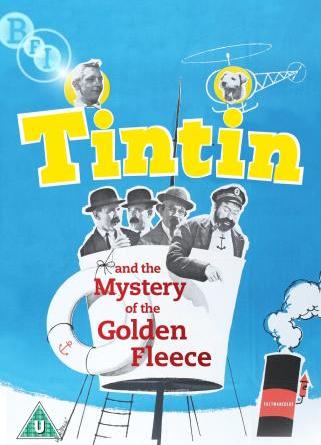
TINTIN AND THE MYSTERY OF THE GOLDEN FLEECE - finally on DVD


The two live-action Tintin films from the sixties now digitally remastered...

(Updated article from 2006)


Frustratingly hard-to-get (until now), these handsomely made children's films will suit Tintin fans of all ages. Both movies are about to be released on DVD in the UK (in mid-October) having been digitally remastered - reportedly a huge improvement in image quality on the previous French and Australian releases. The UK release of Tintin and the Mystery of the Golden Fleece will also include the recently discovered English-language audio track.

I'm sure I remember these two Tintin adventures being available as hardback books in the same style as the other Tintin comic albums, but with photographs and text telling the story of the films. I've recently tracked down both books again but only in French (pictured below). Did I imagine the English editions? I've also seen images on the net of comic album versions of these stories, but I believe they are even rarer.

Besides remembering these stories being included in the classic Tintin comic book collection (early graphic novels, if you like), I also saw Tintin and the Mystery of the Golden Fleece on British television in the seventies. The memory of that broadcast, prompted me to search for these films again four years ago, first finding them on VHS in Canada.


TINTIN AND MYSTERY OF THE GOLDEN FLEECE
(France/Belgium, 1961, 
aka TINTIN ET LE MYSTERE DE LA TOISON D'OR)

Tintin and the Mystery of the Golden Fleece (1961) is by far the more fun of the two. Both films succeed at portraying the famous characters, but Golden Fleece also captures the flavour of a typical Tintin adventure - the globe-trotting, the sense of location and culture, and a good mystery at the core of the plot.

Captain Haddock (played admirably by Georges Wilson) is sitting in his hammock at Marlinspike, when he receives a telegram informing him that he's inherited a ship. He takes Tintin (played in both films by Jean-Pierre Talbot) and of course Snowy down to Istanbul to collect his inheritance.

The ship, called the Golden Fleece, turns out to be an old rust-bucket. But why does international businessman, Anton Karabine, want to buy the ship from them. Rather than sell it, they sail to Greece to deliver the relatively worthless cargo of carpets. Then they discover more about the ship's history and how desperately Karabine still wants to get his hands on it...


The young actor Jean-Pierre Talbot is a real find as Tintin. He looks the part, does his own stunts and is even pretty good at judo (for taking the baddies down). He only seems to fall short of the original character by not getting any comedy moments to himself. He also doesn't get much chance to frown - comic book Tintin always had a great frowny face when he was working out mysteries, but there's none of that here.

The comedy is of course left to Captain Haddock, dotty Professor Calculus and the hapless Thompson Twins, all uncanny lookalikes of the originals. But even the secondary characters appear to have walked off the pages of Herge's illustrations.


The handsome photography complements the many real-life shooting locations which make up the majority of the film. Particularly spectacular are the cityscape of Istanbul and the Greek clifftop monastery (that looks like the same one used in the James Bond movie For Your Eyes Only).


TINTIN AND THE BLUE ORANGES
(France/Spain, 1964, 
aka TINTIN ET LES ORANGES BLEUES)

Tintin and the Blue Oranges (1964) falls short as a follow-up. The characters are still impeccably portrayed, even though it's largely a different cast. Jean-Pierre Talbot returns as Tintin, but Calculus and Haddock are played by new actors. A notable addition to the cast is a cameo by Castafiore, the opera singer, who briefly adds fun to the proceedings.

Basically, Professor Calculus is sent some mysterious blue oranges in the post. When an intruder tries to steal them, Tintin and Haddock realise they're valuable, but why? They head off to Valencia, where Calculus remembers an old colleague was working on something similar. When the Professor is kidnapped and Tintin and Haddock are stranded in a grain silo, they realise that they are getting closer to the heart of the matter...

The problem with the film is the less spectacular locations and the less spectacular plot. The action mostly takes place in small towns in Spain, but nowhere iconic or recognisable. There's also a huge gang of children added to the mix - always a mistake in children's films, I feel. You don't necessarily need child characters for a young audience to identify with.

The whole film feels much smaller in scale, with few memorable scenes. The only highlight for me was an exciting fight scene. Jean-Pierre manages a spectacular flying tackle, a couple of judo throws, and a dropkick all in one take.


Once again, the French DVDs (pictured here) have no English subtitles. The 2007 Australian DVDs have subtitles, but are also from analogue masters (that is, not digitally remastered).


I'd also like to hear from anyone who can find any trace of my another Tintin holy grail - the 1960s' cartoon series that were shown as a series of 5 minute cliffhangers. These are totally off the home video radar as far as I can see. I believe they might have been released on VHS in the UK (in the eighties, before the new 1993 series came out).


For all your other Tintin needs, visit Tintinologist.


September 10, 2010

KARAOKE TERROR (2003) - from the author of AUDITION


KARAOKE TERROR
(2003, Japan, Shôwa kayô daizenshû)

I think he got the point...

This darkly humorous satire of suburban Japan grabs the viewer quickly and stays intriguing to the end. A sunnier, small scale Fight Club, with singing. I shouldn't really try to categorise the unique story, but I certainly enjoyed it. Knowing nothing about Karaoke Terror was a good way to go in...


For the first few minutes I thought I was going to get another Linda Linda Linda, as a group of slackers performed some very bad karaoke in matching costumes, wearing bowler hats that seemed to reference A Clockwork Orange.

But the story soon kicks off when one of their group randomly murders a middle-aged woman on the outskirts of Tokyo. It's nasty, but with just a little too much gushing blood to be totally serious.


It turns out that the victim's friends are also fans of karaoke, and not above resorting to bloody vengeance, if they can track him down before the police do.

It was a while before I figured out this was in fact a satire. Problem being I wasn't getting all the humour. The story of the escalating battle between the middle-aged divorcees and the young slackers isn't quite as important as the contrast between the two sides, their attitudes, lifestyles, and just as importantly, their tastes in music.


This is based on a novel by the author Ryo Murikami, no stranger to controversy as he exposes attitudes lurking in the big cities. He also wrote the infamous Audition, which notably excludes any humorous streak.

The story still gripped me, and while I enjoyed the characters and the brilliant cast, I was very aware of repeatedly missing the point of the choices of music and many cultural references.


Each actor in the ensemble cast carves their own very clear characters. The women are just as immoral as the men, while justifying their crimes in different ways. I only knew the intriguing Ryuhei Matsuda from Nightmare Detective, Otakus In Love and Gohatto. A more experienced actor than the rest of the guys' group, he still modestly blended in completely here.

While looking like modern Japan, this presents a gallery of skewed and surreal characters, like Twin Peaks with an agenda.


Karaoke Terror is available on DVD from Synapse Films in the US (see cover art at top). It includes extensive liner notes with a guide to the 60s pop songs featured in the film, a trailer and a good 20 minute 'making of' feature.


This English-subbed trailer includes some major spoilers...