April 21, 2013

SAMSARA (2009) - worthy of BARAKA and KOYAANISQATSI


SAMSARA
(2012, USA)

Another astonishing 'non-narrative movie' from Ron Fricke

If you've seen Baraka (1992) or Koyaanisqatsi (1983), my job of describing Samsara to you would be much easier.

Most of what I know about these amazing films is from DVD extras and the issues of American Cinematographer that covered them. Officially, Ron Fricke was the cameraman on Koyaanisqatsi which was directed by Godfrey Reggio. In reality it was an experimental collaboration between them. Reggio wanting to communicate just through images and Fricke's eye for the amazing, combined with his innovative use and development of mobile time-lapse cinematography. Koyaanisqatsi shows us the incredible. Together with the hypnotic effects of Philip Glass's soundtrack (which also interacted with the editing and structure of the scenes), it also inspires a contemplation of, well, life on this planet.


Fricke hasn't collaborated with Reggio since, but both continues to direct similar 'non-narrative' movies and short films ever since. Reggio with two more 'Qatsis', Powaqqatsi looking more at the people around the world, Naqoyqatsi at our digital future. Fricke most notably made the epic Baraka - a glorious look at the natural world.


But neither man has since achieved the same hard look at the world as Koyaanisqatsi. Though Samsara comes close by including themes of industry, colossal scales of waste and even disposable people - androids. As well as the astonishing use of Fricke's trademark motion-control timelapse camerawork, but this time for night-time scenes, with stars revolving in the sky and statues lit only by moonlight.


The mix of natural wonder and the never-ending consumption of complex manufactured goods, not to mention animal products, makes for many memorable points without using sledgehammer tactics. The camera stands back, without pointed close-ups, allowing the viewer to pick out their own details. Fricke continues to include his slow-motion 'portraits' of people and couples from around the world. Most touchingly in the section on the aftermath of Hurricane Katrina.

Samsara prompts us to think about many different aspects of the world, I've not mentioned them all, and very different trains of thought to those triggered by advertising, random TV or a YouTube homepage.


It's like drifting around the world in a balloon with a telescope. A mystery tour of amazing places I never knew existed. Like Koyaanisqatsi, the point isn't to constantly pinpoint where and what you're seeing, but to watch what's happening. 


Afterwards, the making-of documentary can tell the story of the five years of collecting amazing footage on huge 65mm cameras, around 25 different countries, in some inaccessible locations and very privileged vantage points. Many directors spend extra effort on their establishing or opening scenes. Samsara feels like a feature compilation made up of those.


This amazing shot of a temple reveals dozens of others in a surreal, smooth, vertical reveal, presumably filmed from a balloon. The number of temples sitting so closely together in a lush green setting honestly looked too good to be true. We needed to double-check our eyes for CG trickery. But that's not how these films are made.

Samsara is further guided by its imagery by being edited without any reference to music. Where Koyaanisqatsi was partly cut to music, Samsara was 'silently edited', each shot allowed to run its course before giving way to the next. Only then, like standard movie-making, was a completed 'cut' given to the musicians to score.

The ethereal music for Samsara is by Michael Stearns (who composed for Fricke's Baraka and Chronos), Lisa Gerrard and Marcello De Francisci. Hearing them talk, I was touched by the fact that I'd first heard Gerrard's singing (wailing?, lamenting?) thirty years ago when she was with ambient gothic group Dead Can Dance. It was like reuniting with an old friend!


Samsara deserves seeing on as big a screen as possible, showing in most theatres on 4k digital. Blu-ray is obviously the next avenue you should explore. The blu-ray image is of course 1080 by 1920, the '8K' referenced on the cover is the resolution width that the film was originally scanned at. 

Also, don't be put off by this being exiled to the documentary section. There's no voice-over, no talking heads. It's in a genre all of its own.


A thorough interview with Ron Fricke and co-writer/producer Mark Magidson about their adventures making Samsara, here on Horror Cult Films.


April 03, 2013

Cinema-going in the 1970s - my decade in the dark


A trip to the cinema doesn't change drastically from decade to decade - pay for a ticket, overpay for junk food and stare at a wall for a few hours. But now it's forty years since my frequent movie-going began, and it was quite a different ritual.

As a child in the 1960s, I was taken to see a movie as an occasional treat, but my appetite became so voracious that, when I was old enough (13 or 14), I went on my own to the local cinemas. A lot. Between 1973 and 1980, I went weekly, sometimes more often. I also went up to London on my own to catch the latest films on even bigger screens.


What's on?

At the time, Britain had to wait several months for the US to finish with their prints of the movie. This often meant that we'd not see major films until the year after they premiered. As well as that delay, London had the opportunity to show new films exclusively for several weeks. With bigger screens and higher prices, it was presumably another chance for word of mouth and press reviews to drum up anticipation around the country. Or it could have been that there weren't enough prints to open everywhere at the same time. The London cinema listings were in national newspapers and the London evening papers.

Then new movies would open in different towns on different weeks, being held over for longer if they did well. I'd check other nearby towns to see if different films were playing. Saturday was when the local paper printed adverts for what was showing in the area, along with screening times. As the cutting above mentions, the programme changed every Sunday. For me it was the first page I'd look at in the the weekend paper. It was also the only way of knowing what films were playing.

At the time, only the biggest movies would get adverts on television. But most new films would have adverts on local radio. Made up of quotes and music from the soundtrack, with a deep, movie guy voice emphasising the taglines from the posters. ("The lucky ones died first!"). I've made a YouTube playlist of the best radio movie ads from the late 70s and early 80s. Many are in stereo - which was still a novelty on radio at the time.


Admission

I've little hard proof, but I think that the price for children was about 50p a ticket, and £1 for the over sixteens. By the end of the decade it was definitely £1.40 for an adult ticket at my local cinema.


Certification

I'm relying on this page on Wikipedia - from 1970 to 1982, cinema certification was U, A, AA and X, which is certainly how I remember defining what I watched. The Rocky Horror Picture Show, Blazing Saddles and Young Frankenstein were 'AA', The Omen and The Exorcist were 'X', and incredibly Jaws was 'A'. Here's what they stood for...

'U' certificate was open to everyone. 

'A' certificate wasn't recommended for under 14s (but we were let in anyway. But before 1970, in many areas, children had to be accompanied by an adult).

'AA' meant that under 14s weren't allowed in (these were roughly the equivalent of American 'R' certificates - violence and swearing but no explicit sex scenes).

'X' certificates were for over 18s only (before 1970. it was only restricted to over-16s), but they were still censored, cut for extreme violence.

As a tall teenager, I played a moneysaving game. I'd pay one week as an adult to see an 'X' film, then be cheeky enough the next week to ask for half-price (because I was under 16). I soon moved up to the right age for 'AA' films, but wasn't supposed to see 'X' certificates until 1979. If I'd agreed to that, I'd have missed the chance to see Carrie, Tower of Evil, Suspiria, Death Race 2000 and many more, so I pretended to be older...

('X' certificate image courtesy of Mounds and Circles blogspot).


Double Features

Throughout the 1970s, local cinemas were still showing double-bills, two full-length films, whether or not they were a suitable pairing.

So, for the price of one ticket, everyone could get three or four-hours of entertainment. Sometimes, I would stay and watch everything through twice - four films in a row. Most of the time, local cinemas didn't have 'separate showings' or booked seats (like they did in the central London cinemas). You turned up when you wanted, you could even go in halfway through. Rather than hang around an hour for the next performance, I made the mistake of going in late, when I saw Jaws for the first time. Then I then saw the first half, and watched it through to the end again.


Many big films kept on making money with rapid re-releases, especially popular series like Planet of the Apes, Pink Panther and James Bond films. They made so much that TV couldn't afford to show recent films until years after they first appeared in cinemas. Double-bill re-releases were a great way of catching up on films that I'd missed and a chance to rewatch favourites. The order I saw them in was of course quite random. For insatnce, I started with the last Planet of the Apes film...


Queues to get in were longer in the evenings, especially at weekends. It was first come, first served. If there weren't enough seats, you'd have to wait till the next showing. Several ushers had to maintain traffic control and scout for empty seats during screenings, pointing torches at the floor to show us the where the steps were. 

In between the support and the main feature, there'd be adverts and trailers. An experience approximated by Tarantino's Grindhouse (2007). The support might be a re-run that was a year or two old, usually with the same certificate. Or it might have been specifically made as a second feature! We'd also see American TV movies, that hadn't been shown in Britain yet - like The Savage Bees. In terms of production values, there was only a thin blurry line between low-budget feature films and TV movies.


Through the decade, the double-bills became rarer - more and more blockbuster movies like Jaws and The Towering Inferno didn't need support films, but the tradition of having a 'supporting feature' remained. Specially-made short films and documentaries, little more than 25 minutes of filler, like travelogues, were shown instead. Few were memorable, except Bob Godfrey's Great (1975, a bawdy, musical, animated story of Isambard Brunel) and Leonard Rossiter as Le Petomagne (1979, based on the true story of a French stage entertainer who could fart musically). With horror films, there was a brief spate of weird, adult short films. I remember a Basil Brush presenter turning up half-naked in one about a sacrifice to Satan! 


Intermissions

Between the support and the main film, there'd be diabolical local adverts, then slicker adverts (usually for alcohol or cigarettes - the Gordon's Gin music became a hit in its own right), then trailers for coming attractions.

Incidentally, smoking was still allowed in most cinemas, ashtrays built into the arms of every seat (but nowhere to put your drinks or popcorn). Smokers were eventually pushed to one side of the cinema (the right). But if the seats on the left filled up, you had to sit with the smokers!


Long 'event' movies, like Ben-Hur, might not get a supporting feature. Though even 2001 - A Space Odyssey (on re-release) started off with a Tom And Jerry cartoon (they were in space, of course). With these epic running times, there'd be a break halfway through the film. I still remember exactly where they stopped Chitty Chitty Bang Bang and The Towering Inferno, both with cliffhangers and groans from the audience.

Waiting for the film to start, you might get music played, but were often sitting in silence listening to the projectionist rewinding the reels for the next performance. You could take the long walk down to the front and get a warm Kia-ora from the usher or a melty ice cream, or hike back down to the foyer for more Revels, as long as you still had your torn ticket stub to get back in.

If you were very lucky, there would be some sort of light display to keep your brain alive. The multi-coloured oil wheel projected over the curtains at Wimbledon Odeon once kept me amused for over half an hour. 


The wait between films could get ridiculous. Presumably. the manager had to stick to the published times placed in the local newspapers, before they actually knew the exact running times. 


Magazines sold at the ticket booth passed the time, though there was barely enough light to read them. There was Film Review or Photoplay magazine, and sometimes a special brochure for the main film. Japan still makes these, with high quality colour photos and behind the scenes info, they're very collectable. 

By the end of the decade, brochures at local cinemas gave way to tie-in magazines and foldout poster mags, which you could buy at any newsagent. Star Wars was one of the first films to have such a tie-in (but you could still get the brochures in the big London cinemas).


Projection

Everything (except in a few of the biggest cinemas) was shown on 35mm film reels, in either 1.85 or 2.35 aspect ratios. 

As I remember, the changeover between film reels was every twenty minutes. The print would visibly get more scratchy, before the circular marks scratched into the top right corner of the picture appeared (once as a warning, the second as a cue) and the sound might glitch out at the moment of changeover. Distributors would try and divide up reels so that there was no music and a gap between dialogue at the end of each reel. There might be a momentary blackout if the projectionist was late switching over. 

Censor cuts would have been made, physically, to each print. Because the projector bulb shone behind a different frame to where the sound pick-up was. If a section of film was cut out, the sound that was removed would differ by half a second. You could often tell where the censor cuts were because of the mismatched audio, besides a blatant jump in continuity.


Odeon Leicester Square, May 1980
Up in town

To see a major new film without having to wait, I'd go up to London, where some cinemas even had multichannel or stereo audio, 70mm prints or even floor-shaking Sensurround. A chance to see them as soon as they'd opened in this country, Star Wars, Close Encounters of the Third Kind, Superman - the MovieAlien, Battlestar Galactica, The Black Hole, Apocalypse Now in six channel stereo... I have the brochures to prove it.


Soon, I'll be looking back in detail at these, my local cinemas at this time, and what's happened to them since. Also, how you can travel back in time to see how your favourite cinemas looked...


March 29, 2013

LIVE AND LET DIE (1973) - the blaxploitation Bond


LIVE AND LET DIE
(1973, UK)

A different Bond  movie in many ways...

After too many wincingly awful moments in Roger Moore's James Bond movies, it's easy to write off all his films as 007. But the first can be seen as an improvement over Sean Connery's last (Diamonds Are Forever). Live and Let Die is Moore's toughest portrayal of the character.


At the time he also presented a younger action hero than Connery, looking great head-to-toe in black, and agreeing to some of his own stunts (getting too close to alligators and driving a speeding speedboat). It didn't take him long to insist on leaving the stunts to the stuntmen...


This is a different Bond in many other ways - Moore's diary of the film's production reveals that the producers avoided situations established for Connery in an effort to avoid too many close comparisons. Gone are the flirting with Moneypenny and the briefing in M's office. There's no gadget show with Q (a rare non-appearance) and few gadgets. This is a stripped down Bond, an agent with a gun... OK, and a hang glider.

Avoiding the dodgy special effects of Diamonds Are Forever's space satellite, the spectacular action scenes are staged for real. Live alligators, car stunts on the streets of Manhattan, an epic speedboat chase (over land and water), and of course the double-decker bus.


A unique aspect is that here Bond tangles with the supernatural. The tarot cards actually predict, and voodoo curses panic their victims and can even resurrect the dead... The graveyard scenes are genuinely spooky, with several shock moments, culminating in a fantastic, early stage effect from Rick Baker, who at the time was a specialist in prosthetic make-up for black actors.

The producers wanted to continue the appeal to the American market (Diamonds Are Forever had mainly been shot around Las Vegas) and needed another story in a US location, but Ian Fleming's 1954 novel of Live And Let Die was racist in its portrayal of the many black American and Caribbean characters.

Not wanting to offend any of their potential US audience, the producers hired an American scriptwriter, Tom Mankievicz. He delivered a story with realistic black characters, and humour that mostly works at Bond's expense, ("Hi Jim. What's happening baby?"). But the underlying subtext of the story is still a disaster - all black people are part of the same huge crime conspiracy!


Yaphet Kotto makes the most of this starring role to make a believable baddie, providing tension and a very real threat to Bond's invulnerability. He makes few of the stupid mistakes other villains have, with a scheme that's all too plausible (flooding New York with heroin to increase demand). At his side is the towering Tee-Hee, a largely silent role for Julius Harris, soon to play the joking, bloody, dictator Idi Amin. A typical Bond henchman, he has a metal arm. 

Geoffrey Holder pretty much plays a Joker, a grinning voodoo magician. The actor was also a dancer and did the choreography, his every move is a scene-stealer. I love the way he starts burning Solitaire's cards in the background, and his early morning greeting, "It's going to be a beautiful day", would make a great alarm clock.


David Hedison (The Fly, The Lost World, Voyage to the Bottom of the Sea) is a great Felix Leiter (Bond's CIA connection), one of the few to play the character twice. He looks the part and gets big laughs with his fuming exasperation. I'd even say that Jane Seymour is good here, though her character is very passive compared to most other Bond 'girls'. Similarly Gloria Hendry is too clumsy to convince as a CIA operative, but shows more range than Seymour, in a fairly brief role. An earlier choice to play Solitaire was Diana Ross, with a possible American actor for Bond - they'd considered Burt Reynolds!

If James Bond had been black, this movie would be blaxploitation, but that's the genre this film is tapping into. It's like a glossy version of Shaft, one man taking on a black underworld. And Shaft is a black version of Bond. That makes these two films an interesting double-bill. 

As Mr Big has so many henchman, the production needed a large number of black stunt performers, who at the time weren't allowed into the Hollywood stunt associations! (During the making of Shaft, only two years earlier, white stuntmen had to 'black up'). This is spelt out in the behind-the-scenes featurettes for both films. By the time of Live and Let Die, they'd had to form their own separate association.


The obvious stereotype in the movie is a white Florida sheriff (Clifton James) who insists on addressing black suspects as 'boy'. But he's played for laughs and dominates several scenes, proving so popular he briefly appeared in the next Bond film. His racist comments pervade several comedy moments, inviting the audience to laugh with him and not at his attitudes.

The premise shares the paranoia of, for instance, the Fu Manchu movies still being made in Britain throughout the 1960s, where a powerful, non-caucasian villain has managed to unite his race in a common cause. Every Chinese person in Fu Manchu stories works for Fu Manchu's evil organisation. Similarly, every black person that Bond meets is a suspect. Taxi drivers, shop assistants, waiters... they all work for Mr Big. Even the shoeshine guy has a secret transmitter! From Harlem to Florida to (a little island that's a bit like...) Haiti.


More startling is the powerful title sequence cut, using Wings' theme song. There are repeated jumpcuts from a close-up of a black actress match-cut to a burning death's head. I mean, it foreshadows the story and all, but the symbolism is a little heavy-handed...

As well as a case study in changing attitudes, it's also fast-paced entertainment. The impressive and frequent stuntwork are from a time when it was hard to fake. You either crash the car in the right place, or you get hurt and they have to wheel out a replica car.


The speedboat jump is ridiculously dangerous (the second jump goes slightly wrong and ends up running into the bank, out of control), but I'm more impressed by the way they skim across the road, narrowly avoid cars and slide back into the water, all in a single take. The superb speedboat sequence was filmed around New Orleans' canals and levees. All this time I'd thought it was shot in the Florida Everglades, associating it with the alligator farm (which was actually a crocodile farm filmed in Jamaica). Shooting with large, live crocs was extremely dangerous (again I'd assumed that they filmed Roger Moore in a safe, empty replica set, but they didn't). 

I love how organic the Bond films are and were. The action scenes are suggested by the best of what the locations have to offer. The producers travel the world with the scriptwriter in search of scenes! They went to New Orleans specifically to scout for the funeral scene and then looked around, found the levees, and invented the boat chase!

Mr Big's underground lair feels a little cramped for a Bond villain (compared to the hollow volcano and the oil rig) and this film very much misses Ken Adam's production design (he was up to his eyeballs in Kubrick's midnight phonecalls for Barry Lyndon at the time).


Another change of formula is George Martin composing the soundtrack. While any Bond film without John Barry is at a disadvantage, I think this is a terrific score, suitable for the film and as standalone music. Barry's return for the next Bond, The Man With The Golden Gun even felt lacklustre and cliched in comparison. I'm sorry that Martin didn't compose many more soundtracks, but of course he's always been extremely in demand.

There aren't many films where I look forward to every scene, every stunt, the soundtrack, the cast, the locations. It's certainly the only Roger Moore where I don't need to skip scenes out of sheer embarrassment. Well, apart from the redneck sheriff...


I watched the UK blu-ray release, which like all the Bond films is packed with extras old and new. The most astonishing are the sequence of five takes where Ross Kananga, the crocodile farm owner, tries to walk across the backs of the crocs without them biting his feet off...


Lastly, some merchandise and publicity material from the film's initial release...


There'd be a cinema brochure on sale when you went to see the film. Full of trivia and colour photos...


This soundtrack album contained only one record, but still had a foldout sleeve revealing this great photo-spread...


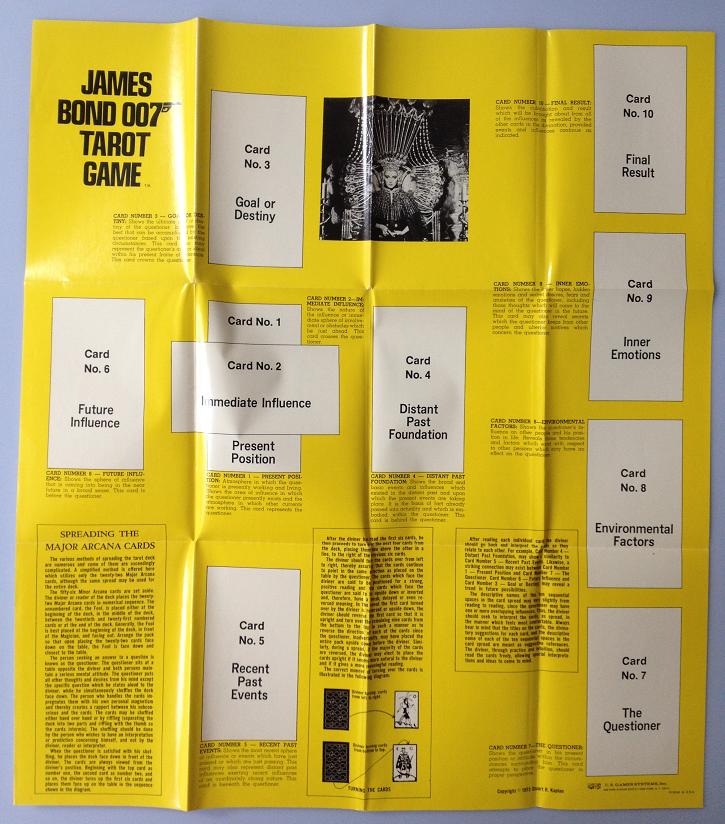
I found this tarot card 'game' in a magic shop Disneyworld, a facsimile of the deck used by Solitaire, specially designed by Fergus Hall for the film. My only complaint was that the design on the back of the cards was red in the film (why was she using '007' tarot cards anyway?). The deck came with a book about tarot and a foldout sheet showing the traditional ten-spread for fortune-telling!


Besides the usual articles in Photoplay and Film Review, the Sunday supplements had to add their own angles. The following were reprinted in the Sunday Times Magazine (I think), sketches by Syd Cain, the production designer.


Design for the purpose-built, fake bridge for the bus stunt

These cuttings have been in one of my scrapbook for forty years!


March 28, 2013

GORGO (1961) - new restoration on DVD and Blu-ray


This excellent restoration, from newly-discovered 35mm film elements in an MGM vault, finally gives us a home video release of Gorgo that surpasses my experience of it on TV! Up until now, I've been tracking the DVD releases and been repeatedly disappointed by the muted colours of this wildly colourful film.

I've written at length about this very British giant monster movie, both for G-Fan magazine, and again in this blog (a review of the film and a look at the earlier DVDs), so here I'll just concentrate on the new VCI restoration.


It's been a long, long wait to see the Technicolor wonder of Gorgo decently represented on home video. This giant monster movie was one of the first in colour (the two earlier Godzilla movies were black-and-white) and may have been boasting the fact by using too much colour! As Gorgo tramples London, setting it on fire, red smoke becomes a vivid backdrop to the dinosaur's night-time raid. The volcano, the lights of the fairground and Gorgo's red eyes all thrive on properly saturated colours now. Not only has the colour been restored, but it hasn't been noticeably digitally tweaked - it's still as I remember, not a revised interpretation.


Film damage and tears has been dealt with, without too much digital enhancement. Of course, this sixty year-old film is still grainy and certainly isn't pin-sharp, but I'd only expect that of big budget, carefully-archived movies. The aspect ratio is 1.85, apparently how the US first saw it. This masks a little visual information off the top and bottom, notably cropping the action in the wonderful shot of Gorgo trampling Piccadilly Circus, but that's the only annoying moment. A good visual guide is how well the opening credits are framed, and here they look perfect at 1.85. I'd have prefered a 1.66 aspect, but for me it's a minor fault.


Regular murmurs from message boards and Twitter always assume Criterion is the best hope for a definitive home video release of their favourite films. But while it's true that Criterion spend a lot on their restorations, they barely represent sci-fi, horror or monster movies. They're into classic film, arthouse and world cinema. It's pointless holding out for a Criterion release of obscure horror movies, when so many smaller labels are totally dedicated to these genres. Here, VCI have restored Gorgo far better than I'd hoped, and I seriously doubt that Criterion could do a better job, mainly because better film elements may not exist. Let's also remember that Criterion releases are far more expensive.


The last word is with DVD Beaver, who have posted high-res screengrabs from the blu-ray, some of which are included here, proving that this transfer bests the DVD and laserdisc releases by a mile.

The extras, included on both the DVD and blu-ray releases, are headed by a new documentary from Daniel Griffith (who put together the amazing feature-length making-of Twins of Evil), with additional looks at as many lobby cards, posters and press material as could be tracked down. You can also 'watch' the entire 'photo-novel', a French comic book entirely made up of screengrabs and speech balloons.


Some amazing photos have been unearthed - I was particularly pleased to see the behind-the-scenes shots of the Gorgo suit and it's workings. It seems every living lead has been followed up in search of material. The trailer is presented widescreen, and also looks in great shape. A selection of photos of Gorgo toys, model kits and resin sculpts are included. Another jewel is the music-and-effects track (the dialogue stripped away) enabling a better appreciation of Angelo Lavagnino's music and Gorgo's scary noises.

The blu-ray is not region-coded, making it playable in UK blu-rays as well.

DVD Beaver blu-ray review with blu-ray screengrabs.

My earlier, extensive, illustrated review of Gorgo.


The new documentary mentions that Gorgo lived on with her own Charlton comic series for a while. Marvel Comics legend Steve Ditko is the reason that these have just been reprinted in a single volume. Further volumes include Black Hole favourite Konga, who also had a Charlton comic!