August 20, 2010

THE HANDS OF ORLAC (1924) - extreme 'horror acting'


THE HANDS OF ORLAC
(1924, Germany/Austria, Orlacs Hände)

But doctor, will I still be able to play the piano?

The name might not be familiar, but many horror films owe a debt to the story and this first adaption of The Hands of Orlac. Besides the better-known remakes, consider The Beast With Five Fingers (1946), the Christopher Lee segment of Dr Terror's House of Horrors (1965), Oliver Stone's The Hand (1981), Ash's possession in Evil Dead II (1987) and especially the homage of Body Parts (1991).

Before surgical transplant procedures had been perfected, there was actually a debate over which organ a person's soul might inhabit, and whether personality was also transferable. In the story, concert pianist Orlac loses his hands in a train crash, waking to find that they've been replaced with those of an executed murderer! He can no longer trust his own hands!

Using this logic, the Frankenstein monster would have had multiple traits from each part of his patchwork body, but in those movies, the donor's personality and memory only transferred when the brains were swapped. In The Hands of Orlac, it's the original function of the hands that's conveyed - they still want to kill, hold knives, strangle...


This far-fetched concept is brought to life purely by the actor's performance. Conrad Veidt (a favourite actor of Christopher Lee) has to convince us he's frightened of his own hands. Not an easy task, but the film is a tour de force nearly two hours long, made fascinating by the extreme 'horror acting' of the cast.

For want of a better phrase, 'horror acting' means to me that someone has to convey extremes of fear and madness when confronted by the impossible, the supernatural, or the downright evil. This is exaggerated to match the extreme circumstances. I'm talking about the frenzied state that 'the final girl' has to convey when she's cornered by a killer, or Ash's descent into madness as the whole house conspires against him. Also the kind of performance needed when the killer is finally unmasked, and has to look like they are insane enough to have committed all those mad murders. But there's a fine line between successfully 'hitting these heights' and over-acting. I think it's also possible, Shatner-style, to overact and take the audience with you.

This is a rare and difficult skill. How often in a horror film have you seen someone scream unconvincingly, or not look scared enough? The reason I gave up on the Saw movies was because of Carey Elwes in the first film. At the crux of the story, trying to look insane enough to cut off your own foot required a height that Elwes didn't reach.

It's the 'horror acting' that really kept me watching The Hands of Orlac. Filmed back when it was a new artform, the art of appearing very, very scared by the supernatural. Paul Orlac (pity he's not called Hans) and his wife, Yvonne, are happy for a couple of minutes before being
dropped into a pit of despair and terror.


Yvonne (Alexandra Sorina) has a similarly extreme emotional rollercoaster ride. First she's awaiting his embrace before he returns from a concert tour, her yearning for the touch of his hands on her body will soon prove problematic. Then she's distraught as she hears that his train has crashed and races to the site not knowing whether he's survived. The torture mounts at the hospital as she waits to hear whether he'll survive, then there's the horror as she learns he'll lose his hands. The actress is limited to playing this last scene in an armchair, but takes distraught to the very limit as if she's climbing the walls.


When Orlac finally regains consciousness, he's relieved to see his new healthy hands unbandaged after the crash, in notably
the only daylight exterior scene. For the rest of the film, once he discovers he's inherited the hands of a criminal, the character is trapped in gloomy, cavernous, expressionistic sets. Besides not being able to play the piano, he fears that he can't trust touch his wife with such murderous hands.


Orlac's battle with his hands through the rest of the story is
extraordinary to watch. The sheer strain of his performance even showing in the veins on Conrad Veidt's forehead. I'd previously thought Bruce Campbell was the king of 'possessed hand' acting after his Oscar-worthy, kitchen-destroying struggle in Evil Dead II. But Veidt has to keep this level of intensity up for most of the film!

But while Veidt and Sorina's performances are exaggerated, they're still truthful. In silents, performers are allowed to show how they feel inside. Like the most memorable scenes of Lillian Gish in the American silent classics The Wind and Broken Blossoms. The latter has her trapped in a cupboard with a killer trying to break his way inside. For me this works ten times better than Shelley Duvall in the bathroom in The Shining. Gish gets so worked up, she eventually looks like a cornered animal being driven frantic with fear. I should say this acting is heightened rather than exaggerated. It has to be amplified because the actor has to convey everything to us, without the help of dialogue, sound effects or music.


Director Robert Wiene continued using surreal set design of early German supernatural cinema, which he'd helped pioneer in The Cabinet of Dr Caligari, also starring Conrad Veidt. The oversized sets, dominated by simple shapes are partly obscured in the murk of the fading prints. But these sets are as unnatural and psychologically wearing as the acting. Not as surreal as in Caligari, but overly imposing and empty, stripped down to the essentials of the script. A music room, a piano. A bedroom, a bed. The patterns on the walls and the frames of the doorways dominate the sets.

The extreme performances look slightly less unusual when we meet the other grotesque characters in this nightmare, Orlac's father and his bizarre butler! I also recognised Fritz Kortner, one of the stars of Pandora's Box, lucky enough to later act opposite Louise Brooks.

The US remake with sound, Mad Love (1935), looks a lot less impressive when you see this first version. This is also for fans of Conrad Veidt, the star of The Cabinet of Caligari (1920), The Student of Prague (1926), The Man Who Laughs (1928), The Spy in Black (1939), The Thief of Baghdad (1940), not to mention Casablanca (1942).


The Kino Video DVD has assembled the best surviving elements of the film, though the picture quality fluctuates throughout. The brightness of each shot flickers a little and there are many scratches. While I'd like it all to look cleaner and a little lighter, these unavoidable artifacts all add to the atmosphere.


Here's a taster, a clip compilation from the Kino DVD transfer, on YouTube...


August 13, 2010

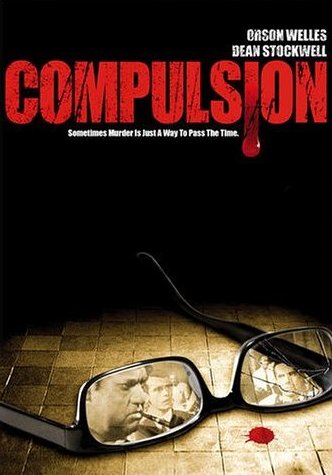
COMPULSION (1959) - re-enacting the story of Leopold and Loeb


COMPULSION
(1959, USA)

They're loaded, and they wanna have a good time...

This is a taut fictionalisation of a famous murder case from 1924. Leopold and Loeb, two wealthy and intelligent Chicago students, thought they were clever enough to plan a perfect crime, and of superior enough intellect to be above the law. While it lead to 'the trial of the century' at the time, fellow student Meyer Levin later told their story in his 1956 book, Compulsion, which stuck to the facts but changed the names of everyone in the case - I'm not clear why. This early true-crime novel predates Truman Capote's 'ground-breaking'
In Cold Blood which has been heralded as the first of its kind.


After the book of Compulsion came a hit play and then in 1959 a hit movie, monopolising on the renewed publicity from the release of one of the murderers on parole (after 33 years in prison).
The movie is gritty for the time, struggling with teenage sex, rape, and child murder, not to mention the killers' homosexual relationship. Many of the elements that Hitchcock loved to spice up his plots with - he used two (subtly gay) murderers who thought they were above the law in his 1948 film Rope. The image of polite college boy killers may have informed the character of Norman Bates in Psycho.

Remember that in Robert Bloch's book, Norman is overweight and middle-aged, and that the real-life inspiration for the character was Ed Gein, a dishevelled old hermit. The young Anthony Perkins couldn't be further from the source material if he tried. Another thematic link between Compulsion and Psycho is Judd Steiner's (Dean Stockwell) hobby of bird-watching and taxidermy, a perfect match for Norman Bates' favourite past-times.


While not nearly as modern or edgy as the movie of In Cold Blood, Compulsion is still fascinating because it follows the events and twists of the real-life case so closely. While it's set in the 1920s, apart from the car and a scene set in a prohibition speakeasy, it's not aggressively a period film and feels very 1950s, with Dean Stockwell rebelling against his family ties and scorning the teachings of his college professor.


The majority of the film shows the killers at large and the cops trailing far behind, don't let the photos here make you think this is only a courtroom drama. The inevitable trial doesn't dominate the film, though the renaming of all the characters robs the courtroom scenes of their historical power. In that I didn't realise that Orson Welles, as the defence lawyer, was in fact portraying Clarence Darrow, also famously fictionalised in Inherit The Wind. Welles steals every scene once he arrives, though his character is an unlikely figure for sympathy, because he looks too much like his most villainous portrayal, in Touch of Evil, released the previous year. It's a far cry from
the image of upstanding legal do-gooders played by Gregory Peck and Spencer Tracy.


Dean Stockwell (above) is always interesting to watch, even as far back as his child roles, like The Boy With Green Hair (1948, a simple but early parable about race relations) and the beautiful 1949 version of The Secret Garden. I also love his later sixties' drop-out roles, especially The Dunwich Horror, and his sublime performance in Blue Velvet (1986). His astonishingly long career continues to fascinate, continuing with his long-running character in the recent Battlestar Galactica remake.


Stockwell's partner-in-crime is played by Bradford Dillman (Bug, Escape from the Planet of the Apes),
pictured above on the right. He's a familiar face to me from many seventies' roles, but had no more parts as high profile as this. Of current interest, he was great as the leading man in Roger Corman's original Piranha (1978), which has just had a big budget 3D remake.

Dillman and Stockwell's screen relationship is not only hinted as being homosexual, but sado-masochistic as well. This is inferred in their performances and the direction, plus a few sneaky coded hints in the dialogue. The tortured but unspoken gay undercurrent heightens the drama throughout. A later adaption of the same case, Swoon (1992), was explicit in showing the sexual relationship as well as the boy's murder. But as a film, it's lacking in drama, looking more like a Madonna video, right down to the buff leading men.


Director Richard Fleischer (Soylent Green, Fantastic Voyage, Blind Terror) uses subtly skewed angles to insinuate the power struggle between the two, and their unbalanced morality. We even get Dillman hiding in a closet - subtle! Fleischer landed two more adaptions of real-life murders later in his career - The Boston Strangler (1968) and 10 Rillington Place (1971).


The US DVD (pictured) has a crisp black-and-white transfer
, in 2.35 anamorphic widescreen. The only extra is a trailer. I don't find the cover art very inspiring, considering the weighty cast and subject matter. They're even the wrong kind of glasses...

Another Compulsion review here, with screengrabs, at
The Sheila Variations.

Cool interview with Bradford Dillman over at Cinema Retro.


A rather sensationalistic trailer, considering the comparatively subtle style of the movie...


August 11, 2010

NARAKA 19 (2007) - a deadly game in Chinese hell


NARAKA 19
THE 19th GATE OF HELL
(2007, Hong Kong, Dei yuk dai sup gau tsang)

Basically, if you're ever in Macau, don't order the monkey brains...

I buy movies when I hear that they might be good. Then they go into a big pile (well, on a shelf - it's not a good idea to store DVDs in a pile) and then years later I watch it, wondering where the hell I first heard of it.


A group of teenage college girls move into an apartment together. One of them is obsessed with her mobile phone and starts hanging around the 'Ghost Tower'. Soon afterwards she seemingly commits suicide, leaving her surviving flatmates in therapy with the creepy, limping Dr Yan, and being snooped by the slightly eccentric Police Inspector Yip. Then another girl starts getting eerie messages on her phone, inviting her to play a game called the 18 Gates of Hell...


I went into this Hong Kong horror movie with an open mind, thankful that it treated the genre fairly seriously. Though it's fairly late to be making a mystery which involves mobile phones (One Missed Call), serial curses that can be passed on (Grudge), ghostly girls (Ring) and suicides (Whispering Corridors). But with a young cast in a film aimed at a young teen audience, we are apparently already at a point where filmgoers might not realise these are well-worn horror cliches.


One of the clues that this was just for teens were that the cop, the doctor, the artist, the students, everyone was young and good-looking. If it wasn't for the nasty suicide at the start, there'd be barely a need for a restrictive certificate. The obsession with mobile phones was another clue - here the gadget can even lead you safely through Hell if you follow the red flashing arrows! Presented as a video game, it all seemed ridiculously easy.


I stuck with this because of the portrayals of Chinese Hell. The linking of modern technology directly to Hell reminded me of the Japanese series Hell Girl and I've enjoyed the visualisations of oriental Hell in Jigoku and Narok. In Naraka 19, the inspiration seems to be Constantine, where the weather in Hell was also post-apocalyptic. Some of the effects were very CGI, but the imaginative scale and execution was original, if underused. I particularly liked seeing a airborne forest of trees with their exposed root systems floating in the sky, all while it's raining knives! A couple of the levels of Hell were also realised almost completely with large sets rather than electronic effects. Though it's a pity that they missed out showing many of the 18 levels.


I was distanced from the film by the fast editing and a barrage of video effects to denote that something weird was going on. Holding a camera upside-down is the sort of novelty that should have worn off at the start of the last century. Distracting and hinting at desperation, I'd have preferred the handsome widescreen camerawork (which I think was carefully shot HD video) to do the scaring instead.


A more obvious drawback will be for any fans of Family Guy. Part of the curse depends on a supposedly scary monkey, who even hides in a locker at one point. Besides the parallel with the evil monkey in Chris' cupboard, it's very hard to get a cute little monkey to look scary. The same way horror movies about satanic cats and killer rabbits are a hard sell to animal lovers...

Topped off with some very arbitrary logic about the rules of passing in and out of other dimensions, a similar annoyance to the later Nightmare on Elm Street films - when anything is possible and everything onscreen could be a dream, it's hard to know or care what's happening by the end.

Still, I enjoyed the various trips to Hell, and that Hong Kong is still dabbling in horror. Also interesting that this had a female director, Caroline Lai.


Naraka 19 isn't on DVD in the UK or US. I got this from YesAsia. The Hong Kong DVD (pictured) is a good-looking 2.35 anamorphic widescreen transfer, with unobtrusive removable English subtitles, though a little loosely translated at times. There's also a trailer and a half-hour behind the scenes programme (no subtitles on the extras though).

More frame grabs at Twisted Flicks and another review at Love HK Film.

Here's a subtitled trailer on YouTube...
August 06, 2010

STORM (2005) - impressive and glossy Swedish nightmare


STORM
(2005, Sweden)

Excellent mindfuck classic...

I'm looking forward to the new horror film Shelter, starring Julianne Moore and Jonathan Rhys Meyers. But here's an earlier film from the same directing duo, Måns Mårlind and Björn Stein.

I saw Storm recommended on Twitch Film years ago. It's precisely the kind of quality recommendation I'd expect of them. Their reviewers know that there are hugely interesting films to be found internationally.

The film is probably relatively unknown because it's Swedish. But it's as professionally polished as anything from Hollywood, and would be a widely-known cult classic if it were in English.


However, knowing nothing about the story is a very good way to go in. Not only was the plot unpredictable, I didn't even know what genre I was in.


It opens with two women running for their lives from a pack of mutant (?) skinheads, led by a bad guy in a suit (Jonas Karlsson). The redhead looks like a kick-ass, hard-boiled version of Tilda Swinton, taking the bad guys down with impressive martial arts skills.

Then we meet Donny (Eric Ericson) a cynical journalist who's found his place in the big city. He won't even commit to a woman for a one-night stand. He lives to drink in the trendiest bars, ligging drinks and entry to the latest clubs. He loves city life and hates that he was born out in the sticks - where smalltown niceness promised a life of boredom. But what exactly does he want from life?


As a huge storm mysteriously disappears over Stockholm, he runs into red-headed Lova (Eva Röse), who's still being chased by the skinheads. The city slacker thinks he's meeting an action hero. She gives him a small metal cube and and a mysterious challenge. After this brief meeting his life turns upside down as he faces murder, time travel and the devilish man in black.


But sit back and enjoy the ride, you're supposed to be as confused as the hero, without a clue where he's going or even where he's been...


There aren't too many clues from the movie references lurking in the corners. This is the only time I've heard Phantasm II get a name-check! At various points I thought the lead character had fallen into a video game, a manga or had maybe watched Donnie Darko once too often.

The mind-bending story aside, there's sly humour, grim drama, truly excellent acting, and sumptuous downbeat cinematography. It's an enjoyable nightmarish treat that will probably only make sense a while after you've watched it...


I enjoyed this tremendously, mostly because it was impressive and fresh and kept me guessing.

I watched Storm on a Thai DVD, but it's also out in the UK, US and all over Europe. Just be careful what the adverts compare it to - it's not like The Matrix at all. Don't be put off by the poster and DVD art, which simply don't do the stylised look of the film justice.

Here's a subtitled trailer on YouTube...


July 30, 2010

SHINJUKU INCIDENT (2009) - Jackie Chan, hard man

SHINJUKU INCIDENT
(2009, Hong Kong)

Jackie Chan proving he can act up a storm

I love the films that Jackie Chan makes in Hong Kong. The last I saw was his belated 2004 entry into the phenomenal Police Story series. Many of his Chinese action movies are legendary, with life-risking stunts and an inventive mastery of martial arts. His direction and imagination in comedy action has been compared to the work of Buster Keaton, one of the few film-makers who also included the ambitious staging of stuntwork into his stories.

But the other brand of Jackie Chan film is something less than phenomenal. His Hollywood films focus more on his imperfect English and are obsessed with him being Chinese. The restrictions on risky stuntwork in Hollywood, plus his advancing years, have prevented him from doing most of his own stunts, severely restricting his talents.


Thinking about it, the last Hollywood film I saw Jackie Chan in was The Cannonball Run II (1984), during his first attempt to break into the American market. Since then, I’ve not been at all tempted by his English-speaking films, mostly comedy or children’s films.

Even in his recent Hong Kong movies, he’s been doing far fewer stunts and more acting. But in his own country, he has no problem being accepted in more serious roles. This is a more interesting side to his talents, best showcased in the new Shinjuku Incident in which he gives his best performance yet.


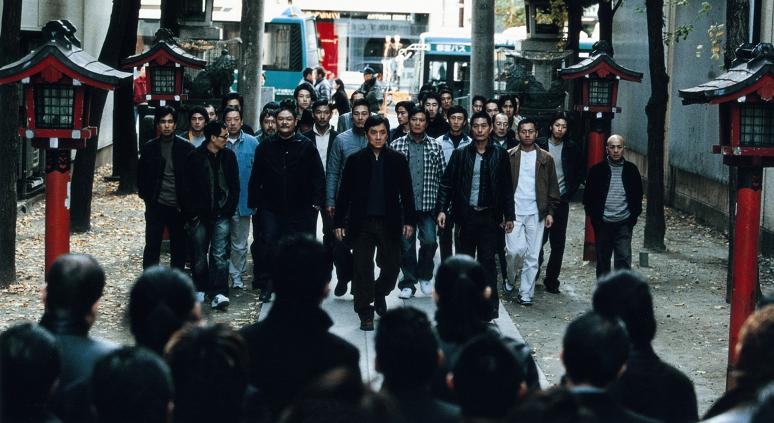
A world away from Rush Hour and Shanghai Noon, this is a tough drama about a sensitive subject, illegal Chinese immigrants trying to work in Japan. The film opens with a spectacular image of a shipwreck and a beach swarming with exhausted survivors. A farmer nick-named Steelhead (Chan) makes his way to Tokyo to join his brother (Daniel Wu). He’s left North-East China to try and find his girlfriend.

But as he tries to find work in Japan, he discovers that crime is easier than the dirty work offered to ‘illegals’. Through flashbacks we see his former life in China, which really doesn’t look that bad. The film presents financial gain as the motivation for his friends and family trying their luck in Japan. But this doesn’t fully explain why so many would repeatedly risk their lives just to be able to afford the latest luxury goods? Is the story avoiding telling the truth about why some Chinese ran away from China?


But Jackie isn’t like the others, he’s not in it for the money. The first half of the film tells a convincing story, with Chan giving an excellent and underplayed performance. It’s also fascinating to see him play an ordinary man who doesn’t know how to fight when he gets into a physical confrontation. I thought this was a cleverly played angle for someone so famous for their fighting skills.

The story takes a rather forced turn as his new friends, in this home from home, take on Japanese organised crime! It turns into a faint echo of The Godfather, right down to the brutal violence. It can’t hope to compete with such a classic, though the unusual setting carries it along. There’s more action and cinematic drama in this second half, but it’s rather rushed, with a noticeable leap in the narrative that hints that the film may once have been even longer.


While Steelhead’s motivations were easy to understand early on, his increasingly complex situation makes it much harder for us to sympathise. It’s hard to feel any compassion during his power struggle in the world of organised crime, however noble his reasons.

This is no less believable than many modern thrillers, in that they forfeit logic for intrigue, but the opening story of immigrants in Japan felt interesting enough. I’d have liked to see it played out logically, comparing the quality of life in China with Japan.


The use of Tokyo as a backdrop, and the mix of Japanese and Chinese actors must have been an ambitious undertaking, but it's entirely successful and fascinating to watch.

As a violent gangster tale in an unusual setting, with Jackie Chan showing just what he’s capable of as an actor, this is worth seeing. It's out in the UK on DVD and Blu-Ray from Cine Asia.

Here's a trailer...


July 23, 2010

SEVEN FOOTPRINTS TO SATAN (1929) - not on DVD


SEVEN FOOTPRINTS TO SATAN
(1929, USA)

Rare, creepy Hollywood silent from the director of Haxan

A fearless bespectacled adventurer (Creighton Hale, also in The Cat and the Canary, 1927) and his fiance (Thelma Todd) get trapped in a house of mystery after panic breaks out at a society party.

They're kidnapped and imprisoned in a huge house filled with secret panels, torturers, assassins and a gorilla on the loose. Quarelling factions help and hinder them from escaping. A Chinese mystic, a dwarf and a monkey man inform them they are unwilling guests in the house of Satan, pawns in a deadly game...


With subtle tracking shots and a masterly use of shadows, the director was already a horror veteran. Benjamin Christensen made the extraordinary Haxan (1922) in his native Denmark, an unsettling and unique history of witchcraft and demonology, visualising devils and their worship. The other-worldly special effects make-ups must have caught Hollywood's eye, though I was surprised that he could adapt to the mainstream after creating such an experimental vision. He also worked on the epic adaption of Jules Verne's Mysterious Island (1929) which, like Satan, was hurriedly adapted into a version with sound, when silent movies suddenly had to compete with the synched dialogue of The Jazz Singer.


From the very first scene, the audience gets wrong-footed, misdirection sustains the surprises that literally leap out of the woodwork. These are often better staged than many modern horrors, where you can easily anticipate the next 'shock'. He often springs surprises just as a scene begins, before the audience has had time to get its bearings.


The parade of weird-looking characters predates Freaks, Angelo Rossitto appearing in both films - here (above) he has a rather strange beard. The use of animalistic make-ups look like a warm-up for Island of Lost Souls. A grotesque character on crutches called 'The Spider' reminded me of a Lon Chaney make-up - the actor is Sheldon Lewis, one of the first actors to play Dr Jekyll and Mr Hyde in a movie (in 1920).


Seven Footprints to Satan has the fast pace of a slapstick two-reeler sustained for feature-length, though it's not intended as comedy. With all the sliding bookcases and hidden panels, it plays like an early Scooby Doo cartoon. I'd love to see it restored, as it should take its place alongside the classic creepy movies of the period. It's as much fun as the highly-acclaimed The Cat and the Canary, and more eventful than The Bat Whispers and Lon Chaney's The Monster. The plot twists are still rewarding at a pulp fiction level, though it's not very faithful to the source novel by Abraham Merritt, whose story Burn Witch, Burn was later adapted for Tod Browning's The Devil Doll (1936).


Christensen's earlier Haxan has been remastered by Criterion but Seven Footprints to Satan seems to be floundering in the grey area of 'public domain'. I've only ever seen this same wobbly, over-exposed print, with its Italian intertitle cards. Some clever person translated them all and edited a new all-English version that was briefly presented on YouTube. Perhaps that makeshift presentation will eventually lead to a proper restoration. Seven Footprints is the only surviving film from Christensen's Hollywood horrors.


The bleached-out visual quality and scratchy print is poor but watchable, though not a great introduction to silent cinema. But it was the only way I've ever been able to watch this film in English, and there might not even be any better prints out there (there's a rumour of one possibly stored in a Danish archive). But anyone enticed by the startling publicity photos, and fans of the director or the period had better hope it'll emerge again one day soon.


The fan-translations of the Italian Intertitles are online, listed here.

Some great stills of the leading characters, on Yesterday's Papers.

More rare stills and posters, here on Gorilla Men and here on a Thelma Todd blog.


All that I can find online now are a few clips (with Italian intertitles) on Vimeo here and here...


July 21, 2010

Meeting William Shatner: the London Film & Comic Con 2010


Just because I want to meet William Shatner, that doesn't make me a Trekkie!

While it presumably pales into insignificance against the San Diego Comic Con, this London version is only a train ride away for me and... William Shatner was attending.

Shatner.

"The Shat".

I guess it's pointless trying to distance myself from Star Trek. But I wasn't wanting to see him because of Star Trek. Every time I say I like horror movies and sci-fi, most people's brains fast-forward immediately to labelling me as a Trekkie. Should I speak more slowly? How do they get from horror movies to Star Trek? Admittedly I first saw him in classic Trek, but I'll watch him in anything: from TV movies to every episode of TJ Hooker, his episode of The Outer Limits, the esperanto movie, anything. His acting style is mesmerising, bizarre, unique, fascinating. I had to meet him!

He was by far the biggest draw at the event - I was delighted that he has so many fans in England. We'd pre-booked tickets to get our photos taken with him, months in advance, and we still had to wait all day to see him.

I'd love a Batmobile, but which version is the best?

In the meantime, there was other fun to be had. Besides the Batmobile (from Batman Begins?) there were some great fan costumes around. My favourite was the classic Cylon with an operational 'scanning' red eye. The lords of the sith were a little overweight, the Imperial Stormtroopers a little short to be stormtroopers, but the Alien xenomorph was good enough to illicit heartfelt screams from the unwary.


I wanted to meet Andrew Robinson - his roles as the really insane killer in the first Dirty Harry film and the nasty dad in the first Hellraiser had provided me with indelible memories. Despite being buried in rubber appliances, his character Garak, in Deep Space Nine, is an impressive and subtle performance, lighting up every scene he's in. I asked him about how he got cast in his first film, Dirty Harry. He said it was because he was friends with the director's son, who he'd already worked with. I thought it was still a stretch that a newcomer to movies could pull off a character as completely demented as Scorpio. Comforting though that the actor is nothing like his screen villains. I also got a little nervous meeting Tony Todd, who's even taller than me. Again, really nice and normal in real life. Would you really want to meet someone like the actual Candyman.


I moved on to meet Tom Noonan, mainly because he was the Tooth Fairy serial killer in Michael Mann's Manhunter, the film that introduced Hannibal Lecter to the big screen. That, and he was the Frankenstein creature in The Monster Squad, one of my favourite movies. Most recently he was in the acclaimed faux 80's horror House of the Devil. I brought up the subject of the possible Monster Squad remake and hit a nerve. Noonan lamented that no less than four movies that he'd been in were currently in the process of remakes.


Onto the Star Wars corner, where there was a spread of Star Wars talent - Dave Prowse and Kenny Baker as usual, Jeremy Bulloch (the first Boba Fett, pictured above), and one I hadn't seen before, Julian Glover. Not only had Glover been in The Avengers, early Doctor Who, Space 1999, Bond film For Your Eyes Only, but was also an Imperial Officer in Star Wars and The Empire Strikes Back. But I wanted to meet him because he'd been in Hammer's Quatermass and the Pit (1967) as the untrustworthy Colonel Breen, one of the few remaining survivors of that cast.


As a break from collecting the autographs of bad guys, we went to meet Sean Young, the star of Blade Runner and Dune, not to mention Ace Ventura - Pet Detective. No, I didn't mention it. While I believe she's fantastic in comedy, it's her character in Blade Runner that I'll always associate her with. While it's my favourite film, this is only the second actor I've met from the cast - the first being Joe Turkel (he played Eldon Tyrell). Again, despite what I'd heard through the years, she was really nice and charming, though I was too starstruck to ask any meaningful questions or pay any original compliments. (The above photo is Sean with my husband.) I'm usually too shy to ask to get photos with my idols. I settle for their autographs.

But finally it was time to meet Shatner.

It was certainly well-organised. Like a military operation. Over the weekend, thousands of fans wanted to get his autograph, get his photograph or attend his Q&A session. The only way this was going to work was on an assembly line. I wasn't under any delusion that I was going to get quality time with him. I recalled my 'meeting' Adam West (my favourite Batman) - there was only time to say "Hello, Mr West" while he signed an autograph. At least he looked up to see who was talking to him.

Much the same thing happened with Shatner, though more surreal. As we queued to get an official photograph taken with him, we noticed how fast the line was moving - an early clue as to how long we were each going to get! As we took a corner around a partition, there was William Shatner, parked on a backless bar stool, grinning at the camera. All we had to do was step up to a line, wait for the signal, step onto the cross, smile, (flash), and move on.

The photographer was calling the shots. Well, shouting the shots, like a drill sergeant. Next! It was my turn. I had to say something to him. I used 'the Adam West manouevre'. I said "Hello, Mr Shatner!". He looked up at me, still grinning - I guess if he dropped the happy expression he'd spoil a shot and his day would get even longer. As our eyes met, and I saw his happy little face, it crossed my mind that he was thinking of how much he was making each time the flash went off.

By talking to him I'd interrupted the flow of the operation. The photographer made me hold for a second photo because we hadn't stuck to the script. I squatted down a little, so as not to tower over the happy gnome. Flash! I was done. Next!

And it was over. I'd met William Shatner. It was just the briefest of moments, but it was all worth it. To a fan of all his works, it was like an audience with the Pope, and I should know...

(That's me on the right.)


Anyone interested in over 50 years of the work of Mr Shatner should sample this unimpeachable blog,
Shatner's Toupee, which reviews his many performances while taking care to also analyse the quality of 'hair acting'...

And finally, (thanks to Megan for the heads up) there's this new dance track that celebrates Mr Shatner selling himself as both an actor and a director...


July 16, 2010

WIRED (1989) - and bad movies about movie stars


WIRED
(1989, US)

Michael Chiklis IS John Belushi...

This isn't about recommending good movies. This is about movies that I've watched because I couldn't believe that Hollywood had dared to make them. When taste and logic have flown right out of the window, really exceptionally fast.

A case in point. 1978, hot off Saturday Night Live John Belushi was becoming Hollywood's hottest comedy actor. I'd never even seen Saturday Night Live (we've never had it on TV in the UK), but I was immediately won over by his performance in National Lampoon's Animal House and I wanted to see him in many more movies. He was priceless as Bluto, the legendary student anti-hero slob, a prototype of the overweight slacker that's currently in favour. The next film of his I saw was Spielberg's 1941, which he wasn't in for enough time for my liking. And then there was the role he's best remembered for, as Jake 'Joliet' Blues, in The Blues Brothers (1980). I didn't see his later films (like Continental Divide, Neighbors) which can't have had a wide release, if any, in the UK. And then he was gone. March, 1982. Dead from a speedball overdose. He was at the forefront of 'comedy as the new rock 'n' roll' but didn't live nearly long enough to reap the benefits.


Movie biographies about movie people, living or recently deceased, have to be done extremely carefully and cleverly. Wired (1989) isn't one of them. John Belushi's life and death was poorly dramatised and drained of humour. The complete opposite of a fitting tribute. I haven't seen it in years, and I always like to watch movies afresh for Black Hole reviews. Problem is, I haven't got a copy any more.

Last time I watched my VHS of Wired, I decided I'd never watch it again. I keep getting that wrong. (Don't be like Mark - don't get rid of stuff). There's always a reason for going back, but please remember the ravenous way that VHS tapes ate up shelf space. In short, I'm relying on memory here.

I originally wanted to see if Wired shed any light on why and how Belushi died. This was definitely the kind of project that Hollywood unites in avoiding, blacklisting actors who dared to show up show business under a bad light. By bad light, I mean a drug-fuelled system with no means of support to prevent their brightest stars from imploding. (Little seems to have changed, except the same self-destructive results are now possible with 'prescription drug' abuse).


Besides the cast risking the ends of their careers appearing in a controversial tragedy literally in the heart of Hollywood, on Sunset Boulevard, it was double jeopardy because they were also in a badly flawed film that was destined to be a critical and financial flop.

Wired uses the movie Sunset Boulevard as a starting point, having it narrated by a corpse, and borrowing the opening that Billy Wilder couldn't use, with a dead man sitting up in a morgue. The character of Belushi then looks back at the highlights of his life. But with so little material legally allowed, and so few actors and movie-makers allowing their names to be used in the story, the recreations of his famous sketches and behind-the-scenes dramas are almost unrecognisable.


Unsurprisingly, Wired was last seen on VHS and has never surfaced on DVD.

Wired was too abstract in its story-telling, so I tried the book, written and researched by no less than Bob Woodward, co-author of All The President's Men which blew the lid on the Watergate scandal of President Nixon's administration. But the totally uninvolving style reads like a court transcript - dense with legally-approved facts, but lacking subtext, opinion or conclusions. (A fictional representation of Woodward is played by the late J.T. Walsh).


Because it was so widely reviled, I honestly thought I'd never see the star of Wired ever, ever again. But that's why I'd like to see it again. I was halfway through watching the first season of The Shield when I looked up the previous credits of Michael Chiklis (who plays the lead, Vic Mackey). I was shocked to see he was the one, the unfunny guy who'd dared to play Belushi. I'd not seen him in anything else, having missed his heavily disguised turn in the series The Commish. Quite a career turnaround - maybe even worthy of a TV movie...


In fact, before he nabbed The Shield, Michael Chiklis again tempted fate with another celebrity impersonation. While Hollywood is now attempting to tackle a big screen version of the lives of the beloved Three Stooges, Chiklis has already appeared in a similar TV movie, as Curly. More details and pics on this are here on As Seen On TV. The Three Stooges (2000) was sort of interesting, but again, couldn't expect to be funny like the originals.


Worse still. Much, much worse. The epitome of disastrous casting in an impersonation movie is the (presumably) deliberately humorous casting of Patsy Kensit as Mia Farrow. In a TV movie made to cash in on the media storm that surrounded Woody Allen and Mia's spectacularly public bust-up, entitled Love and Betrayal: The Mia Farrow Story, I shit you not.


July 14, 2010

GEGEGE NO KITARO: NIPPON BAKURETSU (2008) - Kitaro's first feature-length anime


GEGEGE NO KITARO: NIPPON BAKURETSU
(2008, Japan)

The first ever feature-length animated Kitaro movie, released as part of the anime series' 40th anniversary, was almost lost among the many other Gegege No Kitaro productions in 2008. There was the second live-action film, the weekly anime series, as well as an OVA mini-series.

Nippon Bakuretsu, (roughly translated as Japan Erupts!) is animated in the same style as the 2007-2009 TV series, featuring all the regular characters and indeed, as many different yokai monsters as they could possibly cram in.

The story begins as usual with a spooky local disturbance, as a schoolgirl is harassed by some scary mirror demons (alarming silvery CGI claws), trying to pull her through to another dimension. Her home life is not untroubled as she has trouble pleasing her extremely strict mother.

Luckily she knows where to find Kitaro's post box and calls on the ghost boy to defend her from the mirror demons. But that's not the end of her problems at school or at home, because she's unwittingly involved in a demonic plot that threatens the entire nation of Japan with destruction that not even Enma, the Lord of the Underworld, can prevent...


The film is quite episodic, with three distinct 'chapters', almost like gaming levels, with foes that keep getting tougher. The final 'boss' that Kitaro faces is the largest yokai monster I've ever seen!

While the animation effects and creature designs are impressive, it all still looks like the TV series with an expanded budget. There's still spectacle and dynamic action that the live-action feature films lacked, I just wouldn't volunteer it as an example of a typical modern Japanese anime feature.


While the latest series has been moodier and scarier than its predecessors, the film shows Kitaro taking more of a beating than usual, with several scenes that would upset his youngest fans. A couple of the lizard monsters were also quite sexual in appearance, another departure from the family-friendly series. I'm not saying this is anything as strong as Legend of the Overfiend, but at one point a flurry of tentacles, teeth and one-eyed monsters did remind me of it...

Gegege No Kitaro: Nihon Bakuretsu is out on DVD and Blu-Ray in Japan, but also on a far cheaper Taiwanese DVD, but none of these have English subtitles. The Taiwan DVD is a good-looking 16:9 anamorphic image, with optional Chinese audio and subtitling.

For more about the many TV and movie incarnations of Gegege No Kitaro, here's my extensive overview.


Lastly, here's a Japanese trailer for the movie on YouTube...