November 14, 2011
Ken Russell's THE DEVILS gets DVD special edition (next March)
I actually never thought this was ever going to happen. Ken Russell's The Devils is coming to DVD in March 2012. (See the official BFI news item here).
Three years ago I wrote this article about The Devils (1971). After appearing on VHS in the UK (cropped and strangely squeezed to 1.33), there have been no other home video releases. Mark Kermode showed many of the controversial sequences on TV in a revelatory documentary that should have sparked a DVD release, the same way that his programme on The Exorcist inspired an expanded re-release in cinemas. But even after the news that Warner Brothers had remastered an uncut version of The Devils, it never arrived. It briefly surfaced for a couple of days on iTunes, which was presumably a mistake.
But now, after several screenings of the fully restored version in London, one with the director himself in attendance, it looks like the film will finally debut on DVD in the UK, released by the BFI. But they've also confirmed that the controversial 'rape of Christ' scene cannot be used because it hasn't been licenced to them by Warner Brothers.
The DVD special edition will instead feature the original 'X' certificate version released in UK cinemas back in 1971, as well as commentary and many extras featuring both the director and superfan Mark Kermode. The TV documentary 'Hell On Earth' presented by Mark Kermode could be included but will presumably lose it's glimpse of the missing scene as well. BFI haven't officially confirmed all the extra features as yet.
Despite this not being 'the director's cut' fans were hoping for, this is still a magnificent film, spectacular in scale, subject and bravado. If you thought the exorcism in The Exorcist was shocking (made two years later), you ain't seen nothing yet. Like Russell's biographies of classical composers, The Devils is an exaggerated version of actual events (based on the heavily researched book by Aldous Huxley).
Terrific news, but you'll have to be patient until March of next year. Until then, ignore any other DVDs for sale online, they're not official releases and some have been 'bumped up' from VHS.
Of course there's always the hope that if this sells well, Warner Brothers will relent and release the missing scene, which has already been digitally restored. At the moment there are no plans for a Blu-ray release either.
Thanks to Jonny Sambuca for getting my facts right! (Entry corrected on 16th November...)
Details of the DVD extras are here at the ZetaMinor forum.
My extended look at the movie The Devils is here.
For news and updates on the release, follow this Facebook page.
November 07, 2011
ZOMBIE FLESH EATERS (1979) cost me an arm and a leg...
We are going to fleece you...
The awesome documentary Video Nasties: A Definitive Guide (2011) lives up to its name. But as I started to review it, I could only think of all the time and money I've spent on horror films over this period. For example, a case in point...
UK release poster by Tom Beauvais
It's also called Zombie or Zombie 2, but I saw Lucio Fulci's first zombie epic as Zombie Flesh Eaters in 1979 in my local cinema in London's suburbia, four times in a fortnight. Despite being an 'X' certificate (no one under 18), it was censored for UK cinemas by over two minutes. The eye scene, the 'banquet' and all the throat-ripping was missing (and more).
Some cuts were fairly obvious: on film, the image runs in front of the lens at a different point from the audio pick-up. If a shot is cut from a print, the sound that is removed on that section doesn't exactly match the images that remain. You still hear part of the removed scene! A split-second of screams and gory sound effects would tip off the audience that something was missing. These faults could also be heard on the VHS release.
Yes, the next time I'd see Zombie Flesh Eaters was on an uncertificated VHS, rented from the local video shop. The first release (above, from 1980) was the same version that I'd seen in the cinema, though of course I'd hoped that it would be less cut. Once I knew a film was censored, I'd always hope that the next time it would be more complete. Maybe the next incarnation...
In 1981 there was a special 'strong uncut' edition. Another VHS rental (too expensive to buy), totally uncensored but still 'pan-and-scanned', cropped to 1.33 from 2.35 widescreen.
But then in 1983 the government banned the film altogether. "Video nasties" had been singled out, even though this film had been legally shown in the cinema. Now it couldn't be sold or rented any more, even if it was cut. At the same time, every movie in the UK would have to be checked by the censorship board for its home video release. Even the sleeve art had to be approved, by a separate organisation.
It would be ten more years before Zombie Flesh Eaters was again legally allowed on VHS in the UK. In the meantime, many of the banned copies that had been available in the video rental shops hit the black market at high prices - the only way to see it, unless you risked a bootlegged copy. If a VHS was copied down several generations, you'd maybe see what you were missing without seeing it too clearly.
This widescreen version was released by Vipco in 1996. My first official copy, a 17-year wait. Not the three months you have to wait for a DVD. But now incomplete.
![]() |
| Wormface laserdisc |
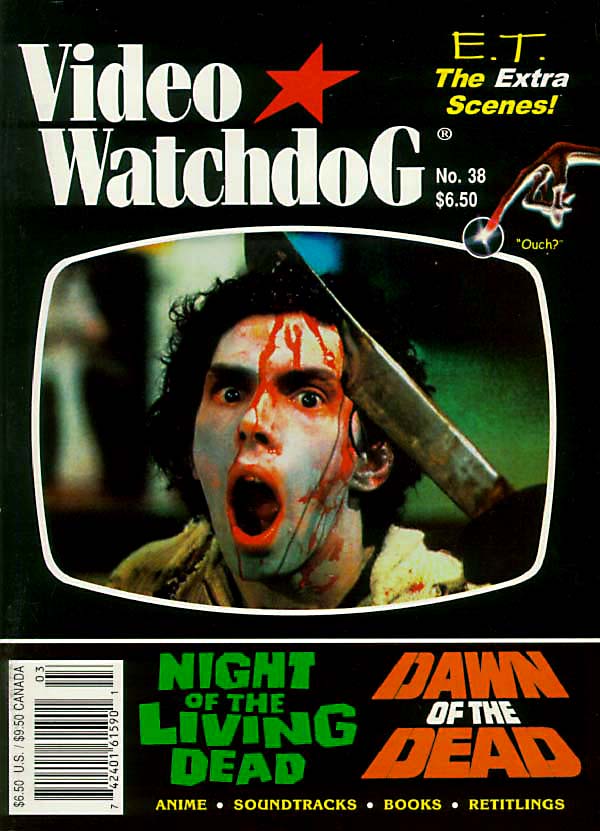
In this chaotic time (pre-internet) accurate information was scarce. One of the few guides to the many versions out there was Video Watchdog magazine. It saved me money because the obsessive writers had checked through everything. It cost me money by highlighting many wonderful and obscure horror films I'd not heard of. Video Watchdog became a bible for the next two decades.
Finally - uncut on DVD
James Ferman, the head of the censorship board who'd presided over movie classification in the UK, passed over the reins in 1999. There was finally a change in attitude, an acceptance that the internet had raised the bar far higher than what was on home video. Finally, many of the video nasties could be released uncut on DVD (and of course then again as a special edition). I had my complete version of Zombie Flesh Eaters after a twenty-five year wait (on DVD in the US in 2004, 2005 in the UK).
Special edition DVD
I'll soon get it on blu-ray, for the carefully restored version, in far better condition than the scratchy print I saw in the cinema.
But this is just one horror film and all the versions that I can remember seeing and buying (yes, all of the above). All the while, taking seriously the many issues surrounding violence and sexualisation in movies, TV, and video games. The press and even the government have thrown a barrage of psychologists and urban myths to muddy the debates, even linking movies to murders. I've followed many of the arguments through the years, read way too much research, all to justify me seeing a bloody zombie movie!
While improved quality and DVD extras now entice us into buying duplicate editions of a movie, it was the censor cuts that fuelled most of my expensive 'double-dips' in a variety of formats. At least the trail of tape, laserdisc and DVD makes it easy to track the evolution of releases, a 'paper' trail that will soon be lost in the digital world.
TV showings are no longer archived, movies are streamed or downloaded. Working out which version of a classic film you own is going to be hard. Without packaging or release dates - how will you know you've got a director's cut or an original? Which is which, which was first, which is the best?
Journey's end - me with two stars of Zombie Flesh Eaters -
Al Cliver and stuntman Ottaviano Dell'Acqua (Wormeye!)
![]() |
| Brooklyn Bridge, 2000 - my own little zombie (flesh eaters) walk |
Yup
November 02, 2011
APPROPRIATE ADULT (2011) - Dominic West as Fred West
APPROPRIATE ADULT
(2011, UK, TV)
A horrendous true story that keeps on getting worse...
The horrifying crimes of Fred and Rosemary West threatened to eclipse those of all previous British serial killers, with ghastly excesses that fuelled tabloid headlines for years. The Moors Murders, a couple that abducted and murdered children, still haunt England from the distant mists of the mid-1960s. These crimes at 25, Cromwell Street, uncovered in the mid-1990s, started with assault and murder in the family home...
The case set a new low benchmark for inhumanity reported in this country. Not in a war zone. Not on the other side of the world. But in an ordinary street, that could easily have been next door.
The idea of adapting the Wests' story as a TV drama, even fifteen years later, sounded impossible. The amount of sexual violence would be hard to work around on mainstream TV.
I wasn't even going to watch Appropriate Adult until it was announced that Dominic West, star of the acclaimed TV series The Wire, was to play Fred West. This indicated a more serious approach than a lurid reconstruction. For the actor, it was potentially a gamble to play one of the most hated men of recent years.
There's a huge disparity in taste between approaches to true crime on TV. I was surprised by an ITV documentary about the Moors Murders which suffered indifferent acting and poor taste crime recreations. Yet the Channel 4 drama Longford (2006) found an intriguing angle to dramatise part of the story, pitting Jim Broadbent (Brazil) as Lord Longford against Samantha Morton (A.I.) as Myra Hindley. But I wasn't expecting such an intelligent drama about Fred and Rosemary from the more mainstream ITV.
The script cleverly follows an appropriate adult, a civilian (Emily Watson) invited into the case when Fred is arrested to ensure he's being understood by the police, as he's suspected of being mentally vulnerable (there's irony for you). Each time they discover a crime has been committed, the more victims there turn out to be. Sitting in on police interviews with Fred West (Dominic West), she also accompanies him and the police in the hunt for where he might have hidden the bodies. Without his cooperation, there'll be no evidence.
As an investigation, this isn't a barrage of flashy technology cracking the case, like in CSI. It's not built around violent flashbacks, like a horror film. We're simply faced with the suspect, trying to discover what and why he did. Is he as stupid as he looks? Is he lying? It starts with a missing person, but the more the police dig, the more crimes they unearth.
Emily Watson (soon to be seen in War Horse) is excellent as the 'appropriate adult' brought in without any preparation to hear West's interrogations and confessions. Unfortunately, Fred starts confiding in her, placing her in increasingly difficult quandaries.
Dominic West is frighteningly convincing, all the more chilling because we're hearing some of the words and motivations of the original murderer in an eerie impersonation of him. The distinction between murders that he does or doesn't find upsetting, the casual way he admits to further crimes. Particularly chilling is the way the victims 'speak to him' as he gets closer to where they were buried.
Rosemary West (Monica Dolan) is a frightening figure who's mostly in the background, with an unconcealed violent attitude towards everyone around her. In contrast, the calm and usually relaxed Fred insists she has nothing to do with all of it.
Shown as two feature-length parts, the first was very tight dramatically, showing the short claustrophobic period of his early interrogations. The second part was less satisfying, because it had to match real events, her sporadic involvement struggles to keep the viewpoint inside the investigation to the end.
The whole story can't be told as completely as a work of fiction would, because of the lack of evidence and the labyrinthine legal process. But I wish the programme had been a little clearer about how some of obstacles to the case had been overcome.
This serves as a restrained reminder of what this pair did, without showing the gory details. But also focuses on how hard it is to establish the truth, even with so much circumstantial evidence and the criminals in custody.
It's not just a situation where an ordinary person is in the same room with someone describing horror, but one where she gets the confidence of and insight into the mind of a psychotic multiple murderer. This took me as close as I wanted to get, and in as much detail as I could take. There are also hints that there were further, even nastier crimes...
The whole story can't be told as completely as a work of fiction would, because of the lack of evidence and the labyrinthine legal process. But I wish the programme had been a little clearer about how some of obstacles to the case had been overcome.
This serves as a restrained reminder of what this pair did, without showing the gory details. But also focuses on how hard it is to establish the truth, even with so much circumstantial evidence and the criminals in custody.
It's not just a situation where an ordinary person is in the same room with someone describing horror, but one where she gets the confidence of and insight into the mind of a psychotic multiple murderer. This took me as close as I wanted to get, and in as much detail as I could take. There are also hints that there were further, even nastier crimes...
It's available on region 2 DVD in the UK (pictured at the top).
October 31, 2011
HALLOWEEN 2002 - a trip to Haddonfield, California
I keep falling for it. The caption near the start of John Carpenter's Halloween (1978) says 'Haddonfield, Illinois' and I believed it. In the cinema, on TV, multiple viewings and I kept falling for it. Yes, it looks like it was shot in a small town in middle America. Then Carpenter himself pointed out in a TV documentary the palm trees visible at the end of the road, in one scene where Jamie Lee Curtis is walking around. It was all filmed around Los Angeles! So, always assume Hollywood movies and TV series are either filmed at the studios or very close by. Until proven otherwise.
On a holiday in LA in 2002, I then couldn't believe how very close to 'Hollywood' the two main locations were. Directly off Sunset Boulevard! While the daylight scenes were shot around South Pasadena, giving it a convincing smalltown vibe, the nighttime scenes of the houses where the teenagers are babysitting are in West Hollywood.
Here's me in front of the house where Jamie Lee Curtis' character Laurie Strode was babysitting and where the final showdown takes place. Below is the house opposite where she first meets The Shape. These houses actually stand diagonally opposite each other, as they appear to be placed in the film.
Disappointingly, this house, where Annie (Nancy Loomis) was babysitting, has since changed its iconic appearance. The chilling scene where The Shape stands beside the corner of the porch can no longer be recreated - the house has been extended on that (the left) side. Michael Myers can no longer carry a body around that corner and into the front door! We were too late in to see it unchanged as I believe the house had been renovated only months before.
These are of course both private residences, one had a sign up about a security firm protecting the grounds, so we didn't stay very long. It looks like an unremarkable suburban street - amazing how lighting and cinematography can make it all look so large, spread out, and scary. Also, how they managed to shoot around the huge trees outside both properties.
A guide to filming locations in the Halloween series can be found here.
Happy Halloween!
October 27, 2011
GORGO (1961) - happy 50th birthday!
(1961, UK)
UPDATE: March 2013 - GORGO has been released on blu-ray
Released in the UK fifty years ago today, Gorgo remains Britain's closest thing to a kaiju eiga, a giant suitmation monster movie. If vintage dinosaur movies are your thing, or if you love seeing London in even more chaos than usual, this is absolutely for you. It was fantastic to see a clip from the film recently appear in Joe Dante's 3D teen-chiller The Hole (2009). Gorgo lives!
In 1961, Godzilla had yet to appear in colour (in King Kong vs Godzilla the following year). Director Eugene Lourié recycled the plot of his The Beast from 20,000 Fathoms (1953) and the London setting of Behemoth the Sea Monster (1959), but this time used a man in a monster suit rather than stop-motion animation.
In fact it was Lourié's The Beast From 20,000 Fathoms, together with a re-release of King Kong (1933), that inspired Toho Studios to make the very first Godzilla movie. So I'm reluctant to label Gorgo as a rip-off of Godzilla. Lourié got there earlier, along with Ray Harryhausen's stop-motion animation and Ray Bradbury's story, of course.
In 1961, Godzilla had yet to appear in colour (in King Kong vs Godzilla the following year). Director Eugene Lourié recycled the plot of his The Beast from 20,000 Fathoms (1953) and the London setting of Behemoth the Sea Monster (1959), but this time used a man in a monster suit rather than stop-motion animation.
![]() |
| Photo-montage with a shadowy demonic monster. Like the Japanese Godzilla, Gorgo doesn't walk around buildings... |
Two salvage experts limp into harbour on a remote Irish island after a volcanic eruption damages their freighter. Before they can make repairs, a dinosaur emerges from the sea terrifying the local fisherman. They decide to capture the creature, load it onboard and sail it to London to make their fortune. After a few fatal accidents, Gorgo is installed as an attraction in Battersea Funfair (just next to the famous power station).
| Hand-tinted lobby card - Tower Bridge is falling down... |
![]() |
Gorgo attacks a rollercoaster in Battersea Funfair, just like The Beast from 20,000 Fathoms at Coney Island
|
![]() |
| Screengrab: Gorgo enjoys a night on the town |
The story has humans too. The stars are William Sylvester (2001: A Space Odyssey, The Hand of Night) and Bill Travers (Born Free, Ring of Bright Water, The Smallest Show on Earth) as the two greedy bastards who cause all the trouble in the first place. They sort of a adopt a boy from the island, which is rather progressive for the time. He's played by Vincent Winter, an Oscar-winning child star who went on to work as production manager on Indiana Jones and the Temple of Doom, The Color Purple and Superman II.
Gorgo certainly isn't low-budget, with some impressive sets (like the war room and the flooded London Underground) and with extensive crowd work to show London's citizens fleeing in panic. Indeed, cinematographer Freddie Young's next picture would be Lawrence of Arabia. He certainly knew how to make flamethrowers look good.
But it's not high budget either, relying too heavily on a mish-mash of stock footage of destroyers and jets before Gorgo hits London. While the modelwork holds up well during the night-time, the early daytime scenes of the boat in a tidal wave are unconvincing. There was certainly enough to fuel a particularly funny Mystery Science Theater 3000 (MST3K season 10, 1998).
I enthused about Gorgo in an extensive article for G-Fan magazine (issue 49, January 2001). I still think it's entertaining as an action-packed monster movie, or as a far-fetched tale with nutty logic and oldschool special effects. It's also an evocative trip around London in 1960. So I'm annoyed that Gorgo still isn't on DVD in the country where it was made.
![]() |
| The sexed-up Monarch novelisation |
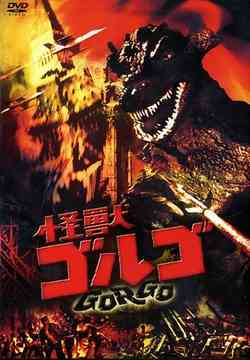
The more recent Japanese DVD (pictured) appears to be a close duplicate of the American VCI DVD and has the same extras. The quality of the film transfer is again slightly soft and the edges of block colours are blurry. It's accurately presented in 1.66 aspect, non-anamorphic.
Director Eugene Lourié later provided the extensive special effects for Crack In The World which recently warranted a Blu-ray release. Gorgo is jealous!
Here's a faded trailer for Gorgo...
October 23, 2011
VAULT OF HORROR (1973) - missing a few zombies
Unfinished business in the graveyard
Not a review, but a mystery that's puzzled me for decades. At the end of each Amicus 'portmanteau' horror movie, there's a twist in the tale - the punchline to the framing story. A photo in Alan Frank's book Horror Movies of Vault of Horror (1973) promised that the main characters (Tom Baker, Michael Craig, Terry Thomas and Daniel Massey) would somehow appear as the undead.
But at the end of the film, this ghoulish apparition is missing. The actors leave the same vault (seen in the picture below) but lumber off, unchanged, into a graveyard. The undead version was shown in lobby cards and publicity photos, (though that's never been a guarantee of anything in the finished film). What I'm saying is that it's a lot of hard work for something that wasn't used, and would've been a greater 'kick' to end the movie with.
So is this a censor cut? Or did it never make the final film? Has anyone ever seen these make-ups appear onscreen? Maybe in a trailer? All we see in the film is the back of them as they walk away...
Like Tales From The Crypt (1972), this corpse make-up was by Roy Ashton, but unlike his brilliant transformation of Peter Cushing as Grimsdyke, he used a complete facemask for each actor. Ironically, at least one of these appliances still survives. Made for Tom Baker, it was sold to the Bradford National Museum of Photography, Film and Television as part of Roy Ashton's collection. This website, with a photo of the mask, gives the impression that it was worn in the film. So, we can see the mask and the publicity photos, but not in any version of the film I've seen.
Admittedly, Vault of Horror still has a legacy of its censorship problems - the US region 1 DVD double-bill with Tales From The Crypt is a cut version, especially distracting for its toned-down finale of the vampire segment. So this gives me hope that the full graveyard scene is only temporarily missing? I'm appealing to your collective memories for the answer.
Apart from the photos, there's this description at the end of the Jack Oleck novelisation from 1973. After they've swapped stories in the comfy 'men's club' surroundings, the room transforms into a stone vault. The door opens not into a lift, but a graveyard. Critchit (Curt Jurgens) pauses outside as they slowly leave. He lifts his arm to wave goodbye... "and when they turned to wave back at him their faces were no longer as they had been. Their lips and noses had vanished. Their eyes were empty holes. Their skin hung in rotting ribbons and a stench of decaying flesh drifted back to him as they turned again and went on and then halted, each beside his own grave, and disappeared like puffs of smoke". Critchit then goes back inside to return to his waiting coffin...
In the film, the four men head off in different directions, but the reverse shot (pictured) shows them all on the same pathway, fading away at slightly different places. I'd never made the intended connection that each of them were returning to their graves, merely that they'd disappeared on the path.
| The colour shot appeared as a lobby card and in Monster Mag #3 |
These photos (the colour is different to the black-and-white) might have been staged for publicity, rather than shot during an actual take (note that behind them Curt Jurgens appears to have been replaced with a stand-in with longer hair). But they could show an alternate take of them setting out into the graveyard? Or maybe, all that we were supposed to see was during the long shot, their undead faces revealed as they turn back and wave? Perhaps the waving looked wrong? The 'walking away' shot is complicated as each actor would have to 'freeze' on the set for the three cross-dissolves.
Like I said, I'm hoping that someone reading this has the answer, or at least some more clues...
October 18, 2011
TARZAN (1966) - Ron Ely TV series
(1966-68, TV, USA)
UPDATE March 8th, 2012 - TARZAN, Season 1 coming to Warner Archives.
Edgar Rice Burroughs invented several popular fictional characters. His John Carter of Mars will be a 2012 blockbuster as well as Pixar's first live-action production.
But next year is the centenary of Burroughs' far more famous creation, a great opportunity to release every Tarzan adaption from the archives. I'm thinking of the 1966 Ron Ely Tarzan TV series. That was the same year of another hit TV show that refuses to hit home video. I've talked about Adam West's Batman and could happily talk about every last one of the 120 episodes Tarzan appeared for two seasons of one hour adventures (57 in all). Unlike many of the early movies, it wasn't shot on a Hollywood studio backlot, but out in the actual jungle. Except, not in Africa.
Shot in Brazil, and later Mexico, the lush jungle locations, village-sized sets, waterfalls, mountains and rivers made this look a million dollars. With interesting, twisty adventure-laden stories and solid casts, the series was repeated for many years on British TV, eventually headlining the Saturday morning line-up into the 1970s. Like Batman, this was so popular and repeatable that it's now imprinted in many young memories, perfectly primed to revisit it on DVD. But this Tarzan is nowhere to be found, except for some double-episodes released as movies that eventually made it to VHS.
Despite a gap of thirty years or more, I can still remember Tarzan's battle against a big game hunter. Hand grenades are lobbed into a river where Tarzan is hiding underwater. He eventually hauls himself out of the water, bleeding from the ears, only to discover that he's wounded, defenceless and deaf (Tarzan's Deadly Silence)... As for his encounter with a dinosaur, I've yet to see the next episode of that two-parter and learn the secret of that shadowy cave. I recently unearthed a scrawled comic strip I drew as a kid, an extensive 'adaption' of that episode. I think I remember a few scenes from the episode, or maybe they're just from the nightmares I had...
The key to the show's success was Tarzan himself. Actor Ron Ely embodies Tarzan for a certain generation. Of the many previous Tarzans, the best Johnny Weissmuller films (Tarzan - The Ape Man, Tarzan and his Mate) were too violent to be shown on TV for many years, eventually surfacing on Channel Four late night in the 80s. I remember the later sequels getting played as seasons on BBC 2, together with the Gordon Scott movies. They're good, but weren't on nearly as often as TV Tarzan.
Ron Ely's incarnation is impressive in many ways. Imposingly well-built, wearing one of the briefest loincloths of any Tarzan, it's hard not to be distracted by his physique every time he's onscreen, which is most of the episode. He can also act, swim, and fight with both men and animals. He's reputed to have done his own stunts and racked up the injuries to prove it. Just running around everywhere barefoot without flinching is quite a feat (sorry).
Aiming at a family audience that kept adults engaged, the episodes often had a tough edge. Fistfights, gunfights, knife fights, constant peril and occasionally deaths! A young boy (Manuel Padilla Jr, later seen all grown up in American Graffiti) is the only other regular cast member (as well as Cheetah the cheeky chimp), but otherwise the stories don't pander to a young audience.
The main reason I think the series hasn't stayed in circulation is the portrayal of black Africans. While it's set 'in the now' with the latest vehicles, firearms and fashions, Africans are still portrayed as they were in the original stories, as tribal communities living in small villages of primitive huts, wearing animal skins and war paint. This may have been acceptable in the movies of the 1930s, but was entirely misleading by 1966, as if it had been researched from a travel brochure.
The approach is duly counterweighted by a few 'modern' black characters like the local game warden (Rockne Tarkington of Daktari and Danger Island), who regularly appeared in the early episodes, as well as guest appearances from other American actors like the formidable Woody Strode (Spartacus) and Bernie Hamilton (Starsky & Hutch).
The mid-sixties roster of ever-changing guest stars adds to the nostalgia, including James Earl Jones, Nichelle Nichols (Star Trek), Maurice Evans (Planet of the Apes), William Marshall (Blacula) and Julie Harris (The Haunting)... With high production values and the frankly awesome Ron Ely, the series is notably missing from circulation.
Afterwards, Ron Ely's most famous role was that of Doc Savage - Man of Bronze (1975), the only movie incarnation of that pulp detective action hero.
Cinema Retro has also bemoaned the serious lack of DVD...
Here's the series title sequence...
Subscribe to:
Posts (Atom)