Showing posts with label recent. Show all posts

January 04, 2014

ONLY GOD FORGIVES (2013) - catching up with Nicolas Winding Refn


Don't ask me to pick my 'film of the year', but Nicolas Winding Refn's Only God Forgives was certainly a high point. I'm still watching everything else he's directed - here's the story so far...

Drive drew me in with its 1980s vibe and car-centric story. I loved it for being unpredictable, gorgeously shot and music-heavy, with characters and performances as intense as David Lynch used to produce. Similarly, the ultra-violence caused me to flinch and shut my eyes. It's probably very realistic, so I've heard.


But is Drive the pinnacle of director Nicolas Winding Refn's career? It was my entry point to his work and I then started at his beginning with the first of the Pusher trilogy, which turned out to be a good match for Drive. 


Another violent loner in an impossible fix. Though Pusher isn't at all stylised. It looks totally authentic, with unfussy, tight camerawork, all on location. Almost invisibly directed, I wasn't sure that any or all of the characters weren't playing themselves. Centred around Frank (Kim Bodnia) a street pusher, it was hard not to think of this as a documentary where the camera was somehow invisible. The only familiar face was a (bald) Mads Mikkelsen, who I remembered as 'Le Chiffre' from Casino Royale. The difference between those two characters demonstrate his huge range as an actor. 


Mads Mikkelsen and Kim Bodnia in Pusher
All three Pusher films are definitely worth seeing for Refn fans, but the first (from 1996) is the best. Describing the mechanisms of illegal drug distribution in a big European city (Copenhagen, Denmark - which has a huge international sea port). Detailing and humanising how the middle-men operate between the big guys who import drugs and the sellers on the street. When a deal goes wrong, Frank has to solve his cash-flow crises quickly, or face serious, merciless physical retribution.

The next two Pusher films didn't deliver the same hit in terms of street education, but rather continues following the other characters, for a fuller picture of how people in a high-risk business work outside the law, within the community. These aren't grandiose, organised, traditional families as represented in The Godfather, but shattered groups of dysfunctional people whose principal employment is trafficking,


Pusher was a startling and accomplished debut for Nicolas Winding Refn, shot around the city where he was born, acclaimed by the film-making hierarchy in Denmark. But, as he revealed in the 2012 documentary 'NWR', the two sequels were aggressively rejected, angering him so much that he vowed not to work in his home country ever again! He returned to America (having briefly lived in New York while growing up) to continue making films.

Trying some of Refn's later work, I didn't enjoy Fear X (2003) though it starts off very well. The surreal elements cheated and diffused the premise (John Turturro investigating the death of his wife) until it meant nothing at all. When reality becomes so remote, it was hard to tell what, if anything, was actually happening to the character. Perhaps I just lost the plot...


Refn's feature-length British TV episode of, er, Miss Marple, (Nemesis, 2007) stars Geraldine McEwan and Richard E. Grant, but shows absolutely no flourishes that distinguish it from any other TV drama. I'd love to know why he did this! 


There's still more Mads Mikkelson in Refn's Valhalla Rising and a Bane-like, beefed-up Tom Hardy in his breakthrough Bronson still to look forward to, LoveFilm permitting. 


In the meantime, came the chance to see a preview of Only God Forgives with a director Q and A afterwards. There were several such screenings around London in June 2013, before the official UK release. Presumably a strategy to give reviewers a chance to formulate their thoughts and maybe sync with early word-of-mouth (which proved to be polarised).


Luckily, I wasn't expecting another Drive, despite it having Ryan Gosling front and centre. And again, with violent revenge is at its core, like so many action films and thrillers. But little about Only God Forgives is predictable. Which I loved. If you want to impress me, show me something new.


Shot entirely in Thailand, it presents Bangkok not from the colourful bustle that tourists enjoy, but the dark backstreets and vivid colours of the underworld at night. For me, it really channels Bangkok. The traditional music, the carved wooden decor, the sound of rain on the streets all accurately and powerfully evoked the city. 


Julian (Ryan Gosling) manages a kickboxing arena as a front to sell drugs. When his brother is killed by a retired cop, it's up to him to get revenge. But Julian is traumatised by obsession and needs motivating by his appalling mother (Kristin Scott Thomas) to uphold family tradition.


Cliff Martinez is called on for a very different soundtrack. Again, don't expect 80s synths, but expect a great soundtrack, with Thai karaoke and terrifying ambience. Visually drenched in psychedelic, saturated colours. Stark, beautifully composed cinematography. A woozy pace and surreal scenarios.


Dialogue is kept to a minimum, but so is movement. Characters move slowly or barely at all, unless they need to. This increases tension as each scene refuses to foreshadow what will happen. You have to watch, because it's quite non-verbal. Any stillness is tense because you never know when it's suddenly going to get nasty. Gosling is even more stone-faced, with even less dialogue than in Drive. The other one to watch carefully is Vithaya Pansringarm, as the karaoke-loving ex-cop. The most memorable character is played by Kristin Scott Thomas, completely out of her safety zone as a terrifying, worst-possible mother. 


Afterward the screening, Refn said he doesn't want to be predictable and baulked against cashing in with another Drive. Anyone expecting another Drive won't get it here. Only God Forgives was in fact originally planned as the project he'd make before before Drive. Ryan Gosling only starred in it because the original actor dropped out (to do a superhero movie) leaving Refn all prepared for a project without a leading man! While they were doing the promotional tour for Drive, Refn asked Gosling what his next job was, and was surprised to hear that he'd nothing lined up! That's why Gosling is in Only God Forgives!
Talking afterwards, Refn actually spelled out a few subtexts (that I'd completely missed), and it was a shock to hear a director betraying his intentions while we were still so fresh from it. It has much of the atmospheric mystery and obliqueness of the characters are what I also enjoy about David Lynch's best films. But his comments are completely unlike Lynch's policy of leaving viewers to make up their own minds. Maybe Refn should too.


At the end, he mentioned that he was devoting the near future to working on the proposed Barbarella TV series, and news about him has been rather quiet since.


I looked at the possible music influences on the Drive soundtrack here...


November 14, 2013

SLEEP TIGHT (2011) - Jaume Balagueró and his apartment horrors


(Updated May 2014, to include Fragile review)

Sleep Tight is the latest in a series of impressive and original thrillers directed by Jaume Balagueró, most of which take place in an apartment building. I'm guessing that is the kind of place where he grew up...

The story of Sleep Tight starts as a man wakes up, kisses the woman asleep in bed with him, and gets ready for work. He's the desk supervisor in that apartment building and he needs to be at the desk early. When the woman leaves for work, she barely looks at him. We realise that they're not a couple...


With the pass-key and some daring tactics, he's sleeping with her without her knowing it. The situation gets more horrifying as it deteriorates, while remaining logical and plausible. A premise that means you might never sleep soundly again...


This is one of the director's best stories yet, presents his most carefully etched-out characters and features his best cast so far. I'd call Sleep Tight a 'creeper' - the story goes at its own pace, gradually getting more creepy. 


Balagueró's stories are strict with logic and continuity, both lacking in many modern horrors. He has equal compassion for male and female characters, young and old. But what's with all these apartment stories?

He's the writer/director behind the successful Rec series. Rec spawned Rec 2, Rec 3: Genesis and the upcoming Rec 4: Apocalypse. Most of his films have been made in Spanish, so Rec was remade in the US as Quarantine, which now has its own sequel.


Rec could be filed under the 'found footage' genre, but it's one of the most intelligent uses of video cameras as part of a story. A young reporter making a TV show about firefighters follows a crew as they answer an emergency call in an old apartment building in the heart of the city. Once inside, they find themselves trapped with the residents, who are being killed by something upstairs. They can't escape because the authorities have sealed the building...

If David Cronenberg's Rabid was a video game, it would look like Rec. The ferocity of 'the infected' lurking in the shadows stayed with me - an effectively realised nightmare.


But Rec 2 is one of the best horror sequels I've seen, taking place in the same time frame as the first, the story carefully intertwined around the original and extending them with an even faster pace. I love that he's fleshed out a fictional place so carefully. 


Rec 2 (2009) tackles the mysteries from the first film, but hits the ground running much faster. Knowing of the danger inside, I was already tense from the very start, and the suspense impressively never lets up. Something nasty can happen at any moment. 


While we're on this series, I'll say that Rec 3: Genesis (2012), the only one which Balagueró didn't direct, also takes place in the same time frame as the first two, despite the title suggesting it's a prequel. Rec 3 has been criticised for introducing humour. I thought it succeeded, and fairly sparse among the usual 'no holds barred' thrills. The setting also spreads the Rec concept on a grander scale. And what better occasion for a story to rely on video cameras, than a wedding...


Keeping a lookout for his name, I caught another of his horror films set in an apartment block, on Film4. To Let (2006) is part of a collection called Films To Keep You Awake, each from a different director. Not as consistent as his later work, but again demonstrating his obsession with apartment claustrophobia.


While writing this, I realised that his 2002 film, Darkness, was the very, very first film I ever reviewed in this blog, back in 2005. Relying mostly on in-camera effects and bursts of disorientating editing, rather than CGI monsters (an approach that the director has since stuck with), it then had trouble getting distribution. The wider international release was delayed for two years after it first appeared in Spain, despite being filmed in English (starring Anna Paquin, Lena Olin and Iain Glen).

I found it on DVD in Thailand in a 104 minute (original length) cut, before the US release (in 2004) and UK (in 2005) saw it with a shorter duration of 88 minutes. (The current UK DVD is the short version, the USA have the longer, slightly bloodier version on DVD and blu-ray).


Darkness is beautifully shot (in 2.35 widescreen) and often creepy, but short on satisfying pay-offs both in storylines or suspense. That's despite having something in it that wouldn't look out of place in Rec. While not set in an apartment block, Darkness relies heavily on the oppressive interior of a building.


Fragile (2005) was partly shot in England (including on the Isle of Wight) again with a named cast, headed by Calista Flockhart, Elena Anaya (The Skin I Live In), Richard Roxburgh (Sanctum, Van Helsing) and Gemma Jones (Ken Russell's The Devils).


Again the scares are confined to a single building, in this case, an old hospital being closed down. The children's ward is among the last to be evacuated and just as a new nurse (Flockhart) joins the staff, a child mysteriously breaks his leg, while simply lying in bed...

Like his other non-Rec horror films, this is a character-led story that slowly increases the tension at its own pace. The fun is in the building atmosphere and the unfolding mystery. It packs its punches when its good and ready! 

Really enjoyable, with a cast who rarely appear in horror films keeping the approach fresh.


Balagueró is a director who has stuck with thrillers and knows how to thrill. I'm looking forward to catching all his earlier films.


September 08, 2013

ANTIVIRAL (2012) - body horror and celebrity culture


ANTIVIRAL
(2012, Canada)

All hail to the new Cronenberg!

The near future, a young man enters an expensive-looking salon. By appointment only, he meets a strange young salesperson who gives him a long careful pitch. They talk about media celebrities and what it means to get closer to them. The punter makes his choice, receives an injection and leaves.


Dedicated fans of intensely famous people have found a new mania - the chance to feel like their idols... when they're ill. Anyone can now experience exactly the same viruses they've suffered, but without the actual harmful effects. A bizarre, wonderful idea at the core of this intriguing sci-fi thriller.

In this world, the obsession with celebrity has reached the point where TV cameras go inside them during operations, and news constantly reports their state of health. There are big announcements of new mass-produced viruses, as if they were brands of perfume. But fanatics always want what others don't have, and not everyone can afford the exclusive prices. Hence, the murky world of virus bootlegging...


Admittedly, I started watched this out of curiosity, with no great hopes. How often is talent genetically passed down from a famous parent? But I soon found Antiviral, Brandon Cronenberg's first feature film, to be greatly rewarding and very different. While his father's 'body horror' stories were set in the near future, just far enough for science to have made a new breakthrough, they inevitably looked like 'now'. Antiviral looks sufficiently like the future.

David Cronenberg has also stopped making genre films. While Shivers, Rabid, Scanners, Videodrome and The Fly are monuments in sci-fi horror, for over ten years he's stuck with drama. Quality films, but not the genre that originally set him apart. Brandon Cronenberg has begun with a body horror all of his own, and it's a treat to have a similar approach to satirical prediction as, say, Videodrome. But its completely in his own style, and a very different target.

I guess the other trait Antiviral shares with the films of Cronenberg Senior is that the story keeps a steady pace, without needing to resort to action scenes. I guess Gattaca would be a reasonable comparison for its tone, but without anywhere near the flashy budget. This is a great example of how good low-budget can now look, with sparingly-used digital effects, an antiseptic production design and precise 'future-look' cinematography.


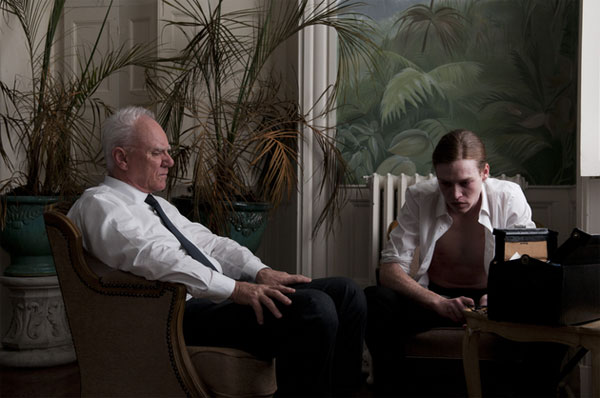
The story is anchored by the creepy, extreme, but not exaggerated performance of Caleb Landry Jones, as the salesman who takes his work far too seriously. His pale skin is perfect for making him look really ill. I was recently struck by his resemblance to another intense young actor...

Udo Kier in Blood For Dracula
Malcolm McDowell is one of the familiar faces, but Nicholas Campbell is a welcome link to David Cronenberg's films, having appeared in The Dead Zone, The Brood and even Fast Company.


Antiviral demonstrates that sci-fi can still be original, inventive, predictive, weird and intelligent. And not need spaceships.


(I watched Antiviral on DVD, hired from LoveFilm. As a result, I've bought the region A blu-ray, which includes a commentary track and a 'making of' documentary.)


June 10, 2013

THE RETURNED - now showing on Channel 4


Just a quick, late reminder that the superbly-made creepy French drama The Returned has started this week on Channel 4. Eight one-hour episodes charts the startling return of a group of dead inhabitants of a remote French village. Technically they're zombies, but they look human enough and walk and talk normally.


Each family deals with the sudden return of a dead relative in a different way, each of them causing their own problems, not to mention that a series of killings has resumed in the village...


Beautifully filmed, subtly judged performances, music from Mogwai and a fresh take on the undead. Adult, occasionally violent, often sexual, the quality of the series has obviously won over Channel 4 into showing a programme from overseas with English subtitles for the first time in twenty years.


In the UK, you can catch up with the first episode on 4OD.


The Returned is known as Les Revenants in France and is a reimagining of an earlier French film from 2004. Full details and a look at the failed American pilot are here in my guide to all things Revenants.


April 21, 2013

SAMSARA (2009) - worthy of BARAKA and KOYAANISQATSI


SAMSARA
(2012, USA)

Another astonishing 'non-narrative movie' from Ron Fricke

If you've seen Baraka (1992) or Koyaanisqatsi (1983), my job of describing Samsara to you would be much easier.

Most of what I know about these amazing films is from DVD extras and the issues of American Cinematographer that covered them. Officially, Ron Fricke was the cameraman on Koyaanisqatsi which was directed by Godfrey Reggio. In reality it was an experimental collaboration between them. Reggio wanting to communicate just through images and Fricke's eye for the amazing, combined with his innovative use and development of mobile time-lapse cinematography. Koyaanisqatsi shows us the incredible. Together with the hypnotic effects of Philip Glass's soundtrack (which also interacted with the editing and structure of the scenes), it also inspires a contemplation of, well, life on this planet.


Fricke hasn't collaborated with Reggio since, but both continues to direct similar 'non-narrative' movies and short films ever since. Reggio with two more 'Qatsis', Powaqqatsi looking more at the people around the world, Naqoyqatsi at our digital future. Fricke most notably made the epic Baraka - a glorious look at the natural world.


But neither man has since achieved the same hard look at the world as Koyaanisqatsi. Though Samsara comes close by including themes of industry, colossal scales of waste and even disposable people - androids. As well as the astonishing use of Fricke's trademark motion-control timelapse camerawork, but this time for night-time scenes, with stars revolving in the sky and statues lit only by moonlight.


The mix of natural wonder and the never-ending consumption of complex manufactured goods, not to mention animal products, makes for many memorable points without using sledgehammer tactics. The camera stands back, without pointed close-ups, allowing the viewer to pick out their own details. Fricke continues to include his slow-motion 'portraits' of people and couples from around the world. Most touchingly in the section on the aftermath of Hurricane Katrina.

Samsara prompts us to think about many different aspects of the world, I've not mentioned them all, and very different trains of thought to those triggered by advertising, random TV or a YouTube homepage.


It's like drifting around the world in a balloon with a telescope. A mystery tour of amazing places I never knew existed. Like Koyaanisqatsi, the point isn't to constantly pinpoint where and what you're seeing, but to watch what's happening. 


Afterwards, the making-of documentary can tell the story of the five years of collecting amazing footage on huge 65mm cameras, around 25 different countries, in some inaccessible locations and very privileged vantage points. Many directors spend extra effort on their establishing or opening scenes. Samsara feels like a feature compilation made up of those.


This amazing shot of a temple reveals dozens of others in a surreal, smooth, vertical reveal, presumably filmed from a balloon. The number of temples sitting so closely together in a lush green setting honestly looked too good to be true. We needed to double-check our eyes for CG trickery. But that's not how these films are made.

Samsara is further guided by its imagery by being edited without any reference to music. Where Koyaanisqatsi was partly cut to music, Samsara was 'silently edited', each shot allowed to run its course before giving way to the next. Only then, like standard movie-making, was a completed 'cut' given to the musicians to score.

The ethereal music for Samsara is by Michael Stearns (who composed for Fricke's Baraka and Chronos), Lisa Gerrard and Marcello De Francisci. Hearing them talk, I was touched by the fact that I'd first heard Gerrard's singing (wailing?, lamenting?) thirty years ago when she was with ambient gothic group Dead Can Dance. It was like reuniting with an old friend!


Samsara deserves seeing on as big a screen as possible, showing in most theatres on 4k digital. Blu-ray is obviously the next avenue you should explore. The blu-ray image is of course 1080 by 1920, the '8K' referenced on the cover is the resolution width that the film was originally scanned at. 

Also, don't be put off by this being exiled to the documentary section. There's no voice-over, no talking heads. It's in a genre all of its own.


A thorough interview with Ron Fricke and co-writer/producer Mark Magidson about their adventures making Samsara, here on Horror Cult Films.


March 24, 2013

SUMMER WARS (2009) - an anime internet disaster movie!


SUMMER WARS
(2009, Japan)

Mind-expanding, family-friendly anime movie

I've been away from anime for too long, after taking a break when Satoshi Kon passed away suddenly, who I regarded as the most consistently interesting director of feature-length anime.

While Summer Wars isn't as completely sci-fi as Satoshi's Paprika (2006), it regularly hits similar heights, providing moments when it feels like your eyes are directly expanding your brain.


It opens with a brilliant, simplified, beautifully-designed, visual summation of the entire internet. In a parallel universe, if the whole world used a single unified browser. Anyone who logs on is represented by one identity, one icon, a little stylised animation of their online self. With this premise, it's easier to follow the story between the real world and the online world.

Summer Wars might have surpassed Paprika in my estimation if it had stayed in cyberspace for the whole movie - which I initially hoped it would. But this is still a hugely impressive.


It isn't a dark and addictive 'loss of identity on the web', as portrayed in the brilliant but downbeat Serial Experiments Lain (1998) (that's now out in the US on blu-ray), but an updated look at how dependent society has now become on the net in so many spheres and by all ages. The setting of an entire Japanese family having their annual get-together pitches the escalating story on TV news, with most family members also connecting online in some way. Importantly, this enables all ages to relate to it.


While this may seem to be a similar pitch for a family audience as a Studio Ghibli film, this is more technical and modern day than a Miyazaki fairy tale. The cyber fighting action (which doesn't dominate the film) might also appeal more directly to teenagers.


After introducing us to the vast, stylised, online world, three teenagers who are still at school kick off the story, as a young man is enticed by his favourite young woman to an important family meal in their countryside mansion. However, he's being deceived and lured into a social trap, also unaware that his online character is about face a mysterious global threat, as the entire internet starts to go wrong.


Director Mamoru Hosoda previously had a big hit with the animated version of The Girl Who Leapt Through Time (2006), which I didn't enjoy nearly as much. Summer Wars is more complex and grander in scale, while at times proving just as fanciful. It's funny, occasionally violent, scary... everything. All while centring on a very traditional Japanese holiday, a view of modern life that we rarely see in the west.


Perfectly designed and directed, there's some beautiful but simple (virtual) camerawork, counterbalancing the dynamic, gravity-light cyberworld.

The story may have a few too many coincidences, but the representation of a whole country as a single extended family makes for a marvellous parable.


Summer Wars is out on DVD and blu-ray in the US and UK.