Trawling through old VHS tapes, I'm reminded of good films that still aren't on DVD. I can only guess why this has dropped out of circulation. There may be confusion over copyright or the cost of restoration may be too great for the perceived demand.
But it's a movie I'd love to see get a new lease of life...

THE HAND OF NIGHT
(1966, UK, aka THE BEAST OF MOROCCO)
I first saw this at the cinema on what was presumably a re-release, around 1968. It made quite an impression on me as a pre-teen, because of the upfront use of skulls and bloodied bats in the bizarrely literal title sequence, and for the disintegration scene in the climax, realised in a series of close-up, special FX make-ups. I always caught it when it showed again on TV, and wasn't disappointed by repeated viewings. The opening nightmare scene, the death-obsessed characters and the beautiful soundtrack by Joan Shakespeare, all continue to fascinate.

Architect Paul Carver (William Sylvester) believes he is a 'harbinger of death', as bad luck dogs his every move. After the deaths of his wife and children, he takes a business trip to Morocco where he meets an archaeologist (Edward Underdown) excavating an ancient tomb. Inside, a newly unearthed Princess of Darkness takes advantage of Carver's fatalistic mood to try and lure him into the land of night.

Not even the pretty young Chantel (Diane Clare) can cheer him out of depression, not that she feels sorry for him. When she hears that Carver is newly bereaved, there are no quiet sympathetic words. Instead, she immediately lays into him for being morbid! I was shocked by her reaction, but don't think that it's an unrealistic approach. She's passionate and, well, French. Even though we, or Chantel, haven't established just how recently the fatal accident was that wiped out his family, she's very angry at him for giving up on life.

He's dwelling on the past, blaming himself and looking forward to drinking himself into oblivion. She continues to challenge his defeatism and continuing fascination with 'the dark'. Although it's not explicit, his fascination for the shadowy, reincarnated Marisa infers he is ready to give up on life. She's a very different breed of vampire, feeding on hope...

Shot mostly on location in Morocco, the film has an unusual look and 'feel'. Considering that Hammer's style of Dracula films was all the rage, this is quite a departure from the gothic castles and vampire mythos of the time. As well as a very different variation of their Egyptian mummy films.

William Sylvester stars, seen here between leading roles in Gorgo and 2001 - A Space Odyssey. Alizia Gur plays the 'vampire' after making a striking debut in the sweaty gypsy camp catfight in From Russia With Love. Diane Clare represents 'the light' and the love interest, in the same year she starred in Hammer's Plague of the Zombies. A special mention also for Terence De Marney as the maniacal Omar, the henchman doing the dirty work of the dark side. He'd just appeared in Die Monster Die, one of Boris Karloff's last films.

On balance, there are a few low-budget faults which I must warn you of that might be distracting. Many of the exteriors were shot day-for-night - quite a task considering Morocco's blistering sunlight. The TV print I watched seems to have completely lost track of which scenes are day or night, and some of the night-time scenes are as warm and light as daytime! Even if there was a 1.85 widescreen crop over the 4:3 image, it wouldn’t remove the bright blue sky from many of these scenes. The climax seems to have been partly shot at dawn, which makes it the most convincing of the night-time scenes, even though it takes place in open desert.
 |
| William Dexter and Edward Underdown |
This is also a very accent-heavy film. All the secondary characters have thick French accents (Morocco's second language) and the two main vampires, De Marney and Gur both seem to have been 'looped' by different actors. Some viewers may be distracted by these technicalities, especially when modern sound-mixing is so much more careful.
Fans of mechanical bats will also delight in the fakery of the title sequence and those that appear throughout the film. One fairly convincing upward shot of the night sky, with a bat shadowing the architect, is spoilt by intercutting with the actor in daylight surroundings, a reverse situation from the jarring dove shot in Blade Runner.

Like many films of the time, the characters are vague about geographical details further than anything familiar to a general audience. They refer to Morocco, but not the cities or areas they are in. I also found this with heist caper Maroc 7 (1967), where the characters travel around Morocco without mentioning where in the country they are. On a recent visit to Marakesh, I was hoping to establish that The Hand of Night had been filmed there, but couldn't find anything at all familiar, apart from the walled city. The desert scenes also look very different to the landscapes in the recent The Hills Have Eyes remake, which was shot around nearby Ouarzazate, doubling for New Mexico. There are beach scenes in The Hand of Night that make me presume this could be Casablanca, somewhere closer to the coast.

I'd recommend The Hand of Night to fans of 1960's British horror. It has solid, dramatic performances, gloomy supernatural drama, and is thick on atmosphere. But it’s not on DVD and I've not seen it on British TV for over 15 years. There are tatty bootlegs out there, but the film deserves much better. I’m baffled that William Sylvester's other sixties horrors Devils of Darkness (1965) and The Devil Doll (1964) have beaten this to DVD.
On YouTube, here are the opening moments of the UK version, including Joan Shakespeare's haunting music, the unusual title sequence and the introductory nightmare that sets up the story...
Fans of mechanical bats will also delight in the fakery of the title sequence and those that appear throughout the film. One fairly convincing upward shot of the night sky, with a bat shadowing the architect, is spoilt by intercutting with the actor in daylight surroundings, a reverse situation from the jarring dove shot in Blade Runner.
Like many films of the time, the characters are vague about geographical details further than anything familiar to a general audience. They refer to Morocco, but not the cities or areas they are in. I also found this with heist caper Maroc 7 (1967), where the characters travel around Morocco without mentioning where in the country they are. On a recent visit to Marakesh, I was hoping to establish that The Hand of Night had been filmed there, but couldn't find anything at all familiar, apart from the walled city. The desert scenes also look very different to the landscapes in the recent The Hills Have Eyes remake, which was shot around nearby Ouarzazate, doubling for New Mexico. There are beach scenes in The Hand of Night that make me presume this could be Casablanca, somewhere closer to the coast.
I'd recommend The Hand of Night to fans of 1960's British horror. It has solid, dramatic performances, gloomy supernatural drama, and is thick on atmosphere. But it’s not on DVD and I've not seen it on British TV for over 15 years. There are tatty bootlegs out there, but the film deserves much better. I’m baffled that William Sylvester's other sixties horrors Devils of Darkness (1965) and The Devil Doll (1964) have beaten this to DVD.
On YouTube, here are the opening moments of the UK version, including Joan Shakespeare's haunting music, the unusual title sequence and the introductory nightmare that sets up the story...




 You're recommended instead to try Kwaidan (1964), currently available in the UK and US.
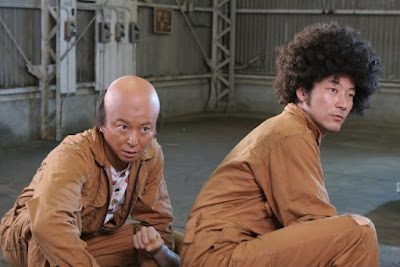
 The set-up is simple: Bomber and Paganini are two inept crooks who attempt a jewel heist by cracking a safe. But stupidity and acetylene torches don't mix - Bomber winds up blinded, and Paganini loses the use of his legs. After a lengthy stay in the prison hospital, they reluctantly team up again, out of necessity. Paganini can see for both of them and needs Bomber to push his wheelchair. But while inside, they've been usurped from their sleazy nightclub headquarters, their only remaining allies are a few prostitutes they used to pimp, and Bomber's mother. This all may sound a bit Farrelly Brothers, but while the characters are slightly stylised, it still feels grubbily real.
 While it's full of wry observational humour, it doesn't get tempted by any slapstick humour for easy laughs. There's some great moments of physical comedy, but their disabilities are believably portrayed, particularly Paganini struggling along without the use of both legs and one arm, shrunken dejectedly into his wheelchair, partly lost inside a huge coat. He somewhat resembles a weaselly version of Robert Carlyle. Bomber reminded me more of an oafish Jean Reno (perhaps it was his Leon glasses).
 Bizarrely this German DVD (