August 31, 2008

ONE MISSED CALL - the sequels (2005) and (2006)

Rather than watch the new US remake of One Missed Call, I instead tried the Japanese sequels. The common thread is the curse of the cell-phone call from the future, that predicts your time of death…

Takashi Miike startled everyone by directing a hit, formula, horror film, the first of his accomplished mainstream movies. After offbeat and ultra-gory cult classics, fans were worried he’d abandon low budget film-making. Thankfully, that’s not been the case, but he’s now proved he can work well in film and TV on any budget.

The first One Missed Call (2003) was a shameless derivative of Ring, but Miike helped push the format into new territory with a fast pace, inventive shock scenes and even satire. In the story, the tabloid media get onto the bizarre murder story, and televise one of the threatened curse deadlines. Highly enjoyable, one of the best J-horrors I’ve seen, it was a sufficient hit to spin off a ten hour TV series and two sequels.


ONE MISSED CALL 2
(2005, Japan)

Scary in a coal mine...

For the sequel, it's highly advisable to have just watched the first film, as there are many back references to its story and characters.
A small group of friends find that they’re being targeted by the cell-phone curse when one of their parents accidentally takes a call intended for one of them. While trying to survive, they discover that the recent events (briefly flashed back from the first film) aren’t over, and an older curse may be personally linked to one of them. As the friends start dying, a reporter and a detective join the race against time as everyone hunts for clues as far as Taiwan and down an old coal mine…


This is just as creepy as the first film, thanks largely to the unnerving and noisy soundtrack, backed by a hypnotic ambient soundtrack. But it’s suspenseful horror, and misses out the inventive set-piece death scenes that I hoped would figure in the sequels. In fact, half of the deaths take place offscreen. As always, the core of the curse is suitably nasty, (let’s just say ‘lips’ and ‘long needle’…) which keeps the tone both tragic and edgy. There's also a very Sadako scene, which almost deliberately reminds us of the trilogy’s debt to the Ring franchise.

The acting is mostly well-played, but the male leads aren’t quite up to convincing screaming and horror hysterics. Their tough guy antics, like breaking through doors and falling about, almost verges on comedy.


One Missed Call 2 is good, but not great. Good for atmosphere but not great on thrills. I watched the Hong Kong DVD release which has good English subtitles and a fantastic DTS soundtrack option. In the US, the region 1 DVD is a double-disc set that includes missing deleted scenes to help explain the twisty plot.


ONE MISSED CALL FINAL
(2006, Japan)

Are you quite sure you want a video phone?

Final is the third film. Far removed from the strengths of the first film, when a mostly adult crowd tackled the curse. Here it’s a class of teenagers on a school trip to South Korea. Probably aimed more at a cell-phone crazy younger audience.

In flashbacks we know that the classmates were so cruel to one girl that she ended up hanging herself. Somehow teamed up with Mimiko, the original cursed girl of the series, she takes revenge by sending deadly telephone calls to the bullies, and ticking them off a class photograph, reminiscent of the Battle Royale poster.


With simple and repetitive shocks (the best seems to have been borrowed from My Bloody Valentine), mostly green staring faces of death and endless clutching hands, occasionally surprise but don’t frighten. Gone is the tense atmosphere of the second film. The scares are almost mild enough to transpose it into the Haunted School series. Interestingly, given the Korean setting, two close girlfriends in the story give a hint of homage to the Whispering Corridors series. But what I really wanted was another One Missed Call film. It’s no surprise that this third film hasn’t been released on DVD in the UK or US yet.


August 29, 2008

LAST HOUSE ON THE LEFT vs THE VIRGIN SPRING

THE VIRGIN SPRING
(1960, Sweden)


LAST HOUSE ON THE LEFT
(1972, USA)


Wes Craven (Nightmare on Elm Street, Scream) and Sean Cunningham (Friday the 13th) made their names in horror by remaking an Ingmar Bergman arthouse classic. While steeling myself to rewatch Craven’s directorial debut, the notoriously nasty Last House on the Left (which Cunningham produced), I watched the Bergman film that inspired it.

I'd only attempted Bergman's Hour of the Wolf many years ago, and recently tried to slog through The Seventh Seal (famously referenced in Bill and Ted’s Bogus Journey). I knew Woody Allen often took inspiration from and even lampooned his films, specifically in Love and Death where he borrowed camera angles and the character of death in his spoof of Tolstoy’s War and Peace!


I wanted to see how strong the link was between the two films. As David A Szulkin’s thorough book observes, Last House on the Left starts by stating it is a true story, even though it’s not. It’s based on The Virgin Spring, which in turn is based on a medieval Swedish folk tale. It’s also black and white, set in medieval Sweden and all in Swedish. But this shouldn’t intimidate even the average horror movie fan because it’s still mystical, powerful stuff. Starring Max Von Sydow, the Exorcist himself, years before he appeared in American films, and 20 years before he became Emperor Ming!


Von Sydow plays the owner/protector of a farm that’s doing well despite a widespread famine. His daughter and step-daughter are sent on a horse ride to their nearest church. But on the way, Karin loses her step-sister and is viciously attacked by a gang of brothers. The twist of fate in both Virgin Spring and Last House, is that the attackers then accidentally visit the victim’s home. If her family find out what they’ve done, they’ll want revenge…

This is all surprisingly fast-moving and story-driven. While there are many opportunities for the characters to discuss whether a Christian God (as opposed to the Norse gods) would allow random acts of violence to befall their family, the message of the film does not push any easy conclusions. Instead it’s stubbornly faithful to the plot of the original fable, regardless of logic or character motivation.


Von Sydow is excellent, but the two daughters - Birgitta Pettersson as virginal Karin and Gunnel Lindblom as bad girl Ingiri - dominate the film. Though neither of them is two-dimensional as good girl and bad girl. Karin is delusionally living a fairy-tale story in her mind. She’s vain and spoilt, and conscious of being everyone’s favourite. She wants to stay pure till her marriage, in a complete contrast to Ingiri who’s single but already pregnant, as well as hateful, scheming and spiteful.


The beautiful glowing cinematography by Sven Nykvist lead to high profile international work. Sleepless in Seattle and What’s Eating Gilbert Grape? are among his diverse American credits.

Of course, this is a far better crafted and acted film than Last House, though less obviously accessible. It’s even been described as a Bergman horror film, which it undoubtedly is. After seeing it, I’m ready to see many more of his films.


Watching Last House on the Left again was less rewarding, even though it’s an important horror film, a cornerstone of the first wave of ‘torture porn’ that remained banned for many years for its prolonged and sadistic rape scene. Today, besides still being pretty nasty, it's not easy to watch due to the limitations of the zero budget and the lousy music. Wes Craven himself admits that he was learning how to direct as he went along. The grainy 16mm gives a cheap look look to the interior scenes. The numerous technical mistakes, like poor focusing, odd edits, bad looping etc… repeatedly distract.

The klutzy script adds insult to multiple injury – trying to leaven groundbreaking hardcore violence with slapstick comedy. To intercut between sadistic violence, torture, rape and comedy relief makes it even more distasteful. Admittedly, this was only supposed to be a supporting feature for two or three local cinemas (hence the micro budget), plus an attempt at something as taboo-breaking as possible.

The handheld, documentary look and the realistic staging of the violent and threatening scenes give the film its power, breaking boundaries of sexual violence that have rarely been matched. Even though it followed the release of A Clockwork Orange and Straw Dogs.

It’s a useful film to reference, especially for fans of Cunningham and Craven, but otherwise it's hard to watch. If you want a vintage Wes Craven film, check out The Hills Have Eyes first.

Last House on the Left is available in the US and UK on DVD in a director-approved version, with thorough documentaries focusing on the arduous low-budget shoot. It's in widescreen 16:9, even though it was shot 16mm. The Virgin Spring is also widely available, and honoured with a Criterion DVD release in the US. It's black and white, 4:3 fullscreen, as originally shot.

August 27, 2008

HORRORS OF MALFORMED MEN (1969) - beyond surreal


HORRORS OF MALFORMED MEN
(1969, Japan)

I’m currently enjoying a stream of late-1960s/early 1970s Japanese movies - a rich vein of surreal and outrageous horror films and lurid thrillers. Women are often topless, art direction is saturated in colour, photography could be arthouse but the stories dwell on the surreal, the sadistic and the taboo-breaking. Intrigued by the fantastic Female Prisoner Scorpion series, and such transgendered film noir as Black Lizard from Kinji Fukasaku, I’m being fed by some welcome new DVD releases in the US.

Horrors of Malformed Men is a rare beast indeed, a film not even available in Japan anymore. Out of respect for the physically handicapped, this is seen to equate physical with mental aberration. But that’s quite a narrow reading of this astonishing film, and luckily it’s been restored and released on DVD in the US by Synapse Films.


I was especially keen to see it, having waited patiently since seeing an enticing photo in Denis Gifford’s Pictorial History of Horror Movies in the early 1970s. In the DVD extras, it’s mentioned how the film wasn’t shown outside of Japan for decades – making me question whether Gifford himself saw everything in his book, which I’m still attempting to do.

From the picture, I was expecting a Japanese rip on Island of Lost Souls (the H.G. Wells novel adapted three times by Hollywood). Horrors of Malformed Men far exceeds my teenage expectations, for that's only a fraction of what's in store.

It begins with a scene of mad outlandish sexual fantasy, with a confused man surrounded by half-naked women behind bars. While expecting him to awake at any moment, I was surprised to see that the scenario was actually happening. The film continues with many dream or fantasy situations as part of the story’s reality. He appears to be trapped in a paranoid nightmare, as an inmate in a psychological institution. He escapes to a circus while straining to remember who he actually is. His vague memories lead him to a rich man's mansion, where he contrives to pose as the dead owner, who he closely resembles. The story turns into a wish fulfilment fantasy of owning plentiful money and property, he even has his own island! As he goes exploring, he discovers his mad dad has started a fantasy island of naked women and surgically-engineered freaks…

But I’m telling you the plot. Full of lascivious and bizarre interludes, all fuelled by the stories written by Edgawa Rampo, who is back in vogue today with more films based on his written works. The late director Teruo Ishii (Jigoku, 1999) explains, in an interview on the DVD, that he thought he wouldn’t get another chance to direct any stories by Rampo, and decided to work in elements from his other favourite stories. Meaning we get such wonderful asides as the man living inside a sofa in order to feel up the owner.

The mad dad in the story resembles a bearded Sadako – long black hair falling over his face, his contorted moves and appearance by a stormy coastline are straight out of Ring and Ring 0: Birthday, but thirty years early. He’s played by a famous dancer and contortionist Tatsujmi Hijikata, who here performs an early incarnation of the frightening Sadako walk.


Despite all the traditional kimonos, we’re reminded that it’s the 1960s by an eye-popping psychedelic scene where silver-painted dancers perform in front of rotating mirrors. Although the times were a-changing, the censor still appears to have drawn a line - as the editing gets a little quirky during the siamese twin operation scene, and a breast-cutting torture in the women’s prison.

I recognised Hideo Ko, the creature from Goke, Bodysnatcher from Hell, even though he appears at one point in full drag, rather an odd uniform for a Prison Governor. Teruo Yoshida, as the central character, was also in Goke.


This is an extraordinary movie. Synapse has included some welcome extras, including interviews with two famous fans of the film, directors Shinya Tsukamoto (Nightmare Detective) and Minoru Kawasaki (Calamari Wrestler). They help give the film a much needed context for the film’s reception in Japan. The film itself looks brand new, presented 2.35 anamorphic. The region 1 NTSC DVD also has a reversible cover, revealing the original Japanese poster art.

August 22, 2008

JUGGERNAUT (1974) - a very British disaster movie


JUGGERNAUT
(1974, UK)

As the American disaster movie genre gained momentum in the seventies, this British film depicted a grittier, more realistic and suspenseful alternative. Before the list of possible disasters soon ran out, Juggernaut was an early example of a plot that sidestepped natural disasters in favour of man-made terrors - there'd soon be endangered aircraft (Airport '75), subway trains (The Taking of Pelham One Two Three), packed sports stadiums (Two Minute Warning and Black Sunday) and funfairs (Rollercoaster).

Juggernaut, with an entire ocean liner held hostage, matched Hollywood for tension and accurately portrayed the stressfulness of the hostage situation. There’s a taut parallel race against time as the police desperately try to track down the identity of the bomber, while disposal experts tackle the seven booby-trapped drums of explosives - if any three explode, the ship will sink. The blackmailer calls himself ’Juggernaut’ and detonates warning blasts to prove that he’s not bluffing. Either pay up, or lose the ship and all onboard…


There's a scene in the film that's famous, but you probably don’t realise it was shown here first. Where the crucial decision has to be made – to cut the blue wire or the red wire.

Another gripping sequence is the bomb squad’s parachute jump to get to the liner. Rough seas prevent the passengers from abandoning ship, they also make getting onboard a lethal and hazardous task.


Using the disaster movie ploy of having an ensemble cast spread across the poster, it stars Richard Harris and David Hemmings, who engagingly represent the best of the bomb squad. Omar Sharif is the increasingly desperate captain. A young Anthony Hopkins is in charge of the frantic police investigation on land, even though his wife and kids are onboard.

From the US, are actors Shirley Knight (recently seen in Desperate Housewives as Bree’s Mother-In-Law) as a freewheeling ‘guest’ at the captain’s table, and Clifton James (a more deserved and reserved character than the comedy redneck Sheriff Culpepper he’s famous for in Live and Let Die). The supporting cast include the formidable Ian Holm (Alien, Brazil), Freddie Jones (The Elephant Man, Dune), and John Stride (The Omen, Brannigan).

Director Richard Lester, in between the brilliant Three and Four Musketeers films and Superman II, adds to the wry sense of gallows humour among the doomed passengers, in particular the attempts of the entertainment officer (the fantastic Roy Kinnear) to lift their spirits. Once again, Lester adds snippets of dialogue to almost every character onscreen, no matter how incidental.


Not sure why this DVD has been renamed with such a TV movie title as Terror on the Britannic. Even in the UK, the DVD doesn’t go under its original cinema release title, (even though Juggernaut thankfully remains the onscreen title). This kind of retitling is a good way to lose sales.

Even so, this remains just as taut and exciting as it was in the cinema, and is a welcome remastering in 16:9 widescreen.

More Juggernaut images at MoviePoster.com.


August 20, 2008

PAURA - LUCIO FULCI REMEMBERED - VOL 1 (2008) - new DVD

PAURA - LUCIO FULCI REMEMBERED - VOL 1
(2008, USA)

The late Lucio Fulci directed some essential Italian horror films, my favourite of which is the extraordinary Zombie Flesh Eaters (1979). While he was a cult figure, and received some attention overseas before he passed away in 1996, he never had much respect in his own country.

Mike Baronas picked up on this recently while producing DVD extras for several of Fulci’s films and, spurred on by not properly meeting his idol, he felt he had to pay tribute somehow and also help people know more of what he was actually like. As Baronas explains in his introduction and liner notes for Paura, he’d ideally like to have done this in a book, (maybe as a companion piece to Beyond Terror by Stephen Thrower, which focusses on Fulci’s films rather than the man himself). While there’s no chance of a book at the moment, Baronas and co-producer Kit Gavin made this DVD to get something out there.


I met Mike Baronas briefly at the Pittsburgh HorrorHound Weekend, where he accompanied Al Cliver and Ottaviano Dell'Acqua, both stars of Zombie Flesh Eaters. Now I’ve had a chance to see his DVD.

Not knowing anything about the project, I was initially disappointed at this not being a documentary about Lucio Fulci's life. It's more of a packed DVD with extras - 88 tributes to the man himself. There are three groups of interviews - collaborators, actors and peers, as in horror movie directors and producers in the Italian film industry who knew Fulci or knew of him.


The memories and anecdotes are honest, sometimes giving a little too much detail, like his tobacco-chewing habits! But the more you hear, a rounded, honest and complete picture emerges of what Fulci was like and how he worked. Many actors and co-workers talk of him very fondly indeed. It’s a fantastic testimonial.

Paura also serves as a valuable overview of many familiar names in Italian horror, some whose names I’ve often heard, but whose faces I've never seen. Such as Ruggero Deodato (Cannibal Holocaust), Lamberto Bava, Luigi Cozzi, Michele Soavi and many, many more. It's also fascinating to see so many actors from this very seventies genre, nearly thirty years later.


On the main menu page, it’s worth seeking out a slightly hidden extra that takes you to an introduction from Baronas. His quest to re-establish Fulci in the canon of great Italian directors has sent him round the world collecting these interviews. His presentation, which explains the events that motivated him, are preceded by an astonishing gallery of photos of him together with each of the contributors.

The DVD is then best experienced in three options of ‘Play All’. Each interview is introduced by photos and a list of their credits In Fulci films. Though the accompanying music gets rather repetitive despite the rarity of the photos. There is nearly four hours of material in all.


This is a labour of love, aimed squarely at Fulci fans who want to get to know the man better. Having watched it, I can’t wait to see his films again.

The Paura DVD is available on this site. There’s also a review here, with screengrabs.

August 16, 2008

APPLESEED: EX MACHINA (2007) - futuristic animation


APPLESEED: EX MACHINA
(2007, Japan)

I've not seen or read anything from the Appleseed saga except for the first film, which was very impressive. It introduced me to the scenario of a futuristic post-war society trying to keep the peace after a devastating Third World War.

Cyborg technology now strengthens the police ranks and repairs the war-wounded. Repopulation has been boosted with Clones who've been genetically tweaked not to cause trouble when angry or stressed. But there are still problems in paradise, and the heavily armoured police now use flying mecha-suits to stamp out trouble. The most powerful cyborg is Briareos a reconstructed ex-soldier, who has a robotic helmet instead of a face, something Deunan, his lover, still has to deal with.

The first film had many dramatic and visually complex set-pieces, like the holographic recreation of a murder scene. Technically, the film was a conserted effort to use 3D CGI animation to represent people, not with photo-realism, but with a stylised more traditional anime look.

The movie sequel Appleseed: Ex Machina pushes this visual approach further, aiming to give the stylised 3D characters more weight and realism, extensively using motion-capture for action, as well as dialogue (it's far harder to map the movements of the many facial muscles). While more time is spent humanising the performances, apparently less time is spent on the plot.


As the various president's of the new world territories meet to unify their communications satellites, cyborg terrorists attack the conference. As the crisis spreads throughout their city, Deunan and Briareos take on a huge new threat to save their fragile future.

The story is too simple, with the characters lagging behind the audience - if only the heavy ops squad were as good at detective work as they were at slow-motion sideways somersaults during gunplay (thanks to co-producer John Woo), a lot of trouble could have been averted.

It's still spectacular, entertaining and represents what can be done in digital cinema using imaginative designwork. The hardware on display looks like it will actually be built one day.

But despite the advances in the animation, I still prefered the more complex first film, where the climax was more impressively large-scale and the story more complex and even philosophical. The totally chaotic action finale is full of those dangers where heroes depend on luck as much as skill.

Also, both films still can't compare to Innocence – Ghost in the Shell 2, which overcame the wide gap between the look of its 2D characters moving around in 3D backgrounds. Appleseed's story isn't as haunting or memorable and it's imagination hasn't been allowed to roam free.

August 14, 2008

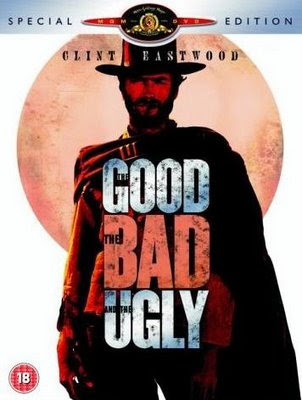
THE GOOD, THE BAD AND THE UGLY (1966) - see it


THE GOOD, THE BAD AND THE UGLY
(1966, Italy/Spain, Il buono, il brutto, il cattivo)

If you only see one spaghetti western, make it this one…

This was one of the earliest epics that really engrossed me. Even on TV, I was totally immersed in the story for two and a half hours. Thankfully it used to be shown on a channel without advert breaks. The story, the characters, the music and the spectacle all help make this my favourite western.


This was the third in the 'Dollars Trilogy'. I know, no dollars in the title, but it’s so similar to A Fistful of Dollars and For A Few Dollars More that they’re always considered together. There are familiar faces from the first two films, though Lee Van Cleef, introduced as Clint Eastwood’s older wiser mentor in For A Few Dollars More, becomes 'The Bad' here. Even in by wild west standards, he shows a marked lack of conscience. As a prison camp commander (director Sergio Leone is keen to remind us that p.o.w.s were interred even during the Civil War). 'Angel Eyes' (Cleef) uses relentless torture to get what he wants, muffling the screams with a band of prisoners.

While 'Blondie' (Eastwood) is more clearly defined as ‘The Good’, he’s still motivated by money, with a cruel streak of humour. ‘The Ugly’ is Tuco, played brilliantly by Eli Wallach. Not a shining representative of Mexico, but for that matter Clint isn't a shining example of all that's American.


The three are gradually introduced, eventually meet up, and then race each other to a stash of army gold. But their journey, alliances and clashes are the treat. The story is far clearer than Few Dollars More, but still character-based and episodic. It contains many classic scenes filled with invention and humour...

A dangerous scam involving faked lynching. Torture by desert crossing. How to sabotage the Civil War. A gunfight in a town under bombardment. And the awesome, oft-copied, circular gunfight. If anyone wants to quote the visual language of a tense gunfight, it's usually from this film. The scene was parodied soon after in the WW2 comedy adventure Kelly's Heroes that also starred Eastwood.


I never tire of the soundtrack music, even after thirty years of listening to it. A key cue from the film’s climax took me by surprise in Las Vegas earlier this year. Outside the front of the Italian-themed Bellagio hotel/casino, a huge synchronised fountain display plays every half hour. I was thrilled to see them use 'The Ecstasy of Gold' from The Good, The Bad and The Ugly, a pretty ironic track, but I was delighted that this particular Ennio Morricone era is still recognised and paid tribute to, especially in such spectacular style.

The latest DVD Special Edition has reinstated scenes missing from the American release version that orignally appeared in Leone’s longer Italian release. This meant belatedly adding 15 more minutes of English language audio, using the actors to dub their performances over thirty years later. Unfortunately this makes the new scenes quite easy to spot, as Wallach and Eastwood’s voices have altered considerably. It’s also not the version that I grew up with and they add nothing crucial to the experience. These scenes would be nice as an option or an extra, but I’m not throwing away my copy of the original English language release. Once again, a film that I love is getting rare in the form that it was originally seen.
` `
The Good, The Bad and The Ugly is being shown around the UK and a Clint Eastwood retrospective is currently running at the BFI Southbank.

August 10, 2008

MOON ZERO TWO (1969) - finally on DVD


MOON ZERO TWO
(1969, UK)

2001 – A Space Odyssey (1968), Stanley Kubrick’s cinematic vision of near-future space travel, and the excitement of the Apollo Moon landings in 1969, inspired film-makers to cash in.

In the same year, compared to the deadly slow Marooned directed by Robert Altman, and Journey to the Far Side of the Sun produced by Gerry Anderson, Hammer Films’ tongue-in-cheek space adventure was a breath of fresh air. Moon Zero Two looked forward to lunar colonisation, envisaging it as the next frontier.


In 2021, there are small cities on the Moon, regular shuttles from Earth, and a race to claim all the mineral riches. The crew of spaceship Moon Zero Two earn their money by salvaging space junk but are also the only independent space vehicle for hire.

Captain Kemp (James Olsen) is approached by shady millionaire J.J. Hubbard (Warren Mitchell) to illegally crash an asteroid on the far side of the Moon. Clementine Taplin (Catherine Schell) also hires him to look for her brother, who has a claim on the far side. Kemp is having a busy few days, and he also has to dodge the attention of the Moon Sheriff who happens to be his girlfriend!


Using American westerns as inspiration, the story weaves in gunfights, claim-jumping, and a bar-room brawl, while accurately predicting life fifty years on. Plastic money, laptop computers, sub-surface ice, and solar energy are now a reality. Made during the Cold War, the film looks forward to Americans and Russians being friends again, pointedly making the crew of Moon Zero Two a citizen of each. It all looks like the sixties, but only the designs date the film, not the story. Spookily, even the date rings true, as NASA are gearing up for more Moonshots by 2020.

The baddies here are money-grabbers and monolithic corporations, and the race for space is now purely economic. Exploration will only happen if it’s for economic gain.

There’s a cheeky reference to 2001, when the Pan Am lunar express tries to jump the cue for re-entry. But like 2001, it encourages a modicum of realism regarding the temperature, pressure, and air supplies needed for human survival. Though for budgetary reasons, there’s an artificial gravity switch inside the buildings, no more of a cheat than in Star Trek.

The impressive sets are huge for a Hammer Film, though the visual FX aren’t so consistent. The spaceship isn’t bad, the wirework space walks and slow-motion low gravity work OK. The most obvious effect is the moon bug tractor – the model looks like a toy, which is a shame as it cross-cuts with an impressive full-scale version. Of course, they didn’t have the budget that Kubrick had.


I’ve always found the film very watchable, with likeable characters and a fast-moving story. All helped enormously by the echoey jazzy score by Don Ellis, in a completely different style to the pounding Julie Driscoll theme tune (the only track that’s out on CD).


James Olsen is the confident hero, Kemp, and token American actor in the cast – he was about to land his biggest screen role, starring in Robert Wise’s The Andromeda Strain (1971). Catherine Schell was also a Bond girl in 1969, but is best remembered as space alien Maya in Space 1999. Carry On regular Bernard Bresslaw, as Hubbard’s brute henchman, was trying hard to get serious roles, but still can’t resist pulling a few comedy faces. Another famous comedian, Warren Mitchell as Hubbard, is far more convincing in villainy.

Adrienne Corri gets a strong role to match her screen presence as Moon Federation Sheriff. She was in many cult films in the seventies, like Madhouse with Vincent Price, Vampire Circus as the ring-master, and A Clockwork Orange, as the main victim of Malcolm McDowell’s Droogs. But this was the only time she had holsters built into thigh-length plastic boots.


Looking at some of the lacklustre poster art for the film, it’s easier to understand why the film wasn’t a success at the time, and why Hammer never ventured into space again. But I’m not the only fan – here’s a website full of photos, modelwork and missing scenes.

Missing from home video for decades, Moon Zero Two has finally been released on DVD in the US as a Best Buy exclusive by Warner Bros. Subtly listed as Sci-Fi 70's Double Feature #1, with the similarly rare When Dinosaurs Ruled the Earth (there's a fantastic appreciation of that film here on SciFi Japan). Both are remastered 16:9 anamorphic, which frames the action quite tightly, but after a wait like that, I’m glad they're available again and finally off my Not On DVD list.

UPDATE: 22nd September
This DVD is now more widely available than just Best Buy stores, and can be ordered online like here from Diabolik.

August 07, 2008

Update: region 2 DVD news

The best news in this batch of region 2 DVD news, is that the weird, wonderful, unique, Czech children's nightmare, that is Valerie and her Week of Wonders, has finally been restored and released. Previous video releases were from a print that literally looked like it had been dragged over a cheese grater. This 1970 film is released in the UK by Second Run video. Full review here.


The Animals Film (1981) will be released in the UK on September 29th by BFI Video. This tough documentary took an unflinching look at the meat industry, and helped me to decide to become a vegetarian nearly 25 years ago.


The awesome adult anime fairy tale Jin-Roh finally gets a DVD release in the west, from Optimum DVD. In an alternate future, where Japan is wracked with civil disobedience, heavily-armed police are used to quell street rioting. When an officer is involved in a fatal incident with a young protestor, he starts to question his allegiance. I can't wait to see this again. It's one of the most dramatic animated feature films, though the tone couldn't be less like a 'cartoon'.

Vexille, another mecha-thriller from the makers of the 3D CGI Appleseed feature films, comes out in the UK on September 1st from Momentum Pictures.


And now for a few more DVD releases, all PAL region 2, from around Europe. The bonkers circus serial killer Berserk (1967) has debuted on DVD in Spain, reportedly with English audio. Joan Crawford and Michael Gough (also both in Trog), Ty Hardin and Judy Geeson star. This was last released on US VHS but has not been on DVD before.


In Germany, the 1975 Doc Savage - The Man of Bronze (
movie reviewed here) gets a DVD release where the UK and USA never have. It's listed as having English audio, which is not necessarily a given on German releases. If confirmed, this sort of removes it from 'Not On DVD' status, but I'd like a widescreen remaster ideally (it's been listed as fullscreen) and to be available closer to home.


Two more rare releases will have to stay on the Not On DVD list because they probably have no English on them. Madchen In Uniform (1931, reviewed here) finally debuts on DVD, but only for German-speakers. Hopefully it's been restored, making it easier for another European distributor to pick it up for a subtitled edition, please, somebody?


Also
in Germany on DVD is Who? (1973), also known as Robo Man on US VHS, which is on my wanted list. This is an American movie, based on a novel by Algis Budrys who passed away recently, telling the story of a scientist whose identity has been erased in a lab explosion, his head now covered by a metallic mask. American authorities have to determine if he is their man, or a trained Russian imposter. It starred Elliott Gould and Trevor Howard, and has apparently been released full-frame, without any English audio or subtitles, as Der Mann Aus Metall. So close, and yet no good. I reviewed an old VHS of the film here.

August 05, 2008

Update: Japanese Blu-Ray news - and more

While it's not surprising that Chinese blockbusters like Curse of the Golden Flower and House of the Flying Daggers are out on Blu-Ray in America, there's a few high definition surprises for sale over in Japan.

Blu-Ray anime in the west is restricted to recent titles like Appleseed: Ex Machina, Tekkon Kinkreet and Satoshi Kon's Paprika. But there are many more, reportedly with English subtitles, on sale or coming soon from Japanese online stores like CD Japan... (Note that Japanese DVD releases that include English subtitles normally only add subs to the main feature, and not the extras or commentary tracks).

Remember also that the Blu-Ray format has it's own new region coding system, that's different to the zones used by DVD companies. Like DVD, your Blu-Ray player or Playstation3 will refuse to play discs from other regions.

Impressively, in Japan, there's already an entire series boxset of Ghost in the Shell: Stand Alone Complex on Blu-Ray, containing both TV series (that's 52 episodes), and the three feature-length spin-offs (series reviewed here). This is a limited release, so hurry.


More exciting still, is the announcement that the revised CGI-enhanced version of the original movie, released to Japanese cinemas earlier this year as Ghost in the Shell 2.0, will appear on Blu-Ray in November. CD Japan only lists English subtitles on the limited edition Boxset version, which also includes a Blu-Ray disc of the original version of the movie.

While Freedom was only releassed on the HD-DVD format in America (first episode reviewed here), the entire series is now a Blu-Ray boxset in Japan, listed as having English subtitles and even the English language track.


A reissue of the Japanese Jin Roh Blu-Ray has English subtitles, where the first release had none. This awesome, adult fairy tale has only just been released on DVD in the UK.


Live-action films take a backseat to anime on Japanese Blu-Ray, but a couple of interesting titles are the first Gegege No Kitaro movie (review here) and Mamoru Oshii's Avalon, both listed as having English subtitles. There's also a Director's Cut of Day Watch that's 15 minutes longer.


A few more movies of interest on Blu-Ray in the US include the live-action Initial D: The Movie (movie review here) made in Hong Kong, as well as Stephen Chow's Kung Fu Hustle and CJ7.


As for movies from Thailand, Vengeance (review here) has appeared in America - a rather odd choice. But only the US remakes of Thai horror hits Shutter and The Eye, and not the originals, are on Blu-Ray as yet. Wha?

August 04, 2008

DVD news: region 1


MISHIMA - A LIFE IN FOUR CHAPTERS (1985)

Paul Schrader's film has rightfully been released as part of the Criterion Collection, with both the Japanese and American voiceovers. Thoroughly recommended, I reviewed it here. Criterion have also released Patriotism, the only film to be directed by Mishima. The short film eerily anticipates his ritual suicide.


THE MAN WHO COULD CHEAT DEATH (1959)

This is a first on DVD and I've never seen it on VHS either. It's certainly taking me decades to see all of Hammer Studio's classic horrors in any form. Newly released, this early Hammer Horror was directed by maestro Terence Fisher after Curse of Frankenstein and Horror of Dracula, just before he made The Mummy in 1959.

The Man Who Could Cheat Death is a tale of science misused for personal gain, with a couple of chills and a classic cast. Anton Diffring (Circus of Horrors, The Beast Must Die) as the scientist with a secret, Hazel Court (Masque of the Red Death) as his dark infatuation, and Christopher Lee as his reluctant aide. The lush transfer is richly colourful and looks fantastic. For fans of Hammer and British horror, this is very welcome title from Legend Films, who have also just released Freddie Francis' The Skull, starring Peter Cushing and Christopher Lee, in 2.35 widescreen for the first time on home video.


MOON ZERO TWO (1969) plus
WHEN DINOSAURS RULED THE EARTH (1970)

Two more rare and sought-after Hammer films debut on DVD as a double-bill. Moon Zero Two is a space western, released to cash in on the Moon landings in 1969. Starring James Olsen (The Andromeda Strain) and Catherine Schell (Space 1999), it's colourful, inventive, and tongue-in-cheek (a lunar property tycoon playing Moonopoly). I particularly like Adrienne Corri as the ray-gun toting space sheriff.

It's paired with When Dinosaurs Ruled the Earth - the title should be familiar to anyone who remembers the finale to Jurassic Park. Following the success of One Million Years BC starring Raquel Welch, Hammer repeated the 'cavemen vs. dinosaurs' formula with more scantily clad cavegirls (headed by Victoria Vetri), grunting dialogue, stop-motion dinosaurs (impeccably animated by Jim Danforth), but with added sex and nudity.

This is only available in the US, and as a BestBuy exclusive but there may be an availability problem, according to chatter on the Classic Horror Forum, Warners appear to have muddled the adult version with the 'G' rated one.


42nd STREET FOREVER

Volumes 1, 2 and 3 of 42nd Street Forever should have been released before Quentin Tarantino's Grindhouse movies, to educate us all as to what the hell 'grindhouse' actually was. Turns out Quentin meant seventies exploitation movies, except I saw them all in the Studio 7 (later 'Pine World') in Kingston-on-Thames, which I'd call 'a fleapit' rather than 'a grindhouse'.

The trailers were often better than the movie in this genre that preceded straight-to-video, The best scenes were always going to be in the trailer, laced together with death-dealing hyperbole.

There are several priceless feature-length collections of trailers from Synapse Video. They illustrate the many seventies trends, where the hunt was on to replace Bruce Lee, and rip-off any of the big hits, like The Exorcist or Animal House.

For instance, Volume 3 'Exploitation Explosion', contains trailers for kung fu thrillers, horror movies, monster action and general sleaze, including Alligator, Blood Beach, Survive, House by the Lake, Tentacles, Enter the Ninja, Prison Girls and dozens more. All the trailers are remastered for anamorphic widescreen.

Sometimes the picture quality is misleadingly dupey and slightly blurry – so remember that the final film may look 100 times better. Well, maybe 10 times. Also, some of these films aren’t on DVD, so this is your only way to catch a glimpse of them.

These outrageous previews for outrageous movies are fun to watch and full of ideas what to check out next. Don’t let the boring cover artwork put you off, these are dynamite. compilations. Thanks to Marios for telling me about these video gems.


CLASSIC SCI-FI - ULTIMATE COLLECTION volumes 1 & 2

This is simply a fantastic collection of classic fifties science fiction, where spectacle and suspense are more important than science. Quality black-and-white movies in their original aspect ratios, this Universal boxset is a reasonable way to jump-start a sci-fi collection.

The titles included are Tarantula (atomic radiation, giant spider), The Mole People (lost civilisation), The Incredible Shrinking Man (atomic radiation accident - based on the novel by Richard Matheson), The Monolith Monsters (alien rocks), Monster on the Campus (prehistoric Dr Jekyll), Dr. Cyclops (1941 technicolor - mad prof with shrink ray), Cult of the Cobra (vengeful snakey cult), The Land Unknown (dinosaurs in the Arctic), The Deadly Mantis (atomic radiation, giant mantis), and The Leech Woman (killing for eternal life).

August 03, 2008

THE DEVILS (1971) - Ken Russell's masterpiece

THE DEVILS
(1971, UK)

Apparently this infamous film has been restored by Warner Brothers, and was even announced for release in May, according to news from BloodyDisgusting who even have the proposed cover art. But the DVD still hasn’t appeared. The previous appearance on home video was on VHS, albeit short of many censor cuts.


Arguably Ken Russell’s greatest and most outrageous film, it’s no surprise that ‘grey market’ bootlegs are cashing in at the moment. This one is far from perfect, the picture is anamorphically presented 16:9 (edge-cropped from 2.35), but has fairly low picture resolution, like it’s been bumped-up from a computer file. But it’s currently on sale from HK Flix and even from Amazon!

The Devils was a very different film from Russell’s usual modernised biographies of the classic composers. It triggered a storm about film censorship when it was released in the UK and the US, targetted for numerous onscreen blasphemies that would reappear with far less controversy in The Exorcist three years later.


Based on an actual case in 17th century plague-ridden France, Russell based his screenplay on the thoroughly researched, but rather dry account The Devils of Loudon, written by Aldous Huxley (Brave New World). Father Grandier was a priest in charge of a walled city who took a stand against Cardinal Richlieu, but with the King of France’s approval. Secretly he was ahead of his time in re-interpreting the testaments, in order to stay faithful to Catholicism, but also have sex, and even marry. But an obsessed nun, who idolised Grandier without ever meeting him, hears of his secret and takes revenge by claiming to be possessed. Richlieu’s cohorts take the opportunity to discredit Grandier by proving his allegiance to the Devil with the help of a crackpot witchfinder. The nuns claim to be possessed rather than face execution, and the ensuing public trials leave the public in trouble deciding where the truth lies.

The Mother Superior is 'tested' for demonic possession and an attempt to exorcise her and her nuns turns the trial into a madhouse. Grandier is tortured into confessing many far-fetched accusations (resorting to even nastier methods than any witnessed in Witchfinder General, three years earlier). Ken Russell’s penchant for showing female nudity and sexuality is unleashed here and has barely been seen on such a debauched scale since.

But the historical facts of the case are astonishing. Russell, like Huxley, is highlighting a gross miscarriage of justice perpetrated by ridiculous means, made possible by preying on the superstitions of the time.


Oliver Reed is in his prime here, and gives a magnetic performance as Grandier. There’s a wild turn from Vanessa Redgrave (Blow Up) as the hateful, crazed hunchback nun – an unforgettable character who should really be ‘up there’ in the annals of dangerous lunatics. Dudley Sutton (The Leather Boys) as the accusor and Michael Gothard (the psycho-vampire in Scream and Scream Again) as the groovy witchfinder-exorcist have great scenes, but somehow fall short of convincing in them. Georgina Hale is fantastic as a spurned lover, her performance seemingly unaffected by having to perform full-frontal nudity, and Gemma Jones adds realism to her character’s pivotal relationship with Grandier.

The astonishing set designs, some of the most impressive that Russell ever worked with, were designed by Derek Jarman, before he began directing his own movies. The huge set for the walled city and the stark white-tiled convent are cheekily modelled on public lavatories of the time. Complemented by Shirley Russell’s costumes, it all looks like the real deal. Jarman would later mix anarchy and anachronism in his own historical films, like Caravaggio and Edward II.

There are many precedents set in the exorcism scenes in The Devils, that later appeared in The Exorcist. There’s vomiting, blasphemy, I mean extreme blasphemy, and even arched-back spider-walking – a stunt eventually used in the restored 2000 edition of The Exorcist. Masturbating the crucifix was shocking enough, but in The Devils there’s a dozen naked nuns, a statue of Christ, and one very popular church candle.

Unsurprisingly, the film attracted the special attention of Mark Kermode, TV presenter and movie critic whose obsession with The Exorcist lead him to make a 1998 documentary that encouraged William Friedkin to restore key sequences into what became The Exorcist - The Version You’ve Never Seen (2000). Kermode then hoped for a similar result with Hell on Earth, his 2002 programme about The Devils.


At the time it was only on home video in a version that had been cut down by both British and American censors. The original UK version, 4 and a half minutes longer than the VHS release/US version, was then shown on TV. The documentary also included the missing 1 and a half minute sequence cut from Russell’s initial UK version, the legendary 'Rape of Christ' scene.

This bootleg DVD (cover art pictured at top, complete with spelling mistakes of one of the stars and the director) cuts the scene back into the UK version to become a crude restoration of a full-length director’s cut. But because it’s taken from the TV showing, the image is still cropped from 2.35 widescreen down to 16:9. For American audiences, this is still the first opportunity to see the six missing minutes of violence, nudity and excessive blasphemy, plus the 50 minute Hell on Earth documentary, plus various interviews from TV programmes about the history of movie censorship, in which The Devils always features!

Hopefully this astonishing film will soon get released and find new acclaim before we lose Ken Russell himself.

August 01, 2008

A FISTFUL OF DOLLARS (1964) - Italian style Western

A FISTFUL OF DOLLARS
(1964, Italy/Spain/West Germany, Per un pugno di dollari)

You won't see many Westerns in the Black Hole, but Spaghetti Westerns are a different genre altogether, one that I repeatedly make time for.

I was initially attracted to them for their gritty violence, unique music and Clint Eastwood's persona. The few Westerns directed by Sergio Leone are also laced with dark humour and feature very early examples of ultra-cool anti-heroes. His film-making is also very visual, realistically detailed, and elegantly constructed. Prime examples of pure cinema. Beautifully crafted European cinema, but entertaining rather than arthouse. The Italian perspective on a very American genre is critical, cynical, funny and often far more accurate than many Westerns made in the U.S..

In the seventies, Clint Eastwood movies were always in the cinema and his Westerns were regularly on late night TV. They were visually cropped to fullscreen and crudely censored for violence (mostly in line with cuts made for the cinema releases). But still they contained raw, regular outbursts of violence and a host of unlikeable characters, leaving audiences to side with the devil they knew.

I’ve always been very aware of music in movies, and here I heard for the first time some of the most famous ever movie soundtracks. Composer Ennio Morricone gained worldwide attention with these films and never looked back. After these Westerns, among the earliest jobs in his long, successful and prolific career in film music, are also the first three horror/thrillers directed by Dario Argento.


I then didn’t miss any more of Clint Eastwood’s films on TV and in the cinema. Throughout the 1970s, he was usually a reliable indicator of an interesting, hard-edged story. But before the 'Dollars Trilogy' - consisting of A Fistful of Dollars, For a Few Dollars More and The Good, The Bad and The Ugly - Eastwood was only a TV star (as second fiddle on Rawhide) and an occasional bit player in movies (like a comedy lab assistant in Revenge of the Creature). He wasn’t first choice for the Man with No Name, but he was the most famous American star that Leone could afford for his first Western.

I repeatedly saw the film on TV, and only once in the cinema in a Dollars Trilogy all-nighter in the Ewell ABC in 1979. Since then, I’d never seen the film again in widescreen 2.35, and never ever seen it uncut. Finally I've watched the beautifully restored 2003 DVD special edition, and I can honestly recommend the film to even ardent non-Western lovers. It's art, action, cult, Italian, dark, funny, intelligent...


The story is closely based on the 1961 Akira Kurosawa film, Yojimbo (The Bodyguard), where a renegade samurai enters an isolated village to discover two powerful families struggling to monopolise the local trade. Sanjuro, (Toshiro Mifune, also a star of The Seven Samurai), plays one family off against the other as they bid on his superior skills of swordsmanship, trying to break the deadlock and sway the balance of power. Yojimbo doesn't have as complex an approach as Leone's remake, but I did enjoy the unconventionally modern soundtrack. It was shot 2.35 widescreen. Leone went as far as to lift shots, dialogue, as well as story elements for A Fistful of Dollars.

The Man With No Name, played by Clint Eastwood, enters a small village on a mule and sees a woman being held prisoner while her husband is beaten up. They are some of the few villagers left in the middle of a power struggle between the Baxter family and the Rojos. Evenly matched in numbers and firepower, the two sides are attempting to corner the arms trade over the border between Texas and Mexico.

The Stranger soon discovers that there’s money to be made as he pretends to ally himself to one family, while maneuvering them against the other. To successfully encourage them towards mutual destruction, he must avoid suspicion from the dangerous Ramon Rojo, a clever and sadistic rifleman who’s just as fast as the Stranger is with his pistol…


The look and atmosphere of A Fistful of Dollars anticipates 1970s Italian horror. The music uses unsettling noise and chords of sustained intensity. The carefully composed widescreen photography flips between expansive, barren wastelands and unflinching extreme close ups. There’s no time spent on romantic subplots or verbose explanations of inner motives – the characters establish themselves in actions, not words.

The regular gunfights are presented like horror movie killings with terrifying music and messy unheroic deaths in the dirt. There's no traditional fistfight in the saloon, with collapsing furniture and comedy barmen. The only hand-to-hand combat is when Eastwood gets totally outnumbered, tortured, and his face is literally beaten to a pulp until his face is unrecognisable. The baddies kick him when he's down, stamp on his hand and don’t pull their punches. Unable to walk, he can only drag himself away. While there’s little blood, these films were instantly berated for being too violent, as if the West was won by fair and necessary means. The Dollars films predate and foreshadow Sam Peckinpah's gory The Wild Bunch - an astonishing benchmark in onscreen violence.

Snidely called 'Spaghetti Westerns' because of the Italian production crew, the films were mostly shot in Spain. To compensate for not being in the authentic locations, or even the right continent, Leone set the stories close to Mexico's border, but was scrupulous over historical detail, referring to period photographs. Onscreen, clothes look suitably like they've been dragged across the desert on a horse. The buildings and streets look realistically derelict and desolate.

Each of Leone’s subsequent Westerns then progress historically to tell the story of the West at key moments in the birth of America, in increasingly epic films that grew in budget along with their international success. Clint Eastwood's three Spaghetti Westerns quickly turned him from a TV actor into both a movie star and a director.


I’ve been watching the 2-disc special editions of the Dollars Trilogy and A Fistful of Dynamite, while reading the informative and photo-packed book, Once Upon A Time In Italy, by Sir Christopher Frayling.

I’ve enjoyed experiencing all my favourite westerns again. Despite the low budget, A Fistful of Dollars is even more exciting and interesting than I’d remembered it.

The two-disc special edition features a pristine restoration – the picture looks brand new, made from the original negative, though the aspect ratio isn't full 2.35 and the compositions looks tight on all sides, inline with most Hollywood DVDs from this film format. This is a shame, particularly with a cinematographer and director who carefully use every part of the frame.

The mono soundtrack has been enhanced into 5.1 stereo, which sounds excellent, though the redirected directional nature of offscreen dialogue is sometimes heavy-handed. The extras are well made and low on padding. Short interesting documentaries, trailers, and commentary. The films can be bought singly or in different Leone boxset collections.


A season of most of Clint Eastwood’s films is running throughout August and September at London’s BFI Southbank, including a national run of The Good, The Bad and The Ugly. A classic film you should see on as large a screen as possible.