May 26, 2007

GEGEGE NO KITARO - a guide to the Ghost Boy

GEGEGE NO KITARO
(1968 onwards, Japan, Spooky Kitaro)

Japanese horror meets children's anime - forty years and still going strong

Article UPDATED - May 2010

A live-action movie of Gegege no Kitaro (2007) spawned a sequel the following year. But the character has been a popular anime series that first appeared in 1968, and as a manga before that. Wildly imaginative, it visualises a parade of bizarre creatures and mythologies with roots in ancient Japanese and Chinese ghost stories. I'm hoping this character will one day gain popularity in the west.

I stumbled on a Gegege no Kitaro exhibition atop the Sunshine Tower skyscraper in Tokyo in 2004. Drawings and cels were on display, as well as vintage memorabilia. I returned to England wanting to know more about the one-eyed boy who was surrounded by monsters.


An original Japanese manga compilation


The Characters
Kitaro and his friends are 'yokai', a Japanese word for monsters, goblins, ghosts and demons. Together, they help sort out problems between humans and mischievous, aggrieved or downright evil yokai monsters.

Usually the stories are of human beings who upset a yokai, or its resting place. The yokai then victimise humans in any number of ways. They can swallow them whole, steal souls, kidnap children, melt faces... all sorts of unpleasantness, rather scary for a young audience. Slightly heavy-handedly, they are also being taught not to litter, not to disrespect their ancestors, stay out of graveyards at night etc).

Kitaro is the last of an ancient 'ghost tribe'. He's undead, often introduced as emerging from a graveyard, and has special powers - yokai-detecting hair, magic wooden sandals and protected by a distinctive waistcoat.

He is aided by his father, who has withered away until he is just an eyeball with a tiny body! ‘Father Eyeball’ is very knowledgeable, and travels around hidden away under Kitaro's hair, presumably living in his vacant left eyesocket! Otherwise he likes to bathe in a hot bowl of water (much like the Japanese spas).

The smelly Ratman (from the 1996 title sequence)

Kitaro’s regular friends translate roughly as Catgirl, Sand-Witch, Old-man Crybaby, Wally-Wall, Rolly-Cloth and of course the smelly and untrustworthy Ratman - a traitorous trouble-maker (much like Dr Zachary Smith in Lost in Space). He's lecherous, greedy and two-faced and his powers derive from his body odours, gasses and foul breath. The whole ghostly crew resemble a family, with Old Crybaby and Sand-Witch as surrogate grandparents.

Kitaro lives a simple life in the forest up in a treehouse, amongst the woodland creatures with which he can also communicate. When he's not flying around on Rolly, he can be sky-lifted by flocks of crows! Kitaro is quite poor ('gegege' roughly means 'lowest of the low') possessing only the clothes on his back. But unlike Ratman, he is content with what he's got, dedicated to keeping the peace between humans and yokai.


A few of the manga stories have been translated into English in three collections, published in 2001.

The only international translation I’ve seen of the title has been 'Spooky Kitaro'. He’s referred to as both Kitaro or Kitarou, but Kitaro is also the name of a Japanese band, so it Googles badly!

This long-running children's favourite has spawned a ton of merchandise. I think the best of it are toys, action figures, CDs, and manga. But he's probably best known internationally in many spin-off video games in Japan.


The King of the Yokai
Shigeru Mizuki is the author and illustrator of the original Kitaro manga stories, and has also single-handedly kept many ancient ghost stories alive. He has written encyclopedic guides about the many ghosts and goblins from local legends all over Japan.

His stories share yokai characters with the Japanese 100 Ghost Stories film trilogy of the 1960s. Indeed Mizuki was heavily involved in the recent remake Yokai Daisenso, and even had a cameo as the King of the Yokai. Like that film, Kitaro also has a modern day setting, alongside ancient demons that have only previously appeared in period-costume ghost stories (like Kwaidan).


Among Mizuki's other manga work is an autobiographical account of his World War II experiences in the South Sea Islands, in which he lost an arm during a bombing raid.

Japan’s love for Mizuki is most evident in his home town of Sakaiminato where
there is a museum dedicated to him (a scene was filmed there for Yokai Daisenso) on a street where there are bronze statues of many of his most famous characters. What a tribute! (See some of the statues and a guide to the town in a tourist website here).


While Shigeru Mizuki's many reference books about yokai monsters have only been published in Japanese, I found this recent publication to be immensely useful - Yokai Attack!: The Japanese Monster Survival Guide (on Amazon here). It lists the most famous yokai, their appearances and habits and answers an awful lot of questions I had about Japanese monsters and superstition.


The TV Shows
Mizuki's popular manga about 'ghost-boy' Kitaro have been turned into long-running TV anime series in every decade from the 1960s onwards, totalling over 400 animated episodes!

In 2006, all the older series started being restored and released in huge (expensive) DVD boxsets in Japan, as 1960s, 1970s and 1980s collections. In 2007, the 1997 series boxset followed, as well as a low budget 1980s live-action movie. An anime movies boxset collected the short supporting films that were made for cinemas.

Though most of these boxsets are now out of print, individual DVD volumes are being released in Japan of all the series, including the new one that started airing in 2007. None of these have any English subtitles on them.

I was hoping that maybe the new films would open the way for some subtitled DVD releases of the anime in the west. But despite the lack of translations, I'd still recommend them. They're great for yokai fans, and a good place to start looking would be the movie versions, because they're nearly all action.

So here’s a brief guide to the anime series so far, and how to tell them apart (thanks in large part to
Anime News Network).


Season 1 (1968) 65 episodes
The opening titles start in a graveyard full of woodland animals singing the theme tune, conducted by Kitaro. Ratman and Kitaro also appear sitting in a car. (See YouTube for these opening titles).


This is a black-and-white anime series. primarily involving just Kitaro, his father (the eyeball) and Ratman (like the early manga stories). The episodes I've seen are interesting examples of early TV anime. Faithful to the manga, they are scary and occasionally brutal, by modern standards.


Season 2 (1971) 45 episodes
The title sequence again opens in a graveyard, but this time in colour. There's lightning flashes, and Kitaro, his father and Ratman are the only regular characters seen in the titles.


This is the first colour series, and has more action in it. It's still very scary, like the Queen Skeleton episodes demonstrate. Ratman is still driving around in his old car, unlike the later series.


Season 3 (1985) 108 episodes
The title sequence opens with skyscrapers, and tilts down to Ratman and (for the first time) the whole gang singing the familiar theme tune, this time arranged in a rock and roll style while everyone pretends to be pop stars. The titles end with Kitaro rescuing a human girl (Yumiko) with his flying wooden sandals. (
See YouTube for the 1985 title sequence, here).

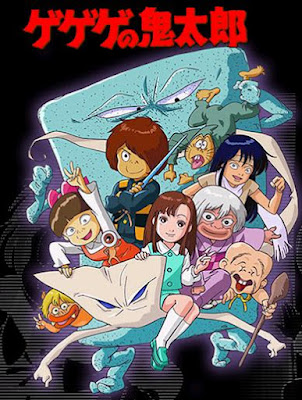
In this series, the regular yokai characters are joined by a human schoolgirl, Yumiko. I thought this was a sign of the anime softening, but it's scary as ever, and Ratman even makes hugely objectionable advances on her and Cat-girl! Sesame Street, this is not. The regular cast now features the whole gang (see picture above) and for some reason, in this series, Sand-Witch has purple robes instead of white.

This series spawned four short movies (each around 40 minutes long) shown in cinemas in 1985 and 1986. They would each have been part of a school-holiday programme that included other cartoons and live-action short films also produced by Toei Studios.

There were also seven extra TV episodes in 1988 (which are included in the 1980s DVD boxset) - and have something to do with 'jigoku' (hell).


Season 4 (1996) 114 episodes
This theme opens with crows flapping. They scatter to reveal a graveyard, from which Kitaro emerges. Besides shots of woodland animals, there are shots of a modern city and a school building being menaced by yokai. The Sand-Witch is dressed in white robes.

With the most advanced animation yet, this series seemed to have a significantly higher budget, with more detailed layouts and special animation effects.


Beside spinning off two 25 minute short films for the cinema (a baseball showdown called Monster Night, and an airbourne battle aboard the Ghost Express Train), there was a 50 minute film called Great Sea Monster, which is well-worth seeing. Based on an early epic manga serial, Kitaro stomps Tokyo whilst trapped in the form of a gigantic whale-monster. This was also adapted as two episodes of the first series.

The short, Ghost Express Train, unusually features western monsters, namely the Frankenstein creature, the Wolfman, a witch and a bizarre version of Dracula, who trap Kitaro and crew on a flying train.


Season 5 (2007) 102 episodes
This title sequence features the traditional theme music but without the song being sung. Sand-Witch is dressed in purple again. Besides Kitaro, the emphasis in the titles isn't on the regular characters, so much as the hundreds of other different yokai monsters in a huge procession through a ghostly city, reminiscent of Spirited Away.


I'm delighted that another anime series was made to coincide with the live-action film of 2007. The anime is presented 16:9 widescreen, and the episodes feel substantially different to the older ones - Kitaro's character-design looks quite different and far from spooky. Also, the use of complex colour schemes, and twistier plots compensate for revisiting the same monster adversaries again.

The series continued into a second year, and are still being released on DVD, under the title Gegege No Kitaro - Dai 2 Ya ('Second Night') refering to the second season - episode 52 onwards.

Besides individual DVD volumes, there's a Japanese boxset of the first season (51 episodes) available, with a similar second season expected. Again, these releases have no English subtitles.


Gegege no Kitaro – the Movie (2007)
The first major live-action movie,
my full review here, relied on CGI for the characters like Father Eyeball, Rolly and Wally. The film builds on the success of Takeshi Miike’s Great Yokai War (2005, which also featured brief cameos from Rolly and Wally).

While we were clued in to that film by the 1960s Yokai Monsters film trilogy, not many westerners know about Kitaro, making it a harder sell. But now he stands the best chance of 'crossing over' and becoming recognised internationally. Fingers crossed and, please, none of you knock over any old shrines…

Various editions of the Japanese DVD release had English subtitles, and the film got a region 1 DVD (and Blu-Ray) in the US - the character's debut on home video in America.


Gegege No Kitaro 2
(2008, Gegege no KitarĂ´: Sennen noroi uta)

The second live-action movie was released on Japanese and Chinese DVDs with English subtitles. This and the first movie were also been released on region 2 DVD in the UK.


Gegege No Kitaro: Nippon Bakuretsu (2008)
The first ever feature-length animated Kitaro movie, released as part of the anime's 40th anniversary. It's made in the same style as the 2007 TV series. Six different versions of the movie have been released, with the character of Cat Girl dressing in different outfits befitting different areas of the country (news courtesy of Anime News Network).


Hakaba Kitaro (2008) 11 episodes
Finally, there's this short anime series, produced for DVD release only (an 'OVA'). It's promoted as depicting Kitaro the way he was first drawn, taking its name from the earliest incarnation of the character, entitled Graveyard Kitaro. Aimed at teenagers (and adults?), the aim is to scare, and tell the full grisly story of Kitaro's early days. The story spans 11 episodes, and for once the opening theme has been dropped in favour of a modern song by the excellent electro band Denki Groove. Full review here.


Do you want to know more?

A description of Kitaro's ghoulish origin is in this strange little page, designed as an introduction to one of the video games,
here on BogLeech.

More links, a bibliography, interviews with Shigeru Mizuki, and even a guide to Kitaro's friends' names in Japanese...
are all here on the Anthropology of Anime and Manga website.

See more of Shigeru Mizuki's original Kitaro manga artwork
here in the ArtCafe artists index.

For a more serious guide to the original legends of Japan's ghosts and yokai monsters,
try this essential article from Mangajin magazine.


May 25, 2007

FRANKENSTEIN - THE TRUE STORY (1973) the longest, the dullest

Frankenstein - the True Story
(1973, US television)

NTSC US region 1 DVD (Universal)

A very poor telling of the novel. Not recommended at all!

This was a highly publicised American TV adaption, spread over two movie-length parts.

A great cast, but with dull direction, music, special effects and a very poor script. In its defence, the editing appears very choppy, making nonsense of much of the dialogue and story. Perhaps it was even longer and was carved down to three hours to try and pep it up? Clues to this scenario include Frankenstein's beard suddenly appearing for one scene, then disappearing the next, back-references to events that we haven't seen, major actors popping up for single, brief scenes... Was this an early mini-series that was edited down to as short as possible?

The irreplaceable James Mason as Dr Polidori

The three-hour running time is still too long, with some leaden performances (including the Baron himself - played by Leonard Whiting) mixed with a few good ones. James Mason and Agnes Moorhead (Endora in Bewitched) are the best of a big bunch.

There's Michael Sarrazin (Eye of the Cat), David McCallum (The Man from UNCLE), Jane Seymour (Live and Let Die), Nicola Pagett, Ralph Richardson (Tales from the Crypt), John Gielgud, Tom Baker (very briefly) and even Julian Barnes (a lead in The Haunted House of Horror), but this is very hard going indeed. Not helped by the lousy, ill-fitting music.


The busy narrative simply trots through the scenes from the book, without elaborating on the subtext, character motivations or Mary Shelley's ideas.

Worse still, the horror elements of a classic horror tale are pared down to the minimum. A tale of bloody murder and cadavers being carved up to make new life is all skirted round to appease TV censor's. There's off-screen violence and so little blood, that key scenes are nothing but confusing. There's screaming but you might not know why! Looking at the more explicitly bloody publicity stills that circulated at the time, my hopes were raised that it would be worth watching.

At the time, I was hoping that The True Story would be gorier than even the Hammer films, but I'd have to wait until I saw Flesh for Frankenstein (also 1973) before that happened. The True Story was the last chance in a long time for the Baron to be taken seriously, with Young Frankenstein and The Rocky Horror Picture Show about to famously lampoon him.


Not recommended – try any Frankenstein with Peter Cushing, for all your serious, gothic, Frankenstein needs.

If you must try out this recent DVD release, beware the 5 minute intro at the start of the first part - it's completely full of spoilers! And unlike the original TV showing (yes, I remember it at the time), there's no break between parts 1 and 2 (when you really need a breather).

Do you (really) want to know more?

DVD Beaver (click here) has some great frame grabs that make this look more enticing than it actually is.


- - - - - - -

May 23, 2007

TWISTED NERVE (1968) a tormented psycho-thriller


Twisted Nerve
(1968, UK)

Reviewed on Warner Bros PAL VHS

This film is recently famous for providing Daryl Hannah's 'whistling theme' in Kill Bill: Vol 1. But what's it actually about?


A tormented thriller that hinges on the mental state of Hywel Bennett’s character, Martin/Georgie. The textbook 'Psychopathia Sexualis' appears in one scene and presumably inspired/justified the story. It hit controversy even before its cinema release. A surly voiceover, tacked on at the start, reiterates that there's no proven link between Down's Syndrome and psychopathic behaviour, yet that's the whole basis of the plot.

A pity, because Martin could easily have been a conman, rather than anyone mentally ill. Because of his upbringing with his Down’s Syndrome brother, he successfully pretends to have an infant's mental age. He dupes his way into staying at Hayley Mills’ house, into her mother's affections and establishes an alibi for a darker purpose...

Carefully directed in a style reminiscent of Hitchcock, with slow, precise camerawork, there's even a masterful soundtrack by Bernard Herrmann, near the end of his career. His delicate score evokes echoes of the quieter moments in Psycho. The original vinyl soundtrack for Twisted Nerve hasn't been re-released on CD and nowadays fetches high prices on eBay.


All the main characters are carefully drawn and well-written, progressively even, including a wry portrayal of an Indian student doctor, who has a running duel of words with a fellow lodger, parrying his casually racist table talk.

The film pushes the contemporary limits of taste by weaving sexual taboos into the mix, all supposedly elements of Martin’s illness. Unsubtle hints that he might be oedipal, gay, excessively masturbating, over-sexed... shows that the writer must have trotted through the chapter headings of the psychology book.

Besides misinforming the audience about the facts of Down's Syndrome, the more widespread then (and offensive now) terms of ‘mongol’ and ‘mongolism’ are used, dating the film terribly. After I'd watched the film on an old VHS release. I was very surprised that the film is about to be released on DVD in the UK in June (from Optimim DVD). Are they going to add extra disclaimers before the existing disclaimer?

Back in 1966, Hayley Mills and Hywel Bennett had previously acted together in The Family Way, in very different roles playing a young married couple in a small village. After Twisted Nerve, Bennett later became famous as a comedy actor on the big screen (Percy) and the small (Shelley) and is still busy today in TV, though he’s barely recognisable from his baby-faced looks of the sixties.

Hayley Mills was successfully breaking away from her childhood Disney image (That Darn Cat, The Parent Trap) and here enjoys an adult role and sixties mini-skirts. She is currently a regular in TV's Wild at Heart.

Her mother is played by the always excellent Billie Whitelaw (the original 1976 Mrs Baylock in The Omen), who successfully juggles her maternal role with that of a sexually-active landlady.

Barry Foster, as the objectionably randy lodger, soon appeared in a psychotic role of his own in Alfred Hitchcock's vicious Frenzy (1972). The basic characterisation in that film wasn’t much different though. Foster had also co-starred with the two leads before, also in The Family Way.

In 1968, Frank Finlay was a big name in theatre. On the big screen, he was only doing bit parts in thrillers, or big parts in horrors (The Deadly Bees). Here he plays a brutish father-figure, a million miles from his witty, bumbling turn as the ever-hungry Porthos in Richard Lester's The Three (and Four) Musketeers (1973).

If you overlook the daft psychology, Bennett’s anguished performance still works well, and generates drama and suspense, amongst a top-grade cast, with a particular bonus from Billie Whitelaw’s complex performance.

It's not a script that could work nowadays, but it is a well-made thriller, and a fascinating glimpse into the attitudes and sexual preoccupations of the recent past. It's going to be interesting to see how the DVD is received.

Play.com are already listing this for sale on DVD, here.

- - - - - - -

May 21, 2007

More vintage trailers and stuff on YouTube

Here's some more trailers and clips on YouTube, just click on the movie titles below:


HARPYA (1979) a short scary part-animated harpy horror - here in its entirety

Kubrick talks (1968) it's not often you hear Stanley Kubrick speak (especially about 2001) - great voice!

MEL BROOKS' THE CRITIC (1963) a very early animated short, directed and voiced by Mel Brooks


CLASSIC HORROR TRAILERS:

ALIEN (1979) original trailer

CORRUPTION (1968) rare Peter Cushing slasher

The DEVIL RIDES OUT (1968) classic satanic Hammer

DR BLOOD'S COFFIN (1961) rare Hazel Court horror

DR JEKYLL AND SISTER HYDE (1971) bisexual Hammer

FRANKENSTEIN MUST BE DESTROYED (1969) the grittiest Peter Cushing baron

HUMANOIDS FROM THE DEEP (1980) Doug McClure meets sex and violence

MY BLOODY VALENTINE (1981) a slasher down the mines

PLAGUE OF THE ZOMBIES (1966) from Hammer

RABID (1978) early all-action David Cronenberg bio-horror

TENTACLES (1979) Italian rip off JAWS

TERROR TRAIN (1980) Jamie Lee Curtis slasher

ZOMBIE FLESH EATERS (1979) UK trailer for this Italian gorefest


SIXTIES CULT TRAILERS:

The ITALIAN JOB (1968) original trailer for the original film

The LAND THAT TIME FORGOT (1974) Doug McClure vs dinosaurs

The TRIP (1967) director Roger Corman wrestles with LSD, Peter Fonda and Bruce Dern investigate...


NEW FROM JAPAN...

ERGO PROXY (2006) interesting anime opening titles, with music from Monoral

PARANOIA AGENT (2004) astonishing titles sequence from this Satashi Kon anime, with music by Susumu Hirazawa

REINCARNATION (2005) Takeshi Shimizu's scary RINNE - the Japanese trailer

SPEED GRAPHER (2006) opening titles with original Duran Duran music

...and more

  • BASKET CASE (1982) trailer

  • BATGIRL test episode (1968)

  • BATMAN (1966) movie trailer

  • BEN (1972) killer rat trailer

  • BEYOND VALLEY OF THE DOLLS

  • The CASE OF THE MUKKINESE BATTLEHORN - classic short film from The Goons

  • CHIAKI KURIYAMA interview

  • CORRUPTION (1968) trailer

  • The CRITIC (1963) Mel Brooks

  • DEATH RACE 2000 (1975) trailer

  • DR JEKYLL & SISTER HYDE

  • EARTH DIES SCREAMING clip

  • EYE OF THE CAT

  • FUTURE SHOCK (1972)

  • GAMERA 2 - ADVENT OF LEGION

  • GAMERA THE BRAVE (2006)

  • GEGEGE NO KITAROU (2007)

  • GOKE BODYSNATCHER from HELL

  • GORGO (1961) trailer

  • The HAND OF NIGHT clip

  • The GREEN SLIME trailer

  • The HOST (2006) US trailer

  • HUMANOIDS from the DEEP

  • JAWS - Bollywood style

  • KIDAN / INFERNO (2005) trailer

  • LAST MAN ON EARTH (1964)

  • LOVE DEATH trailer

  • MARINE BOY theme tune

  • Ms 45 - ANGEL OF VENGEANCE

  • MUSHISHI / BUGMASTER (2006)

  • MY BLOODY VALENTINE (1981)

  • MYLENE FARMER anime

  • NEGADON (2005)

  • The OMEGA MAN trailer

  • PRINCESS BLADE trailer

  • RABID (1978) Cronenberg!

  • REINCARNATION (2005) RINNE

  • REPTILICUS trailer

  • RETURNER trailer

  • ROLLERBALL (1975) trailer

  • SCREAM AND SCREAM AGAIN

  • SPEED GRAPHER (2005) anime

  • STAR WARS HOLIDAY SPECIAL

  • The TAKING OF PELHAM 1 2 3

  • TALES FROM THE CRYPT (1972)

  • TENTACLES (1977)

  • TOWER OF EVIL (1972) trailer

  • The TRIP (1967) trailer

  • TROG (1970) trailer

  • The WHITE ROOM - K.L.F.

  • WILLARD and BEN


  • - - - - - - -

    May 20, 2007

    THE DUNWICH HORROR (1969) a psychedelic Lovecraft movie

    THE DUNWICH HORROR
    (1969, US)

    Last in my coverage of early H.P. Lovecraft adaptions. This is recommended as a 'mad movie' - it's hokey horror, but works better as sixties 'trippy' nightmare. Good and bad, but always enjoyable.

    Reviewed on US region 1 DVD (MGM Midnite Movies)

    I mentioned in the review of The Haunted Palace that director Daniel Haller seems to have been inspired to concentrate and expand on that story of the warlock ‘bringing through’ the older gods. Giant demons called the Old Ones, were summoned to rule over the Earth again. To do this, you need the book, the Necronomicon, and a willing young lady…

    Once again we’re in jolly old Arkham in New England (well, California actually), and warlock Wilbur Whately finds the only copy of the Necronomicon in the library, where else? There too he finds a pretty young librarian and his plan starts to come together. A local Professor who knows a little about the power of the book is curious as to why Wilbur is curious in it.

    Dean Stockwell (later destined for a show-stopping cameo in Blue Velvet and a long running stint on TV in Quantum Leap) is excellent as the intense young Wilbur, using subtle hand gestures and an over-attentive stare. He may be secretly influencing her actions, much in the way black magic is actually supposed to work. I’m not sure, but much of the ritual performed in the film could also be based on satanism, which was very popular with the counter-culture at the time. According to the magazine Castle of Frankenstein (in 1969), Peter Fonda was the first choice for the role, indicating the ‘type’ the producers were looking for.

    Sandra Dee is surprisingly good as Nancy – innocent but not stupid, looking virginal, but sexy. But I know her casting here is a hurdle for American audiences who were exposed to her many movies as the teenage Tammy and Gidget. In the UK, we didn't get to see much of those films, even on TV, so for us, her casting is fine.

    Professor Armitage of the Arkham University is played by Ed Begley in one of his last roles. I loved him as the monstrous power-hungry General in Ken Russell’s Billion Dollar Brain (1967). It's a stretch for me to warm to him as one of the good guys.

    Lower down the cast, there’s one Talia Coppola (actually Francis Ford’s sister) before she married, became Talia Shire, and played Sylvester Stallone’s long-suffering girlfriend in Rocky! (and the other Rockies). There are so many stars who start and end their careers in low-budget horror films.

    Although this story fits into the hackneyed ‘old spooky house’ genre, an effort is made to modernise the experience. With subliminal editing, trippy (wide-angled) nightmare sequences and luridly psychedelic optical effects for the demons.

    The opening animation under the title sequences, seems to skew the story towards a battle between heaven and hell, while the music underlines this with an almost hymn-like theme. But Les Baxter’s memorable score also mixes in otherworldly electronic sound effects, more in line with the transdimensional conflict in the story. Though the mysterioso electronic shriek that announces Whately’s mansion is way over the top! OK, OK, danger, danger – we get it.

    Of course the old house also has a shuttered room upstairs with someone (or something) very angry inside trying to get out. There’s also mad old codger Wilbur’s dad, played by Sam Jaffe. Most of the cast were more usually spotted on TV, especially Lloyd Bochner (The Night Walker) who often played slimy lawyers – the kind Lieutenant Columbo would take one look at and know ‘he done it’.

    The ‘old age’ make-up, necessary for one flashback, is truly awful and wouldn’t even convince on stage if you were at the back of the theatre. Bochner has grey stuff smeared in his hair and a white moustache that simply isn’t convincing. Similarly, the old woman in the asylum has a terrible stuck-on grey wig that makes the line “it’s hard to believe she’s only 45” all the funnier.

    The flat lighting and cramped sets also give this the feel of a TV movie, but with the nudity, trippy tea leaves, black magic and sustained sensual atmosphere, it can’t have been. Presumably, it’s old Roger Corman saving nickels and dimes as the Executive Producer.

    Sandra Dee is obviously trying to detonate her good girl Gidget image, with extended scenes of near orgasm on the ritual altar, though I suspect that many of the visible buttock-clenching is done by a double, as we never see her face. Again, this is possibly an influence of the overtly sexual content of Rosemary’s Baby from the year before, (the copyright on Dunwich Horror is 1969).

    For its age, this DVD presentation has used a good print with strong colours, but with slightly rough audio – there is some background hiss in some scenes – something you don’t often hear in this digital world nowadays. I also suffered a period of loose lip-synch 55 minutes into the film – the scene in the cemetary, and the fight in the museum – which were mistimed by over a second. That’s possibly my set-up, but look out for it.

    The crisp DVD picture makes the traditional Corman clifftop matte painting look unconvincing, but thankfully many of the film’s other special effects are so ‘way out’ that you can’t fault them. The psychedelic, fast editing of the demon attacks is a barrage of montage, so that you can’t spot whether the effects make-up is ropey or not. It’s very effective. Together with the demon’s birds-eye view as it flies over the countryside, blowing trees around violently and invisibly disturbing the surface of a lake. This all adds to the atmosphere of the climax.

    This movie always worked for me, but I’m now aware there’s too much in it for a new audience to take seriously. I think the story is solid, the central cast are fine and technically it’s very interesting. But dampers include the poor dialogue, complete lack of gore and a special effects climax that’s almost over before it gets going. It's flawed but there's never a dull moment, with some memorable and unique elements and even shocks!

    The DVD was available as a single film, or as a double-bill with the also recommended Lovecraft movie Die, Monster, Die. As double-bills go, that’s almost perfect!

    The movie soundtrack floated around in a ‘grey’ (is this a bootleg?) edition on CD, but was definitely originally released on vinyl (pictured), and occasionally surfaces on eBay.

    That’s the last of the early Lovecraft films. Now it’s time to return to Japan for a bit…


    Do you want to know more?
    Eccentric Cinema has another review and some great DVD frame grabs worth a thousand words...

    For my reviews of the other early H.P. Lovecraft movies, click here.

    - - - - - - -

    Collectible silicate monsters from the ISLAND OF TERROR (1966)


    Here's something you don't see every day...

    Three marvellous little resin figures of the silicate monsters from Island of Terror, the 1966 Peter Cushing classic, directed by Hammer maestro Terence Fisher. These suckers will extract your bone marrow while your still alive! Then divide into two quickly enough to over-run an entire island community, isolated from the mainland. This set of three figures double as fridge magnets, but don't let that put you off, the sculpting, attention to detail and paint-job is superb.


    They're incredibly cheap, and you can order them
    from Ultratumba productions, who have also produced life-size fear-creatures from The Tingler, not to mention SpiderBatRatCrab monsters from The Angry Red Planet.

    The region 2 DVD release

    I haven't reviewed the film itself, because so many other people have. But I do recommend it as an earnest British monster movie, from the genre of 'Pub invasions', where most of the story's counterforce is co-ordinated from a hotel bar or pub. Night of the Big Heat, Devil Girl From Mars, The Earth Dies Screaming, and even Shaun of the Dead are also in this very British movie genre.

    Two silicates for the price of one - an icky screen grab from the film - a monster in the process of dividing

    The fact that we never see any action actually by the coast, betrays that this wasn't shot on an island at all, but cosily near the film studios of West London, with the woods around Black Park standing in for the forest. The first few times I saw this (late night on TV of course), I fell for this trick completely - a few stock footage shots of a small boat crossing the sea, and an outdoor set with a tiny puddle of water at the edge of frame conjured up the island's port.

    I also love the cast, with Edward Judd (First Men in the Moon) playing his usual, bossy, womanising hero. Carole Gray (Curse of the Fly) looking too classy and beautiful for b-movie monsters. Also, Niall MacGinnis (Night of the Demon, Jason and the Argonauts) plays a reliable double-act with scientist Peter Cushing, making the slightly silly-looking premise work much better than it should.

    The rollicking soundtrack is supplemented by Barry Gray's (Thunderbirds are Go, Space 1999, UFO) unforgettable electronic sound effects, that I swear have been sampled in various high-profile dance tracks.


    A recent German DVD of the film even included an old censor cut, missing from other DVD versions of the film, involving Peter Cushing's arm and an axe... I ordered mine from Amazon.de, despite the awful cover art.


    Do you want to know more?
    Complete plot summary with enticing video grabs here on Stomp Tokyo and here on BadMovies!


    - - - - - - -

    May 18, 2007

    THE HAUNTED PALACE (1963) the first H P Lovecraft movie


    THE HAUNTED PALACE
    (1963, USA)

    Region 1 DVD (MGM)

    Never-a-dull-moment Vincent Price horror is recommended, despite looking rather dated

    The first official adaption of H P Lovecraft as a movie, was legendary low-budget producer/director Roger Corman. Though it was dressed up to resemble one of his very successful cycle of Poe films, that starred Vincent Price.

    Lovecraft's The Case of Charles Dexter Ward was fleshed out with elements of other HPL stories - there's a thing locked in a shuttered room, an old god waiting to cross over, and a nameless thing in a pit...Further Lovecraftian name-checks include the village of Arkham, the Necronomicon, and even Cthulhu and Yog-Sothoth.

    In case this change of direction proved too unfamiliar, the plot was bolstered by brutal fiery serial killings and a necrophiliac resurrection. The film certainly starts strongly enough, with the angry villagers (with torches) storming the castle – this scene usually doesn’t happen until the finale. The warlock’s curse at the start of the film, echoes the opening of Mario Bava’s The Mask of Satan (1960).


    The atmosphere is equally as downbeat as Corman's Poe movies, but with a few too many horror cliches. Corman's 8 minute rule means cheap scares appear like clockwork – like a huge snake in a cupboard (in New England?), and crash zooms in on scary uplit faces... These undermine the slow reveals of the story, the effective chills of Dexter's slow takeover of his descendent, as well as the secret of the pit and the village mutants.

    Vincent Price enjoys his double role, though the use of coloured make-up and lighting somewhat overshadow his efforts at transformation through acting alone.


    The huge dungeon set is almost the bigger star in the film, with it's towering wooden staircase and impressive sacrificial pyramid.


    Debra Paget plays Price's wife. A plucky actress, she adds a natural humour and a convincing disbelief in the supernatural in the early part of the story.

    Lon Chaney Jr, in one of his last decent roles, plays a likeable handyman, but because his face is inexplicably green, and lit from below, the others are supposed to be frightened, and even faint dead away! It’s like he was told he was playing a character, but he’s just being used as a stereotype ‘monster man’, in the tradition of his father.

    Other drawbacks to a modern audience are perhaps the obvious matte paintings and painfully obvious movie set graveyard. Topped off with the over use of Ronald Stein's creepy score, which is also way too loud.

    The story obviously impressed production designer Daniel Haller, because he soon directed his own updated version of the story as The Dunwich Horror. Haller even re-used a member of the Haunted Palace cast – Ezra’s wife, played by a young veteran of Corman movies, the lovely Barboura Morris (Wasp Woman, The Trip, The Man With X-Ray Eyes).

    The region 1 DVD is beautifuly presented in 2.35 anamorphic. The print looks excellent for its age. It was released as a ‘Midnight Movie’ from MGM Studios, on a double bill with Tower of London (1962). But that is only a pale rehash of the Boris Karloff 1939 original – a grisly Shakespearian tale of murder and torture about the hunchbacked Richard III as he kidnaps two young heirs to the throne. This version is only of interest really to see Roger Corman trying to do a historical epic on a shoestring, propped up with re-used sets and stock footage. As a double-bill, it’s a poor bedfellow, but as an extra, it’s very generous!

    All the above lobby card reproductions are available from Pop Culture Graphics via Amazon.com.

    Do you want to know more?
    There's a longer review and deeper look at Lovecraft's influence on The Haunted Palace here on Chroma Noize.

    My other HP Lovecraft movie reviews are listed here.


    - - - - - - -

    May 12, 2007

    CURSE OF THE CRIMSON ALTAR (1968) Lovecraft's THE CRIMSON CULT


    The Curse of the Crimson Altar
    (1968, aka The Crimson Cult)


    The flipside of Witchfinder General – another 1968 Tigon horror film - is lacking in everything

    This is another of my reviews of H.P. Lovecraft adaptions. It’s the least recommended movie in this batch of the four earliest movies based on HPL’s work.

    Curse of the Crimson Altar uses Lovecraft’s ‘Dreams in the Witch-House’ as a starting point for the script. This story may be more familiar to you from the recent Stuart Gordon adaption from the first TV season of Masters of Horror (2005).

    In Curse of the Crimson Altar, the short story is barely fleshed out to fill 90 minutes. Yes, there’s a man confusing a nightmare about a witch’s bizarre sacrificial ritual, with the history of the country mansion he’s sleeping in. But when our hero’s awake, the film plays more like a sex farce, occasionally punctuated by the downbeat meanderings of Christopher Lee and an ill-looking Boris Karloff. Boris certainly looks less perky than he did in Die Monster Die, from three years earlier.

    Horror icons Karloff and Lee are wasted in the film, sidelined by the plot, and there’s even a throwaway Karloff ‘gag’ in the film. Also ghastly, is a scene set at a fireworks display. Boris gets an exploding firework chucked at him, while he’s stuck in a wheelchair! It looks a great deal less than respectful.

    Other cast members that are essentially wasted are Michael Gough, who makes the most of a timid butler role. You can really see the pecking order of the horror stars at the time. Karloff, Lee, Gough. Squire, professor, butler. To me Gough should still have been headlining movies, not just playing butlers. His manic performances in Horrors of the Black Museum, Konga, Trog, The Black Zoo, Beserk! are all to be treasured. I’m very happy that Tim Burton kept on casting him, even as recently as Sleepy Hollow. At least his role as Alfred in the Batman films, is a butler part to be proud of.


    Another wasted horror icon, (this film has survived on the credentials of the cast list alone) is Barbara Steele, rarely seen in British movies, she was usually at work in Italy, before starring in a few seventies US films (like Shivers and Piranha) and then moving into producing. Her gothically beautiful face made many Italian horror films a success, like the shocking image of her face scarred by spikes in Black Sunday (aka Mask of Satan). In Crimson Altar she is painted green, given a fabulously demonic, errrr, horned hat and given almost nothing to do in the brief dream sequences. I’m not even sure if they used her real voice. Steele is also constantly upstaged by the near nude men and women in the witchy rituals.

    There’s more cheeky nudity in a student party early in the film. Breasts only being covered by pasted-on tassles was a trick used in sixties Soho strip joints, playing games with the strict obscenity laws. There’s also some fetish rubber wear on show. It’s quite revealing, but hardly sexy - a very lame orgy indeed.

    Also lame are the plot, the underwritten dialogue, and the lazy direction. Some of the simplest dialogue scenes don’t even cut together very well. This is all backed up by some truly awful backing music, especially the movie’s opening theme.

    The director, Vernon Sewell, must take some of the blame here. His other horror film The Blood Beast Terror (also 1968) is similarly extremely poor. I don’t want to be harsh, but I’ve seen some awful horror films, and these two films commit the crime of being not only boring, but a terrible waste of talent. With a cast and crew like this at his disposal, he has no excuse to make a dull picture.

    Sewell even has Johnny Coquillon as director of photography, whose work on Witchfinder General made it one of the most beautifully shot British horror films ever. In Crimson Altar, The lighting of the dream sequences is great, but the staging and editing are criminally dull, barely making any more sense in their assembly as an Ed Wood Film.

    Sewell also doesn’t seem to be bothered about making a horror film scary. The younger cast members don’t act frightened, instead playing it all as light comedy.

    To pump up the certificate, there seems to be more sex than scares, with a shot of Virginia Wetherell’s bum (when she gets out of bed) and a side-on shot of her breast in the love scene. These shots could easily then be removed, as required, by any censorship.

    The production company Tigon would take a huge leap forward later in the year, with the gutsy Witchfinder General (US title: The Conqueror Worm). One of the most provocative and progressive horror films of the era. It didn’t pull its punches, there was no campery, no cliches, and a surfeit of realistic violence. It’s a film for adults, Crimson Altar is just juvenile.

    There’s more overlap between the two films. Rupert Davies appears in both films, as priests. There’s even a mention in Crimson Altar of the practice of ‘pricking’ suspect witches, a torture that’s graphically portrayed in Witchfinder General.


    So, barely Lovecraft, barely watchable. If you’re stil interested, it’s out on DVD in the UK. But I certainly haven’t bought a copy, I just watched on old VHS, so I can’t tell you how the DVD looks.

    See also my look at
    Die, Monster, Die and The Shuttered Room, for more Lovecraftian tales from the same era.


    - - - - - -

    May 11, 2007

    Rare horror movie trailers on YouTube


    Been finding some great and rare movie trailers on YouTube, mostly for seventies horror films.

    I'll post the best links in a new category in the sidebar down the right on the Black Hole Reviews homepage.

    Hopefully, the 1972 Tales from the Crypt (reviewed here) and Willard trailers will encourage a whole new audience to demand that these films get a DVD release that they deserve.

    It's a futureshock for me that these trailers, recently nothing more than an interesting extra on a DVD or even an old VHS compilation, can now actually do their original job and hype their movies again, albeit in an entirely different arena.


    TALES FROM THE CRYPT (1972) original trailer on YouTube...


    So here's a list of the first batch of trailers that I'll recommend. I think that both the trailers and the movies are very worthwhile. All these links will also appear in the sidebar on the home page, and I'll keep updating that as I find any others of interest...


    - - - - - - -

    May 05, 2007

    SHIBUYA KAIDAN (2003) aka THE LOCKER aka SPIRIT OF VENGEANCE


    THE LOCKER
    (2003, Japan)
    Region 1 DVD (Geneon)

    Japanese title: Shibuya Kaidan (translates as Shibuya Ghost Story)

    Hong Kong VCD title: Spirit of Vengeance

    Recommended for fans of Japanese ghosts with long black hair


    A group of frisky young adults on a camping trip unwittingly release a deadly curse connected with an urban myth. There’s a group of public lockers in the heart of Tokyo’s busy shopping district, Shibuya. If you leave a gift in one of them, it will mean you’re lucky in love. But lately, this schoolgirl superstition is going horribly wrong, with a string of inexplicable deaths.

    It would make sense if these two Shibuya Kaidan films, (released together on one DVD as The Locker in the US) were made just after the initial success of the two Ju-on/Grudge v-cinema films. They use a similar plot and similar scare tactics, but was made several years later.


    The child-ghost Sat-Chan on the cover of a Japanese DVD

    The Locker 1
    I know that there has been a glut of Grudge and Ring lookalikes sweeping South East Asia, but I will recommend the ones that ‘work’. At least this is successfully scary. Though it does cheat on many occasions by pumping the volume up suddenly, or using bone-crunching sound effects, when onscreen there is little or no evidence of any such damage.

    Also, towards the end of the second film, you see a little too much of the ghost for it to be scary – it looks exactly like what it is – a little girl in a wig of long black hair! But for the most part, the acting, story and scares are convincing, with some original twists along the way.

    As three couples go camping, telling ghost stories to frighten each other, a sacred statue has its head ripped off (which I'm noticing more and more as a plot device in these supernatural revenge stories).

    After the group returns to the city, baby handprints start appearing around them, and they start hearing (really loud) unnerving baby cries which no one else can hear. When the haunting peaks, they die violently by unseen hands.

    The damaged statue was part of a shrine dedicated to aborted babies, and there’s the rub. The six sexually-liberated students are being haunted by a rather strict ghost of ‘sex before marriage’. But after they repair the statue, the hauntings continue and the plot thickens…

    Both films are quite short, but have both been included on the same DVD in the US release called The Locker, which is well-presented in 16:9 anamorphic widescreen. They are also both in an English-subtitled VCD called Spirit of Vengeance, from Hong Kong.


    Both films are also in this VideoCD edition

    The Locker 2
    Don’t you hate it when horror movies end with a trick ending? The baddy is dead, then there’s that final scary shot that means it’s not dead? Blackout. End credits. But… but… that means the story isn’t over. What happens next?

    Well, The Locker 2 has the luxury of picking up exactly when the first film ended.

    But instead of a group of young asults, the sequel centres around a schoolgirl who’s getting bullied. Her friends and enemies all know about the supposedly magic locker in Shibuya… Meanwhile, the doctor who was caught up in the case is trying to help the police find a link between the mysterious deaths...

    There’s more ghosts and noisy deaths, but the plot is less carefully constructed, with locker key number 9 magically moving around as it pleases. Which makes for lazy storytelling rather than an inventive narrative.

    It looks even more professional than the first instalment, with less handheld camerawork and slower steadier tracking moves. The acting is good and the music continues to be catchy.

    The second Locker ends up even more open-ended than the first, but perhaps it's because they were already planning a third.

    These films are likeable and scary, and are a far more commercial venture for Osamu Fukutani, the writer/director of the rather dull Suicide Manual (which I didn’t enjoy at all, reviewed here).


    Poster for Shibuya Kaidan: The riaru toshi densetsu

    The Locker 3
    After a break of two years, I think a third film was made. Called Shibuya Kaidan: The riaru toshi densetsu (2006) - it’s listed on IMDB as a TV series. An unsubbed version is available from CD Japan, but is listed as a movie. I’ll track down a subtitled version as soon as I can to find out more.


    There's also something called Shibuya Kaidan: Sacchan no Toshi Densetsu, listed on the Japanese Horror Movies Database as appearing on the internet in 2004, and available from CD Japan as 14 (10 minute) episodes. I’m guessing that this was a publicity tie-in on the web, to launch the second film.


    Do you want to know more?
    A longer review of the first two films appears on Sarudama with some screengrabs.


    - - - - - - -

    May 01, 2007

    DVD updates of Black Hole favourites


    A round-up of DVD updates for films that have previously been covered previously in Black Hole Reviews - click on the titles to link to the full original article - the pictures are of the actual DVD cover art

    Firstly, a couple of 'Not On DVD' films are about to get their status revoked...

    Caltiki - the Immortal Monster has emerged on region 2 DVD in Italy as a special edition, in it's correct aspect ratio, with Italian and English audio tracks. Fans are holding their collective breath in case this is eventually released in the US, with all the extras translated as well. Not sure I can wait for that.

    Zero Hour!, the creaky airplane thriller that inspired Airplane! is coming out on region 1 DVD at the end of June, released by Warner Brothers 'Camp Cult Classics'. Dana Andrews (Night of the Demon) plays the original Ted Striker...

    Also in this series of Warner releases, Freddie Francis' Trog is also out in June. Trog (1970) was Joan Crawford's last film, and directly inspired John Landis' apeman-on-the-loose parody Schlock (1973).


    Cutie Honey - The Movie the cheeky, funny live-action Japanese superheroine movie is out on region 1 DVD now.


    Thailand's superb Dorm is getting a region 1 release on May 27th (Tartan Asia Extreme), though the cover art is rather perplexing - it shows the lead character looking as if he were possessed! Completely misleading, and this scene doesn't appear in the film, it's not an 'extreme' Asian movie either.

    I recently watched the region 3 release, with English subtitles and I love the film even more now. Hard to classify, it's very easy to enjoy. A ghost story, rites-of-passage, drama, mystery, with a dab of horror and a light touch of comedy. This region 1 DVD promises audio commentary, deleted scenes, and a featurette.

    Already out on region 1 is William Girdler's mad Exorcist-riff The Manitou (1978), finally gets anamorphic widescreen treatment.

    French singer Mylene Farmer's promo videos for her latest album are now out in her Music Videos IV DVD, available region 2 in France. The collection includes the stunning anime mini-epic animated by Production I.G for her song 'Peut-Etre Toi', where there's more than a little influence from Ghost in the Shell 2: Innocence.

    There are 8 promos in all, plus a making-of featurette about her live-action video for 'F*ck Them All'. Although Mylene has been making videos in widescreen for over twenty years, this DVD is the first to present them in 16:9 anamorphic widescreen.


    Spectacular, raunchy, tongue-in-cheek, horror action anime series Speed Grapher is now out region 1, and coming soon to region 2, but these western releases sadly lack the Duran Duran 'Girls on Film' track used for its theme tune, due to international music rights difficulties (according to the latest US edition of Newtype). Probably the sort of anime that Mylene Farmer would watch!

    The best five, first five films of the Tomie Japanese horror series, are out in one boxset, called The Tomie Collection. I've previously reviewed all seven films in the series, based on Junji Ito's manga character.


    Who Can Kill a Child? is getting a Special Edition release in the US. The uncut international version is not for the squeamish. Due at the end of June from Dark Sky Films. Great DVD review and movie review here at DVD Savant.


    The weird Japanese horror compendium, Zoo, is now out on region 1 DVD.


    ... and some titles I'd recommend, but haven't yet Black Hole reviewed...

    The awesome, supernatural, samurai, comedy anime Bleach is slowly being released on region 1 DVD, but they've got a long way to go. There are over 100 episodes and a movie in this smash-hit Japanese series. I don't watch too much anime, but this is very watchable. Fun characters with fantastic powers, spectacular animation, epic storylines and bizarre monsters threatening to tear the sky apart...

    Christina Ricci stars in this much-delayed British horror film The Gathering. It's highly recommended and is now out on region 1. Reminiscent of seventies Brit horrors, this relies on atmosphere and mythos, rather than gore. It still packs a punch though...

    Night of the Comet is finally out on DVD, region 1. Post-apocalyptic zombie mayhem returns to the shopping mall in this well-written, comedic horror. Good to see a cheerleader kicking zombie butt in her actual cheerleader outfit too! Buffy never did that! Great zombie make-up.


    Laserdisc cover art based on the original poster art

    The Monster Squad (1987) is also destined to be taken off my personal 'Not On DVD' list soon. One of my favourite ever movies, it's a bit like The Goonies, but with many more monsters, all from the Universal pantheon (Dracula, his Brides, the Frankenstein monster, the Mummy, the Wolfman and the Gillman) all re-designed by Stan Winston. About time!

    BloodyDisgusting.com report a release date of July 24th for a US DVD release - it's a two-disc special anniversary edition, with the second disc packed with extras. Whoo-hoo! See the report here... News is that if this one flies off the shelves, Fred Dekker's previous classic Night of the Creeps will finally be released too.


    - - - - - -