October 29, 2006

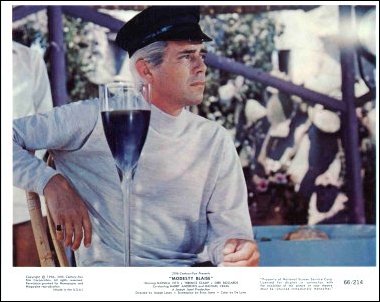
MODESTY BLAISE (1966) A goofed spy spoof


MODESTY BLAISE
(1966, UK)

Region 1 NTSC DVD (Fox)

A mute recommendation...

I really wish this was good, but it always disappoints. It fits into two sub-genres of the sixties that I really enjoy. Lightweight comedy spy flicks - the ones that Austin Powers movies reference – like Our Man Flint and Casino Royale (1967), and comic strip adaptions - a more varied bunch than the endless Marvel Comics franchises that we’re choking on at the moment - like Batman, Barbarella and Danger: Diabolik.

Unfortunately Modesty Blaise is the least watchable in both camps, despite having enough talent to have made it the best. With Joseph Losey directing, one expects daring and gritty dramas. The Servant, King and Country and Accident (all starring Bogarde) are all heralded British films that critics agree are the work of a quality auteur. But they forget to mention Losey’s disastrous lapses with Modesty Blaise and Boom! (possibly Elizabeth Taylor’s worst movie).


Monica Vitti as Modesty uncannily looks the part, is devastatingly glamorous and a natural comedy actress to boot. Terence Stamp was at his sexiest too. Dirk Bogarde is blond arch-villain Gabriel, Clive Revill has a dual role as his book-keeping sidekick and an arab sheik…

To digress for a second – it’s sad when talented actors are hot one moment and then dropped the next. Clive Revill was great in comedies, often playing Russians, and could hold his own as a lead (The Legend of Hell House) but disappeared Stateside to do TV and still does high profile voiceover work in animation. I guess his turn as the voice of the Emperor in The Empire Strikes Back changed his life.

Michael Craig too, here playing an MP being twisted around Modesty’s little finger, was a familiar face in sixties movies. He lead the castaways in Mysterious Island, but his film career was buried alive with Vault of Horror (1973), and he’s been working on stage and TV ever since.

So, Modesty Blaise - the cast is good. So what’s wrong with the film? I’d say that the director was perhaps extremely condescending about “comic strips”. So much so, that he refuses to take the characters or any of the action seriously. Most of the fights are played for comedy, especially the climactic battle. Losey seems to lose interest whenever the plot is involved, instead pushing the camera towards close ups of pop culture fads, fashions and furniture, while making in-jokes , most of which we don’t get.

Losey’s humorous touches may have been warranted if they’d actually been funny. Only the occasional black comedy works, and it’s especially sadistic, even for James Bond. Gabriel’s ‘wife’, Mrs Fothergill’s silent torture of a mime, and the use of a dead body to counterweight an escape down a cliff, are both amusingly grim.

Apart from Johnny Dankworth’s theme tune, the music is ill-chosen and rarely complements the mood or the action, instead being used to amuse. The monk serenading Gabriel on the church organ, as he arrives on his island, seems to go on forever. The cacaphony of barrel-organs during the Amsterdam knife fight is totally distracting. The songs that Vitti and Stamp are required to sing are just embarrassing.
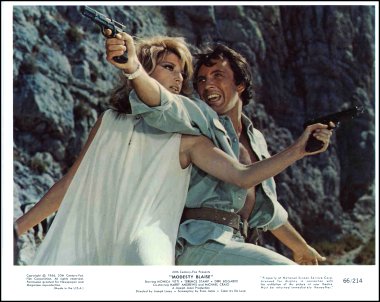
Maybe with different music, a different edit (it's too long at two hours) and tighter post-synching, this could have been, should have been, a whole lot better. Though, the groovy sets and fashions could make this an excellent choice to play at a party, but with the sound down! An odd recommendation, I know.

It was mostly shot on location in Amsterdam and Naples - particularly spectacular are Gabriel’s clifftop monastery (actually in Sicily, I believe) and the un-exciting car chase up and down the winding roads of Mount Vesuvius (which is where I've just been and why I watched this again).

The Region 1 DVD has absolutely no frills or notes, but is presented anamorphic widescreen 1.85 for the first time. The mono and stereo audio tracks sound a little dull, which is very apt.

Modesty's creator wrote the movie tie-in novel, launching the comic strip heroine as a successful literary character - the best thing that came of the film!


October 28, 2006

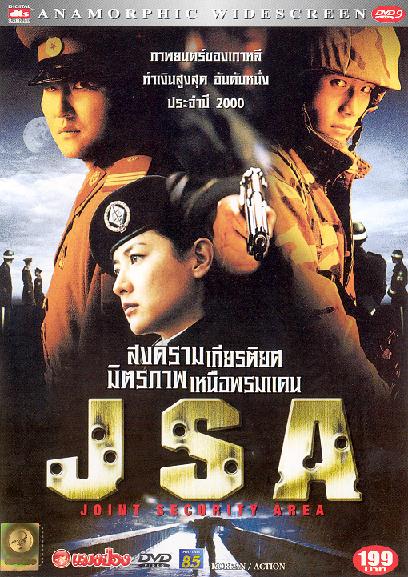
J.S.A. JOINT SECURITY AREA (2000) North and South

J.S.A. JOINT SECURITY AREA
(2000, South Korea, IMDB title: Gongdong gyeongbi guyeok JSA)
Thai Region 3 PAL DVD


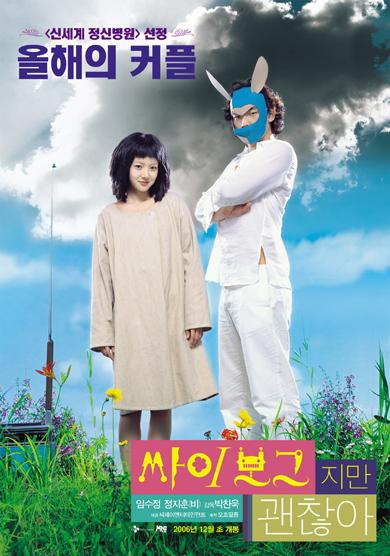
Like many fans of South East Asian cinema, I'm more than impressed with director Chan-Wook Park's 'vengeance trilogy'. So while I keenly await his next film Cyborg OK (the trailers are already online), I've just watched the film whose success enabled him to make Sympathy For Mr Vengeance.

A poster for Chan-Wook Park's next film - I'm A Cyborg, But That's OK
Joint Security Area isn't as outrageous stylistically or narratively as Oldboy or Lady Vengeance, being a fairly straightforward murder mystery. But there are some directorial flourishes and a offbeat dark humour that indicate the direction he would soon take. Set in the neutral no-go area between North and South Korea, a shooting incident leaves two soldiers dead and two wounded survivors - one from each country.

A Dutch investigator, fluent in Korean, is brought in by the neutral peace-keeping force to determine exactly what happened. In prolonged flashbacks we learn about the lives of the men in the months leading up to the fateful night - a scenario the authorities hadn't anticipated...

The director manages to play both sides here, delivering a violent, occasionally bloody thriller to demonstrate an anti-violence theme. The film also attempts to counter the demonisation of North Koreans as seen by the South. For an international audience, there's enough exposition to get everyone up to speed with a brief history of the country's division - certainly very relevant at the moment. Other recent Korean films braving the subject, like Ki-Duk Kim's The Coast Guard (2002), expected the audience to know their history.

The main strength of the film is the performances - the leading members of the cast all returned to appear in Park's subsequent films. The investigating officer in J.S.A. is played by Lady Vengeance herself, Yeong-ae Lee. The North Korean officer is Kang-ho Song, Mr Vengeance, also a familiar face in cult Korean films such as The Quiet Family, Memories of Murder, and this year's blockbuster The Host. The other soldiers in 'the incident' are played by Ha-kyun Shin, also from Sympathy for Mr Vengeance, and Byung-hun Lee, the lead in Park' s contribution to
Three: Extremes.

The only distraction in the film were the western actors with English-speaking parts, but thankfully they are not in many scenes. The film is otherwise very satisfying on many levels - beautifully shot, cleverly written, with an excellent cast. It maintains quite a grip throughout, because we know where the story leads... but not how it happened. It's quite hard to categorise in terms of genre, and different scenes could be war, mystery, comedy, thriller, or drama. Once again, I'd recommend this over many Hollywood films, but it's only going to be seen by those who can cope with subtitles.

This Thai DVD (pictured at top) is 2.35 anamorphic widescreen, with DTS and 5.1 audio. There's a trailer included and some behind-the-scenes footage. The English subtitles are OK, but occasionally mis-timed. Thankfully, the film has also been released in many other countries on DVD, including the UK and the US.
- - - - - - -

October 27, 2006

Holiday reading: In defence of pulp

Why pay for the latest page-turner when you've still got pulp in the attic?

Took some 1960's pulp fiction on holiday with me, including this one, Juggernaut by 'Bron Fane' (surely a pseudonym). The evocative cover art accurately depicts the opening chapters of the book – a mile high humanoid is flying around the galaxy, tearing open the life-support domes of human colonists, flattening their buildings and knocking over their huge 'computors' ('electronic brains'). The abundance of dated British sixties slang, still in use in the 29th century, is as amusing as the prose, which is so badly written, even I noticed.

I only mention this because despite being true 'pulp' and obviously written in a rush, it was still very readable. Juggernaut kept me going to the very last page. Crucially, the story was pretty unusual, maybe not for a comic book or manga, but unusual stuff in prose. To me, if the story is interesting, I’ll suffer many shortcomings and still enjoy it.

This of course goes for films too. If there’s one element in a trashy movie that you can enjoy – a favourite actor, some background music, even a ‘look’ of an outdated film stock – it just takes one redeeming feature to make it still watchable. Even if the film bombed, or was critically panned, or your mates have never heard of it... unknown films can still warrant extensive pleasure. I just wouldn’t necessarily recommend trying to inflict these ‘pleasures’ on your friends…

- - - - - - -

On Location: JASON AND THE ARGONAUTS

ON LOCATION WITH:
JASON AND THE ARGONAUTS (1963)
- The Home of the Harpies

Why build a set when you can use the real thing?

Just spent a week in Southern Italy and happily stumbled into the world of fantasy films by accident. We stared into the mouth of Vesuvius and visited the well-preserved city of Pompeii at its base. In 79 A.D. volcanic ash buried the city in a cataclysmic eruption and has since inspired disaster movies both old and new. As you walk around the streets and buildings, the preserved shells of fallen bodies bring home the scale of the tragedy as if it were yesterday. On a lighter note...

My Poseidon Adventure...

More relevantly to this blog however, was a visit to Paestum, which is quite close to Sorrento. 2,000 years ago, Paestum was a Greek settlement named after the God of the sea, 'Poseidon'. Today, three incredibly well-preserved Greek temples are still standing there - some of the best examples of Greek temples anywhere, even in Greece.

Todd Armstrong as Jason and Patrick Troughton as Phineas

It was here that the Harpies scene in Jason and the Argonauts was filmed - my favourite ever Ray Harryhausen film. Because the temples are so well-preserved (the Greek architects had built in various earthquake-defying features), they provided an excellent location for the scene where Patrick Troughton as Phineas the blind soothsayer is punished by the gods by having his food stolen by Harpies.

The use of the location was also a homage - Harryhausen refered to the archaeologists' pictorial reconstruction of one temple here - dedicated to the goddess Hera. He recreated the temple for the opening scene of the film, where Jason's mother is murdered – in the film that’s a set – we’ve seen the original!

The three temples all have all their pillars still standing, but all three are missing their roofs. The columns were all about thirty feet high – I wouldn’t have fancied being one of the stuntmen running around on top with the Harpie nets. Phineas’ stone dining table and the fallen columns in the foreground must have been props.


It’s hard for me to precisely explain the thrill of visiting old movie locations – I was caught out when I was recently asked why it interested me. I guess surviving locations are the only physicality that remains of most movies, (besides people and props).

We went to Paestum to see the ancient temples, which was exciting enough. It turned out we'd seen an actual ‘set’ from Jason and the Argonauts, which is very exciting, especially since it looks pretty much the same as it did when the film was shot. I mean, some of the locations for the legendary skeleton fight, like the cliff where Jason jumps, are now underneath multi-storey hotels.

Now where on Earth is Talos Beach?

- - - - - - -

October 25, 2006

DR BLACK, MR HYDE (1976) Dr Jekyll gets blaxploited

DR. BLACK, MR. HYDE (1976)
aka Dr. Black and Mr. White
(Not available on home video)

We're back in the seventies. Low-budget 'blaxploitation' films are claiming many movie genres, including horror. One of the more successful is a reworking of Dr Jekyll and Mr Hyde

A successful black scientist called Dr Pride, is trying to find a serum to cure liver disease. He has a beautiful, intelligent girlfriend, Billie, who’s also a scientist.

But, under pressure to get results, he starts cutting ethical corners by testing serums on human rather than animal subjects. Aslo developing a drink problem, he starts hanging out at low-life bars, where he befriends a prostitute, Linda.

Caught between two worlds, and taking the serum himself, his life splits into a black half and a monstrous white half. As 'Hyde', he’s unable to control his impulse to kill…

Many plotlines are introduced that lead to dead-ends, and it’s hard to believe Pride’s motivations, such as cheating on his girlfriend, played by Rosalind Cash, an actress who shone in The Omega Man as a tough cookie who could give Cleopatra Jones a run for her money. But her part here is quite small, as Pride gets more interested in Linda.

As the title characters, ex-footballer Bernie Casey doesn't clue us in much as to what’s going on in his head. He also muffs the crucial transformation scene, which relies almost solely on performance rather than special effects, which incidentally were provided by Stan Winston. But Casey’s physical scenes are convincing - he excels at throwing people across the room!

Technically, I think this is the best of the blaxploitation horror films - it's better written and has the money to provide enough action. Despite William Marshall’s princely performances as Blacula, I’ve found the other 'black' horror films dull and/or too cheaply mounted. Dr Black, Mr Hyde is faster-paced, with an interesting if scattershot premise. While various interesting themes are introduced, little is made of them – Dr Pride gets whiter each time he transforms, and he seems to be falling for Linda but instead wants her as another test subject.

The film has political points to make, but these are unbalanced by the harsh treatment of the female characters (like pimps keeping their girls in line), nudity expected of the female cast, and comedy relief being provided by drug-pusher characters. Obviously, Dr Pride and his girlfriend Dr Worth would be fine professional role-models if it wasn’t for his greed for success.

Still interested? A Dr Black, Mr Hyde trailer is here on YouTube...

Thrillers like Shaft and comedy-dramas like Cotton Comes to Harlem were far more successful vehicles for empowerment than horror films could ever hope to be. However, they were part of a wave of films that provided all-black casts (with a couple of token honkeys) for every movie genre.

My favourites from that era were the bigger budgeted affairs that crossed over into the mainstream – Car Wash, a slice-of-life comedy with a classic soundtrack, and the all-action Shaft’s Big Score, starring ‘black James Bond’ Richard Roundtree.

Although horror is my bag, the blaxploitation horrors are mostly unenjoyable, partly because they are so hard to get to see in any decent state. To enjoy a film where the print is badly damaged and the audio hissy and inaudible, it's also difficult to evaluate them properly. But I don’t think even a sparkling new transfer of Blackenstein, Blacula, Abby (aka Black Exorcist), or The Zombies of Sugar Hill will change my mind.


Do you want to know more?
Here’s
a starter list of blaxploitation films from Wikipedia…
And a review of Sugar Hill that made me want to go back and re-watch it.

- - - - - -

October 11, 2006

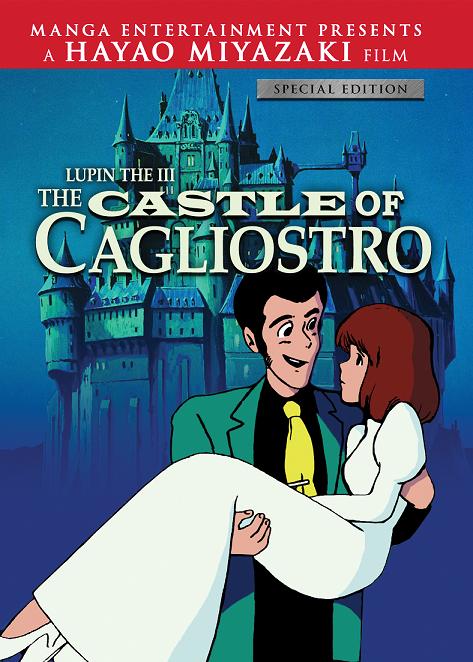
THE CASTLE OF CAGLIOSTRO (1979) new DVD special edition

THE CASTLE OF CAGLIOSTRO
(1979, Lupin III: Cagliostro No Shiro)
Region 1 NTSC DVD

(from Manga Entertainment)

Hiyao Miyazaki to the rescue


ANIME IN THE WEST
Like many western fans, my interest in anime really started with Akira. But the anime that followed in the west, were sold primarily on the basis of sex and violence. For a short time, this strategy worked, but such cynical marketing had a negative effect. It quashed the possibility of getting a wider audience for subsequent releases of anime feature films or TV.

Public consensus still misunderstands anime as being dominated by half-naked schoolgirls and extreme violence, whereas in reality it is as varied in tone as any fiction-based, live-action TV. Besdies anime for the very young, there’s sci-fi, horror, romcoms… all genres for all ages. The controversial stuff was only in a tiny minority of releases.

Akira did lead to an interest in what else Japanese animation had to offer, with a focus on other adult sci-fi anime series. But this didn’t rise above the level of ‘cult’ and enter into the mainstream. Subesequent releases like Ghost in the Shell and Final Fantasy: The Spirits Within didn't cause the same stir as Akira.

Recently, some of the most intricate, ground-breaking animated movies in the world have had terribly half-hearted cinema releases, and been overlooked by critics. Astonishing films like Appleseed, Innocence (Ghost in the Shell 2) and ironically Steam Boy (director Katsuhiro Otomo's first feature since Akira) have snuck out into cinemas without finding an audience. These are titles with challenging plots, predictive sci-fi, hugely entertaining action... that are often dumped straight onto video.

Admittedly, the west has got a lot of readjusting to do – in Japan the adult consumption of manga has removed the stigma of ‘cartoons’. At least we’re finally appreciating the films of Hiyao Miyazaki. Princess Mononoke, Spirited Away and Howl’s Moving Castle herald a new wave of anime that has found a mainstream audience. This has lead to a demand for the twenty year back-catalogue of animated films from Studio Ghibli. Indeed, in France, these older films are getting re-releases in the cinema, not just on DVD.


THE CASTLE OF CAGLIOSTRO
So here I am still working my way through Miyazaki’s older films – having been introduced to his work with the theatrical release of Princess Mononoke. The latest I’ve seen is The Castle of Cagliostro. A 1979 feature film made at the time when Miyazaki was moving from TV work into cinema.

For copyright reasons, it’s been obscured that the film is all about the characters from the long-running Lupin III series of manga and TV. Arch-criminal Lupin, is the grandson of Arsene Lupin of French literature, here embarking on an epic adventure with his usual accomplices, somewhere in Central Europe.

After raiding a casino, Lupin notices that rather than being incredibly rich, he merely has a carful of counterfeit cash. He decides to pursue the fake notes back to their source – the royal castle in a small duchy - Cagliostro. As he gets near, he encounters a very young bride, trying to escape the castle, and his mission suddenly becomes far more complicated and dangerous than he had ever imagined…

Even in 1979, Miyazaki has to walk a precarious tightrope between providing a family film, and being faithful to the bawdy violence of the original manga, which portrayed Lupin as a ‘ladykiller’. While there’s action, a little slapstick and some exaggerated face-pulling to please younger viewers, there’s also a little blood, lots of gun-play, a little swearing, an under-age wedding, and several characters smoking like chimneys! Like Spielberg begging the censors not to cut Jaws and Indiana Jones movies, Miyazaki has to push boundaries to keep both audiences happy.

Miyazaki and his crew also try to achieve the best animation they can. They never shy away from ambitious 'camera moves' – like point-of-view shots, or complicated tracking shots. Complex three-dimensional objects like the auto-gyro or the workings of the clock-tower would have to have been realised without the aid of computers. The results is so successful, that it's hard to guess what year it was made, the animation looks so advanced.

But the production doesn’t show off, it all serves the story. One that could equally have worked as live-action, and has been ‘laid out’ as if it were. The famous car chase is shot as if they had photographed from 'camera cars'. It’s an exciting scene, as well as funny for using tiny little French cars, rather than flashy sports models.

I was also very impressed with the the endless inventiveness in the castle buildings’ many hidden secrets. Lupin has to face underwater traps, impossible wall-climbs, crowds of ninja assassins and high tech defences. The look of the various background layouts also indicate that Miyazaki’s team must have at least done extensive picture research of Central Europe - I wouldn't be surprised that they actually visited.

Miyazaki only includes a little bit of politics in the story, and there’s very little subtext like his usual scripts. Cagliostro is a purely entertaining adventure with plenty of humour.

Also, despite an all human cast, the style of character animation is not his usual naturalistic approach, but uses exaggerated 'cartoony' actions in keeping with the humour, and in line with the manga characterisations.


THE NEW DVD SPECIAL EDITION
This Manga Entertainment DVD release is notable for a spotless transfer that makes the film look brand new. Only the occasional original animation faults (like a frame shift, or slightly rough-edged drawings), date the animation at all. The picture aspect is 1.85 anamorphic, like it’s original presentation.

There’s a 5.1 mix for the english soundtrack, as well as the original Japanese audio (which is what I listened to). The english subtitles take great pains to translate the jokes and the slang. My only criticism of the set is that the Japanese mix isn’t 5.1 and that the cover art doesn’t do the beautiful and intricate art of the animation any favours at all – it makes it look like a soppy romance, rather than a gothic James Bond adventure.

This is a flipper disc with the entire film on one side and special features on the other. There are storyboards, and an interview with the animation director, (who also worked on the first Lupin III TV anime), and a trailer for the original Japanese movie release.

If only we’d had Miyazaki films in the west 25 years ago, when they were released in Japan. He’d have given anime a good name!

Do you want to know more?

There are many Lupin III manga and anime, including more feature films. It's another huge Japanese subject to investigate...


Of course the original 'Arsene Lupin' is an anti-hero of French literature, and has been filmed many times though the years, including a big-budget French action film in 2004.

The real-life Cagliostro family of Italy is a tale in itself...

Wikipedia is a good place to start…


- - - - - - -

October 06, 2006

THE NIGHT CALLER (1965) low-key but eerie sci-fi horror

DVD cover artwork


THE NIGHT CALLER
(UK title, 1965)

aka THE NIGHT CALLER FROM OUTER SPACE (DVD title)
aka THE BLOOD BEAST FROM OUTER SPACE (US title)


Region 1 NTSC DVD (from Image Entertainment)

Enjoyable black & white sci-fi horror, in the Quatermass vein

The Night Caller is a low-budget British ‘B’ movie that I repeatedly revisit. That’s partly due to the nostalgia factor – I first saw this as a schoolboy in the seventies, only being allowed to stay up late once a fortnight to watch horror films on TV. It reminds me of the excitement and antcipation I felt for horror films back then – they certainly weren’t as accessible as they are today.

But objectively, it’s also worth recommending because…

- It’s shot in crisp black and white with a creepy use of shadows and ‘dutch’ (slanted) angles when it gets crazy! (This is before TV’s Batman wore out the technique a year later)

- Every actor in it is a star turn – from the leads to the supporting cast – all playing the invasion-from-outer-space plot deadly seriously, but realistically

- It’s directed by John Gilling who here peaked in the mid-sixties along with Hammer horrors Plague of the Zombies and The Reptile

- There's a star cameo by Aubrey Morris as a creepy porn-merchant, flirting with the granite-faced Detective (Alfred Burke) – “magic seeing you again”. Morris later played the abusive probation officer in A Clockwork Orange – talk about typecast!

- Another cameo by the always excellent John Carson – who also played Dr Marcus in Captain Kronos - Vampire Hunter, and the squire in Plague of the Zombies

- A rare bit part by Ballard Berkeley – the only time I’ve seen him onscreen, besides playing the ‘Major’ in Fawlty Towers


This sci-fi/horror starts with a UFO landing on wasteland just outside London. The army track it and bring in three scientists from a nearby Government research facility. Convinced that it was a spacecraft, they are all surprised to discover a small sphere, the size of a football, sitting on the ground. There’s no crater, so it must have been guided down. They hold it at their lab for further tests. Surrounded by the army, the scientists discover that, late at night, the object glows intensely and a dark, clawed figure appears.

In the panic, the figure disappears with the sphere, as do dozens of young women a few weeks later. Thinking that they’re going for an exlusive modelling job in the heart of London’s seedy Soho, the don’t realise they’re meeting the monster from the lab. As the kidnappings continue – how can the scientists help the police stop the creature from space?

Should Barbara Stevens have posed for the camera?

Loving the low-budget Quatermassy atmosphere of the film, I forgive the obviously rubber claw that signifies the alien for most of the film, and also the cheesey make-up job for his disappointing unveiling. Also the story runs out of steam at the climax, but it ends logically and faithfully to the original novel ‘The Night Callers’ by Frank Crisp, first published in 1960.


On the plus side are moments of suspense, similar to those currently generated by Asian horror horror films, where an atmosphere of fear is conjured up by the actors, rather than by showing anything much. Even with so little on-screen terror, the film still warranted an X certificate in 1965. This is a British 'X', then only for over-16 year olds, rather than an American 'X' meaning hardcore porn.

Strangely, there’s a scene in the film, ‘blocked' (planning the layout of the set and the actor’s movements) the same way as an almost identical one in Hammer’s The Satanic Rites of Dracula (1974) – where Drac poses as a millionaire in a swish futuristic room, backlit by anglepoise lamps so that his face can’t be seen. The same ‘long room and back-lighting’ subterfuge is used halfway through The Night Caller – I’ve only just connected these two very similar scenes after years of confusing them with each other.

Patricia Haines hasn't looked behind her

A youthful John Saxon heads the cast, years before appearing in cult favourites, Enter the Dragon and Battle Beyond the Stars, and as a cop in Dario Argento’s Tenebre, Black Christmas (1973) and several Nightmare on Elm Streets. He’s accompanied by frosty blonde Patricia Haines, who I’m surprised didn’t make more movies, though she worked steadily in top British TV series, including three episodes of The Avengers.

Artwork used for the VHS and Laserdisc releases


The third scientist is the stalwart Maurice Denham, whose most famous role was probably as the panicky recipient of ‘the runes’ in the classic opening sequence of Night of the Demon (1957).

Warren Mitchell does an apparently improvised scene with Marianne Stone, as parents of a missing teenager. Mitchell is famous as TV’s bigotted Alf Garnett in sitcom Till Death Us Do Part, the original template for Archie Bunker in All in the Family. Despite being typecast as Garnett, he was versatile enough to play Russian diplomats in a couple of The Avengers episodes and Hammer’s space western Moon Zero Two.

The only home video version in circulation is the region 1 US DVD – this is a shame because this is a slightly censored version (an alternate take covers up the nudie magazines in the Soho sex shop) and far worse, it has an awfully dated song over the opening credits, replacing the atmospheric ‘northern soul’ instrumental of the British version, one of my favourite movie theme tunes ever! The track is coincidentally called "Image" and credited to Joe Glenn, Larry Greene and Bob Sande. I was looking forward to finally having a digital copy of this music, but it wasn't to be.

Here's how the it sounds, on the version that's been playing on British TV for decades...

It still plays on TV regularly. So if you get the DVD, ignore the theme song and carry on!

Do you want to know more?
Here's a longer plot description and numerous screen grabs from the DVD on the Horror-wood webzine, (though I heartily disagree that The Cosmic Man is a better film)!